

NGC 5965 from my „Sterntaucher“ observatory
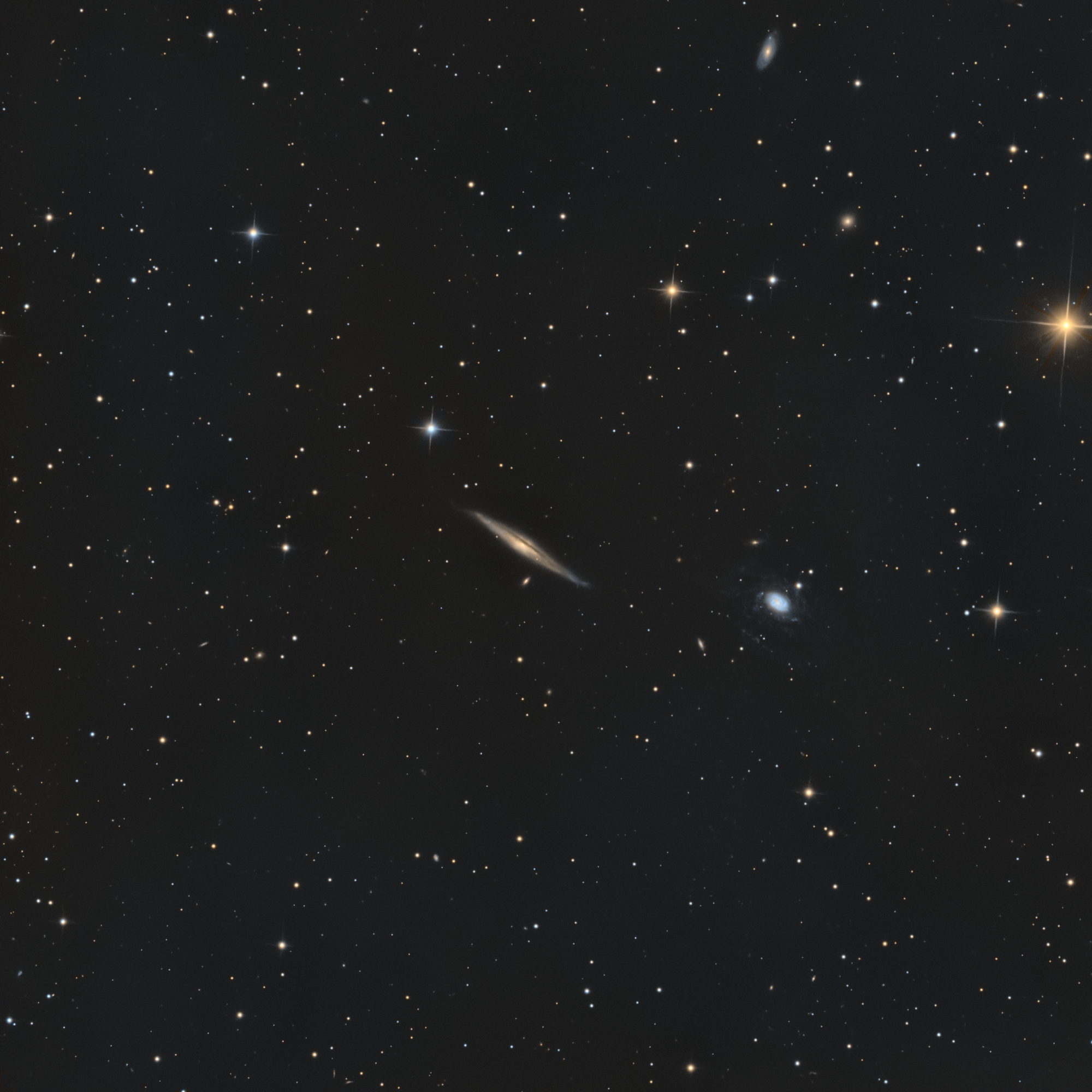
In 2018, I imaged the spiral galaxy NGC 5965 from my observatory in Krefeld using my dual-rig setup. The luminance data were captured with a higher-resolution optical system, while the RGB color information was recorded simultaneously with a second telescope. Combining the two datasets produced a detailed LRGB image that highlights the galaxy’s delicate dust lane and elongated stellar disk while preserving natural color throughout the field.
NGC 5965 is located in the constellation Draco at a distance of approximately 140 million light-years. It is classified as a barred spiral galaxy and is viewed almost perfectly edge-on, giving it a striking needle-like appearance. The galaxy extends for more than 150,000 light-years, making it considerably larger than the Milky Way.
One of the most remarkable features of NGC 5965 is its prominent boxy/peanut-shaped bulge, which is believed to be the result of a stellar bar viewed nearly edge-on. Modern numerical simulations have shown that such bulges form naturally as bars evolve and become vertically thicker over billions of years. NGC 5965 therefore serves as an excellent example for studying the internal dynamics of barred spiral galaxies.
Deep images reveal a thin galactic disk crossed by an intricate network of dark dust lanes that partially obscure the bright central regions. Numerous subtle star-forming regions can be detected along the disk, while the galaxy’s smooth outer halo gradually fades into the surrounding darkness. The nearly edge-on orientation makes NGC 5965 particularly valuable for investigating the vertical distribution of stars, gas, and dust in spiral galaxies.
NGC 5965 forms part of a small galaxy group that includes several nearby companion galaxies, although none are as visually prominent as the main galaxy itself. The surrounding field is populated with numerous faint background galaxies, adding both depth and scientific interest to the image.
From a scientific perspective, NGC 5965 is an important object for studying the structure and evolution of disk galaxies. Its pronounced bar, extensive dust lane, and well-defined edge-on geometry allow astronomers to investigate how bars redistribute stars and gas within galaxies and influence their long-term evolution.
The final LRGB image combines the high-resolution luminance data with carefully registered RGB color information, revealing the galaxy’s fine structural details and subtle color gradients. The result showcases one of the most elegant edge-on spiral galaxies in the northern sky and demonstrates the effectiveness of the dual-rig imaging technique for producing detailed deep-sky images.
For the 2025 data the calibration, registration and the final processing was done with PixInsight. The result was as follows:
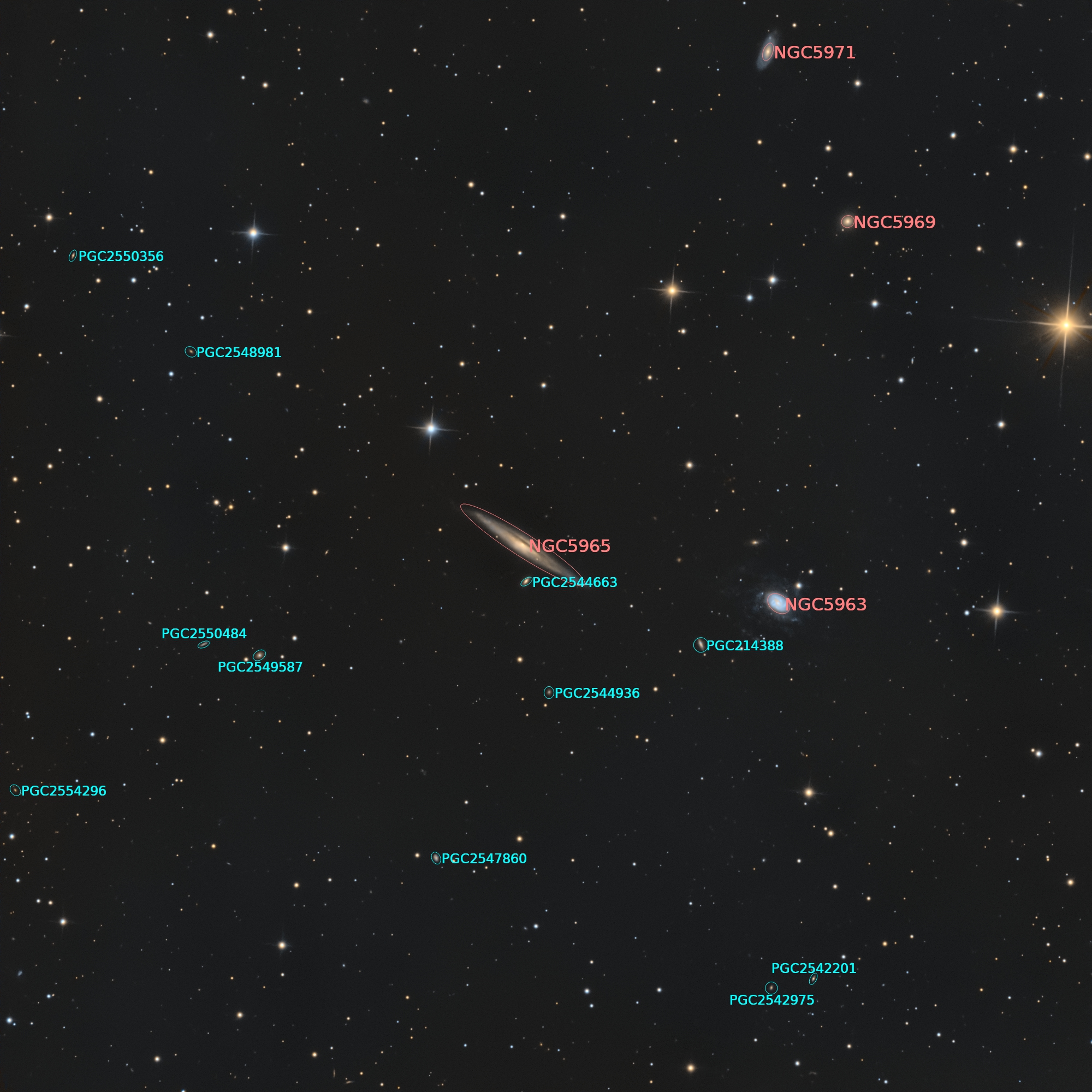
Here is an overview of the used equipment and the exposure times:
- Date: 2018
- Location: Krefeld
- Telescope/Lense: 10″ Newton ohne Namen – TS IS 65 Apo
- Focal length [mm]: 1000 – 420
- Focal ratio: 3.9 – 6.5
- Mount: Losmandy G11 and Skywatcher EQ 8
- Camera: Moravian 8300 FW – QSI 583 WS
- Filter: L – R:G:B
- Exposure time [min]: 360 – 120:120:120
- Resolution: 1.11/px




Leave a reply