

NGC 2841 from my own „Sterntaucher“ observatory
In 2020, I imaged the spiral galaxy NGC 2841 using a dual-rig setup from my observatory. The luminance data were captured with a 10″ Newtonian telescope, while the RGB color information was simultaneously recorded with a small apochromatic refractor. Both systems used CCD cameras, combining the high-resolution capabilities of the larger telescope with the wide-field color performance of the APO setup. For the final LRGB image, the RGB data were carefully aligned and scaled to match the higher-resolution luminance frames, allowing the detailed monochrome structure to define the image while preserving natural color information.
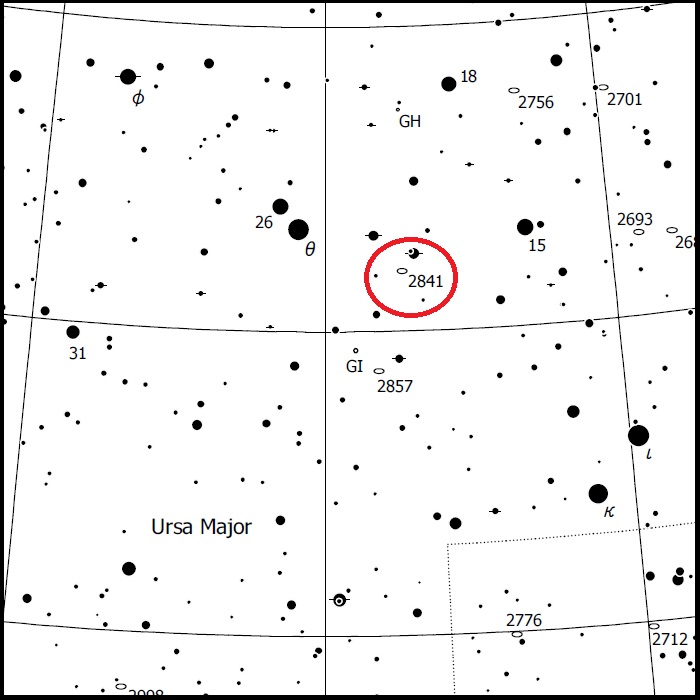
NGC 2841 is located in the constellation Ursa Major at a distance of approximately 45–50 million light-years. It is classified as an unbarred spiral galaxy (SA(r)b) and is considered one of the finest examples of a massive flocculent spiral galaxy. Unlike grand-design spirals with strongly defined spiral arms, NGC 2841 exhibits a far more subtle and fragmented structure, composed of numerous patchy dust lanes and star-forming regions distributed across the disk.
The galaxy is particularly remarkable for its enormous and complex system of dark dust lanes, which become highly visible in deep luminance exposures. These dusty structures surround a bright yellowish core dominated by an older stellar population. In contrast, the outer regions contain scattered bluish star-forming knots and diffuse H II regions. Observations in infrared and radio wavelengths have revealed that NGC 2841 possesses an extensive gaseous halo and a very massive dark matter component, making it an important object for studies of galactic structure and evolution.
One of the scientifically interesting aspects of NGC 2841 is its relatively low overall star formation rate despite its large mass. This gives the galaxy a somewhat “quiescent” appearance compared to more actively star-forming spirals such as M101 or NGC 6946. Nevertheless, high-resolution images reveal an extraordinary amount of fine structure throughout the disk, especially in the form of thin dust filaments and subtle brightness variations.
The combination of deep luminance data from the 10″ Newtonian and carefully matched RGB information from the APO refractor allowed the final LRGB image to capture both the galaxy’s intricate dust structures and its delicate color gradients. The result emphasizes the contrast between the warm central bulge, the cooler outer disk, and the remarkably rich texture of one of the most detailed spiral galaxies visible in the northern sky.
Data calibration and registration and the final processing was done with PixInsight. The RGB Data was upscaled to the luminance data. The result was as follows:
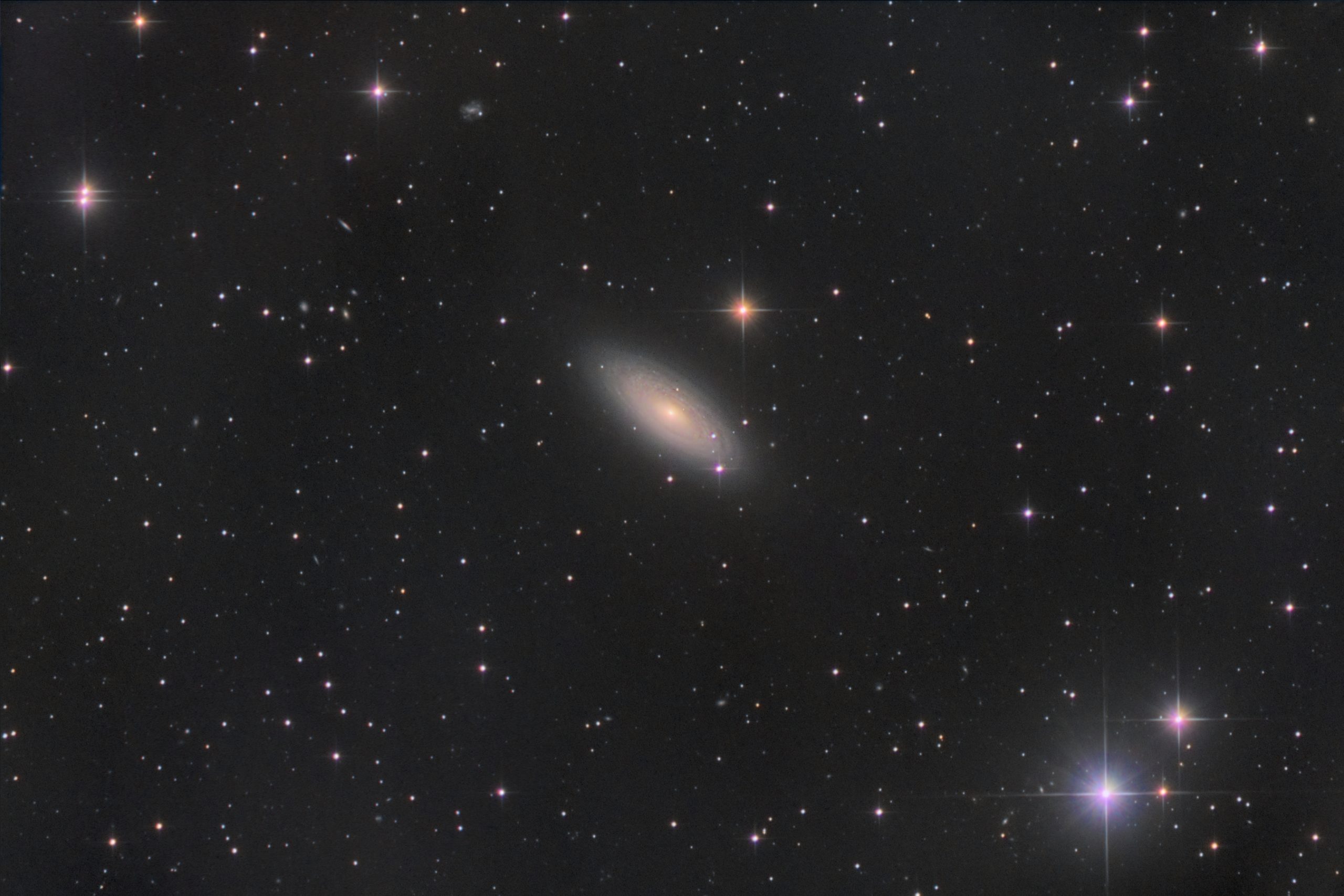
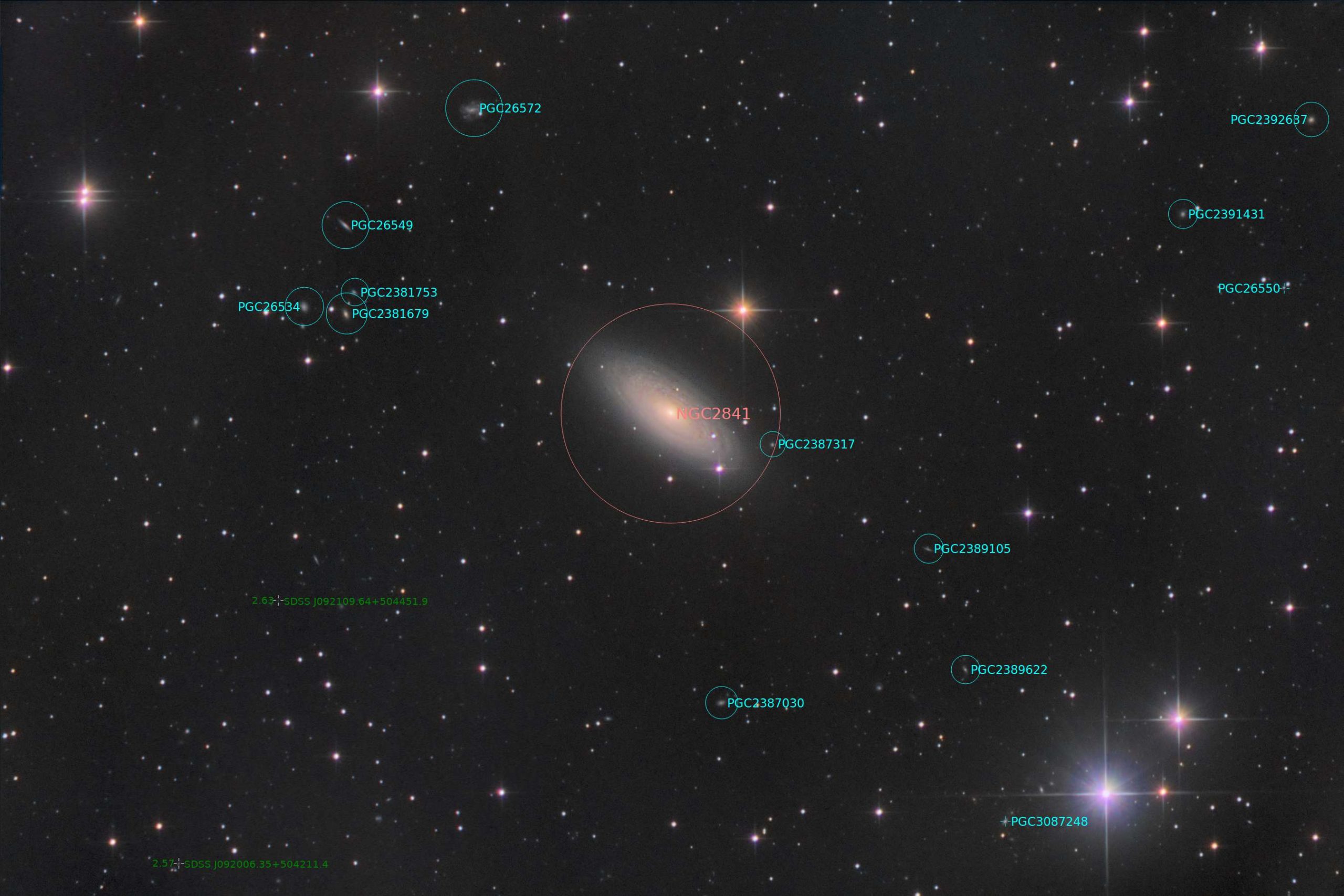
The faintest star in my image has an apparent magnitude of 21.0 magG (Gaia DR2).
The two highest redshift quasars [Flesh 2015] in the image are:
SDSS J092109.64+504451.9 z=2.63 magG=20.3 (Gaia DR2)
SDSS J092006.35+504211.4 z=2.57 magG=19.5 (Gaia DR2)
Here is an overview of the used equipment and the exposure times:
- Date: 2020
- Location: Krefeld
- Telescope/Lens: 10″ Newton ohne Namen – TSQ-65ED Apo
- Focal length [mm]: 1000 – 420
- Focal ratio: 3.9 – 6.5
- Mount: Skywatcher EQ8
- Camera: Moravian G2 8300 FW – Moravian G3 16200 FW
- Filter: CLS – RGB
- Exposure time [min]: 460 – 175:150:170
- Resolution: 1.11″/px – 2.95″/px



Leave a reply