

NGC 2683 from my own „Sterntaucher“ observatory
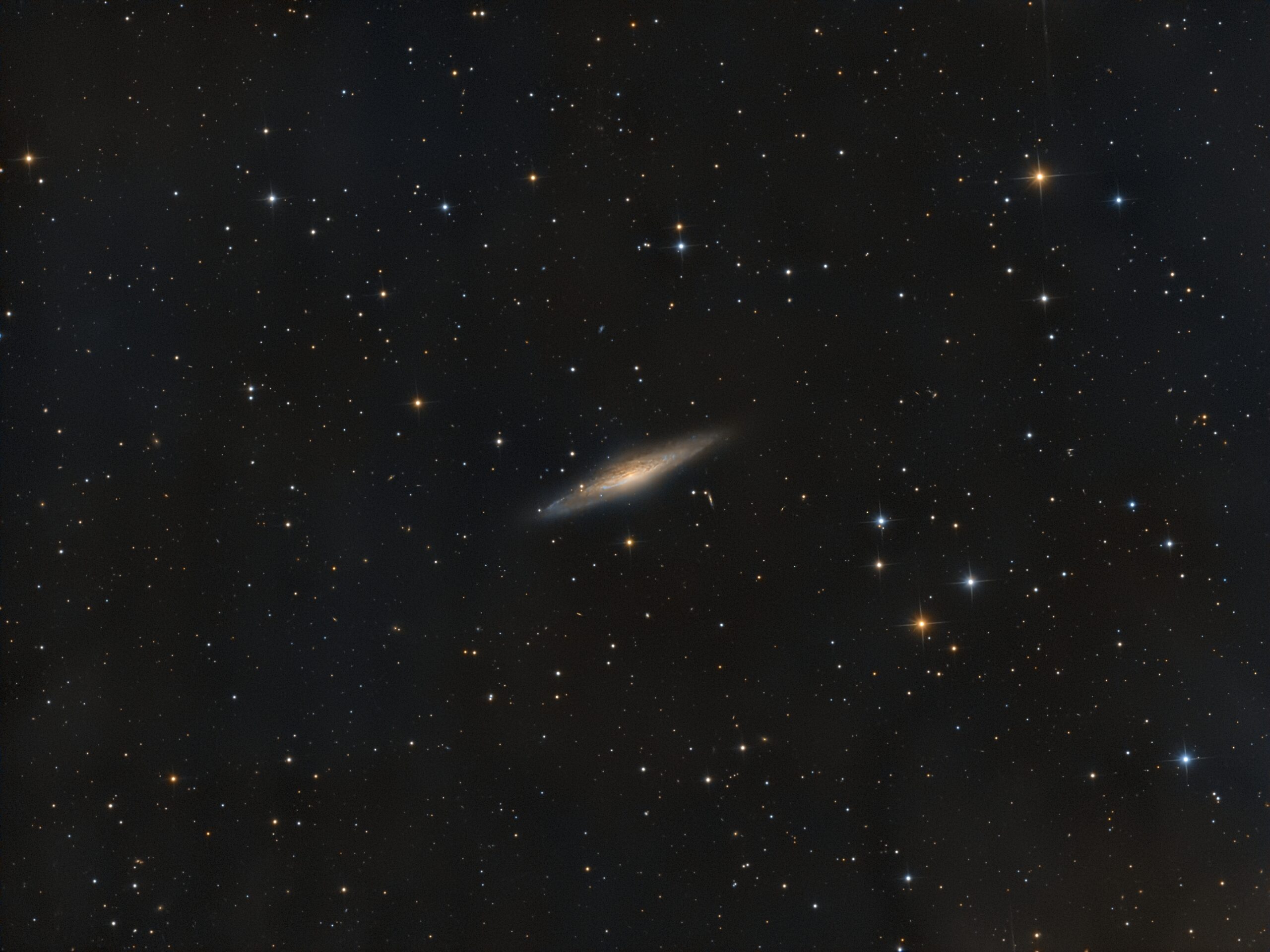
In 2018, I imaged the spiral galaxy NGC 2683 from my observatory in Krefeld using a dual-rig setup. The luminance data were captured with a higher-resolution optical system, while the RGB color information was recorded simultaneously with a second telescope. For the final LRGB image, the RGB data were carefully upscaled to match the resolution of the luminance frames, allowing the detailed structural information from the luminance channel to define the image while preserving accurate color from the RGB dataset.
Scientifically, NGC 2683 is a fascinating edge-on spiral galaxy located in the constellation Lynx, approximately 25–30 million light-years away. Because of its orientation, the galaxy is often referred to as the “UFO Galaxy,” as its thin disk and bright central bulge resemble the appearance of a classic flying saucer in deep images.
NGC 2683 is classified as an Sb-type spiral galaxy and is considered a relatively isolated system, showing no strong signs of recent major gravitational interaction. This isolation makes it particularly useful for studying the internal structure and evolution of spiral galaxies without the complications introduced by nearby companions. Deep luminance data reveal an extremely prominent and sharply defined dust lane running along the galactic plane, partially obscuring the bright central bulge and giving the galaxy a dramatic three-dimensional appearance.
One of the most interesting aspects of NGC 2683 is the visible warp and subtle asymmetry in its outer disk. Observations suggest that the galaxy possesses an extended halo of gas and dust, likely influenced by internal star formation activity and minor accretion events over cosmic timescales. Numerous compact star-forming regions can also be detected along the thin disk, contrasting strongly with the older yellowish stellar population concentrated toward the center.
Because the galaxy is viewed almost perfectly edge-on, it offers an excellent opportunity to study the vertical structure of a spiral disk and the distribution of interstellar dust. In deep exposures, faint extensions above and below the galactic plane become visible, revealing how gas and dust are transported away from the disk through stellar feedback processes.
The combination of high-resolution luminance data and carefully upscaled RGB color information allowed the final LRGB image to preserve both the intricate dust structures and the subtle color gradients across the galaxy. The result highlights the contrast between the warm central bulge, the cooler bluish outer disk, and the dark absorbing dust lane that dominates the visual appearance of this elegant edge-on spiral galaxy.
Data calibration and registration and the final processing was done with PixInsight.
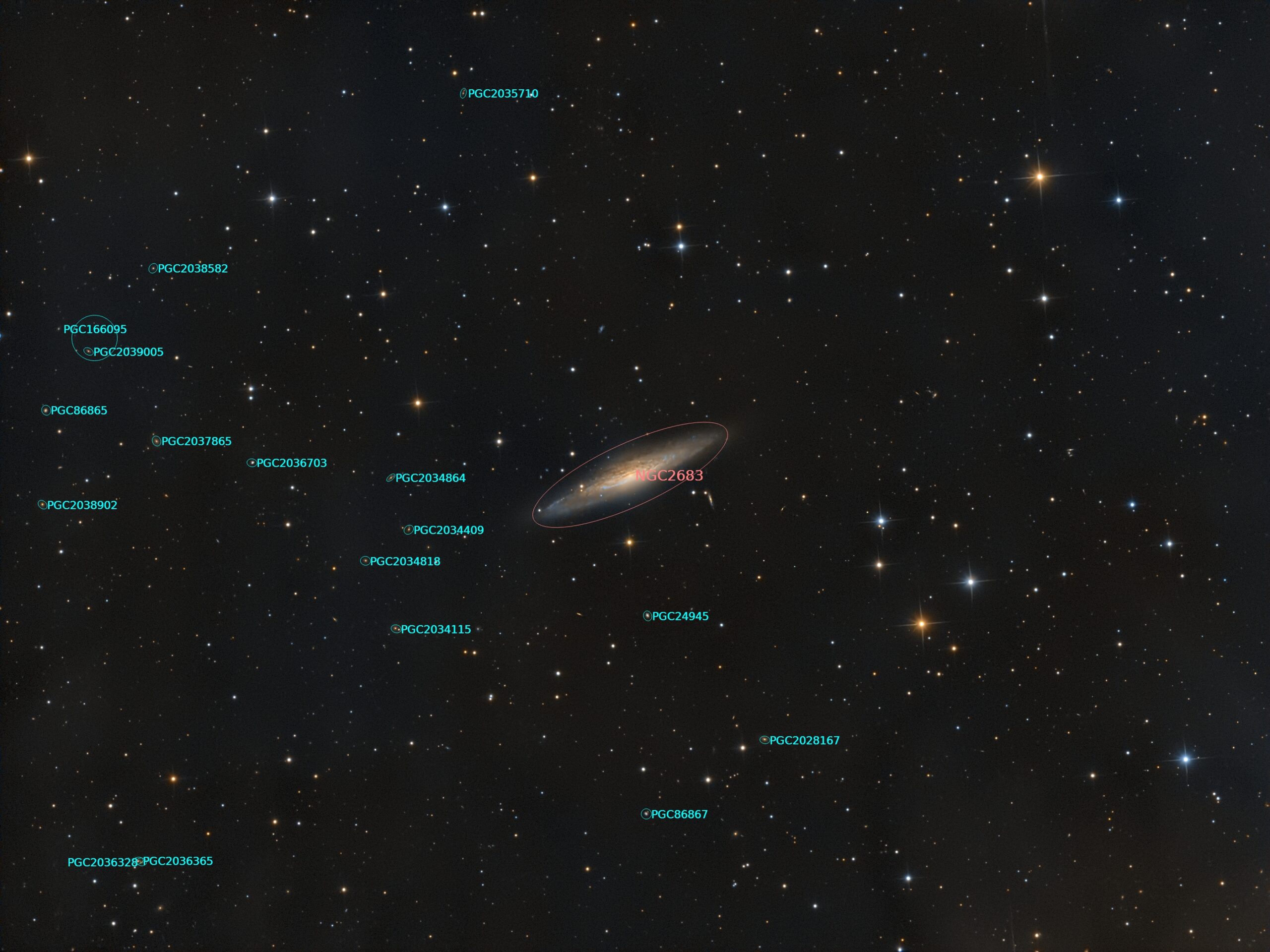
Here is an overview of the used equipment and the exposure times:
- Date: February 2018
- Location: Krefeld
- Telescope/Lens: 10″ Newton ohne Namen – TSQ-65ED Apo
- Focal length [mm]: 1000 – 420
- Focal ratio: 3.9 – 6.5
- Mount: Skywatcher EQ8
- Camera: Moravian 8300 FW – QSI 583WS
- Filter: L – RGB
- Exposure time [min]: 720 – 360:180:180
- Resolution: 1.11″/px – 2.95″/px



Leave a reply