

NGC 2359 (Thor’s Helmet)
Because NGC 2359 culminates very low above the horizon from my observing locations in Germany, I worked with remote datasets of this remarkable object on two occasions. The first dataset was obtained in 2018 from the Deep Sky West Observatory, while the second followed in 2021 from the Insight Observatory. Both datasets were acquired with CCD cameras, providing high sensitivity and excellent narrowband performance for this faint and structurally complex nebula.
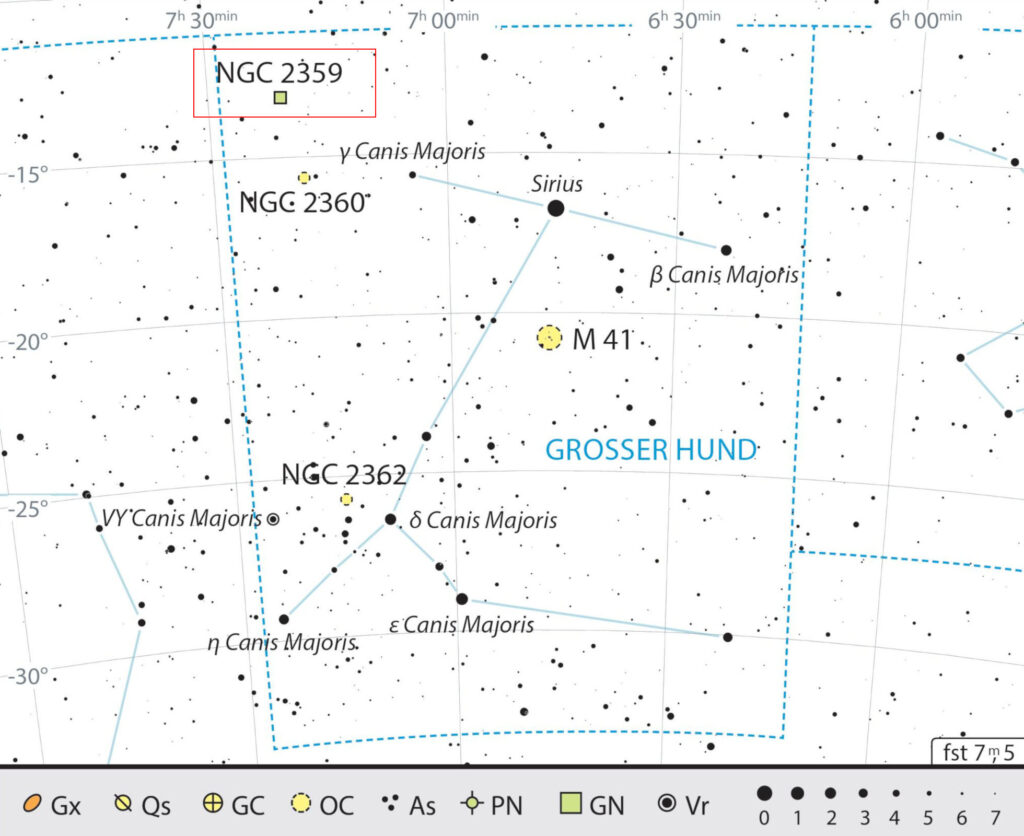
NGC 2359 is located in the constellation Canis Major at a distance of roughly 12,000–15,000 light-years. Often nicknamed “Thor’s Helmet”, the nebula owes its dramatic appearance to a powerful Wolf–Rayet star near its center. This extremely hot and massive star is losing material through intense stellar winds traveling at thousands of kilometers per second. These winds collide with previously ejected gas and the surrounding interstellar medium, producing the nebula’s characteristic bubble-like structure, filamentary arcs, and wing-like extensions.
Scientifically, NGC 2359 is an excellent example of how massive stars shape and enrich their environment before ending their lives as supernovae. The interaction between fast stellar winds and older circumstellar material generates strong shock fronts that are particularly prominent in Hα and [O III] emission. Deep narrowband imaging reveals intricate filaments, knots, and turbulent structures throughout the nebula, highlighting the violent processes taking place around the central Wolf–Rayet star.
The combination of the 2018 and 2021 CCD datasets allowed for a highly detailed rendering of the nebula, bringing out both the bright central shell and the faint outer structures that are often difficult to capture. Remote imaging from darker and more southerly locations proved essential for recording this spectacular object at high quality.
For the 2021 data the calibration, registration and final processing was performed in PixInsight. The result was as follows:
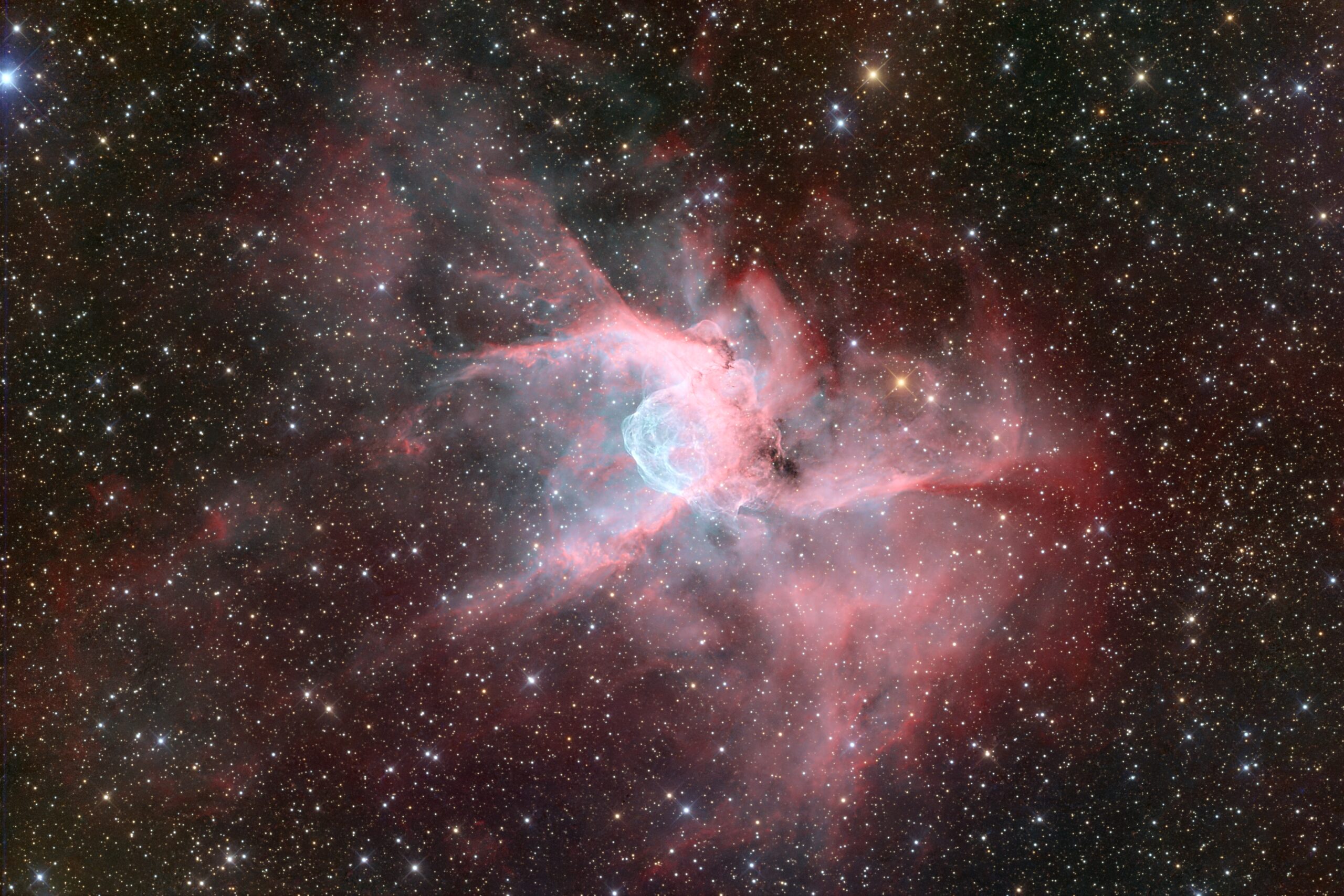
The faintest object in this image has an apparent magnitude of approx. 22.0 magG (GAIA DR2).
The images were taken with the following equipment (AFIL-1, Insight Observatory):
- Date: 2021
- Location: Lijiang, China
- Telescope/Lens: AG10 CDK
- Focal length [mm]: 1665
- Focal ratio: 6.7
- Mount: Skywatcher EQ8RH
- Camera: FLI Proline 6303
- Filter: R:G:B:Hα:[OIII]:[SII]
- Exposure time [min]: 30:35:40:540:555:1440
- Resolution: 0.75″/px
For the 2018 data the calibration, registration and the final processing was performed with PixInsight. The result was as follows:
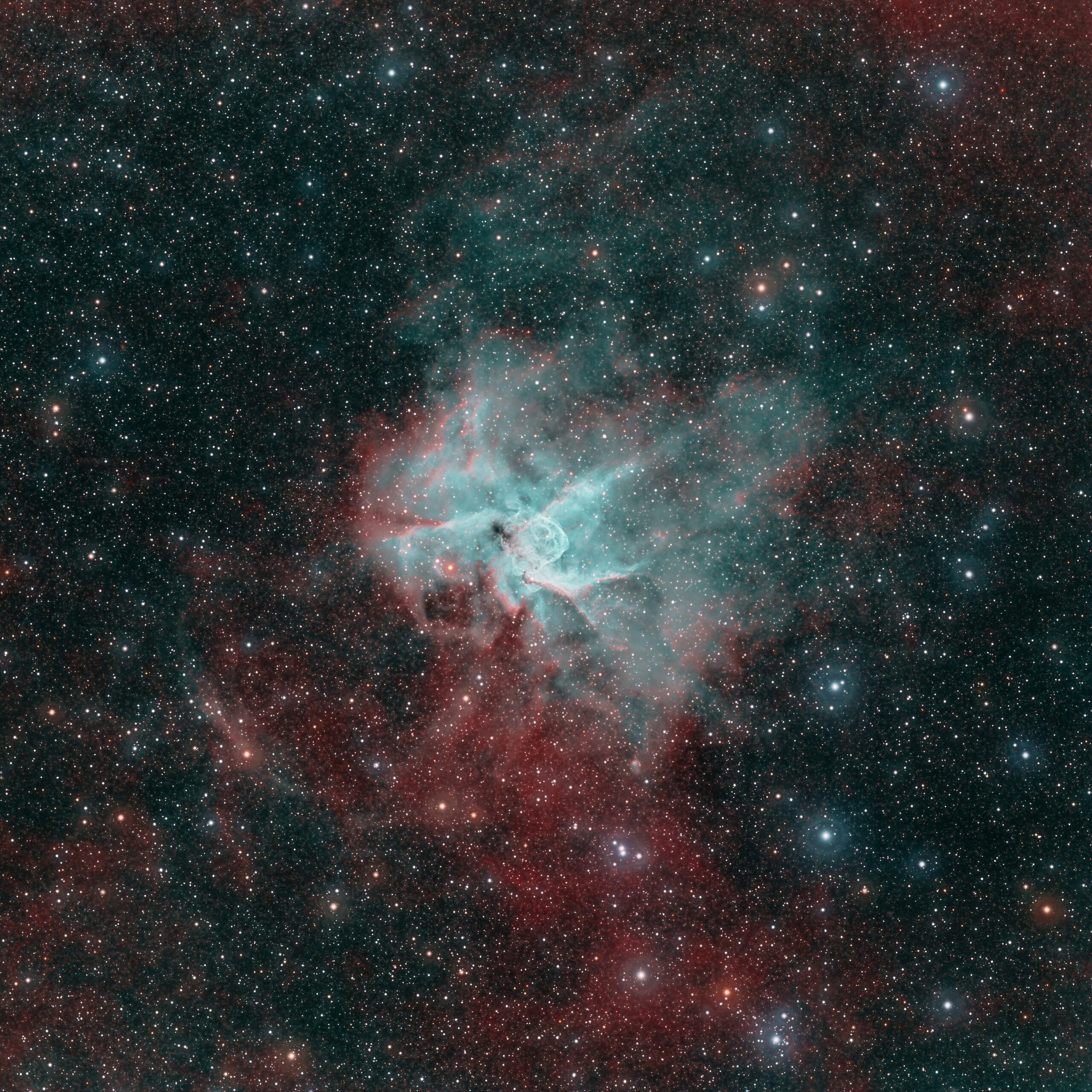
The images were taken with the following equipment:
- Date: 2018
- Location: Rowe, New Mexico
- Telescope/Lens: Astrophysics RH 305
- Focal length [mm]: 1159
- Focal ratio: 3.8
- Mount: Astrophysics 1600
- Camera: SBIG STX 16803
- Filter: R:G:B:Hα:[OIII]
- Exposure time [min]: 195:140:190:570:960
- Resolution: 1.66″/px



Leave a reply