• Home
  • Blog
  • Astrophotography
    • Deep Sky
      • Galaxies (Galaxien)
      • Nebulae (Nebel)
      • Planetary Nebulae (Planetarische Nebel)
      • Globular Clusters (Kugelsternhaufen)
      • Open Clusters (Offene Sternhaufen)
      • Miscellaneous (Verschiedenes)
    • Solar System (Sonnensystem)
      • Comets (Kometen)
      • Moon (Mond)
      • Planets (Planeten)
      • Sun (Sonne)
  • Archiv

    • Mai 2026
    • April 2026
    • Dezember 2025
    • November 2025
    • Oktober 2025
    • September 2025
    • August 2025
    • Juli 2025
    • Juni 2025
    • Mai 2025
    • April 2025
    • März 2025
    • Januar 2025
    • November 2024
    • Oktober 2024
    • September 2024
    • Juli 2024
    • Mai 2024
    • April 2024
    • März 2024
    • Januar 2024
    • Dezember 2023
    • November 2023
    • Oktober 2023
    • September 2023
    • August 2023
    • Juli 2023
    • Juni 2023
    • Mai 2023
    • April 2023
    • März 2023
    • Februar 2023
    • Januar 2023
    • Dezember 2022
    • November 2022
    • Oktober 2022
    • September 2022
    • August 2022
    • Juni 2022
    • Mai 2022
    • April 2022
    • März 2022
    • Februar 2022
    • Januar 2022
    • Dezember 2021
    • November 2021
    • September 2021
    • August 2021
    • Juli 2021
    • März 2021
    • Februar 2021
    • November 2020
    • September 2020
    • August 2020
    • April 2020
    • März 2020
    • Februar 2020
    • Januar 2020
    • Dezember 2019
    • November 2019
    • Oktober 2019
    • September 2019
    • August 2019
    • Mai 2019
    • April 2019
    • März 2019
    • Dezember 2018
    • November 2018
    • September 2018
    • Juli 2018
    • Juni 2018
    • Mai 2018
    • April 2018
    • Februar 2018
    • Januar 2018
    • Oktober 2017
    • Juli 2017
    • Januar 2017
    • September 2016
    • Mai 2016
    • März 2016
    • Oktober 2015
    • Mai 2015
    • März 2015
    • Februar 2015
    • September 2014
    • März 2014
    • Februar 2014
    • Oktober 2013
    • September 2013
    • März 2013
    • November 2012
    • Juli 2012
    • März 2012
    • Januar 2012
    • November 2011
    • Oktober 2011
    • September 2011
    • August 2011
    • April 2011
    • März 2011
    • Oktober 2010
    • September 2010
    • August 2010
    • Juli 2010
    • April 2010
    • Juli 2009
    • Juli 2008
    • Januar 2008
    • Oktober 2007
    • Juli 2007
    • Februar 2007
    • Juni 2006
    • August 2005
    • Januar 2005
  • Kategorien

    • Asterism
    • Astrophotography
    • Barnard
    • Comet
    • Galaxies
    • Globular Cluster
    • IC
    • Messier
    • Moon
    • Nebula
    • NGC
    • Open cluster
    • Photography
    • Planetary Nebula
    • Travel
  • Meta

    • Anmelden
    • Eintrags-Feed
    • Kommentar-Feed
    • WordPress.org
  • Privacy Policy
  • Impressum
  • Haftungsausschluss
  • Cookie-Richtlinie
  • Datenschutzerklärung

wonderfuluniverse.de
  • Home
  • Blog
  • Astrophotography
    • Deep Sky
      • Galaxies (Galaxien)
      • Nebulae (Nebel)
      • Planetary Nebulae (Planetarische Nebel)
      • Globular Clusters (Kugelsternhaufen)
      • Open Clusters (Offene Sternhaufen)
      • Miscellaneous (Verschiedenes)
    • Solar System (Sonnensystem)
      • Comets (Kometen)
      • Moon (Mond)
      • Planets (Planeten)
      • Sun (Sonne)

NGC 2683 from my own „Sterntaucher“ observatory


In 2018, I imaged the spiral galaxy NGC 2683 from my observatory in Krefeld using a dual-rig setup. The luminance data were captured with a higher-resolution optical system, while the RGB color information was recorded simultaneously with a second telescope. For the final LRGB image, the RGB data were carefully upscaled to match the resolution of the luminance frames, allowing the detailed structural information from the luminance channel to define the image while preserving accurate color from the RGB dataset.

Scientifically, NGC 2683 is a fascinating edge-on spiral galaxy located in the constellation Lynx, approximately 25–30 million light-years away. Because of its orientation, the galaxy is often referred to as the “UFO Galaxy,” as its thin disk and bright central bulge resemble the appearance of a classic flying saucer in deep images.

NGC 2683 is classified as an Sb-type spiral galaxy and is considered a relatively isolated system, showing no strong signs of recent major gravitational interaction. This isolation makes it particularly useful for studying the internal structure and evolution of spiral galaxies without the complications introduced by nearby companions. Deep luminance data reveal an extremely prominent and sharply defined dust lane running along the galactic plane, partially obscuring the bright central bulge and giving the galaxy a dramatic three-dimensional appearance.

One of the most interesting aspects of NGC 2683 is the visible warp and subtle asymmetry in its outer disk. Observations suggest that the galaxy possesses an extended halo of gas and dust, likely influenced by internal star formation activity and minor accretion events over cosmic timescales. Numerous compact star-forming regions can also be detected along the thin disk, contrasting strongly with the older yellowish stellar population concentrated toward the center.

Because the galaxy is viewed almost perfectly edge-on, it offers an excellent opportunity to study the vertical structure of a spiral disk and the distribution of interstellar dust. In deep exposures, faint extensions above and below the galactic plane become visible, revealing how gas and dust are transported away from the disk through stellar feedback processes.

The combination of high-resolution luminance data and carefully upscaled RGB color information allowed the final LRGB image to preserve both the intricate dust structures and the subtle color gradients across the galaxy. The result highlights the contrast between the warm central bulge, the cooler bluish outer disk, and the dark absorbing dust lane that dominates the visual appearance of this elegant edge-on spiral galaxy.

Data calibration and registration and the final processing was done with PixInsight.
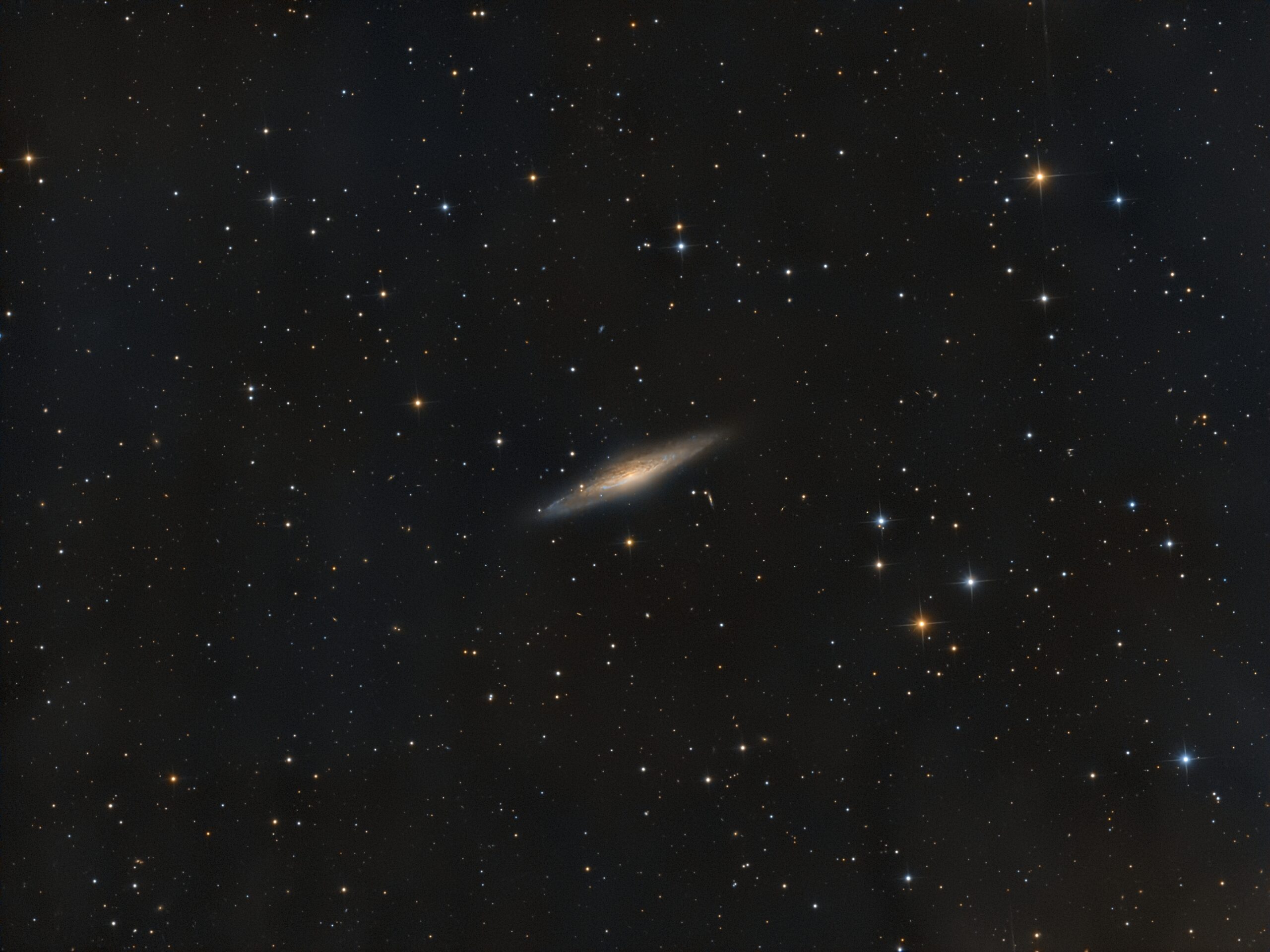
NGC 2683, Krefeld, 2018

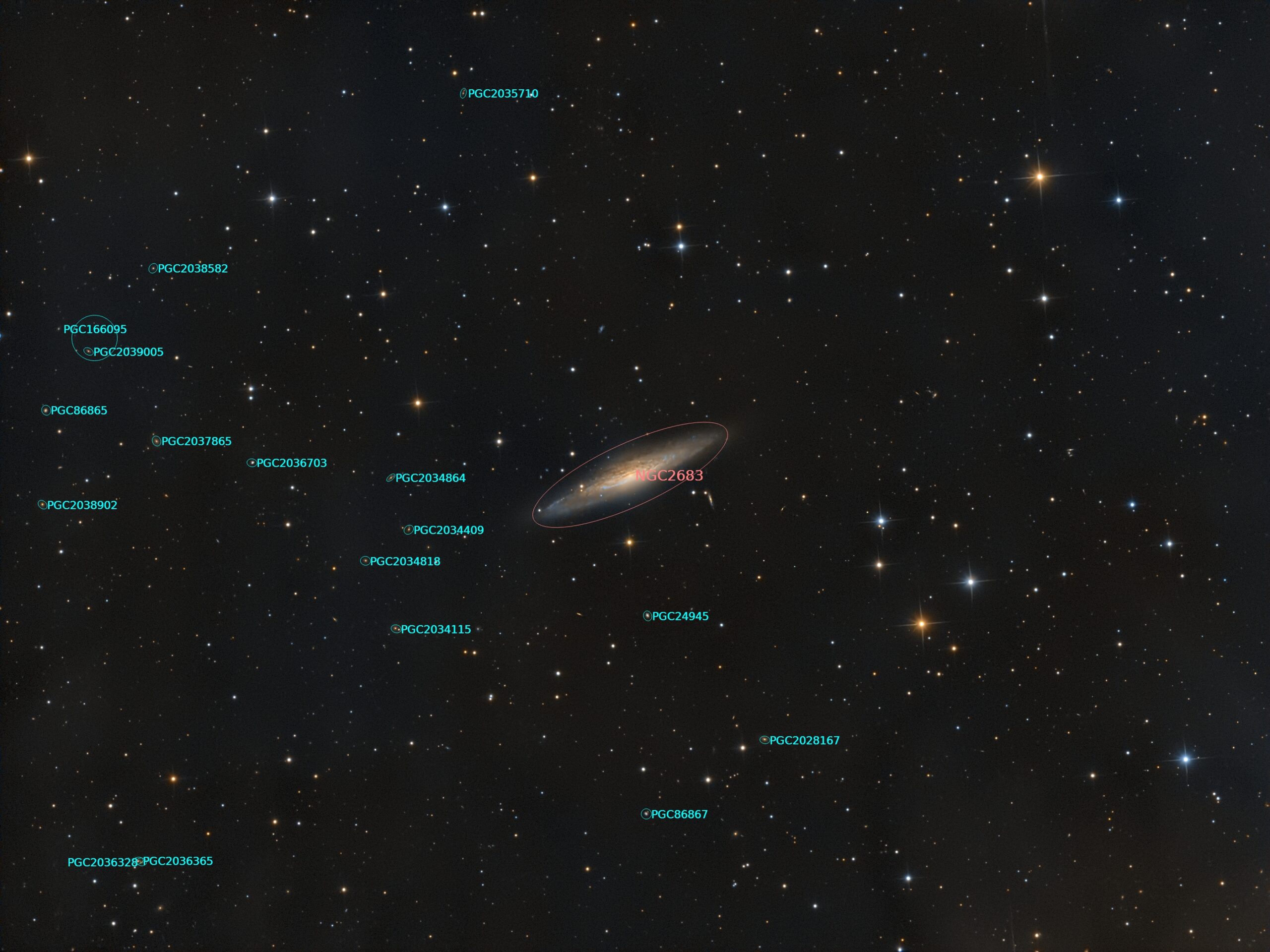
NGC 2683 annotated
NGC 2683 annotated


Here is an overview of the used equipment and the exposure times:

  • Date: February 2018
  • Location: Krefeld
  • Telescope/Lens: 10″ Newton ohne Namen – TSQ-65ED Apo
  • Focal length [mm]: 1000 – 420
  • Focal ratio: 3.9 – 6.5
  • Mount: Skywatcher EQ8
  • Camera: Moravian 8300 FW – QSI 583WS
  • Filter: L – RGB
  • Exposure time [min]: 720 – 360:180:180
  • Resolution: 1.11″/px – 2.95″/px


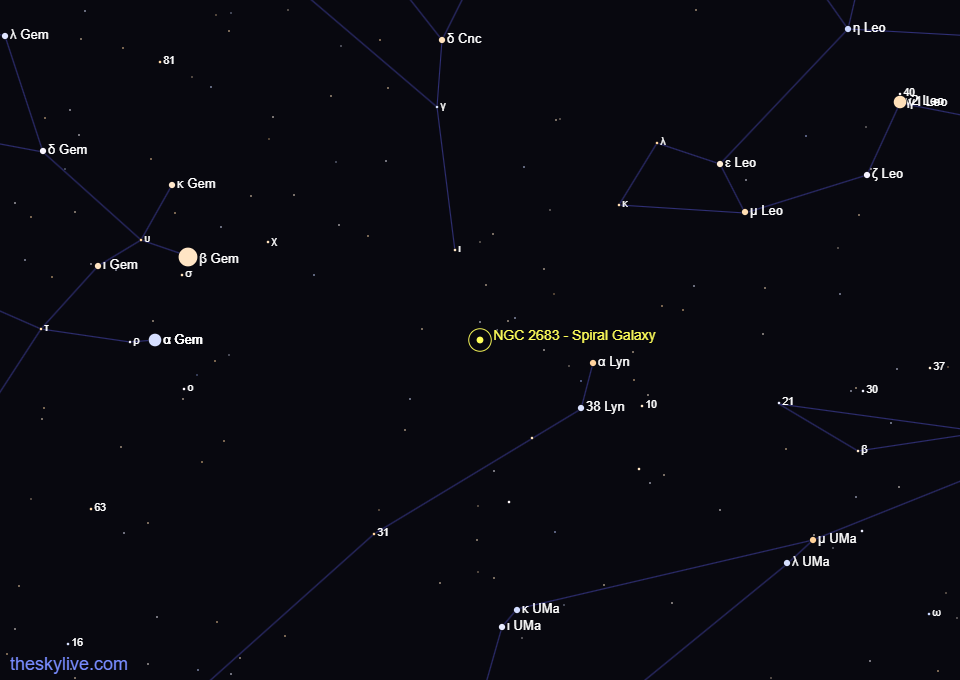
NGC 2683 Finder Chart

Stephan Küppers


You might also like
Messier 13 (NGC 6205)
10. Mai 2026
Messier 106 (NGC 4258)
8. Mai 2026
Messier 51
2. Mai 2026

Leave a reply

Schreibe einen Kommentar Antwort abbrechen

Deine E-Mail-Adresse wird nicht veröffentlicht. Erforderliche Felder sind mit * markiert


© Stephan Küppers 2020-2022

Cookie-Zustimmung verwalten
Wir verwenden Cookies, um unsere Website und unseren Service zu optimieren.
Funktional Immer aktiv
Die technische Speicherung oder der Zugang ist unbedingt erforderlich für den rechtmäßigen Zweck, die Nutzung eines bestimmten Dienstes zu ermöglichen, der vom Teilnehmer oder Nutzer ausdrücklich gewünscht wird, oder für den alleinigen Zweck, die Übertragung einer Nachricht über ein elektronisches Kommunikationsnetz durchzuführen.
Vorlieben
Die technische Speicherung oder der Zugriff ist für den rechtmäßigen Zweck der Speicherung von Präferenzen erforderlich, die nicht vom Abonnenten oder Benutzer angefordert wurden.
Statistiken
Die technische Speicherung oder der Zugriff, der ausschließlich zu statistischen Zwecken erfolgt. Die technische Speicherung oder der Zugriff, der ausschließlich zu anonymen statistischen Zwecken verwendet wird. Ohne eine Vorladung, die freiwillige Zustimmung deines Internetdienstanbieters oder zusätzliche Aufzeichnungen von Dritten können die zu diesem Zweck gespeicherten oder abgerufenen Informationen allein in der Regel nicht dazu verwendet werden, dich zu identifizieren.
Marketing
Die technische Speicherung oder der Zugriff ist erforderlich, um Nutzerprofile zu erstellen, um Werbung zu versenden oder um den Nutzer auf einer Website oder über mehrere Websites hinweg zu ähnlichen Marketingzwecken zu verfolgen.
  • Optionen verwalten
  • Dienste verwalten
  • Verwalten von {vendor_count}-Lieferanten
  • Lese mehr über diese Zwecke
Einstellungen anzeigen
  • {title}
  • {title}
  • {title}