• Home
  • Blog
  • Astrophotography
    • Deep Sky
      • Galaxies (Galaxien)
      • Nebulae (Nebel)
      • Planetary Nebulae (Planetarische Nebel)
      • Globular Clusters (Kugelsternhaufen)
      • Open Clusters (Offene Sternhaufen)
      • Miscellaneous (Verschiedenes)
    • Solar System (Sonnensystem)
      • Comets (Kometen)
      • Moon (Mond)
      • Planets (Planeten)
      • Sun (Sonne)
  • Archiv

    • Mai 2026
    • April 2026
    • Dezember 2025
    • November 2025
    • Oktober 2025
    • September 2025
    • August 2025
    • Juli 2025
    • Juni 2025
    • Mai 2025
    • April 2025
    • März 2025
    • Januar 2025
    • Dezember 2024
    • November 2024
    • Oktober 2024
    • September 2024
    • Juli 2024
    • Juni 2024
    • Mai 2024
    • April 2024
    • März 2024
    • Februar 2024
    • Januar 2024
    • Dezember 2023
    • November 2023
    • Oktober 2023
    • September 2023
    • August 2023
    • Juli 2023
    • Juni 2023
    • Mai 2023
    • April 2023
    • März 2023
    • Februar 2023
    • Januar 2023
    • Dezember 2022
    • November 2022
    • Oktober 2022
    • September 2022
    • August 2022
    • Juni 2022
    • Mai 2022
    • April 2022
    • März 2022
    • Februar 2022
    • Januar 2022
    • Dezember 2021
    • November 2021
    • September 2021
    • August 2021
    • Juli 2021
    • März 2021
    • Februar 2021
    • November 2020
    • September 2020
    • August 2020
    • April 2020
    • März 2020
    • Februar 2020
    • Januar 2020
    • Dezember 2019
    • November 2019
    • Oktober 2019
    • September 2019
    • August 2019
    • Mai 2019
    • April 2019
    • März 2019
    • Dezember 2018
    • November 2018
    • September 2018
    • Juli 2018
    • Juni 2018
    • Mai 2018
    • April 2018
    • März 2018
    • Februar 2018
    • Januar 2018
    • Oktober 2017
    • Juli 2017
    • Juni 2017
    • Januar 2017
    • September 2016
    • Mai 2016
    • März 2016
    • Oktober 2015
    • September 2015
    • Mai 2015
    • März 2015
    • Februar 2015
    • September 2014
    • März 2014
    • Februar 2014
    • Oktober 2013
    • September 2013
    • August 2013
    • April 2013
    • März 2013
    • November 2012
    • August 2012
    • Juli 2012
    • Mai 2012
    • März 2012
    • Januar 2012
    • November 2011
    • Oktober 2011
    • September 2011
    • August 2011
    • April 2011
    • März 2011
    • Oktober 2010
    • September 2010
    • August 2010
    • Juli 2010
    • April 2010
    • Juli 2009
    • Juli 2008
    • Januar 2008
    • Oktober 2007
    • Juli 2007
    • Februar 2007
    • Juni 2006
    • August 2005
    • Januar 2005
  • Kategorien

    • Asterism
    • Astrophotography
    • Barnard
    • Comet
    • Galaxies
    • Globular Cluster
    • IC
    • Messier
    • Moon
    • Nebula
    • NGC
    • Open cluster
    • Photography
    • Planetary Nebula
    • Travel
  • Meta

    • Anmelden
    • Eintrags-Feed
    • Kommentar-Feed
    • WordPress.org
  • Privacy Policy
  • Impressum
  • Haftungsausschluss
  • Cookie-Richtlinie
  • Datenschutzerklärung

wonderfuluniverse.de
  • Home
  • Blog
  • Astrophotography
    • Deep Sky
      • Galaxies (Galaxien)
      • Nebulae (Nebel)
      • Planetary Nebulae (Planetarische Nebel)
      • Globular Clusters (Kugelsternhaufen)
      • Open Clusters (Offene Sternhaufen)
      • Miscellaneous (Verschiedenes)
    • Solar System (Sonnensystem)
      • Comets (Kometen)
      • Moon (Mond)
      • Planets (Planeten)
      • Sun (Sonne)

Veil Nebula – NGC 6960, NGC 6992, NGC 6995


I imaged the magnificent Veil Nebula several times over the years, documenting both my own progress in astrophotography and the evolution of my equipment. My first attempt dates back to 2007, during a stay at the Emberger Alm, where I photographed the eastern part of the Veil, consisting of NGC 6992 and NGC 6995, using my DSLR equipment. In 2010, during a stay in Banon, I turned my attention to the western portion, NGC 6960, employing a newer DSLR camera that provided improved sensitivity and image quality.

Four years later, again under the dark skies of Banon, I captured the entire Veil Nebula with my CCD camera in Hα and [O III], producing my first complete narrowband mosaic of this spectacular supernova remnant. Finally, in 2018 and 2019, I received two exceptionally deep datasets from Deep Sky West, covering both the eastern and western sections of the nebula. These professional-quality datasets revealed an extraordinary wealth of delicate filamentary detail that is difficult to achieve from central Europe.

The Veil Nebula is located in the constellation Cygnus at a distance of approximately 2,400 light-years. It is the expanding remnant of a massive star that exploded as a supernova between 10,000 and 20,000 years ago. The explosion released an enormous amount of energy, sending a shock wave racing through the surrounding interstellar medium at hundreds of kilometers per second. Today, the expanding shell spans nearly three degrees on the sky, corresponding to a physical diameter of more than 100 light-years, making it one of the largest and most spectacular supernova remnants visible from Earth.

The eastern and western Veil represent the brightest portions of this enormous expanding shell. Their intricate filaments are produced where the supernova shock wave compresses and heats interstellar gas, causing it to emit strongly in Hα and [O III]. Hydrogen emission traces the denser regions of ionized gas, while oxygen emission highlights areas where the shock front reaches particularly high temperatures. The resulting network of glowing filaments resembles delicate strands of lace and is among the finest examples of shock-excited emission in the night sky.

One of the most interesting features within the western section is the bright foreground star 52 Cygni, which appears projected against the nebula but is unrelated to it. The star lies much closer to Earth and merely happens to be aligned with the expanding remnant along our line of sight.

The wide-field images also include the faint Pickering’s Triangle, a complex web of fine filaments connecting the eastern and western sections. Once thought to be a separate object, it is now recognized as another part of the same expanding supernova shell.

From a scientific perspective, the Veil Nebula is one of the best laboratories for studying shock physics, the interaction between supernova remnants and the interstellar medium, and the enrichment of the Galaxy with heavy elements. Material forged inside the massive progenitor star has been dispersed into space by the explosion, where it will eventually become incorporated into future generations of stars and planetary systems.

The images acquired between 2007 and 2019 beautifully document both my own astrophotographic journey and the extraordinary beauty of this iconic supernova remnant. From the early DSLR photographs of the individual eastern and western sections to the narrowband CCD mosaic and the exceptionally deep Deep Sky West datasets, each image reveals new levels of detail within one of the Milky Way’s most spectacular remnants of a stellar explosion.

For the 2019 data from DSW the calibration, registration and the final processing was done with PixInsight.

The first image shows a HOO version:
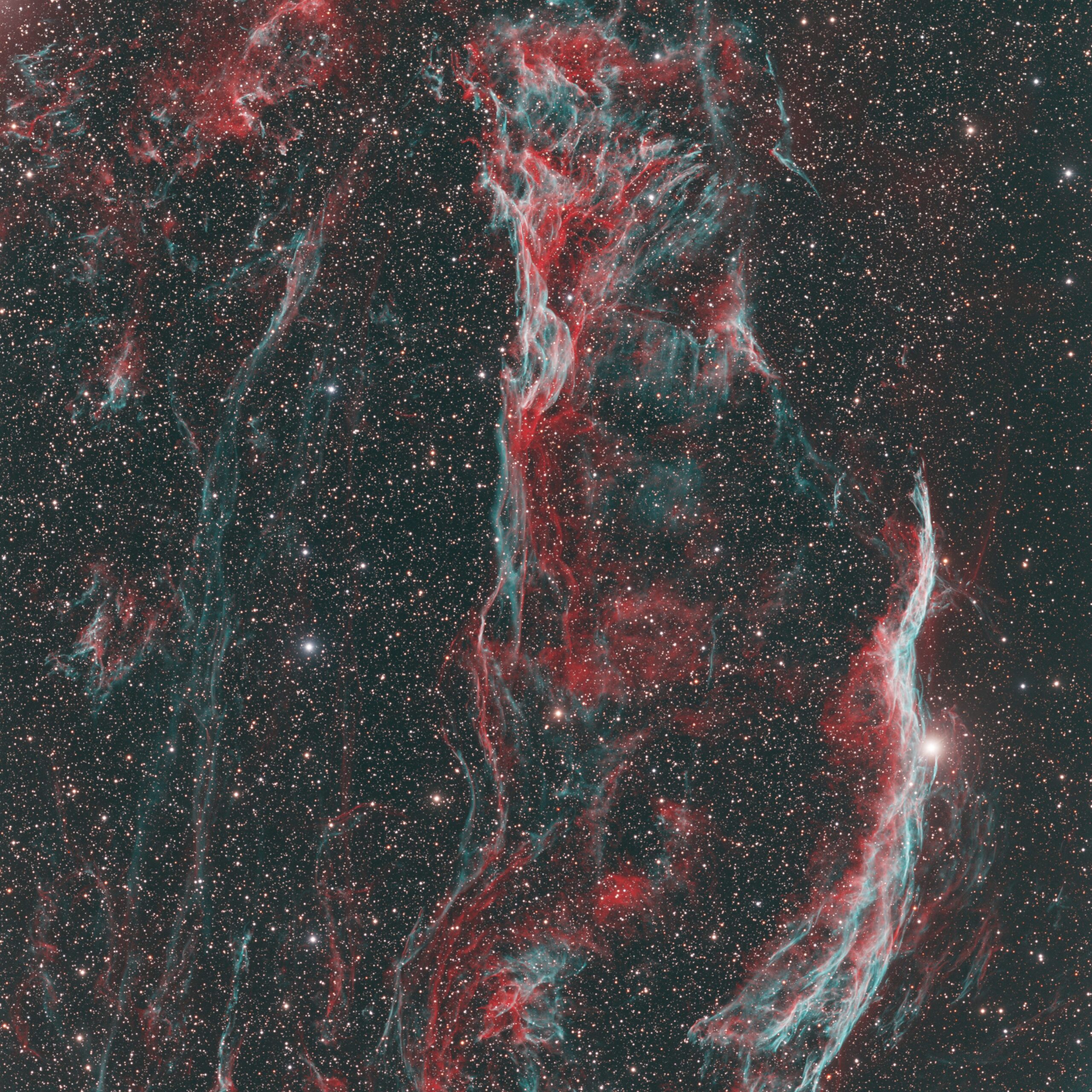
NGC 6960 (HOO-Version)

For the next image I used the FORAXX palette.
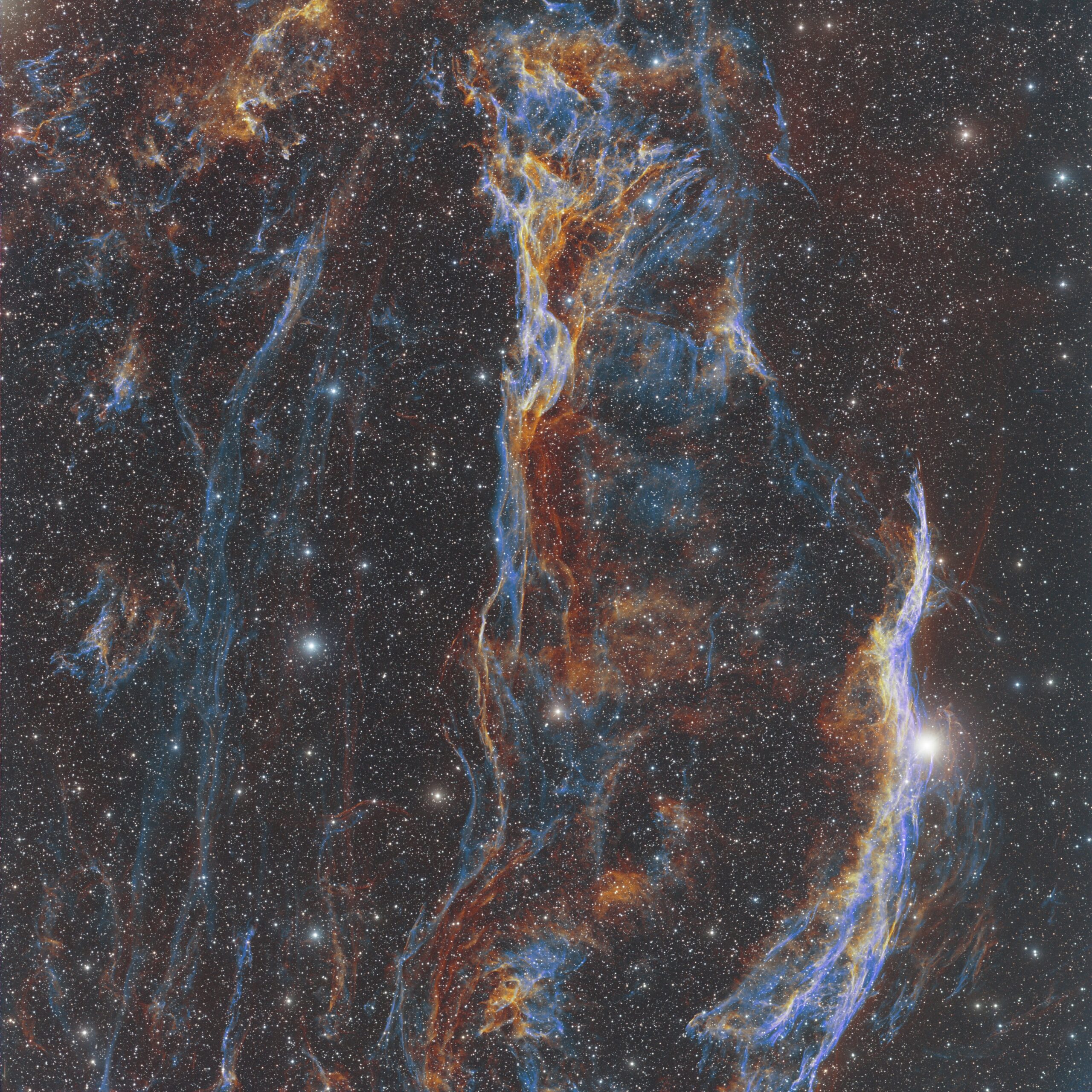
NGC 6960 (FORAXX)


The images were taken with the following equipment (DSW):

  • Date: 2019
  • Location: Rowe, New Mexico
  • Telescope/Lens: FSQ 106
  • Focal length [mm]: 530
  • Focal ratio: 5
  • Mount: Paramount MyT
  • Camera: QSI 683
  • Filter: Hα:[OIII]:[SII]
  • Exposure time [min]: 780:600:870
  • Resolution: 2.1″/px


For the 2018 data from DSW the calibration, registration and the final processing was done with PixInsight.
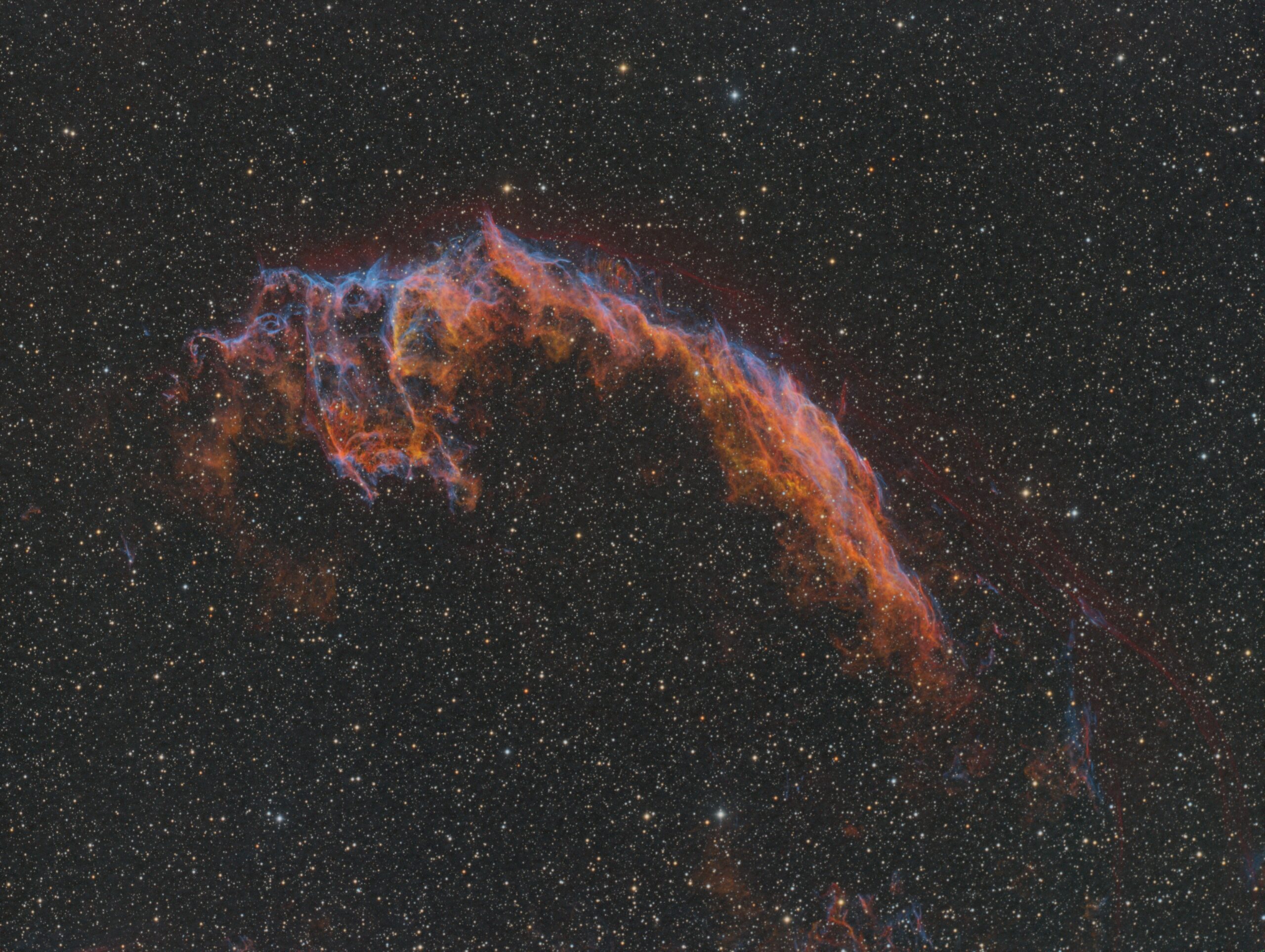
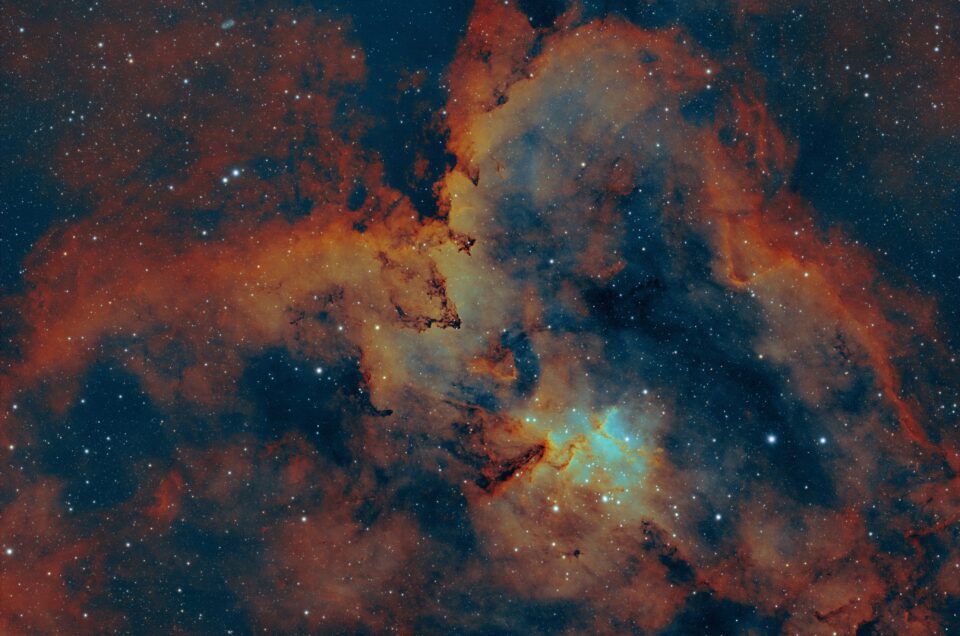
NGC 6992/5, DSW, Rowe, New Mexico, 2019


The images were taken with the following equipment (DSW):

  • Date: 2019
  • Location: Rowe, New Mexico
  • Telescope/Lens: FSQ 106
  • Focal length [mm]: 530
  • Focal ratio: 5
  • Mount: Paramount MyT
  • Camera: QSI 683
  • Filter: R:G:B:Hα:[OIII]
  • Exposure time [min]: 60:65:60:680:500
  • Resolution: 2.1″/px


For the 2014 data the calibration, registration and the final processing was done with PixInsight.
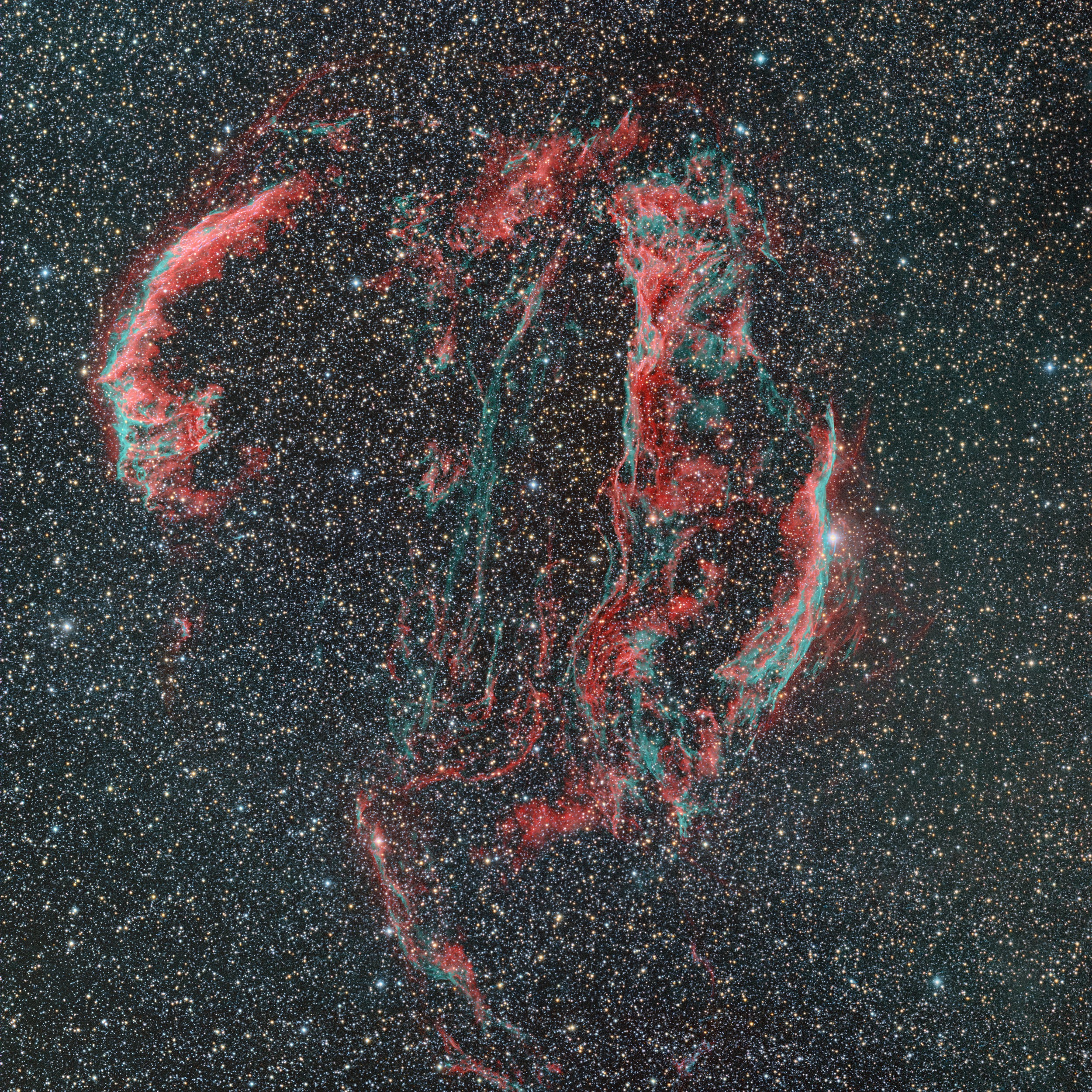
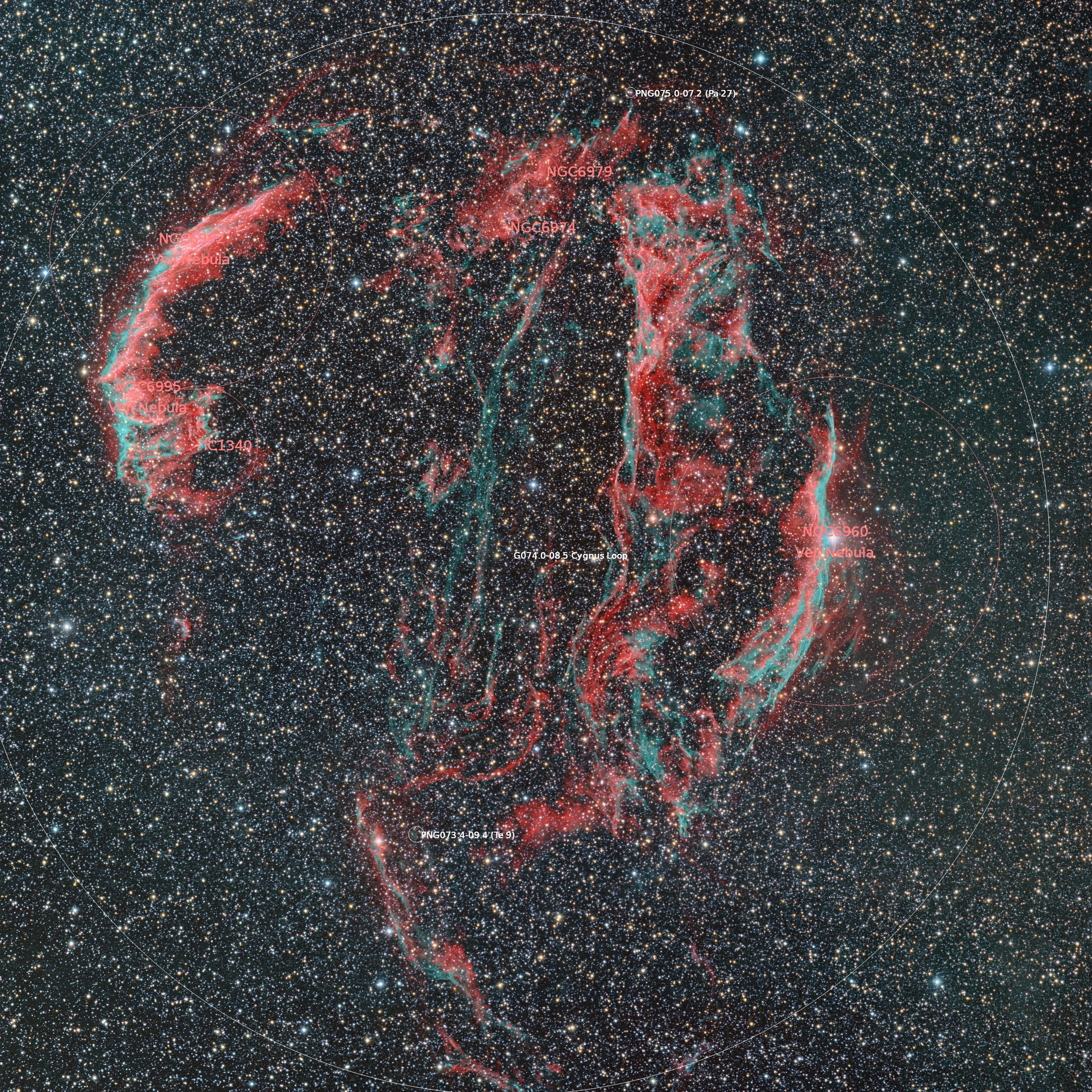
Veil Nebula, Banon, France, 2014

Veil Nebula (2014) annotated


The images were taken with the following equipment:

  • Date: 2014
  • Location: Banon, France
  • Telescope/Lens: Canon Tele Lens
  • Focal length [mm]: 200
  • Focal ratio: 4
  • Mount: Skywatcher NEQ6
  • Camera: Moravian FW 8300
  • Filter: Hα:[OIII]
  • Exposure time [min]: 200:200
  • Resolution: 5.57″/px


For the 2010 data the calibration and registration was done with DeepSkyStacker and the final processing was done with PixInsight.
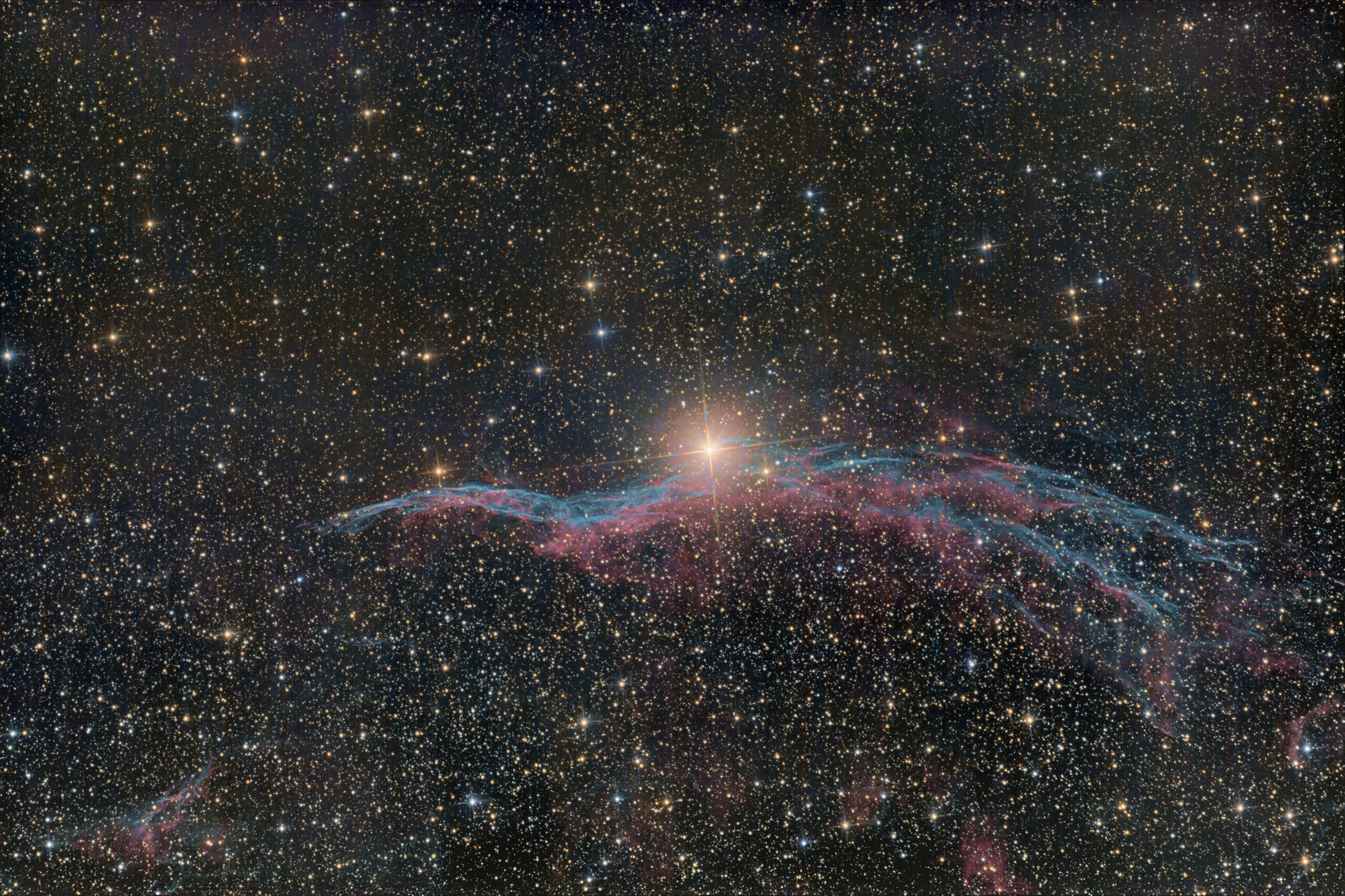
NGC 6960, Banon, France, 2010


The images were taken with the following equipment:

  • Date: 2010
  • Location: Banon, France
  • Telescope/Lens: 8″ GSO Newton
  • Focal length [mm]: 800
  • Focal ratio: 4
  • Mount: Skywatcher NEQ6
  • Camera: Canon 500 Da
  • Filter: OSC
  • Exposure time [min]: 75
  • Resolution: 1.19″/px


For the 2007 data the calibration and registration was done with DeepSkyStacker and the final processing was done with PixInsight.
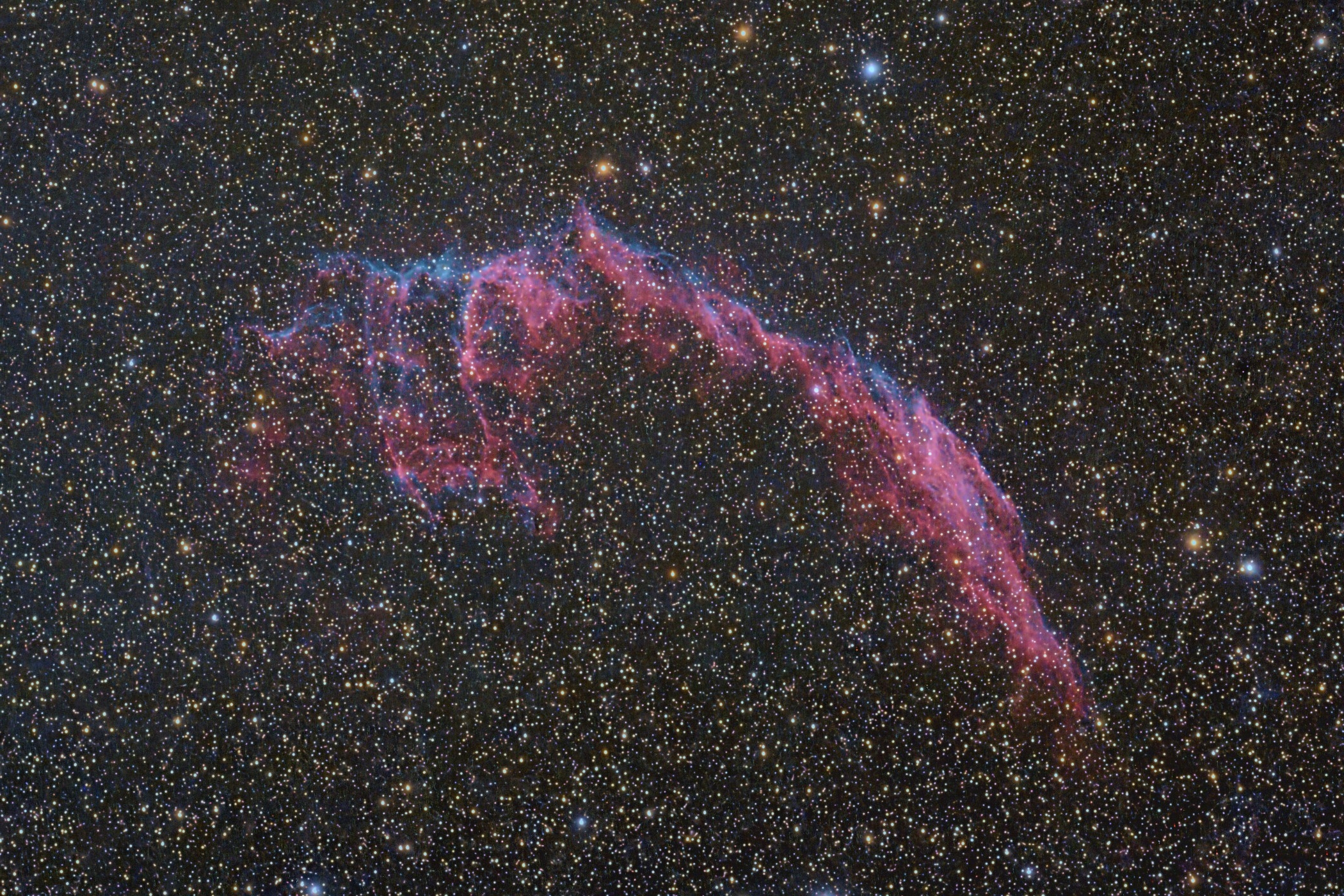
NGC 6992/5, Emberger Alm, Austria, 2007


The images were taken with the following equipment:

  • Date: 2007
  • Location: Emberger Alm, Austria
  • Telescope/Lens: Pentax 75
  • Focal length [mm]: 500
  • Focal ratio: 6.7
  • Mount: Vixen-GPDX
  • Camera: Canon 300 Da
  • Filter: OSC
  • Exposure time [min]: 60
  • Resolution: 3.03″/px


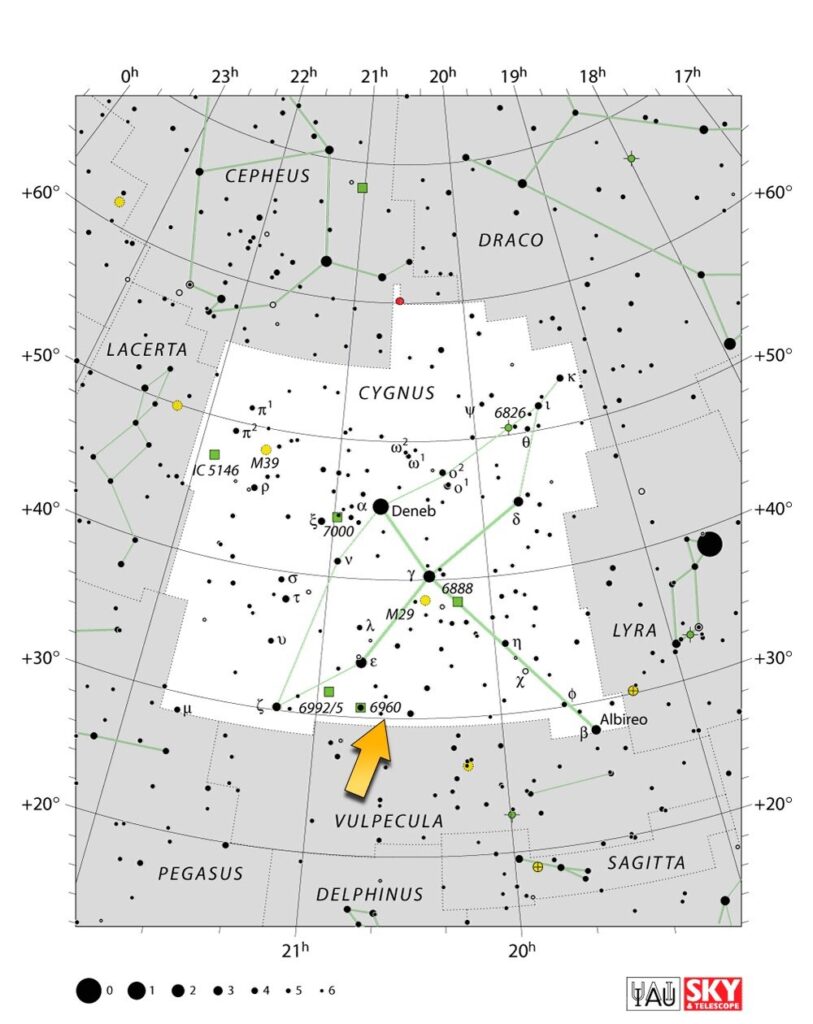
NGC 6960 Finder Chart

Stephan Küppers


You might also like
NGC 5907
15. Mai 2026
Messier 13 (NGC 6205)
10. Mai 2026
Messier 106 (NGC 4258)
8. Mai 2026

Leave a reply

Schreibe einen Kommentar Antwort abbrechen

Deine E-Mail-Adresse wird nicht veröffentlicht. Erforderliche Felder sind mit * markiert


© Stephan Küppers 2020-2022

Cookie-Zustimmung verwalten
Wir verwenden Cookies, um unsere Website und unseren Service zu optimieren.
Funktional Immer aktiv
Die technische Speicherung oder der Zugang ist unbedingt erforderlich für den rechtmäßigen Zweck, die Nutzung eines bestimmten Dienstes zu ermöglichen, der vom Teilnehmer oder Nutzer ausdrücklich gewünscht wird, oder für den alleinigen Zweck, die Übertragung einer Nachricht über ein elektronisches Kommunikationsnetz durchzuführen.
Vorlieben
Die technische Speicherung oder der Zugriff ist für den rechtmäßigen Zweck der Speicherung von Präferenzen erforderlich, die nicht vom Abonnenten oder Benutzer angefordert wurden.
Statistiken
Die technische Speicherung oder der Zugriff, der ausschließlich zu statistischen Zwecken erfolgt. Die technische Speicherung oder der Zugriff, der ausschließlich zu anonymen statistischen Zwecken verwendet wird. Ohne eine Vorladung, die freiwillige Zustimmung deines Internetdienstanbieters oder zusätzliche Aufzeichnungen von Dritten können die zu diesem Zweck gespeicherten oder abgerufenen Informationen allein in der Regel nicht dazu verwendet werden, dich zu identifizieren.
Marketing
Die technische Speicherung oder der Zugriff ist erforderlich, um Nutzerprofile zu erstellen, um Werbung zu versenden oder um den Nutzer auf einer Website oder über mehrere Websites hinweg zu ähnlichen Marketingzwecken zu verfolgen.
  • Optionen verwalten
  • Dienste verwalten
  • Verwalten von {vendor_count}-Lieferanten
  • Lese mehr über diese Zwecke
Einstellungen anzeigen
  • {title}
  • {title}
  • {title}