

Sh2-129, Outters 4 from my „Jade“ observatory
Over the years I have imaged Sh2-129 twice, each project demonstrating how advances in equipment and processing techniques can reveal increasingly subtle details within this remarkable region of the night sky. My first image was acquired in 2025 from my backyard observatory using a full RGB, H-alpha and OIII imaging setup, revealing also Outters 4, while a second project followed in 2026 using the remarkably capable Seestar S30 Pro.
Sh2‑129 is a large emission nebula (H II region) in the constellation Cepheus, commonly called the Flying Bat Nebula because of its broad, wing‑like shape in deep Hα images. Its angular size is about 140 arcminutes across, so it covers over two degrees of sky, and it is classified as an irregular, filamentary H II region of medium surface brightness. Distance estimates place Sh2‑129 at roughly 400 parsecs, about 1,300 light‑years from Earth, putting it relatively nearby on the inner edge of the Gould Belt and associated with the Cepheus OB2 group of massive stars.
Physically, Sh2‑129 is a bubble or sheet of ionized hydrogen gas traced by strong Hα emission. The ionization is primarily driven by the ultraviolet radiation from massive early‑type stars in the region, most notably the bright triple system HD 202214 (HR 8119) near the centre of the nebula. HR 8119 is classified around spectral type B0 II–V, and is considered a member of the Cepheus OB2 association or of the young cluster linked to Sh2‑129. Its intense UV flux ionizes the surrounding gas, creating the extended H II region you see as the reddish Flying Bat structure.
Morphologically, Sh2‑129 shows a mix of amorphous and filamentary structures. Early work described it as an “irregularly shaped” nebula with amorphous to thread‑like structure and noted that it is part of the I Cep association. In modern narrowband images, the nebula appears as a large, slightly curved red shell with subtle internal filaments and dark dust lanes, indicating interaction between stellar winds, the ambient interstellar medium, and local magnetic fields. It is a good example of how feedback from massive stars (ionizing radiation and winds) sculpts the surrounding gas into large‑scale H II regions.
Embedded within Sh2‑129 is Outters 4 (Ou 4), the Giant Squid Nebula, a very faint, highly excited bipolar nebula dominated by [O III] emission. Ou 4 was discovered in 2011 by the French amateur astrophotographer Nicolas Outters during deep narrowband imaging of Sh2‑129; subsequent spectroscopic work by Agnès Acker and others confirmed its unusual nature and strong [O III] line emission.
Ou 4 spans nearly a degree on the sky, and if it lies at the same distance as Sh2‑129 (∼2,300–3,200 light‑years in some studies), its physical size would be on the order of 50 light‑years across. Its morphology consists of a central, disc‑like region centred on HR 8119, and two elongated lobes extending in opposite directions, giving it the characteristic appearance of a giant squid or jet‑driven bipolar nebula. The spectrum is dominated by the green [O III] lines whose total intensity is roughly twenty times that of Hβ, indicating a very high excitation class consistent with a very hot central source.
Initially, Ou 4 was considered a candidate planetary nebula because of its bipolar shape and excitation, but more recent work suggests it is not a classical planetary nebula. Instead, it is interpreted as a shock‑excited bipolar outflow, likely launched by the same massive triple star system (HR 8119) that ionizes Sh2‑129. Matching radial velocities, extinction, and distance indicators for Sh2‑129 and Ou 4 support the idea that Ou 4 lies physically within the H II region rather than being a chance superposition along the line of sight.
In this scenario, Ou 4 would represent a spectacular large‑scale outflow, driven some ∼90,000 years ago by HR 8119, carving into the interior of Sh2‑129 and creating bow shocks and a central dust cavity where its lobes interact with the ambient gas. That makes the Sh2‑129 / Ou 4 system an astrophysically interesting case of stellar feedback: the same massive stars both ionize the surrounding cloud (the Flying Bat) and drive a highly collimated, high‑excitation outflow (the Squid), visible only through deep [O III] imaging.
For the 2026 data the calibration, registration and the final processing was done with PixInsight. The result was as follows:
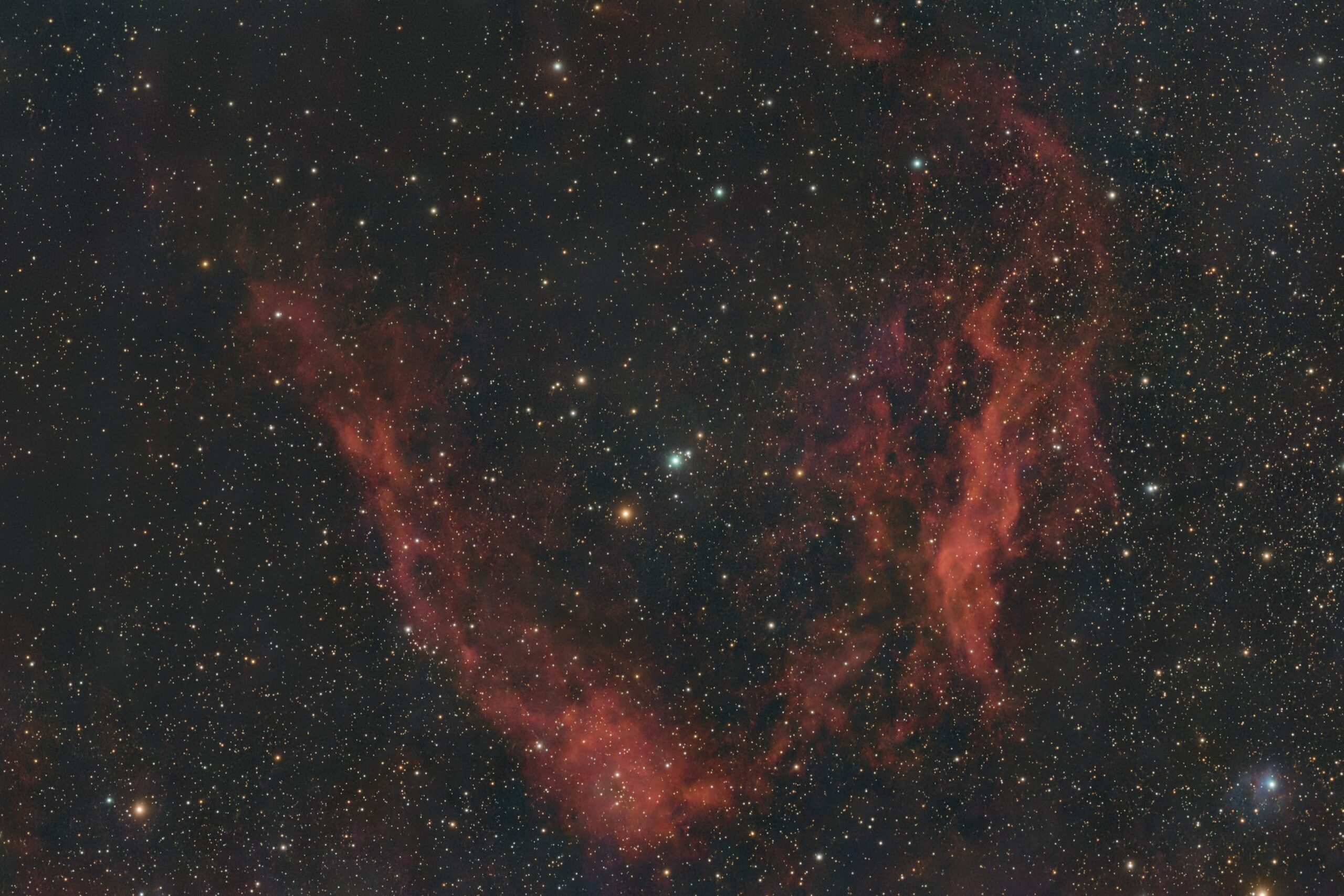
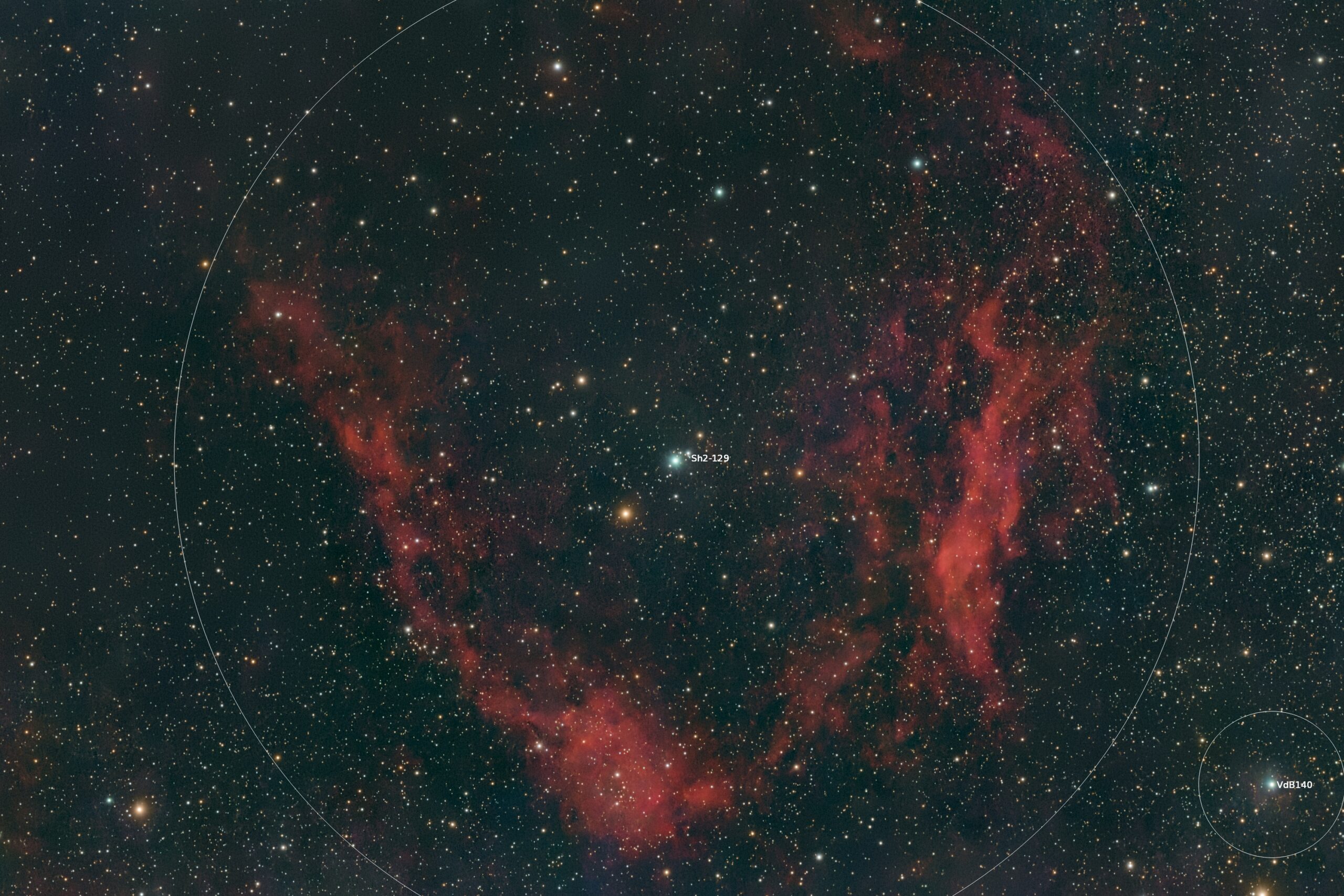
Here is an overview of the used equipment and the exposure times:
- Date: 2026
- Location: Varel
- Telescope/Lense: Seestar S30Pro
- Focal length [mm]: 160
- Focal ratio: 5.3
- Mount: EQ mode
- Camera: Seestar Tele
- Filter: LP
- Exposure time [min]: 404
- Resolution: 3.6″/px
For the 2025 data the calibration, registration and the final processing was done with PixInsight. The result was as follows:
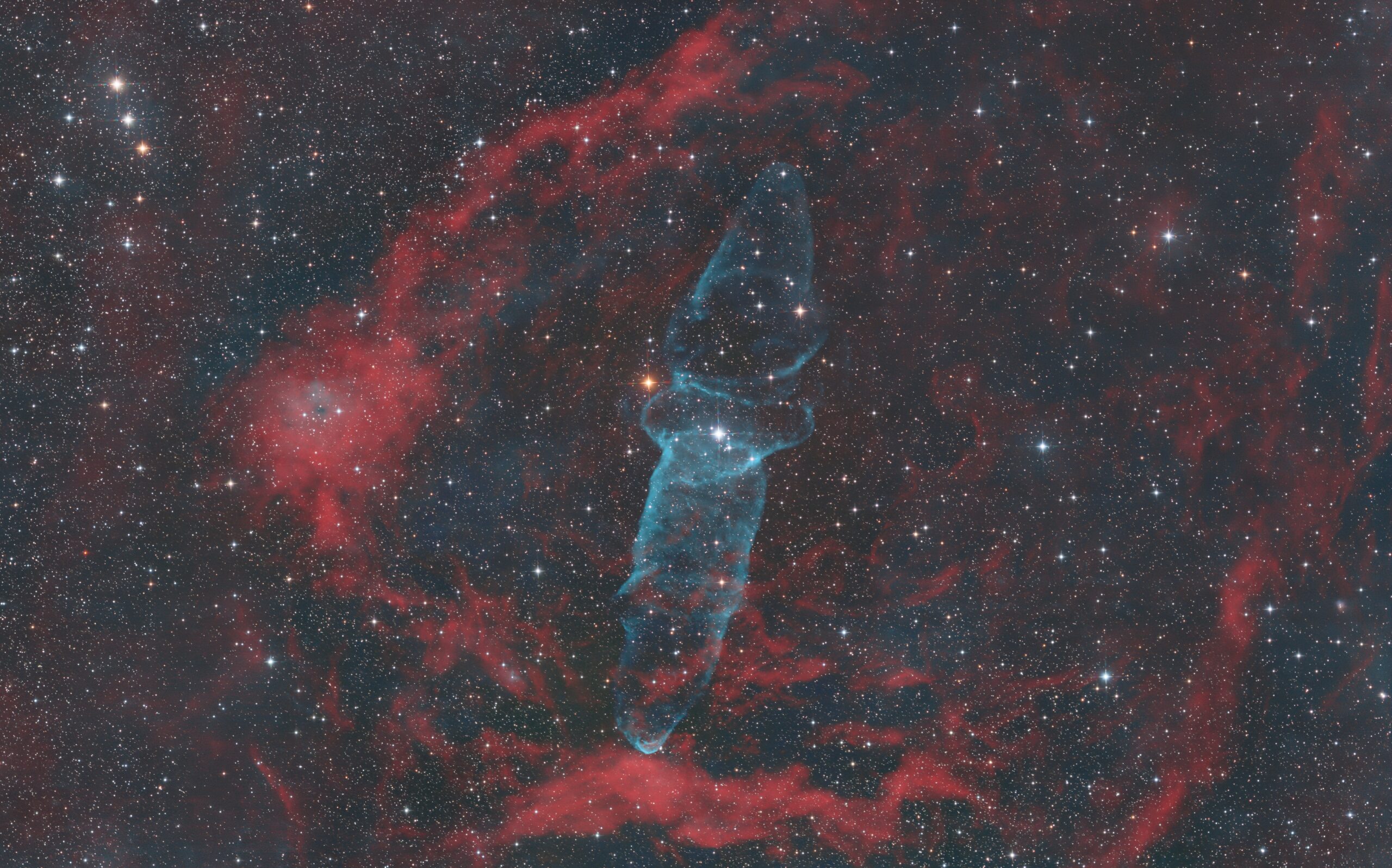
Here is an overview of the used equipment and the exposure times:
- Date: August and September 2025
- Location: Varel
- Telescope/Lense: 6″ Lacerta Newton
- Focal length [mm]: 450
- Focal ratio: 3
- Mount: Skywatcher EQ 8
- Camera: Lacerta Deepsky 2600 M
- Autoguiding: Off-Axis with ZWO Asi 120 MM Mini
- Filter: R:G:B:[Hα]:[OIII]
- Exposure time [min]: 45:45:40:250:370
- Resolution: 1.72/px

You might also like


Leave a reply