

NGC 7771
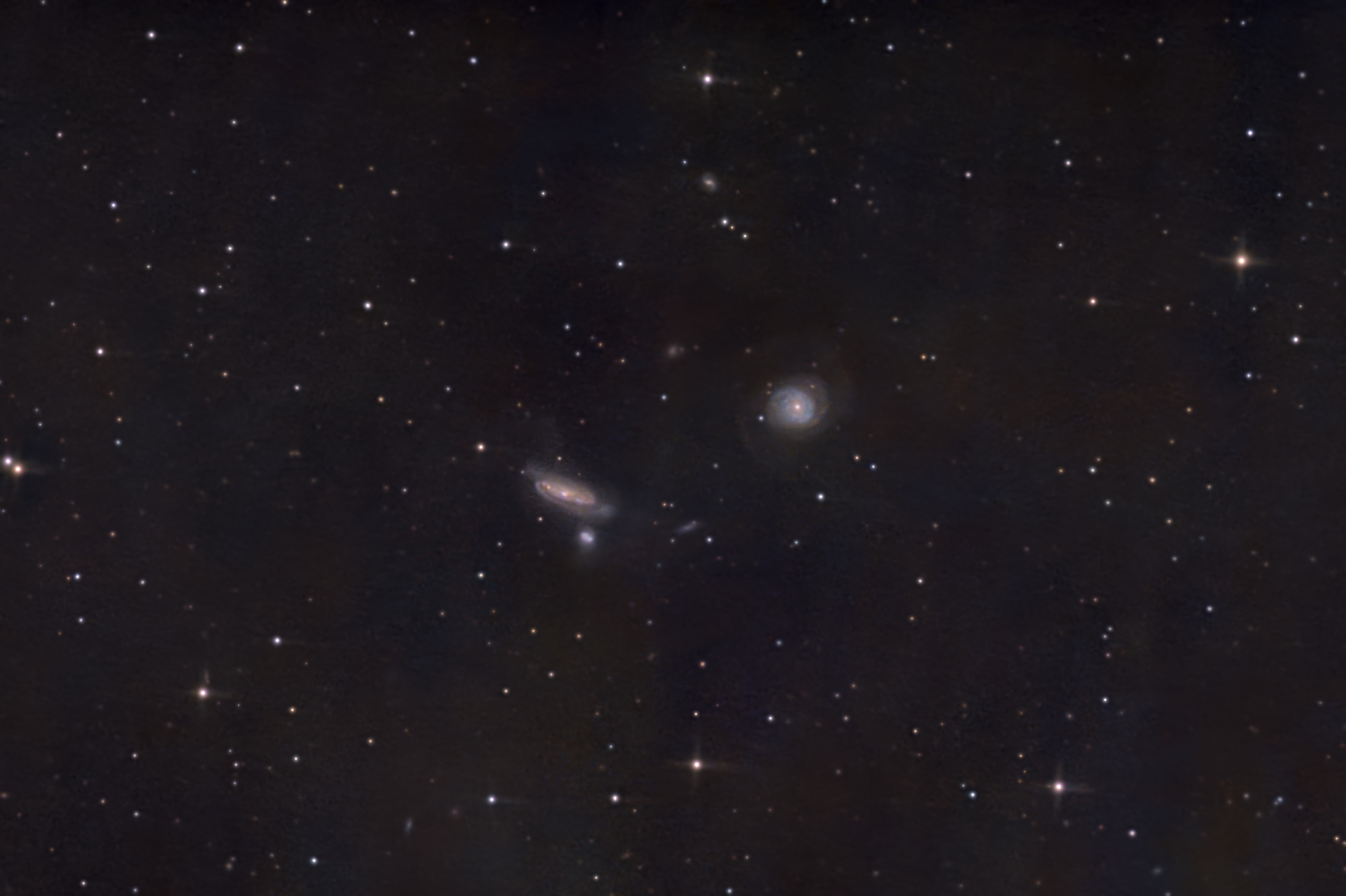
I imaged the interacting galaxy group consisting of NGC 7771, NGC 7770, and NGC 7769 three times over the years, documenting both my development in astrophotography and the evolution of my equipment. My first images were acquired from my backyard observatory in 2011 using my DSLR equipment. In 2012, I revisited the group and recorded additional luminance data with a CCD camera, which I combined with the earlier DSLR RGB data to produce a significantly more detailed LRGB image.
My most recent image was captured in 2017 during a stay at the Tivoli Astrofarm in Namibia, where I used the equipment of a rented observatory. The pristine southern skies and professional instrumentation revealed much finer details in the galaxies‘ spiral arms, dust lanes, and tidal features than had been possible from my suburban backyard.
Located in the constellation Pegasus, the three galaxies lie approximately 200 million light-years from Earth and form a spectacular example of an interacting galaxy group. The dominant member, NGC 7771, is a large barred spiral galaxy viewed nearly edge-on. It possesses a remarkably long central bar and prominent spiral arms rich in dark dust lanes and bright H II regions, where vigorous star formation is taking place.
The galaxy’s unusual appearance is the result of strong gravitational interactions with its neighboring galaxies, particularly NGC 7770. This smaller companion has passed close to NGC 7771, disturbing its disk and triggering an intense burst of star formation. Such encounters compress large clouds of interstellar gas, leading to the rapid formation of massive young stars and making interacting galaxies important laboratories for studying galactic evolution.
To the west lies NGC 7769, another spiral galaxy that also participates in the gravitational dance of the group. Although it has been less strongly distorted than NGC 7771, careful observations reveal subtle asymmetries in its spiral structure that testify to the ongoing interaction. Together, the three galaxies illustrate the profound influence that gravity exerts over hundreds of millions of years, gradually reshaping galaxies through repeated close encounters.
Deep images reveal faint tidal streams and extended stellar material connecting the galaxies, evidence that stars and gas have been pulled from their original disks during past interactions. These delicate structures are extremely faint and require long integration times together with excellent sky conditions to become visible. They provide astronomers with valuable clues for reconstructing the orbital history of the group and understanding how spiral galaxies evolve through mergers and encounters.
The surrounding field is populated with numerous faint background galaxies, emphasizing the enormous depth of the universe captured in a single image. Many of these distant systems lie billions of light-years beyond the interacting foreground group, providing an impressive sense of cosmic scale.
The images obtained in 2011, 2012, and 2017 beautifully document the progress of my astrophotography. The combination of DSLR RGB data with CCD luminance significantly enhanced the detail visible in the first image, while the later observations from Namibia benefited from exceptionally dark skies and professional equipment. Together, these images showcase one of the most interesting interacting galaxy groups in Pegasus and demonstrate how improvements in imaging techniques and observing conditions can reveal increasingly subtle structures within distant galaxies.
The data calibration and registration, as well as the final image processing, were all done with PixInsight.

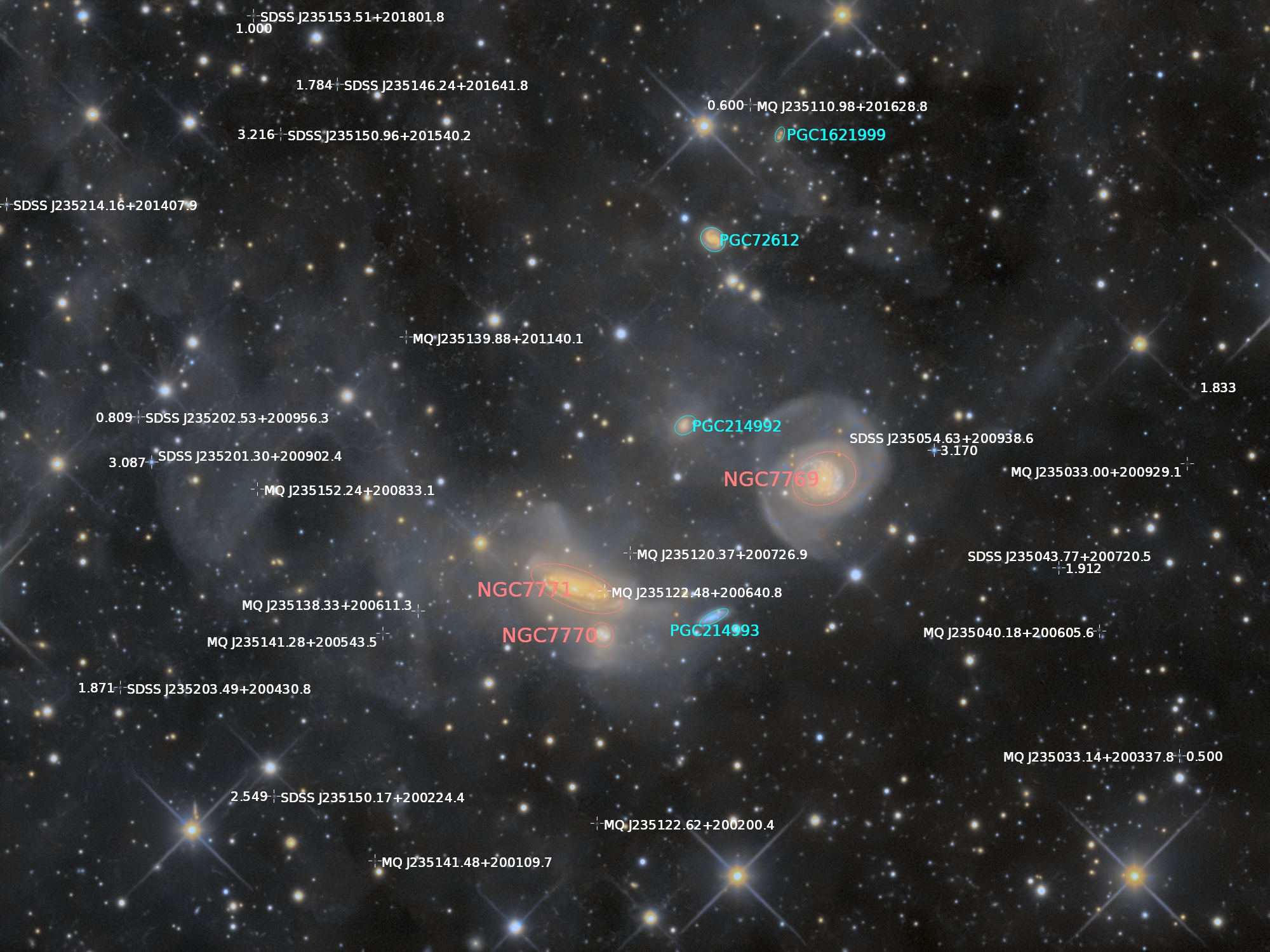
In the image, countless background galaxies and quasars are scattered across the field of view. Among them, the most distant identified object are:
- SDSS J235150.96+201540.2 with a redshift of 3.22
- SDSS J235043.77+200720.5 with a redshift of 3.17
The images were taken with the following equipment:
- Location: Tivoli, Namibia
- Telescope: 12″ ASA Astrograph
- Focal length [mm]: 1076
- Focal ratio: 3.6
- Mount: ASA DDM85
- Camera: FLI Microline ML16200
- Filter: L:R:G:B
- Exposure time [min]: 210:45:45:45
- Resolution: 0.76″/px (150%)
For the 2012 data the calibration, registration and the final image processing, were all done with PixInsight.

The images were taken with the following equipment:
- Date: 2011 – 2012
- Location: Krefeld, Germany
- Telescope: 10″ TS Newton
- Focal length [mm]: 1140
- Focal ratio: 4.5
- Mount: Skywatcher NEQ6
- Camera: Canon 500 Da – Moravian 8300FW
- Filter: OSC – L
- Exposure time [min]: 507 – 320
- Resolution: 0.85″/px
For the 2011 data the calibration, registration and the final image processing, were all done with PixInsight.
The images were taken with the following equipment:
- Date: 2011
- Location: Krefeld, Germany
- Telescope: 10″ TS Newton
- Focal length [mm]: 1140
- Focal ratio: 4.5
- Mount: Skywatcher NEQ6
- Camera: Canon 500 Da
- Filter: OSC
- Exposure time [min]: 507
- Resolution: 0.85″/px

You might also like


Leave a reply