

NGC 7380
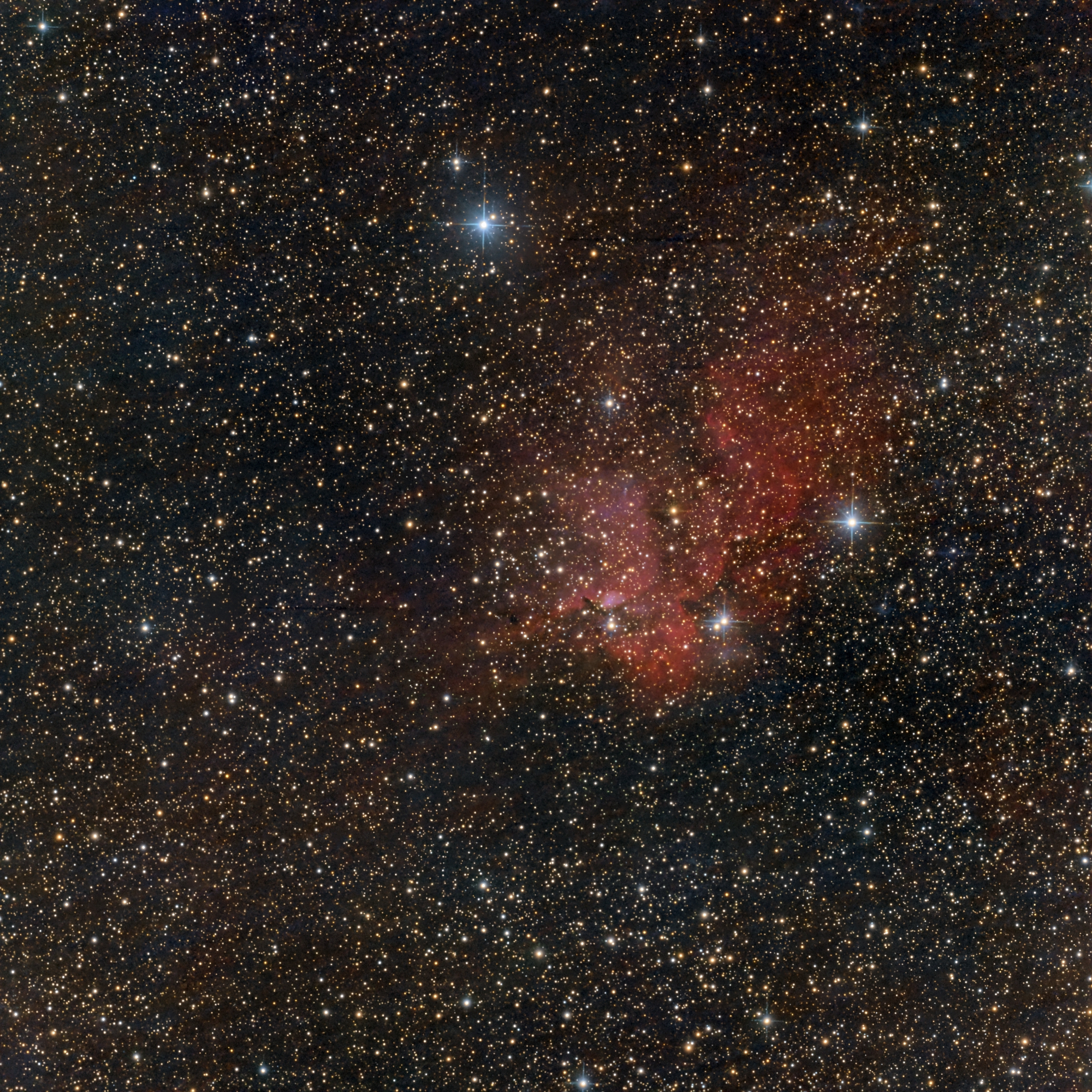
In 2010, during a stay in Banon, I imaged the remarkable emission nebula NGC 7380 using my DSLR equipment. The dark skies of Haute-Provence provided excellent conditions for recording this beautiful yet relatively faint object. Despite the modest equipment, the long exposures revealed the nebula’s characteristic glowing hydrogen clouds surrounding a rich open star cluster, making it one of my favorite deep-sky images from that observing trip.
Located in the constellation Cepheus, NGC 7380 lies at a distance of approximately 7,000 to 8,000 light-years from Earth. The object is a combination of a young open cluster and the surrounding H II emission nebula, where ultraviolet radiation from massive young stars ionizes the hydrogen gas, causing it to glow with its characteristic red color.
NGC 7380 is commonly known as the Wizard Nebula, a nickname inspired by the silhouette that resembles a wizard wearing a pointed hat when viewed in deep photographs. This striking appearance is created by intricate networks of bright ionized gas, dark dust clouds, and towering pillars sculpted by the intense radiation and stellar winds from the cluster’s hottest stars.
The embedded open cluster, also designated NGC 7380, is extremely young, with an estimated age of only about 4 million years. It contains numerous hot O- and B-type stars, whose energetic ultraviolet radiation shapes the surrounding molecular cloud. Their powerful stellar winds compress nearby gas while simultaneously eroding dense dust clouds, triggering new episodes of star formation in some regions while dispersing the remaining material in others.
Deep images reveal a fascinating landscape of dark dust lanes, bright ionization fronts, and dense molecular pillars. Embedded within these dusty structures, infrared observations have detected numerous young stellar objects and protostars, demonstrating that star formation is still actively taking place. The Wizard Nebula therefore offers astronomers an excellent opportunity to study how massive stars influence the birth of future generations of stars.
The surrounding field is rich with countless foreground and background stars of the Milky Way, as NGC 7380 lies close to the Galactic plane. Deep exposures also reveal numerous faint nebular filaments extending beyond the bright central region, emphasizing that the Wizard Nebula is part of a much larger complex of interstellar gas and dust.
The image I obtained in 2010 remains a memorable part of my astrophotographic archive. Captured with a DSLR camera under the dark skies of Banon, it demonstrates how even relatively modest equipment can successfully record one of the northern sky’s most beautiful star-forming regions. It also marks an important stage in my astrophotographic journey, long before I began using dedicated astronomical cameras and narrowband imaging techniques.
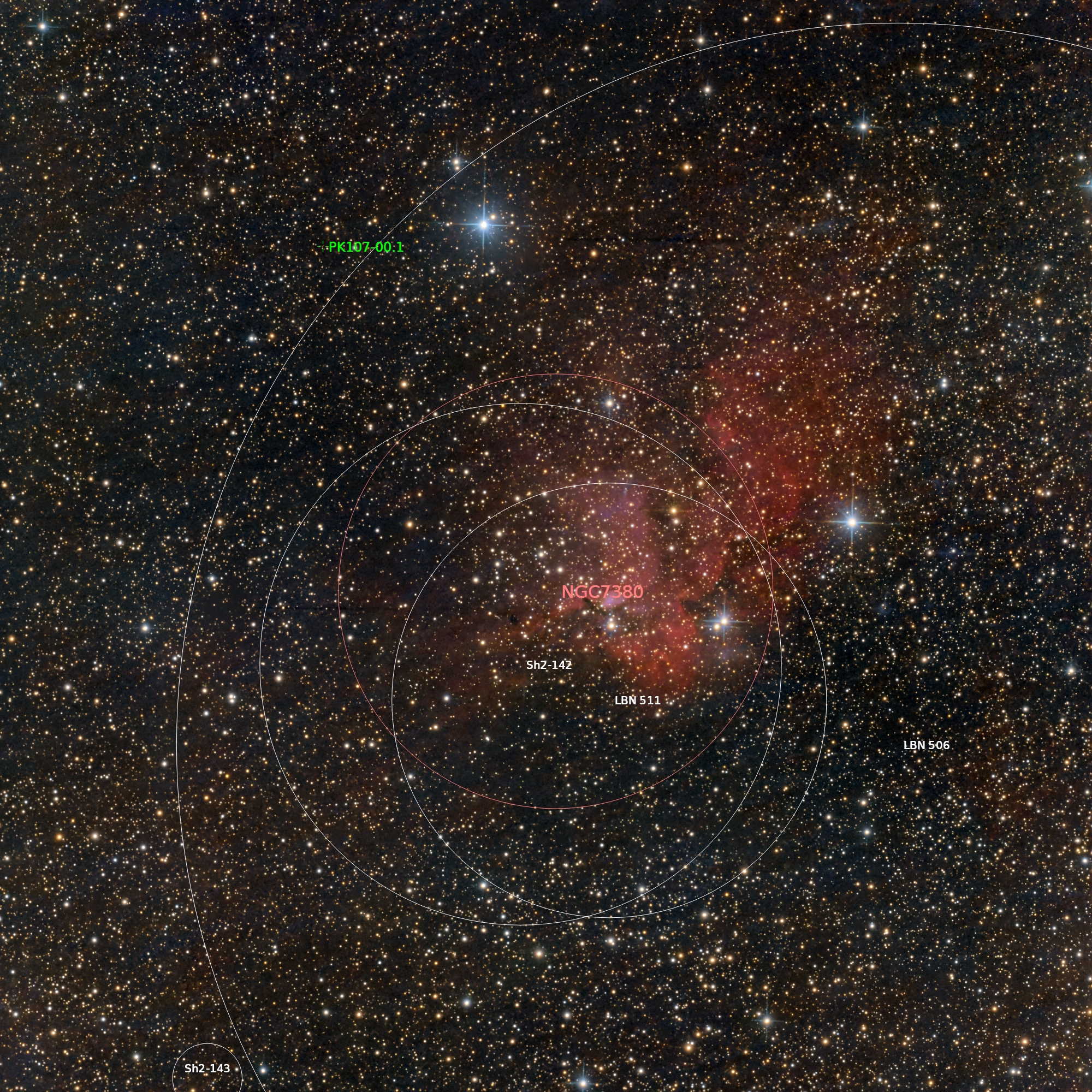
Data calibration and registration was performed with DeepSkyStacker, the final processing was done with PixInsight. The result was as follows:
The images were taken with the following equipment:
- Date 2010
- Location: Banon, France
- Telescope: 8″ GSO Newton
- Focal length [mm]: 200
- Focal ratio: 4
- Mount: Skywatcher NEQ6
- Camera: Canon 500 Da
- Filter: OSC
- Exposure time [min]: 160
- Resolution: 1.88″/px



Leave a reply