• Home
  • Blog
  • Astrophotography
    • Deep Sky
      • Galaxies (Galaxien)
      • Nebulae (Nebel)
      • Planetary Nebulae (Planetarische Nebel)
      • Globular Clusters (Kugelsternhaufen)
      • Open Clusters (Offene Sternhaufen)
      • Miscellaneous (Verschiedenes)
    • Solar System (Sonnensystem)
      • Comets (Kometen)
      • Moon (Mond)
      • Planets (Planeten)
      • Sun (Sonne)
  • Archiv

    • Juli 2026
    • Juni 2026
    • Mai 2026
    • April 2026
    • Dezember 2025
    • November 2025
    • Oktober 2025
    • September 2025
    • August 2025
    • Juli 2025
    • Juni 2025
    • Mai 2025
    • April 2025
    • März 2025
    • Januar 2025
    • Dezember 2024
    • November 2024
    • Oktober 2024
    • September 2024
    • Juli 2024
    • Juni 2024
    • Mai 2024
    • April 2024
    • März 2024
    • Februar 2024
    • Januar 2024
    • November 2023
    • Oktober 2023
    • September 2023
    • August 2023
    • Juli 2023
    • Juni 2023
    • Mai 2023
    • April 2023
    • März 2023
    • Februar 2023
    • Januar 2023
    • Dezember 2022
    • November 2022
    • Oktober 2022
    • September 2022
    • August 2022
    • Juni 2022
    • Mai 2022
    • April 2022
    • März 2022
    • Februar 2022
    • Januar 2022
    • Dezember 2021
    • November 2021
    • September 2021
    • August 2021
    • Juli 2021
    • März 2021
    • Februar 2021
    • November 2020
    • September 2020
    • August 2020
    • April 2020
    • März 2020
    • Februar 2020
    • Januar 2020
    • Dezember 2019
    • November 2019
    • Oktober 2019
    • September 2019
    • August 2019
    • Mai 2019
    • April 2019
    • März 2019
    • Dezember 2018
    • November 2018
    • September 2018
    • Juni 2018
    • Mai 2018
    • April 2018
    • März 2018
    • Februar 2018
    • Januar 2018
    • Oktober 2017
    • Juli 2017
    • Juni 2017
    • Januar 2017
    • September 2016
    • Mai 2016
    • März 2016
    • November 2015
    • Oktober 2015
    • September 2015
    • Mai 2015
    • März 2015
    • Februar 2015
    • September 2014
    • März 2014
    • Februar 2014
    • Oktober 2013
    • September 2013
    • August 2013
    • April 2013
    • März 2013
    • November 2012
    • August 2012
    • Juli 2012
    • Mai 2012
    • März 2012
    • Januar 2012
    • November 2011
    • Oktober 2011
    • September 2011
    • August 2011
    • April 2011
    • März 2011
    • Oktober 2010
    • September 2010
    • August 2010
    • Juli 2010
    • April 2010
    • Juli 2009
    • Juli 2008
    • Januar 2008
    • Oktober 2007
    • Juli 2007
    • Februar 2007
    • Juni 2006
    • Oktober 2005
    • September 2005
    • August 2005
    • Januar 2005
  • Kategorien

    • Asterism
    • Astrophotography
    • Barnard
    • Comet
    • Galaxies
    • Globular Cluster
    • IC
    • Messier
    • Moon
    • Nebula
    • NGC
    • Open cluster
    • Photography
    • Planetary Nebula
    • Travel
  • Meta

    • Anmelden
    • Eintrags-Feed
    • Kommentar-Feed
    • WordPress.org
  • Privacy Policy
  • Impressum
  • Haftungsausschluss
  • Cookie-Richtlinie
  • Datenschutzerklärung

wonderfuluniverse.de
  • Home
  • Blog
  • Astrophotography
    • Deep Sky
      • Galaxies (Galaxien)
      • Nebulae (Nebel)
      • Planetary Nebulae (Planetarische Nebel)
      • Globular Clusters (Kugelsternhaufen)
      • Open Clusters (Offene Sternhaufen)
      • Miscellaneous (Verschiedenes)
    • Solar System (Sonnensystem)
      • Comets (Kometen)
      • Moon (Mond)
      • Planets (Planeten)
      • Sun (Sonne)

NGC 7009 from my own backyard


In 2005, I imaged the beautiful planetary nebula NGC 7009 using my DSLR equipment. At the time, DSLR astrophotography was still in its early stages for me, making this compact but fascinating object a challenging target. Despite the limited sensitivity and resolution compared to modern astronomical cameras, the image successfully captured the nebula’s characteristic elongated shape and distinctive blue-green color. Looking back, it represents one of my early attempts at imaging small planetary nebulae and marks an important step in my astrophotographic journey.

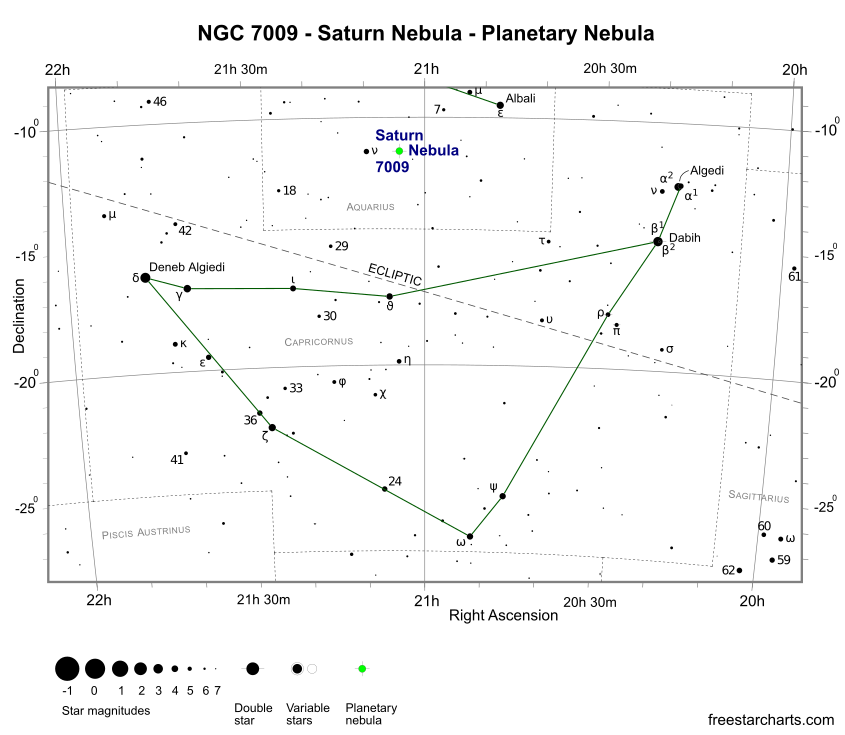
NGC 7009 is located in the constellation Aquarius, approximately 4,000 light-years from Earth. It is one of the brightest and most studied planetary nebulae in the sky and is popularly known as the Saturn Nebula because its elongated outer extensions resemble the rings of the planet Saturn when viewed through early telescopes.

The nebula was formed when a Sun-like star reached the end of its life and expelled its outer layers into space. The remaining stellar core has evolved into an extremely hot white dwarf with a surface temperature of more than 80,000 Kelvin. Its intense ultraviolet radiation ionizes the expanding shell of gas, causing it to emit strongly in Hα, [O III], and [N II]. The particularly strong [O III] emission gives the Saturn Nebula its characteristic turquoise-blue appearance in deep photographs.

One of the most remarkable features of NGC 7009 is its highly complex internal structure. High-resolution images reveal multiple concentric shells, delicate filaments, bright knots, and a pair of striking outer extensions known as ansae—small, symmetrical condensations of gas aligned with the nebula’s major axis. These ansae are expanding at high velocity and are believed to result from collimated outflows or jets produced during the final stages of the progenitor star’s evolution. Their exact formation mechanism remains an active topic of astronomical research.

Beyond the bright inner nebula lies a much fainter outer halo, representing material ejected during earlier episodes of stellar mass loss. Deep imaging has shown that NGC 7009 possesses a surprisingly complex three-dimensional structure rather than a simple ellipsoidal shell. Modern observations suggest that multiple interacting shells, bipolar outflows, and changing stellar winds have shaped the nebula over thousands of years, producing the intricate appearance observed today.

From a scientific perspective, the Saturn Nebula is an important laboratory for studying the late stages of stellar evolution. Its rich morphology provides valuable insight into how planetary nebulae are formed and shaped, while spectroscopic observations reveal the chemical elements returned to the interstellar medium. These elements, including carbon, nitrogen, and oxygen, will eventually become incorporated into future generations of stars and planetary systems.

Although my 2005 DSLR image could not resolve the finest details visible in modern CCD or space-based observations, it successfully captured the nebula’s distinctive shape and brilliant color. It remains an important milestone in my astrophotographic archive, illustrating both the beauty of one of the sky’s finest planetary nebulae and the progress that has been made in astronomical imaging over the years.

Data calibration and registration was done with DeepSkyStacker and the final processing was done with PixInsight. The result was as follows:
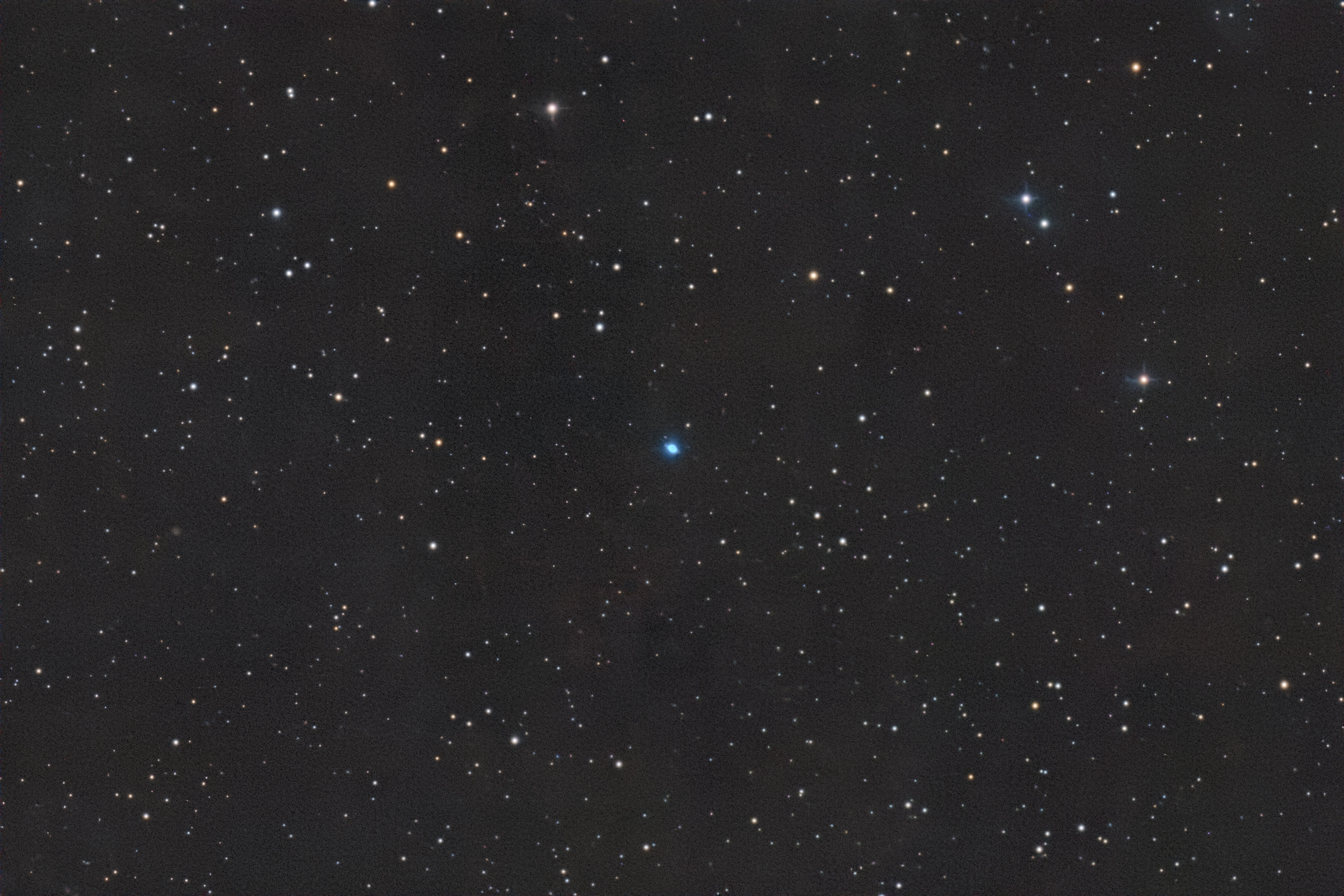
NGC 7009, Krefeld, 2005


The images were taken with the following equipment:

  • Date: 2005
  • Telescope: GSO 8″ Newton
  • Focal length [mm]: 800
  • Focal ratio: 4
  • Mount: Vixen GP-DX
  • Camera: Canon 300 Da
  • Filter: OSC
  • Exposure time: 5,5
  • Resolution: 1.88″/px


NGC 7009 Finding Chart

Stephan Küppers


You might also like
IC 1318
15. Juli 2026
NGC 7000 with IC 5070
24. Juni 2026
NGC 7023 (Iris Nebula) and LBN 468
25. Mai 2026

Leave a reply

Schreibe einen Kommentar Antwort abbrechen

Deine E-Mail-Adresse wird nicht veröffentlicht. Erforderliche Felder sind mit * markiert


© Stephan Küppers 2020-2022

Cookie-Zustimmung verwalten
Wir verwenden Cookies, um unsere Website und unseren Service zu optimieren.
Funktional Immer aktiv
Die technische Speicherung oder der Zugang ist unbedingt erforderlich für den rechtmäßigen Zweck, die Nutzung eines bestimmten Dienstes zu ermöglichen, der vom Teilnehmer oder Nutzer ausdrücklich gewünscht wird, oder für den alleinigen Zweck, die Übertragung einer Nachricht über ein elektronisches Kommunikationsnetz durchzuführen.
Vorlieben
Die technische Speicherung oder der Zugriff ist für den rechtmäßigen Zweck der Speicherung von Präferenzen erforderlich, die nicht vom Abonnenten oder Benutzer angefordert wurden.
Statistiken
Die technische Speicherung oder der Zugriff, der ausschließlich zu statistischen Zwecken erfolgt. Die technische Speicherung oder der Zugriff, der ausschließlich zu anonymen statistischen Zwecken verwendet wird. Ohne eine Vorladung, die freiwillige Zustimmung deines Internetdienstanbieters oder zusätzliche Aufzeichnungen von Dritten können die zu diesem Zweck gespeicherten oder abgerufenen Informationen allein in der Regel nicht dazu verwendet werden, dich zu identifizieren.
Marketing
Die technische Speicherung oder der Zugriff ist erforderlich, um Nutzerprofile zu erstellen, um Werbung zu versenden oder um den Nutzer auf einer Website oder über mehrere Websites hinweg zu ähnlichen Marketingzwecken zu verfolgen.
  • Optionen verwalten
  • Dienste verwalten
  • Verwalten von {vendor_count}-Lieferanten
  • Lese mehr über diese Zwecke
Einstellungen anzeigen
  • {title}
  • {title}
  • {title}