

NGC 6914 from remote
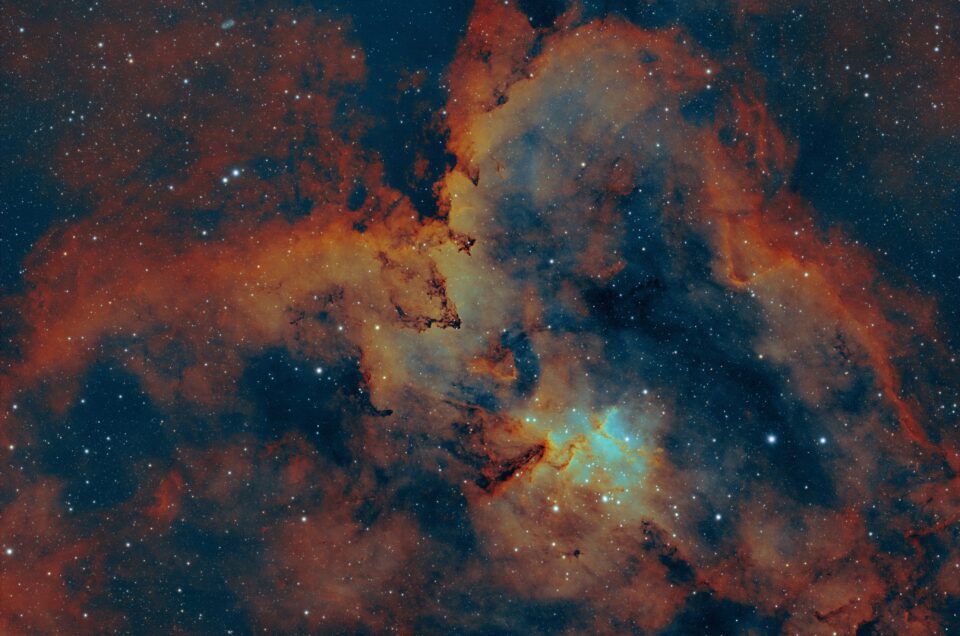
From time to time, I obtain datasets from remote observatories around the world. One of my favorite providers is Deep Sky West, which operates professional telescopes under the exceptionally dark skies of New Mexico. One of the datasets I received in 2018 featured the beautiful reflection nebula NGC 6914, a fascinating object located in one of the richest regions of the northern Milky Way.
NGC 6914 is situated in the constellation Cygnus, at a distance of approximately 6,000 light-years. Unlike emission nebulae, which glow because their gas is ionized by ultraviolet radiation, NGC 6914 is primarily a reflection nebula. Its characteristic blue color is produced when fine interstellar dust scatters the light of nearby hot, young stars. Since blue light is scattered more efficiently than red light, the nebula exhibits the same bluish appearance that is commonly seen in reflection nebulae such as the Pleiades.
The nebula is embedded within the enormous molecular cloud complex of Cygnus, one of the Milky Way’s most active star-forming regions. Although reflection dominates its appearance, deep images also reveal delicate patches of faint Hα emission mixed with the blue dust clouds. This combination of reflection and emission gives the region a remarkable visual complexity and makes it an outstanding target for astrophotography.
Surrounding the bright nebula are intricate dark dust lanes and dense molecular clouds that obscure the rich stellar background of the Milky Way. These dark clouds consist of cold gas and microscopic dust particles that absorb visible light. Embedded within them are numerous young stellar objects and protostars that remain hidden at optical wavelengths but become visible in infrared observations. The entire region therefore represents an active stellar nursery where new generations of stars continue to form.
NGC 6914 is actually composed of several closely associated reflection nebulae, including NGC 6914A, NGC 6914B, and NGC 6914C, which together create the characteristic branching appearance seen in deep photographs. The illuminated dust clouds are shaped by stellar winds and radiation from nearby massive stars, producing delicate arcs, filaments, and sharply defined dust boundaries.
From a scientific perspective, NGC 6914 is an excellent laboratory for studying the interaction between young massive stars and their natal molecular clouds. Observations across optical, infrared, and radio wavelengths help astronomers investigate the processes of star formation, dust evolution, and the influence of stellar radiation on the surrounding interstellar medium.
The Deep Sky West dataset obtained in 2018 beautifully captures the subtle blue reflection nebulosity, the intricate dark dust structures, and the rich stellar background of Cygnus. The exceptional image quality and dark skies of New Mexico reveal delicate details that are difficult to capture under light-polluted conditions, producing a striking portrait of one of the Milky Way’s most beautiful reflection nebulae.
Data calibration and registration and the final processing was done with PixInsight. The result was as follows:

The images were taken with the following equipment:
- Date: 2018
- Location: Rowe, New Mexico
- Telescope/Lens: Takahashi FSQ-106
- Focal length [mm]: 530
- Focal ratio: 5
- Mount: Paramount MyT
- Camera: QSI 683-WSG-8
- Filter: L:R:G:B:Hα
- Exposure time [min]: 240:240:180:255:450
- Resolution: 2.08″/px




Leave a reply