

NGC 6826 from my own backyard
In 2013, I imaged the planetary nebula NGC 6826 from my backyard in Krefeld using my CCD equipment. The image was acquired in HORGB, combining Hα data with broadband RGB to enhance the nebula’s delicate emission structures while preserving the natural colors of the surrounding star field. Despite the challenges of imaging from a suburban location, the narrowband data significantly improved the visibility of the faint outer regions and revealed fine structural details within this remarkable planetary nebula.
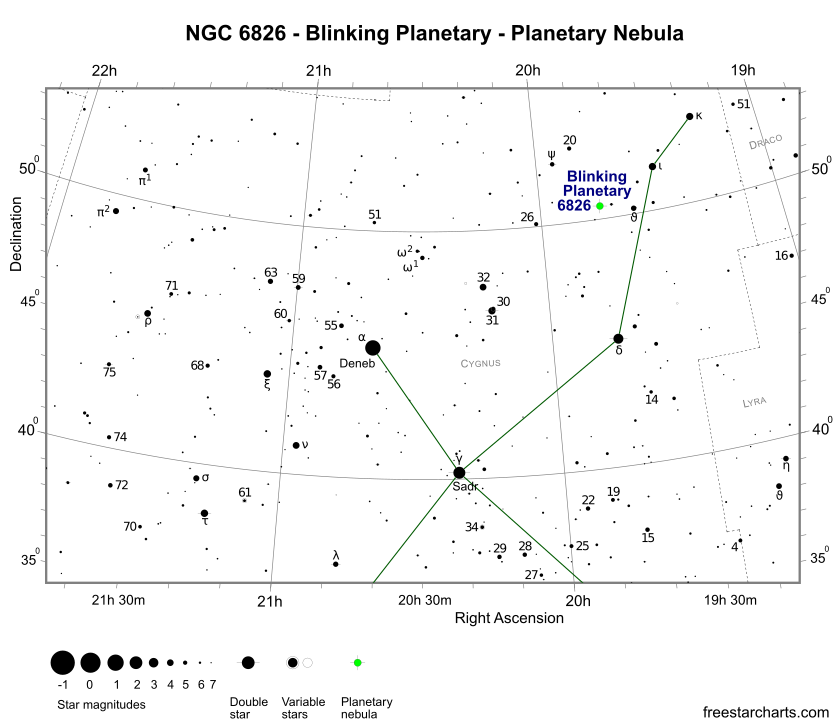
NGC 6826 is located in the constellation Cygnus, approximately 2,200 light-years from Earth. It is one of the best-known planetary nebulae in the northern sky and is popularly known as the Blinking Planetary Nebula. This unusual nickname originates from a fascinating visual effect: when viewed through a telescope, the bright central star dominates direct vision, causing the surrounding nebula to appear to disappear. Looking slightly away from the object activates the eye’s more sensitive peripheral vision, making the nebula suddenly „blink“ back into view.
Like all planetary nebulae, NGC 6826 marks the final evolutionary stage of a star similar in mass to our Sun. After exhausting its nuclear fuel, the progenitor star expelled its outer layers into space, leaving behind an extremely hot white dwarf whose ultraviolet radiation ionizes the expanding shell of gas. The nebula shines primarily in Hα, [O III], and [N II], producing the characteristic colors seen in deep astrophotographs.
The bright inner nebula displays a complex elliptical shell filled with delicate filaments, knots, and subtle arcs that have been sculpted by successive episodes of stellar mass loss. Surrounding the bright central region is a much fainter outer halo, representing material ejected during an earlier phase of the star’s evolution. Detecting this halo requires deep exposures and careful image processing, making it an excellent target for Hα-enhanced imaging.
The central star itself is one of the hottest known central stars of a planetary nebula, with a surface temperature of nearly 50,000 Kelvin. Its intense stellar wind continues to interact with the surrounding gas, creating shock fronts and contributing to the intricate internal structure visible in high-resolution images. The nebula continues to expand at several tens of kilometers per second and will gradually disperse into the interstellar medium over the next few tens of thousands of years.
From a scientific perspective, NGC 6826 has become an important object for studying the late stages of stellar evolution, the dynamics of expanding planetary nebulae, and the interaction between stellar winds and previously ejected material. Its relatively bright central star and well-defined shell have made it a favorite target for both professional astronomers and amateur astrophotographers.
The final HORGB image successfully combines the natural stellar colors with the enhanced hydrogen emission, revealing the detailed internal structure of the nebula while also bringing out the faint outer envelope. The result demonstrates how narrowband imaging can significantly enhance planetary nebulae even from a light-polluted backyard, producing a detailed portrait of one of the most iconic planetary nebulae in the northern sky.
For the 2013 data the calibration and registration and the final processing was done with PixInsight. The result was as follows:
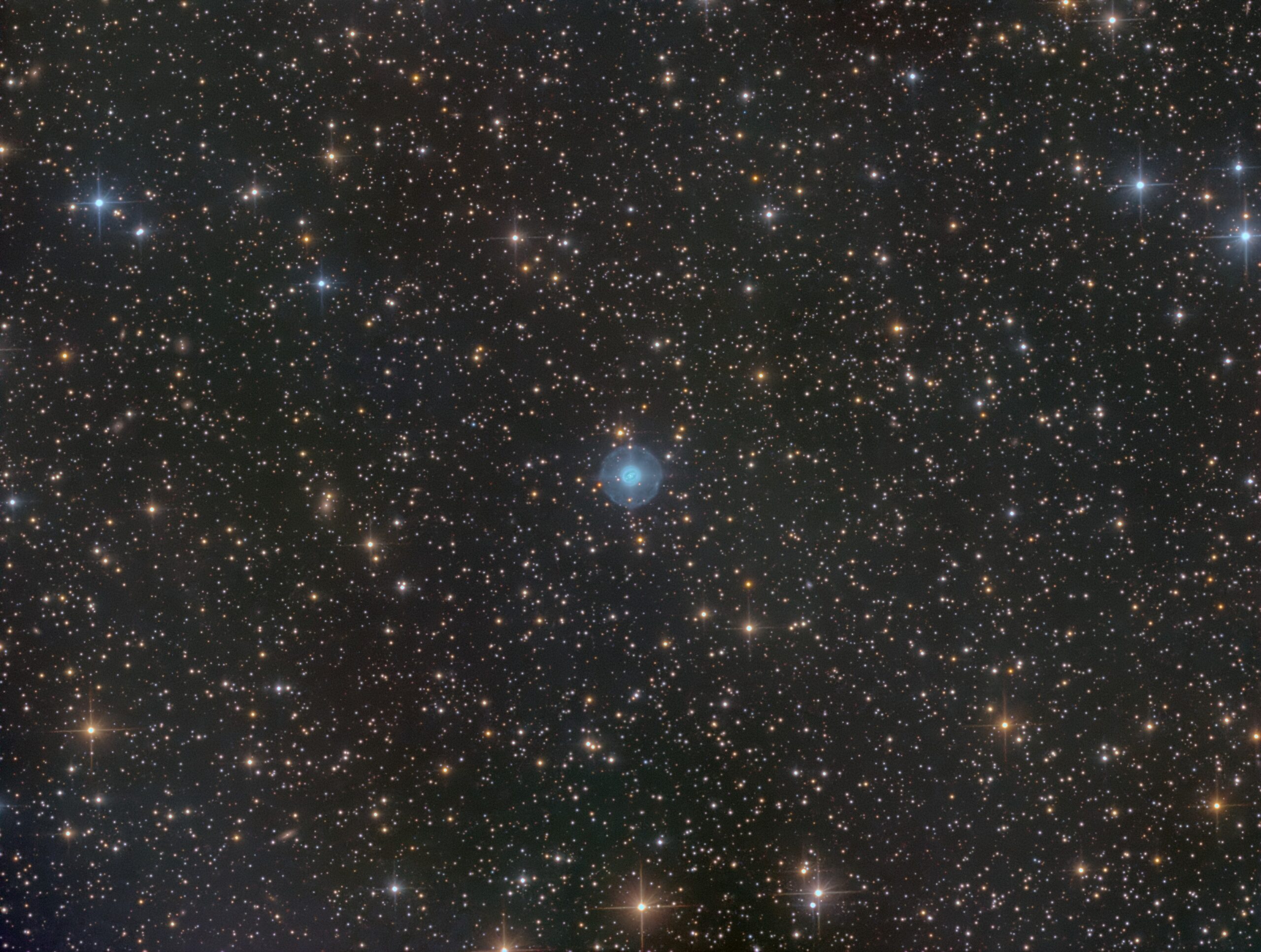
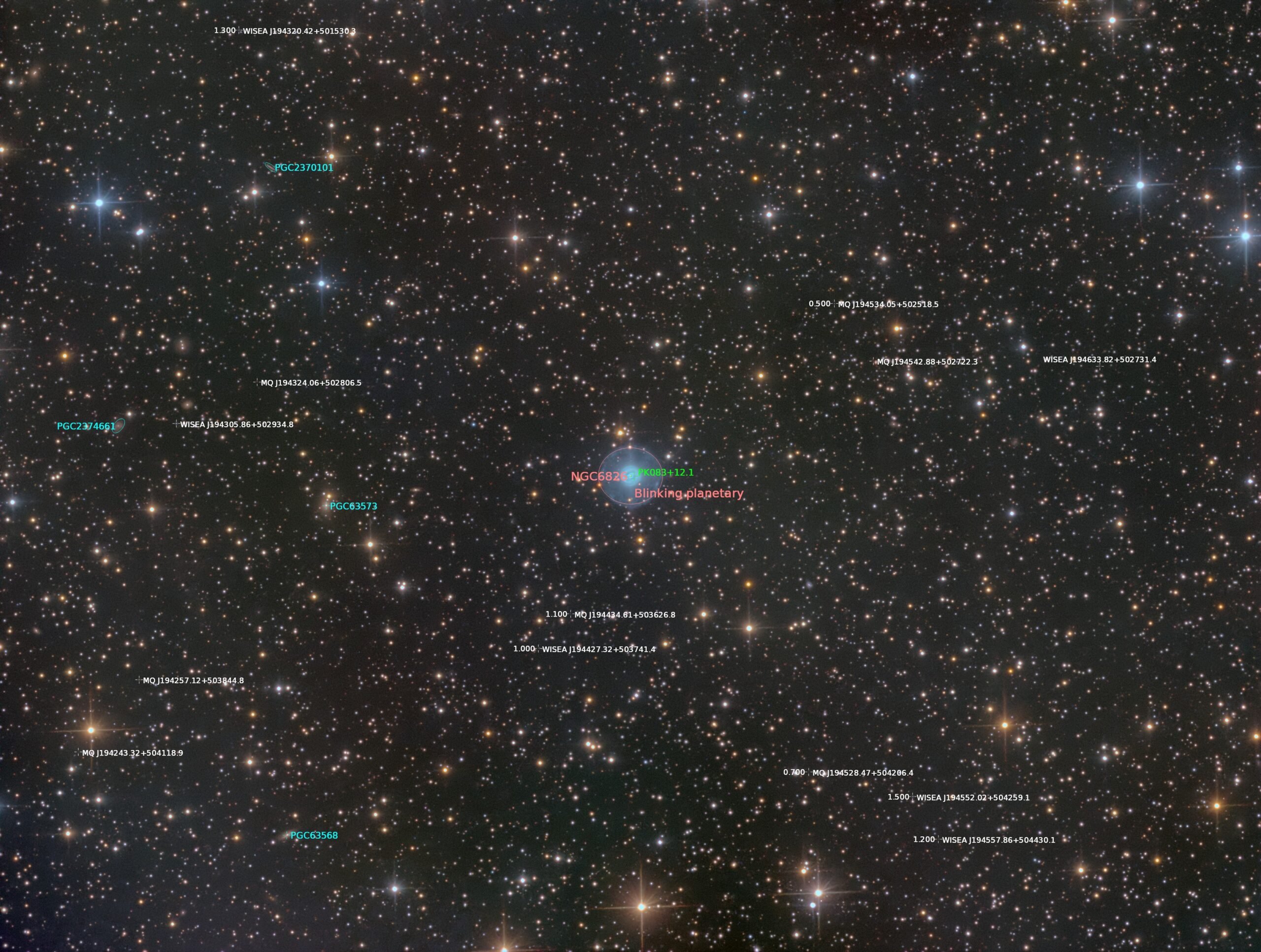
The images were taken with the following eqipment:
- Date: 2013
- Location: Krefeld
- Telescope: 8″ GSO Newton
- Focal length [mm]: 920 with Comacorrector
- Focal ratio: 4.6
- Mount: Losmandy G11
- Camera: Moravian 8300FW
- Filter: R:G:B:Hα:[OIII]
- Exposure time [min]: 75:70:55:180:180
- Resolution: 0.81″/px



Leave a reply