• Home
  • Blog
  • Astrophotography
    • Deep Sky
      • Galaxies (Galaxien)
      • Nebulae (Nebel)
      • Planetary Nebulae (Planetarische Nebel)
      • Globular Clusters (Kugelsternhaufen)
      • Open Clusters (Offene Sternhaufen)
      • Miscellaneous (Verschiedenes)
    • Solar System (Sonnensystem)
      • Comets (Kometen)
      • Moon (Mond)
      • Planets (Planeten)
      • Sun (Sonne)
  • Archiv

    • Juli 2026
    • Juni 2026
    • Mai 2026
    • April 2026
    • Dezember 2025
    • November 2025
    • Oktober 2025
    • September 2025
    • August 2025
    • Juli 2025
    • Juni 2025
    • Mai 2025
    • April 2025
    • März 2025
    • Januar 2025
    • Dezember 2024
    • November 2024
    • Oktober 2024
    • September 2024
    • Juli 2024
    • Juni 2024
    • Mai 2024
    • April 2024
    • März 2024
    • Februar 2024
    • Januar 2024
    • November 2023
    • Oktober 2023
    • September 2023
    • August 2023
    • Juli 2023
    • Juni 2023
    • Mai 2023
    • April 2023
    • März 2023
    • Februar 2023
    • Januar 2023
    • Dezember 2022
    • November 2022
    • Oktober 2022
    • September 2022
    • August 2022
    • Juni 2022
    • Mai 2022
    • April 2022
    • März 2022
    • Februar 2022
    • Januar 2022
    • Dezember 2021
    • November 2021
    • September 2021
    • August 2021
    • Juli 2021
    • März 2021
    • Februar 2021
    • November 2020
    • September 2020
    • August 2020
    • April 2020
    • März 2020
    • Februar 2020
    • Januar 2020
    • Dezember 2019
    • November 2019
    • Oktober 2019
    • September 2019
    • August 2019
    • Mai 2019
    • April 2019
    • März 2019
    • Dezember 2018
    • November 2018
    • September 2018
    • Juni 2018
    • Mai 2018
    • April 2018
    • März 2018
    • Februar 2018
    • Januar 2018
    • Oktober 2017
    • Juli 2017
    • Juni 2017
    • Januar 2017
    • September 2016
    • Mai 2016
    • März 2016
    • November 2015
    • Oktober 2015
    • September 2015
    • Mai 2015
    • März 2015
    • Februar 2015
    • September 2014
    • August 2014
    • März 2014
    • Februar 2014
    • Oktober 2013
    • September 2013
    • August 2013
    • April 2013
    • März 2013
    • November 2012
    • August 2012
    • Juli 2012
    • Mai 2012
    • März 2012
    • Januar 2012
    • November 2011
    • Oktober 2011
    • September 2011
    • August 2011
    • April 2011
    • März 2011
    • Oktober 2010
    • September 2010
    • August 2010
    • Juli 2010
    • April 2010
    • Juli 2009
    • Juli 2008
    • Januar 2008
    • Oktober 2007
    • Juli 2007
    • Februar 2007
    • Juni 2006
    • Oktober 2005
    • September 2005
    • August 2005
    • Januar 2005
  • Kategorien

    • Asterism
    • Astrophotography
    • Barnard
    • Comet
    • Galaxies
    • Globular Cluster
    • IC
    • Messier
    • Moon
    • Nebula
    • NGC
    • Open cluster
    • Photography
    • Planetary Nebula
    • Travel
  • Meta

    • Anmelden
    • Eintrags-Feed
    • Kommentar-Feed
    • WordPress.org
  • Privacy Policy
  • Impressum
  • Haftungsausschluss
  • Cookie-Richtlinie
  • Datenschutzerklärung

wonderfuluniverse.de
  • Home
  • Blog
  • Astrophotography
    • Deep Sky
      • Galaxies (Galaxien)
      • Nebulae (Nebel)
      • Planetary Nebulae (Planetarische Nebel)
      • Globular Clusters (Kugelsternhaufen)
      • Open Clusters (Offene Sternhaufen)
      • Miscellaneous (Verschiedenes)
    • Solar System (Sonnensystem)
      • Comets (Kometen)
      • Moon (Mond)
      • Planets (Planeten)
      • Sun (Sonne)

NGC 6822


In 2015, during a stay at the astrofarm Tivoli in Namibia, I imaged the fascinating dwarf galaxy NGC 6822 using the equipment of a rented observatory. The exceptionally dark and transparent skies of Namibia provided ideal conditions for recording this large but faint member of the Local Group. Long exposures revealed not only the galaxy’s irregular structure but also numerous bright star-forming regions scattered throughout its disk. Imaging Barnard’s Galaxy from the Southern Hemisphere was particularly rewarding, as the object culminates much higher in the sky than it does from central Europe.

NGC 6822, better known as Barnard’s Galaxy, is located in the constellation Sagittarius at a distance of approximately 1.6 million light-years. It was discovered in 1884 by the American astronomer Edward Emerson Barnard and was the first galaxy identified beyond the Magellanic Clouds that was later recognized as lying outside the Milky Way. Today it is known to be one of the nearest members of the Local Group, the collection of galaxies that includes the Milky Way, Andromeda Galaxy, and the Triangulum Galaxy.

Barnard’s Galaxy is classified as a barred irregular dwarf galaxy. Unlike the elegant spiral structure of galaxies such as the Milky Way, NGC 6822 exhibits a chaotic appearance with no clearly defined spiral arms. Instead, it consists of an irregular distribution of stars, gas, and dust interspersed with numerous active star-forming regions. This irregular morphology is typical of dwarf galaxies, which are strongly influenced by internal stellar feedback and, in some cases, interactions with neighboring galaxies.

One of the most remarkable features of NGC 6822 is its abundance of H II regions, where newly formed massive stars ionize the surrounding hydrogen gas. Several of these nebulae are bright enough to be catalogued individually, including Hubble V and Hubble X, among the largest and brightest star-forming regions in the Local Group. These glowing nebulae stand out prominently in deep images and demonstrate that Barnard’s Galaxy continues to actively form new generations of stars.

The galaxy is also rich in neutral hydrogen, extending well beyond its visible stellar component. Radio observations have shown that its hydrogen envelope is significantly larger than the optical galaxy itself, providing an abundant reservoir of material for future star formation. Numerous Cepheid variable stars within NGC 6822 have played an important role in establishing the cosmic distance scale, making the galaxy historically significant for measurements of extragalactic distances.

From a scientific perspective, Barnard’s Galaxy serves as an important laboratory for studying the evolution of dwarf galaxies. Because of its proximity, astronomers can resolve individual stars and investigate their ages, chemical compositions, and motions in great detail. These studies provide valuable insight into how small galaxies evolve and how they contribute to the formation and growth of larger galaxies such as the Milky Way.

The image obtained in 2015 captures both the delicate stellar body of Barnard’s Galaxy and its bright star-forming regions against the rich background of the Sagittarius Milky Way. Thanks to the exceptional observing conditions at Tivoli and the capabilities of the rented observatory, the final image reveals one of the nearest galactic neighbors of the Milky Way—a fascinating dwarf galaxy that continues to provide astronomers with important clues about galaxy evolution within the Local Group.

The data calibration and registration, as well as the final image processing, were all done with PixInsight.
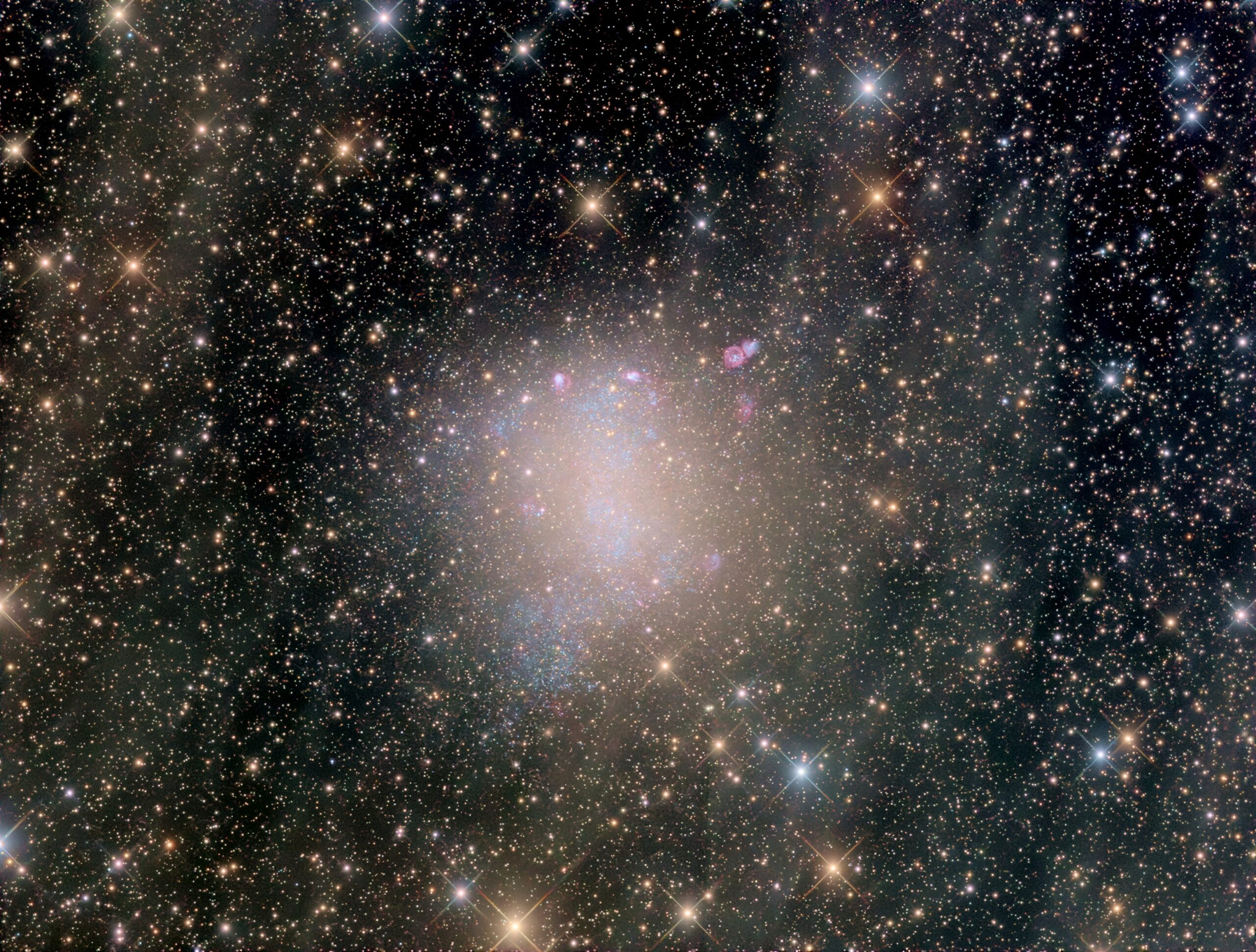
NGC 6822, Tivoli, Namibia, 2015
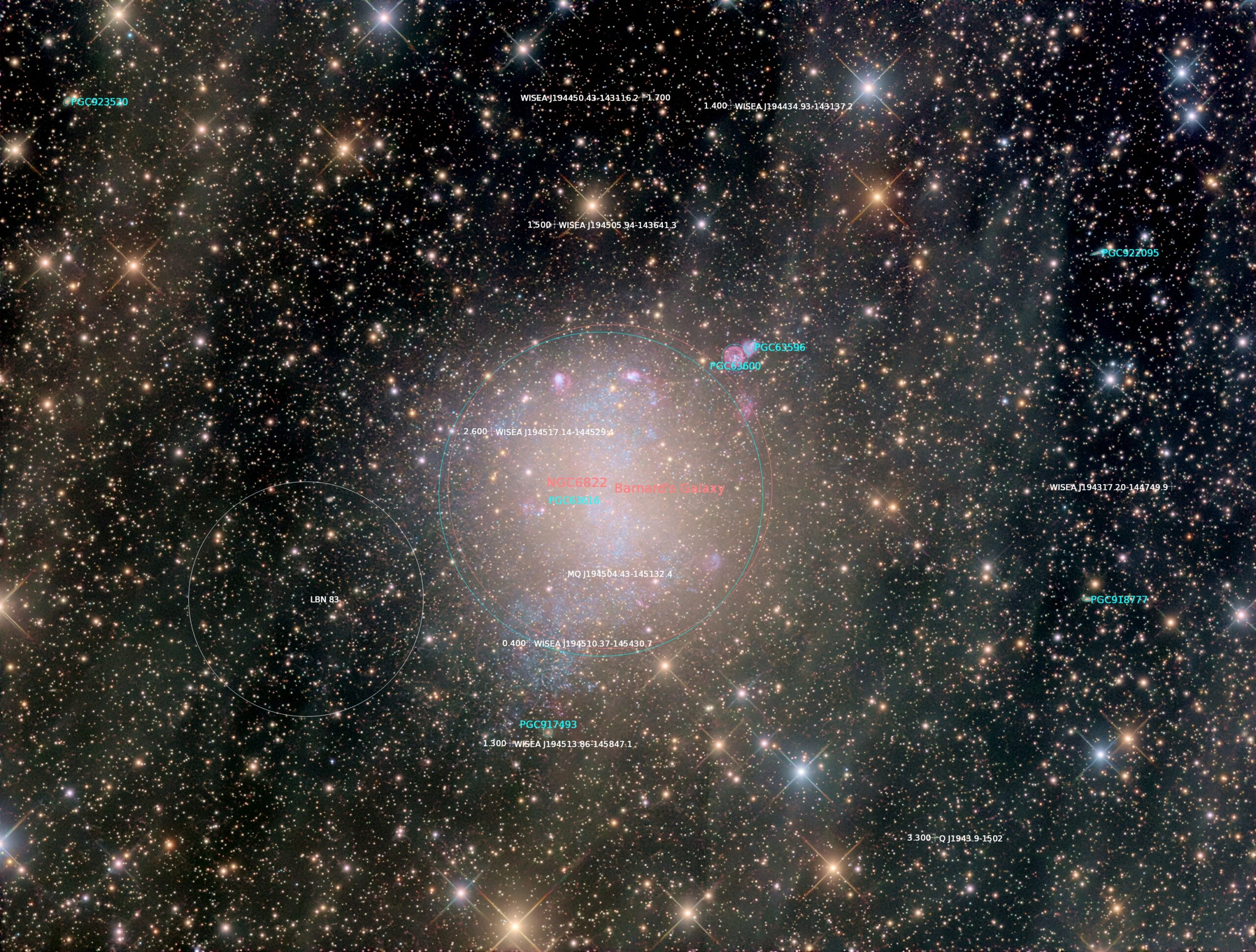
NGC 6822 annotated
NGC 6822 annotated

The field is also rich in distant background objects. Careful annotation revealed numerous background galaxies as well as several quasars.


The images were taken with the following equipment:

  • Date: 2015
  • Location: Tivoli, Namibia
  • Telescope/Lens: 12″ ASA Astrograph
  • Focal length [mm]: 1076
  • Focal ratio: 3.6
  • Mount: ASA DDM85
  • Camera: FLI Microline ML8300
  • Filter: R:G:B
  • Exposure time [min]: 120:120:120
  • Resolution: 1.04″/px


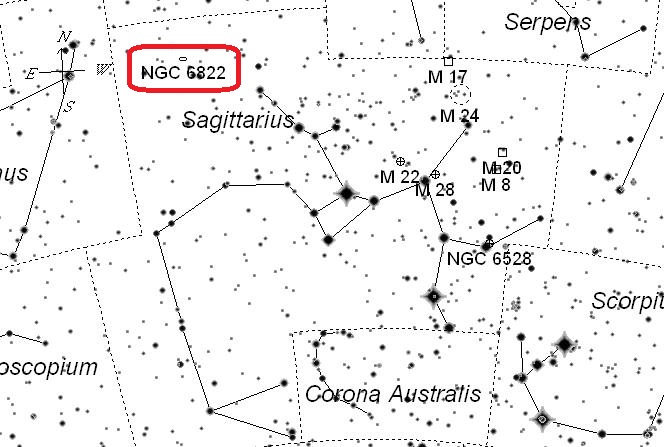
NGC 6822 Finding Chart


Stephan Küppers


You might also like
IC 1318
15. Juli 2026
NGC 7000 with IC 5070
24. Juni 2026
NGC 7023 (Iris Nebula) and LBN 468
25. Mai 2026

Leave a reply

Schreibe einen Kommentar Antwort abbrechen

Deine E-Mail-Adresse wird nicht veröffentlicht. Erforderliche Felder sind mit * markiert


© Stephan Küppers 2020-2022

Cookie-Zustimmung verwalten
Wir verwenden Cookies, um unsere Website und unseren Service zu optimieren.
Funktional Immer aktiv
Die technische Speicherung oder der Zugang ist unbedingt erforderlich für den rechtmäßigen Zweck, die Nutzung eines bestimmten Dienstes zu ermöglichen, der vom Teilnehmer oder Nutzer ausdrücklich gewünscht wird, oder für den alleinigen Zweck, die Übertragung einer Nachricht über ein elektronisches Kommunikationsnetz durchzuführen.
Vorlieben
Die technische Speicherung oder der Zugriff ist für den rechtmäßigen Zweck der Speicherung von Präferenzen erforderlich, die nicht vom Abonnenten oder Benutzer angefordert wurden.
Statistiken
Die technische Speicherung oder der Zugriff, der ausschließlich zu statistischen Zwecken erfolgt. Die technische Speicherung oder der Zugriff, der ausschließlich zu anonymen statistischen Zwecken verwendet wird. Ohne eine Vorladung, die freiwillige Zustimmung deines Internetdienstanbieters oder zusätzliche Aufzeichnungen von Dritten können die zu diesem Zweck gespeicherten oder abgerufenen Informationen allein in der Regel nicht dazu verwendet werden, dich zu identifizieren.
Marketing
Die technische Speicherung oder der Zugriff ist erforderlich, um Nutzerprofile zu erstellen, um Werbung zu versenden oder um den Nutzer auf einer Website oder über mehrere Websites hinweg zu ähnlichen Marketingzwecken zu verfolgen.
  • Optionen verwalten
  • Dienste verwalten
  • Verwalten von {vendor_count}-Lieferanten
  • Lese mehr über diese Zwecke
Einstellungen anzeigen
  • {title}
  • {title}
  • {title}