

NGC 6781
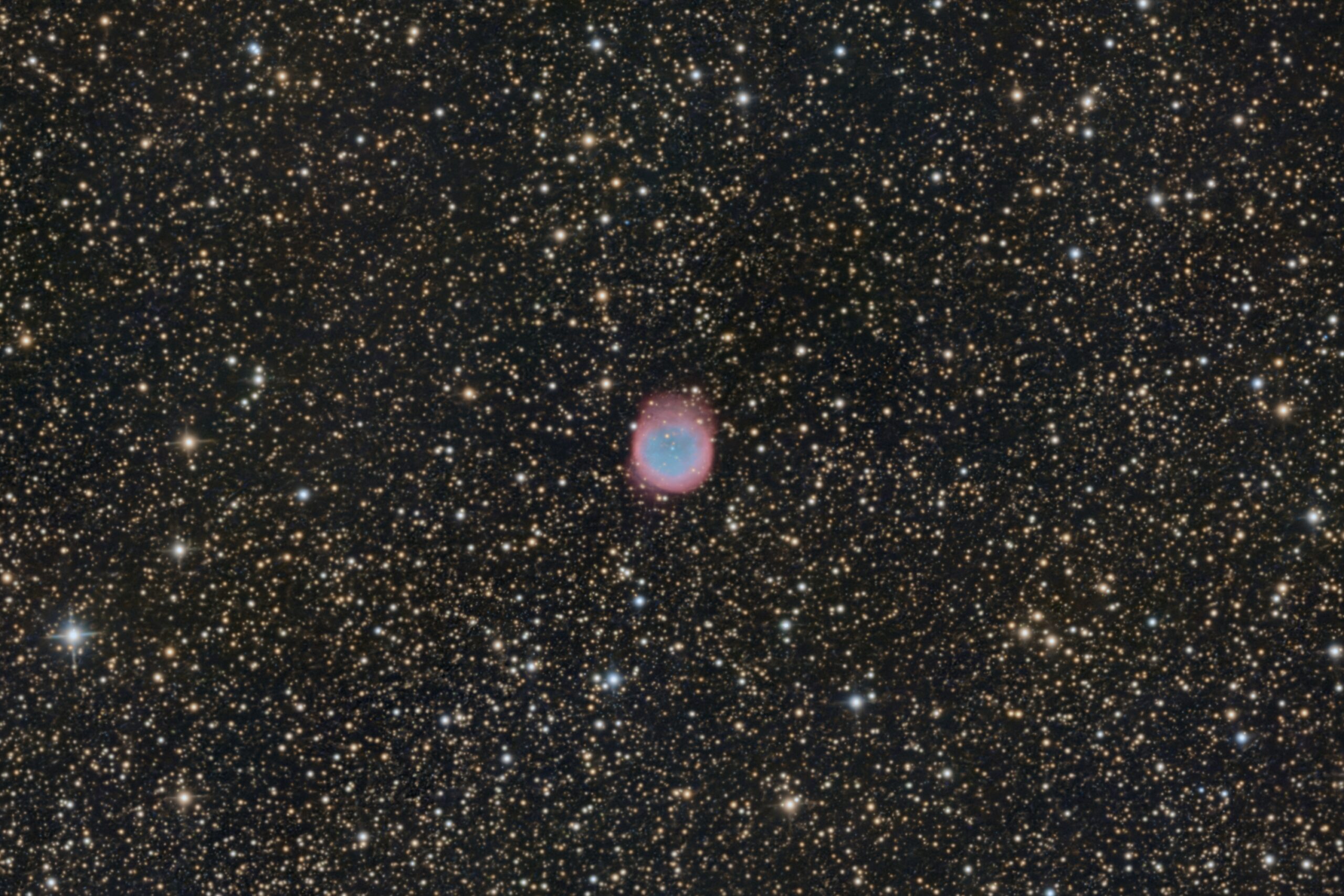
In 2011, during a stay in Banon, I imaged the beautiful planetary nebula NGC 6781 using my DSLR equipment. The dark skies of Haute-Provence provided excellent conditions for capturing this large and relatively faint planetary nebula. Even with a DSLR camera, the long exposures revealed its characteristic ring-like structure together with the rich star field of the summer Milky Way.
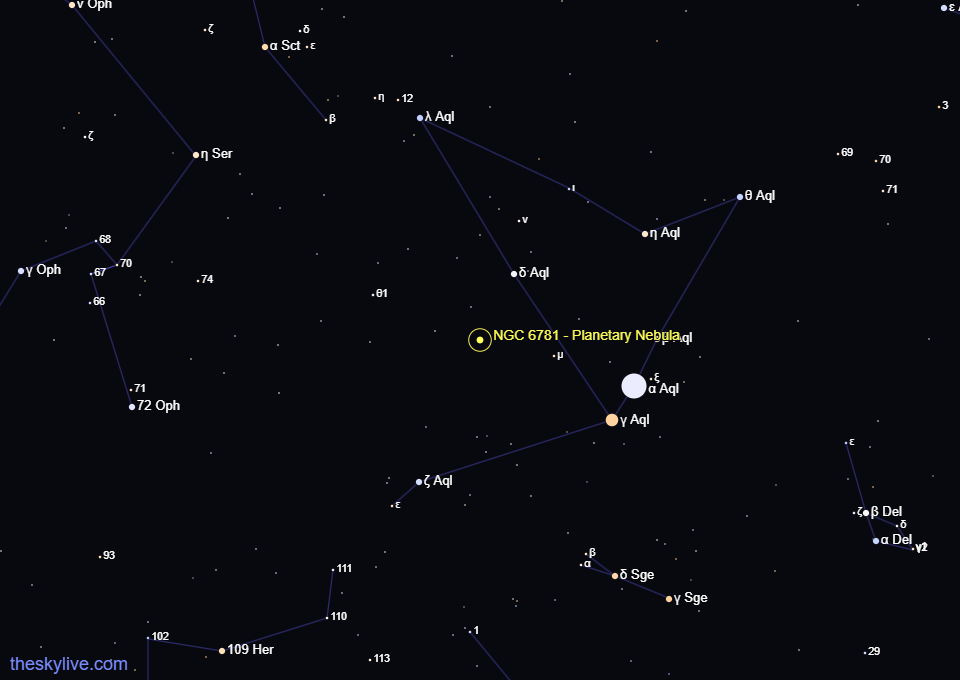
NGC 6781 is located in the constellation Aquila at a distance of approximately 2,500 light-years. Although it appears as a nearly circular ring in optical images, modern observations have shown that the nebula is actually a bipolar planetary nebula viewed almost along its symmetry axis. This orientation creates the illusion of a simple ring while concealing its true three-dimensional structure.
Like all planetary nebulae, NGC 6781 represents the final evolutionary stage of a Sun-like star. After exhausting its nuclear fuel, the progenitor star expelled its outer layers into space, leaving behind a hot white dwarf whose intense ultraviolet radiation ionizes the surrounding gas. The nebula shines predominantly in the emission lines of Hα, [O III], and [N II], producing the striking red and blue-green colors commonly seen in deep astrophotographs.
One of the most remarkable characteristics of NGC 6781 is its extensive network of dark dust filaments embedded within the bright gaseous shell. These dust structures divide the glowing nebula into numerous intricate arcs and knots, giving it a highly textured appearance. Infrared observations have also revealed significant amounts of molecular hydrogen and dust, making NGC 6781 one of the richest planetary nebulae in molecular material. These observations provide important clues about the mass-loss processes that occur during the final stages of stellar evolution.
Because of its relatively large apparent size and well-defined structure, NGC 6781 has become an important target for both professional astronomers and amateur astrophotographers. It has been studied extensively across the electromagnetic spectrum, from radio wavelengths to infrared and X-rays, helping astronomers understand how planetary nebulae evolve and enrich the interstellar medium with heavy elements.
The image obtained in 2011 captures the delicate ring structure, subtle dust features, and rich stellar background that make NGC 6781 one of the most attractive planetary nebulae in the northern sky. It remains a rewarding target whose combination of beauty and scientific significance continues to fascinate both observers and researchers alike.
Data calibration and registration was done with DeepSkyStacker and the final processing was done with PixInsight. The result was as follows:
The images were taken with the following equipment:
- Date: 2011
- Location: Banon
- Telescope: TS 10″ Newton
- Focal length [mm]: 1140
- Focal ratio: 4.5
- Mount: Skywatcher NEQ6 Synscan
- Camera: Canon 500Da
- Filter: OSC
- Exposure time [min]: 90
- Resolution: 0.64″/px (1.5 Drizzle)



Leave a reply