

NGC 6559
From time to time, I obtain datasets from remote observatories around the world. One of my favorite providers is Telescope Live, which operates telescopes in locations such as Chile, Australia, and Spain. One of the datasets I received in 2022 featured the beautiful emission and reflection nebula NGC 6559, acquired with a telescope in Chile.
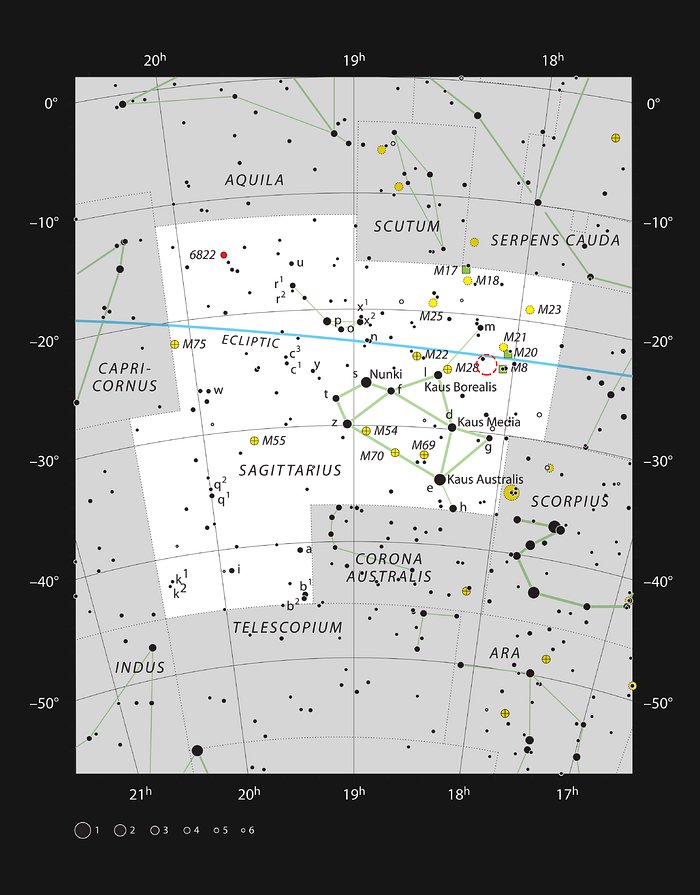
NGC 6559 is located in the constellation Sagittarius, approximately 5,000 light-years from Earth, on the edge of the rich star fields surrounding the Galactic Center. It is part of a vast complex of gas and dust associated with the giant molecular clouds of the Sagittarius spiral arm, making it one of the Milky Way’s most active regions of ongoing star formation.
Unlike many nebulae that are dominated by a single emission process, NGC 6559 is particularly fascinating because it combines several different types of interstellar objects within a relatively small area. Bright H II regions glow red as ultraviolet radiation from newly formed massive stars ionizes the surrounding hydrogen gas. Adjacent to these emission regions are delicate blue reflection nebulae, where starlight is scattered by fine dust particles. Dark molecular clouds and intricate dust lanes weave between these bright structures, creating a spectacular contrast of light and shadow.
Embedded within the nebula are numerous young stellar objects, protostars, and compact Bok globules—dense clouds of gas and dust that may eventually collapse to form new stars. Powerful stellar winds and radiation from the young stars continue to sculpt the surrounding material, producing bright ionization fronts, curved shock fronts, and intricate filamentary structures that make NGC 6559 a particularly rewarding target for deep astrophotography.
The nebula lies only a few degrees from the famous Lagoon Nebula and Trifid Nebula, forming part of one of the richest star-forming regions in the entire sky. Together, these nebulae illustrate the various stages of stellar birth and the complex interaction between young stars and the interstellar medium.
From a scientific perspective, NGC 6559 serves as an excellent laboratory for studying the earliest phases of star formation. Its combination of ionized gas, reflection nebulae, dense molecular clouds, and newly formed stars provides astronomers with valuable insight into the processes that govern the birth and evolution of stars within giant molecular clouds.
The high-quality Telescope Live dataset from Chile beautifully captures the subtle interplay between glowing hydrogen clouds, blue reflection nebulae, and dark dust lanes. The excellent image quality and dark southern skies reveal the intricate structures of this often-overlooked object, making NGC 6559 one of the hidden gems of the Sagittarius Milky Way.
Data calibration and registration and the final processing was done with PixInsight. The result was as follows:

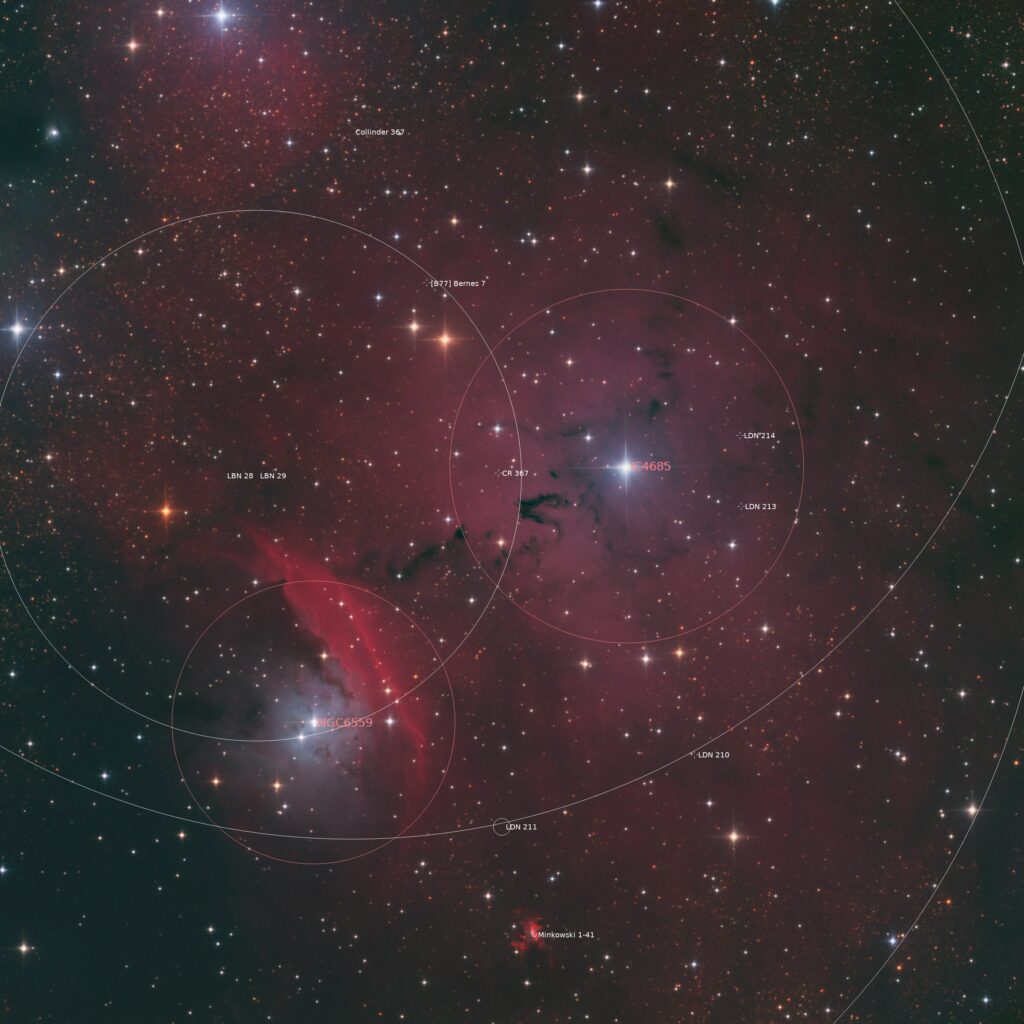
NGC 6559 annotated
The images were taken with the following equipment (Telescope Live CHI-1):
- Date: 2022
- Location: El Sauce Observatory, Chile
- Telescope/Lens: Planwave CDK24
- Focal length [mm]: 3900
- Focal ratio: 6.5
- Mount: Mathis MI-1000/1250
- Camera: FLI Proline 9000
- Filter: Hα:R:G:B
- Exposure time [min]: 280:280:260:260
- Resolution: 0.62″/px



Leave a reply