

NGC 6302
In 2017, during a stay at the Tivoli astrofarm in Namibia, I imaged the spectacular planetary nebula NGC 6302 using the equipment of a rented observatory. The exceptionally dark skies and excellent seeing conditions of the Namibian highlands provided an ideal opportunity to capture one of the most complex and fascinating planetary nebulae in the southern sky. The combination of modern instrumentation and pristine observing conditions revealed an extraordinary wealth of fine filaments, dust structures, and emission regions.
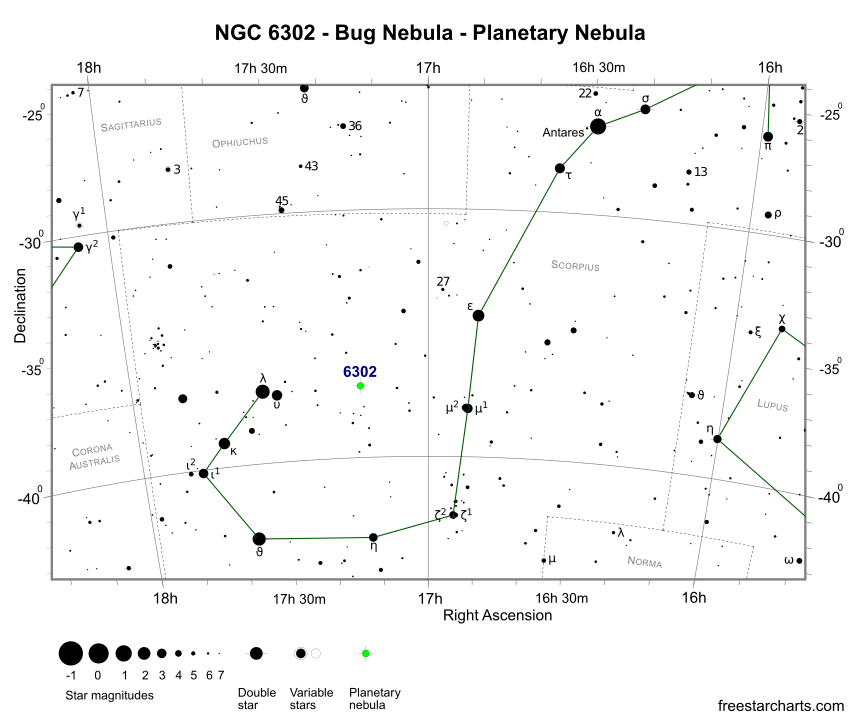
NGC 6302 is located in the constellation Scorpius at a distance of approximately 3,400 light-years. Better known as the Butterfly Nebula, it is one of the most spectacular bipolar planetary nebulae in the Milky Way. Its characteristic appearance is dominated by two enormous lobes of glowing gas extending outward from a dense, dusty central region, giving the nebula the appearance of a butterfly with outstretched wings.
Despite its name, a planetary nebula has nothing to do with planets. It represents one of the final evolutionary stages of a Sun-like star. After exhausting its nuclear fuel, the star expelled its outer layers into space while its hot stellar core remained behind as a white dwarf. The intense ultraviolet radiation from this remnant ionizes the expanding gas, causing it to emit brightly in lines such as Hα, [O III], and [N II].
NGC 6302 is particularly remarkable because its central star is among the hottest known white dwarfs, with an estimated surface temperature exceeding 200,000 Kelvin. The star itself is hidden behind a dense equatorial disk of dust, making it difficult to observe directly in visible light. This dusty torus is thought to have played a major role in shaping the nebula’s spectacular bipolar morphology by collimating the outflowing gas into two opposing lobes.
Deep images reveal an intricate network of filaments, knots, and shock fronts created by multiple episodes of mass loss during the star’s final stages of evolution. The nebula also contains large quantities of molecular gas and dust enriched with heavy elements synthesized inside the progenitor star. These materials will eventually become part of the interstellar medium, contributing to future generations of stars and planetary systems.
From a scientific perspective, NGC 6302 is one of the best-studied planetary nebulae in the sky. Its extreme central star, complex internal structure, and rich emission spectrum make it an important laboratory for investigating the late stages of stellar evolution, the formation of bipolar nebulae, and the chemical enrichment of the Galaxy.
The image obtained in 2017 captures the extraordinary complexity and vivid structure of the Butterfly Nebula. Thanks to the superb observing conditions at Tivoli and the capabilities of the rented observatory equipment, the final result reveals the delicate filaments, intricate dust lanes, and glowing bipolar lobes that make NGC 6302 one of the most beautiful and scientifically significant planetary nebulae in the southern hemisphere.
The data the calibration and registration and the final processing was done with PixInsight. The result was as follows:
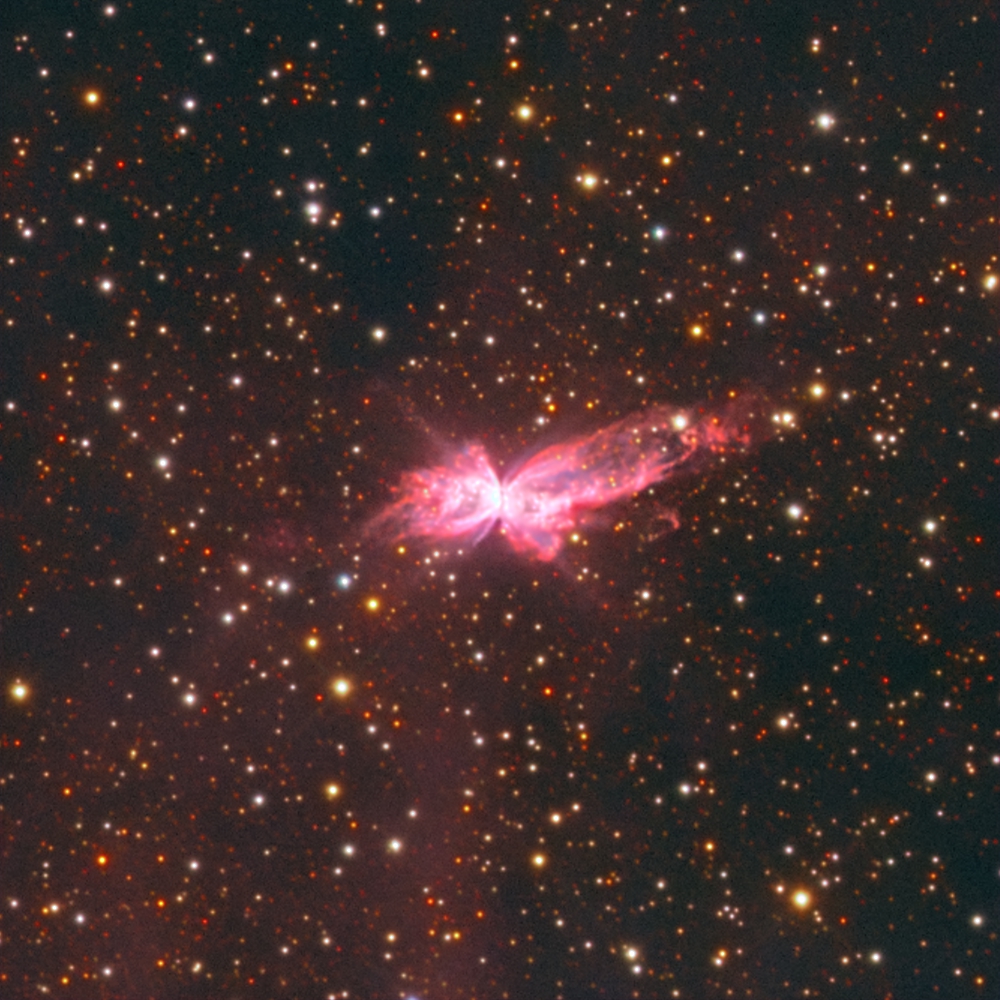

The images were taken with the following equipment:
- Date: 2017
- Location: Tivoli, Namibia
- Telescope/Lens: ASA 12″ Astrograph
- Focal length [mm]: 1078
- Focal ratio: 3.6
- Mount: ASA DDM85
- Camera: FLI ML 16200
- Filter: Hα:R:G:B
- Exposure time [min]: 120:60:60:60
- Resolution: 1.14″/px



Leave a reply