

NGC 6231
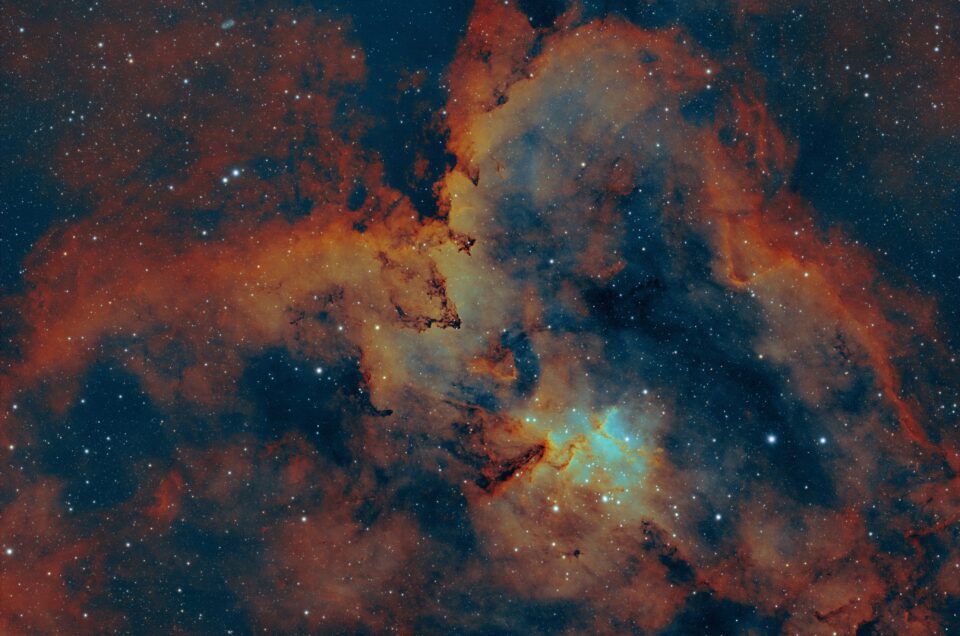
In 2006, during a stay at the Tivoli Astrofarm in Namibia, I imaged the magnificent open cluster NGC 6231 using my DSLR equipment. The exceptionally dark skies and excellent transparency of the Namibian winter provided ideal conditions for capturing this spectacular southern star cluster. Even with relatively modest equipment, the rich stellar population and surrounding Milky Way star field were recorded with impressive depth and color.
NGC 6231 is located in the constellation Scorpius at a distance of approximately 5,200 light-years. It is one of the youngest and most massive open clusters in the Milky Way, with an estimated age of only 3–7 million years. The cluster contains well over a hundred confirmed member stars, many of them hot, luminous O- and B-type stars that dominate its brilliant blue appearance.
Often referred to as the Northern Jewel Box, NGC 6231 serves as the core of the larger Scorpius OB1 stellar association. This vast grouping of massive young stars extends over several degrees of the sky and represents one of the Galaxy’s most active regions of recent star formation. The intense ultraviolet radiation emitted by these young stars has profoundly influenced the surrounding interstellar medium, ionizing nearby gas clouds and helping to shape the surrounding nebulae.
Among the cluster’s stellar population are numerous massive binary systems, variable stars, and several stars that are expected to end their lives as supernovae within only a few million years. These massive stars enrich the interstellar medium with heavy elements through their powerful stellar winds and, eventually, through supernova explosions. Consequently, NGC 6231 provides astronomers with an important laboratory for studying the earliest stages of stellar evolution and the formation of massive stars.
The cluster is embedded in one of the richest regions of the southern Milky Way. Wide-field images reveal countless foreground and background stars, dark interstellar dust clouds, and neighboring emission nebulae, creating a spectacular celestial landscape. The combination of the bright blue cluster members and the densely populated Milky Way background makes NGC 6231 one of the most attractive open clusters in the southern hemisphere.
The image obtained during my 2006 stay in Namibia captures both the beauty and the scientific significance of this remarkable object. It documents one of the Milky Way’s youngest massive star clusters under some of the finest observing conditions on Earth and remains one of the highlights of my early astrophotography trips to the southern skies.
The data calibration and registration were done using DeepSkyStacker, while the final image processing was performed in PixInsight.


The images were taken with the following equipment:
- Location: Tivoli, Namibia
- Telescope: Rubinar lens
- Focal length [mm]: 500
- Focal ratio: 5.6
- Mount: Vixen Atlux
- Camera: Canon 300 Da
- Filter: OSC
- Exposure time [min]: 17
- Resolution: 4.84″/px




Leave a reply