

NGC 5139 (Omega Centauri)
I imaged NGC 5139 three times over the years, documenting both my progress in astrophotography and the advances in imaging technology. My first image was taken in 2005 during a stay at the astrofarm Hakos in Namibia, using my DSLR equipment. Even with relatively simple gear, the exceptionally dark southern skies allowed the galaxy’s unusual appearance to be recorded. In 2006, during another visit to the astrofarm Tivoli in Namibia, I revisited the object with the same DSLR setup but accumulated a significantly longer total exposure time, revealing more of the galaxy’s faint outer structure and the surrounding star field.
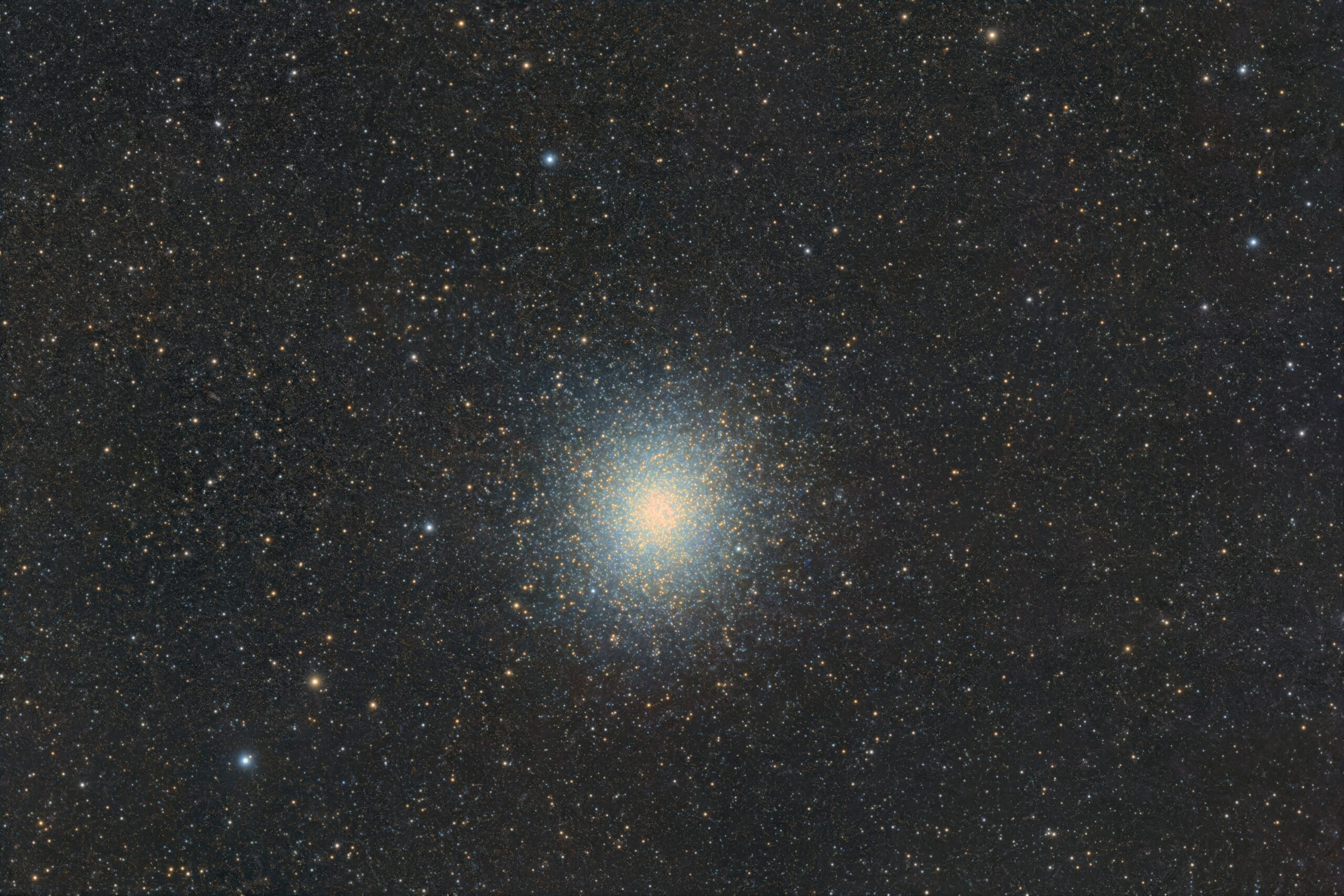
The most recent image was created from a wide-field dataset obtained through Telescope Live in 2023, acquired with professional equipment in Australia. The modern dataset provided excellent resolution and depth while also placing the cluster within its broader celestial environment. Comparing the three images offers an interesting perspective on both the evolution of imaging technology and the timeless beauty of one of the most remarkable objects in the southern sky.
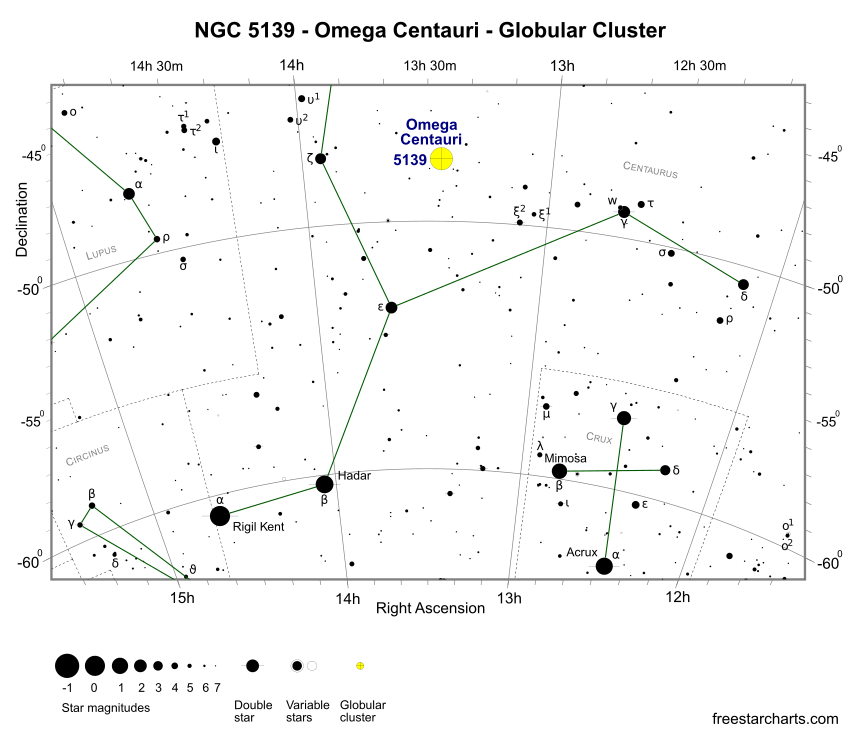
NGC 5139 is far better known as Omega Centauri, the largest and brightest globular cluster associated with the Milky Way. Located in the constellation Centaurus, it lies at a distance of approximately 16,000 light-years and contains an estimated ten million stars. With a diameter of roughly 150 light-years, Omega Centauri is by far the most massive globular cluster in our galaxy and is visible to the naked eye from southern latitudes.
Unlike most globular clusters, Omega Centauri displays an unusually complex stellar population. Detailed studies have revealed multiple generations of stars with different chemical compositions and ages. This diversity has led many astronomers to believe that Omega Centauri may not be a true globular cluster at all, but rather the remnant core of a dwarf galaxy that was captured and stripped apart by the Milky Way billions of years ago. If this hypothesis is correct, the cluster represents the surviving nucleus of an entire galaxy whose outer stars were gradually absorbed into the Milky Way halo.
The cluster is also home to numerous variable stars, X-ray sources, and exotic stellar systems formed through close stellar encounters in its dense core. Its immense mass and high stellar density make it an important laboratory for studying stellar evolution, stellar dynamics, and the formation history of the Milky Way itself. Some studies have even suggested the possible presence of an intermediate-mass black hole near its center, although this remains a topic of ongoing research.
Deep images reveal an extraordinary concentration of stars that gradually becomes less dense toward the outer halo. The wide-field Telescope Live dataset beautifully captures both the dense core and the extensive outer regions of the cluster, while the earlier DSLR images from Namibia showcase what can be achieved under truly dark southern skies.
The images from 2005, 2006, and 2023 together document not only one of the most spectacular globular clusters in the sky but also nearly two decades of astrophotographic development, from early DSLR imaging in Namibia to modern professional datasets obtained through remote observatories.
For the Telescope Live data the calibration and registration and the final processing was done with PixInsight. The result was as follows:


The images were taken with the following equipment (AUS-2 CCD, Telescope Live):
- Date: 2024
- Location: Heaven’s Mirror Observatory, Australia
- Telescope/Lens: Takahashi FSQ-106ED
- Focal length [mm]: 390
- Focal ratio: 3.6
- Mount: Paramount MX+
- Camera: QHY 600M Pro
- Filter: L:R:G:B
- Exposure time [min]: 125:110:95:115
- Resolution: 1.46″/px
For the 2006 data the calibration and registration was done with DeepSkyStacker and the final processing was done with PixInsight. The result was as follows:

- Date: 2006
- Location: Tivoli, Namibia
- Telescope/Lens: Rubinar lens
- Focal length [mm]: 500
- Focal ratio:5.6
- Mount: Vixen Atlux
- Camera:Canon 300Da
- Filter: OSC
- Exposure time [min]: 24
- Resolution: 3.18″/px
For the 2005 data the calibration and registration was done with DeepSkyStacker and the final processing was done with PixInsight. The result was as follows:
- Date: 2005
- Location: Hakos, Namibia
- Telescope/Lens: Rubinar lens
- Focal length [mm]: 500
- Focal ratio: 5.6
- Mount: Liebscher
- Camera:Canon 300Da
- Filter: OSC
- Exposure time [min]: 8
- Resolution: 2.7″/px



Leave a reply