

NGC 5128 (Centaurus A)
I imaged NGC 5128 three times over the years, documenting both my progress in astrophotography and the advances in imaging technology. My first image was taken in 2005 during a stay at the astrofarm Hakos in Namibia, using my DSLR equipment. Even with relatively simple gear, the exceptionally dark southern skies allowed the galaxy’s unusual appearance to be recorded. In 2008, during another visit to the astrofarm Tivoli in Namibia, I revisited the object with the same DSLR setup but accumulated a significantly longer total exposure time, revealing more of the galaxy’s faint outer structure and the surrounding star field.
The most recent image was created from a wide-field dataset obtained through Telescope Live in 2024, acquired with professional equipment in Australia. The wider field of view not only captured the galaxy itself in exquisite detail but also revealed its rich surroundings, including numerous foreground stars and faint background galaxies. Comparing the three images provides an interesting look at how both equipment and processing techniques have evolved over nearly two decades.
NGC 5128, better known as Centaurus A, is located in the constellation Centaurus at a distance of approximately 12 million light-years. It is one of the nearest and most extensively studied active galaxies in the sky. At first glance, Centaurus A appears highly unusual, consisting of a giant elliptical galaxy crossed by a broad and prominent dark dust lane. This striking appearance is believed to be the result of a merger between a large elliptical galaxy and a smaller spiral galaxy that occurred hundreds of millions of years ago.
The galaxy hosts an extremely active nucleus powered by a supermassive black hole containing tens of millions of solar masses. Material falling toward the black hole generates enormous amounts of energy across the electromagnetic spectrum, from radio waves to gamma rays. Centaurus A is one of the strongest radio sources in the sky, producing gigantic jets of energetic particles that extend hundreds of thousands of light-years into intergalactic space. These jets interact with the surrounding environment and provide astronomers with a unique opportunity to study the physics of active galactic nuclei.
Deep optical images reveal that the prominent dust lane contains large quantities of gas and dust along with numerous regions of ongoing star formation. The merger that created the galaxy has left behind shells, streams, and other faint structures that can be detected in long-exposure photographs. These features provide valuable clues about the galaxy’s complex evolutionary history.
Because of its proximity, brightness, and extraordinary structure, Centaurus A is considered one of the most important galaxies for studying galaxy mergers, active galactic nuclei, and the interaction between supermassive black holes and their host galaxies. The images acquired in 2005, 2008, and 2024 together document not only this remarkable object but also my own astrophotographic journey, from early DSLR imaging under Namibia’s pristine skies to modern professional datasets obtained through remote observatories.
For the Telescope Live data the calibration and registration and the final processing was done with PixInsight. The result was as follows:

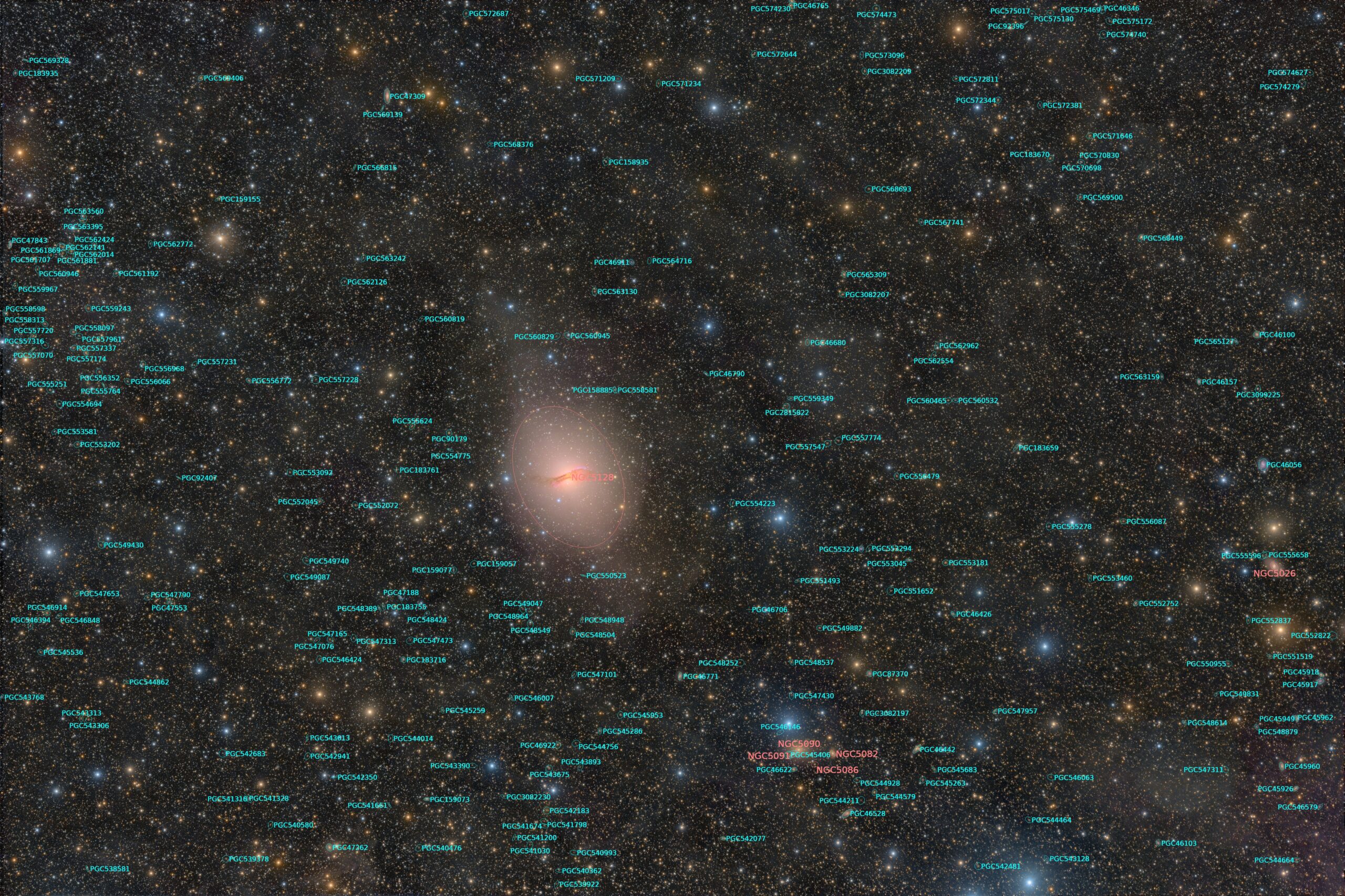
The images were taken with the following equipment (AUS-2 CCD, Telescope Live):
- Date: 2024
- Location: Heaven’s Mirror Observatory, Australia
- Telescope/Lens: Takahashi FSQ-106ED
- Focal length [mm]: 390
- Focal ratio: 3.6
- Mount: Paramount MX+
- Camera: QHY 600M Pro
- Filter: L:R:G:B
- Exposure time [min]: 140:130:140:130
- Resolution: 1.46″/px
For the 2008 data the calibration and registration was done with DeepSkyStacker and the final processing was done with PixInsight. The result was as follows:

- Date: 2008
- Location: Tivoli, Namibia
- Telescope/Lens: Pentax 75
- Focal length [mm]: 500
- Focal ratio: 6.7
- Mount: Vixen Atlux
- Camera:Canon 300Da
- Filter: OSC
- Exposure time [min]: 66
- Resolution: 1.52″/px
For the 2005 data the calibration and registration was done with DeepSkyStacker and the final processing was done with PixInsight. The result was as follows:
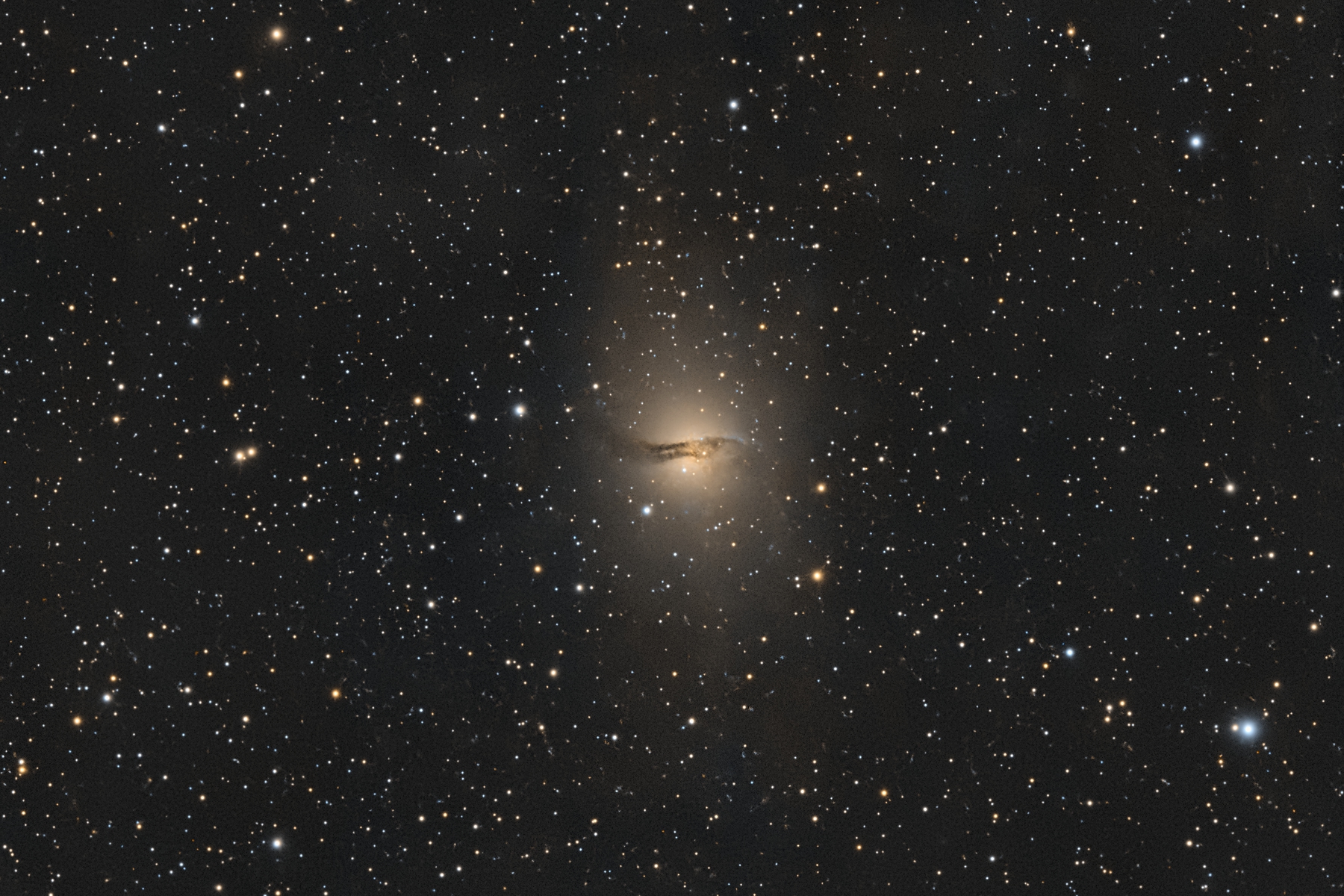
- Date: 2005
- Location: Hakos, Namibia
- Telescope/Lens: Rubinar lens
- Focal length [mm]: 500
- Focal ratio: 5.6
- Mount: Liebscher
- Camera:Canon 300Da
- Filter: OSC
- Exposure time [min]: 10
- Resolution: 2.7″/px




Leave a reply