

NGC 4490 from my backyard
In 2016, I imaged the spiral galaxy NGC 4490 from my backyard using a CCD camera and RGB filters. Even under suburban skies, the combination of long exposure times and the sensitivity of the CCD system allowed the complex structure of this fascinating interacting galaxy to be captured in considerable detail.
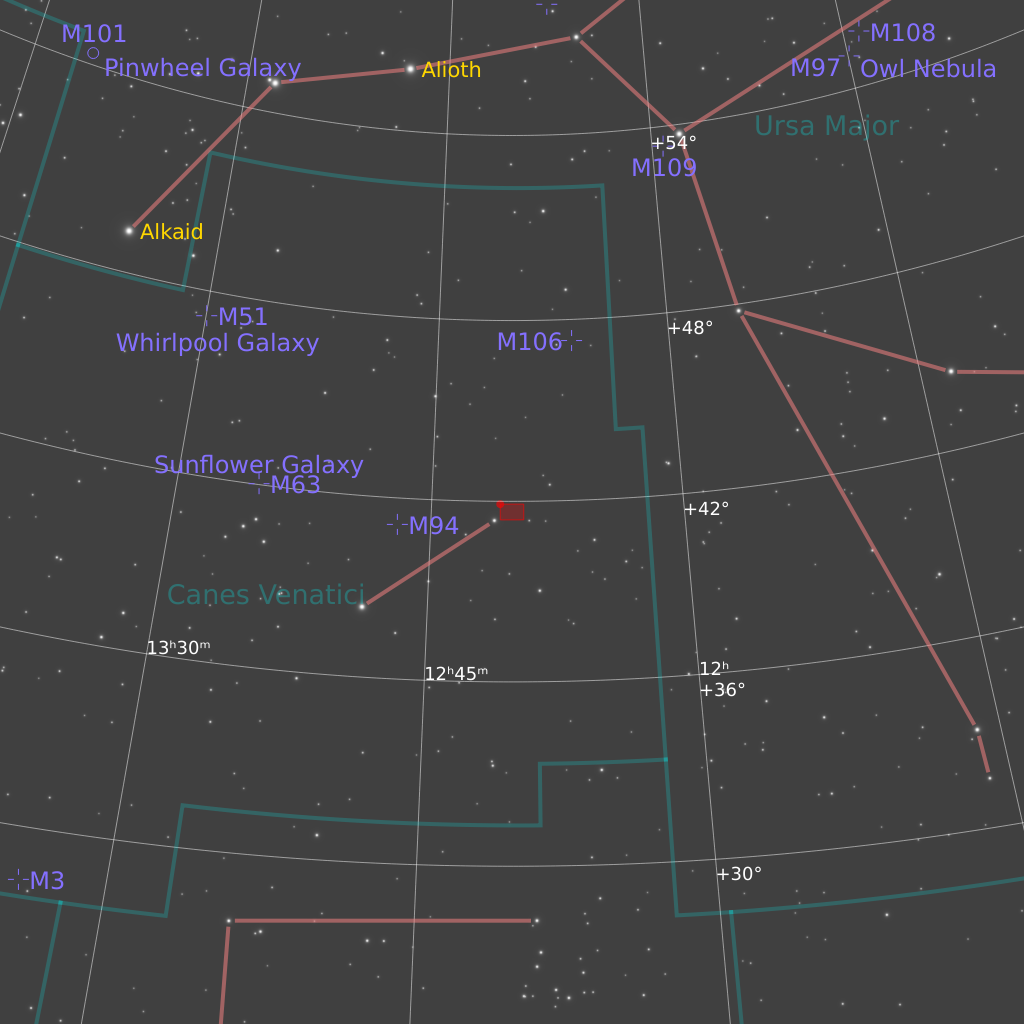
NGC 4490 is located in the constellation Canes Venatici at a distance of approximately 25–30 million light-years. It is best known for its close interaction with the smaller companion galaxy NGC 4485. Together, the two galaxies form one of the most striking interacting systems in the northern sky and are often referred to as the Cocoon Galaxy system.
The ongoing gravitational interaction between the galaxies has dramatically influenced their appearance. Tidal forces have distorted the structure of both systems, triggering widespread star formation and creating vast clouds of gas and dust. Deep images reveal numerous bright H II regions scattered throughout NGC 4490, indicating intense ongoing star formation activity. These regions are populated by young, massive stars whose radiation causes the surrounding hydrogen gas to glow.
One of the most remarkable discoveries associated with NGC 4490 is the enormous envelope of neutral hydrogen gas surrounding the galaxy pair. Radio observations have revealed tidal streams extending far beyond the visible galaxies, evidence of material being pulled out during their gravitational encounter. These structures demonstrate how interactions can redistribute gas and stars on scales far larger than the galaxies themselves.
NGC 4490 is often classified as a starburst galaxy because the interaction with NGC 4485 has significantly enhanced its star formation rate. The galaxy contains numerous young star clusters, emission nebulae, and regions of intense stellar activity. Such systems provide astronomers with valuable insight into how galaxy interactions can stimulate star formation and drive galactic evolution.
The final RGB image reveals the contrast between the bright central regions, the complex dust structures, and the bluish star-forming knots distributed throughout the disk. The nearby companion NGC 4485 adds further visual interest, clearly showing the effects of the ongoing interaction. Together, the two galaxies present a spectacular example of the dynamic processes that shape galaxies over cosmic timescales and make NGC 4490 one of the most rewarding interacting galaxy systems for astrophotographers.
Data calibration and registration and the final processing was done with PixInsight. The result was as follows:


Here is an overview of the used equipment and the exposure times:
- Date: 2016
- Location: Krefeld
- Telescope/Lens: 10″ Newton ohne Namen
- Focal length [mm]: 1000
- Focal ratio: 3.9
- Mount: Losmandy G11
- Camera: Moravian G2 8300 FW
- Filter: RGB
- Exposure time [min]: 120:120:120
- Resolution: 1.11″/px



Leave a reply