

NGC 3576
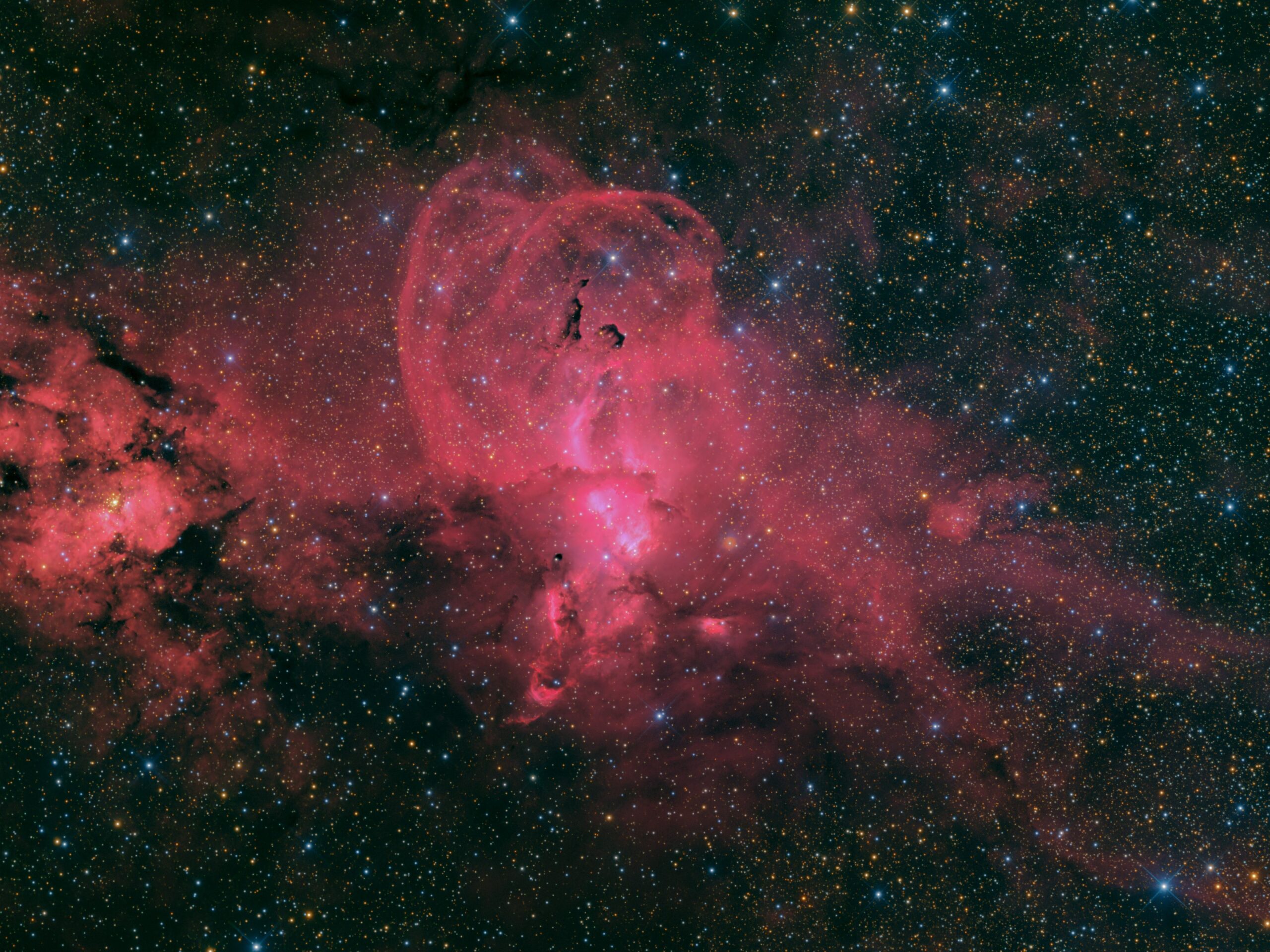
In May 2015, I spent some time under the magnificent southern skies at the Tivoli Astrofarm in Namibia. During that stay, I captured several deep-sky images using the observatory’s “Stella” equipment, taking advantage of the exceptional seeing conditions and dark desert nights. One of the objects I focused on was the fascinating emission nebula NGC 3576.
NGC 3576 is located in the constellation Carina at a distance of approximately 9,000 light-years. It is one of the most active and luminous star-forming regions in the southern Milky Way and is often compared to smaller versions of the famous Carina Nebula and Orion Nebula. The nebula is part of a giant molecular cloud complex where new generations of stars are currently being born.
At the heart of NGC 3576 lies a young cluster of massive stars that remains partially hidden behind dense clouds of gas and dust. The intense ultraviolet radiation from these hot stars ionizes the surrounding hydrogen, causing the nebula to glow brightly in Hα emission. Deep images reveal an intricate network of bright ridges, dark dust lanes, pillars, and cavities sculpted by stellar winds and radiation pressure from the newly formed stars.
One of the most striking features of NGC 3576 is its complex interaction between star formation and the surrounding interstellar medium. Massive stars within the nebula continuously inject energy into their environment, compressing nearby gas clouds while simultaneously eroding others. This process can trigger additional episodes of star formation, creating a dynamic and constantly evolving stellar nursery. Infrared observations have revealed numerous embedded protostars and young stellar objects still hidden within the dust clouds, indicating that star formation is actively continuing throughout the region.
The nebula is also rich in dark globules and dense molecular condensations. These structures are thought to be the remnants of the original molecular cloud from which the cluster formed. Similar to the famous Pillars of Creation in the Eagle Nebula, some of these dust structures are being slowly eroded by intense ultraviolet radiation while potentially harboring future generations of stars.
From an astrophotographic perspective, NGC 3576 is a spectacular target because it combines bright emission regions with intricate dark nebulae and rich surrounding star fields. The southern location of the nebula makes it difficult to observe from Europe, but from Namibia it climbs high into the sky, allowing excellent image quality and revealing extremely fine detail.
The exceptional observing conditions at Tivoli, combined with the capabilities of the Stella observatory equipment, allowed the delicate structures and subtle variations within NGC 3576 to be captured in remarkable detail. The resulting image showcases one of the Milky Way’s most active stellar nurseries and highlights the powerful processes of star formation that continue to shape our galaxy today.
All data calibration, registration, and final image processing were performed in PixInsight
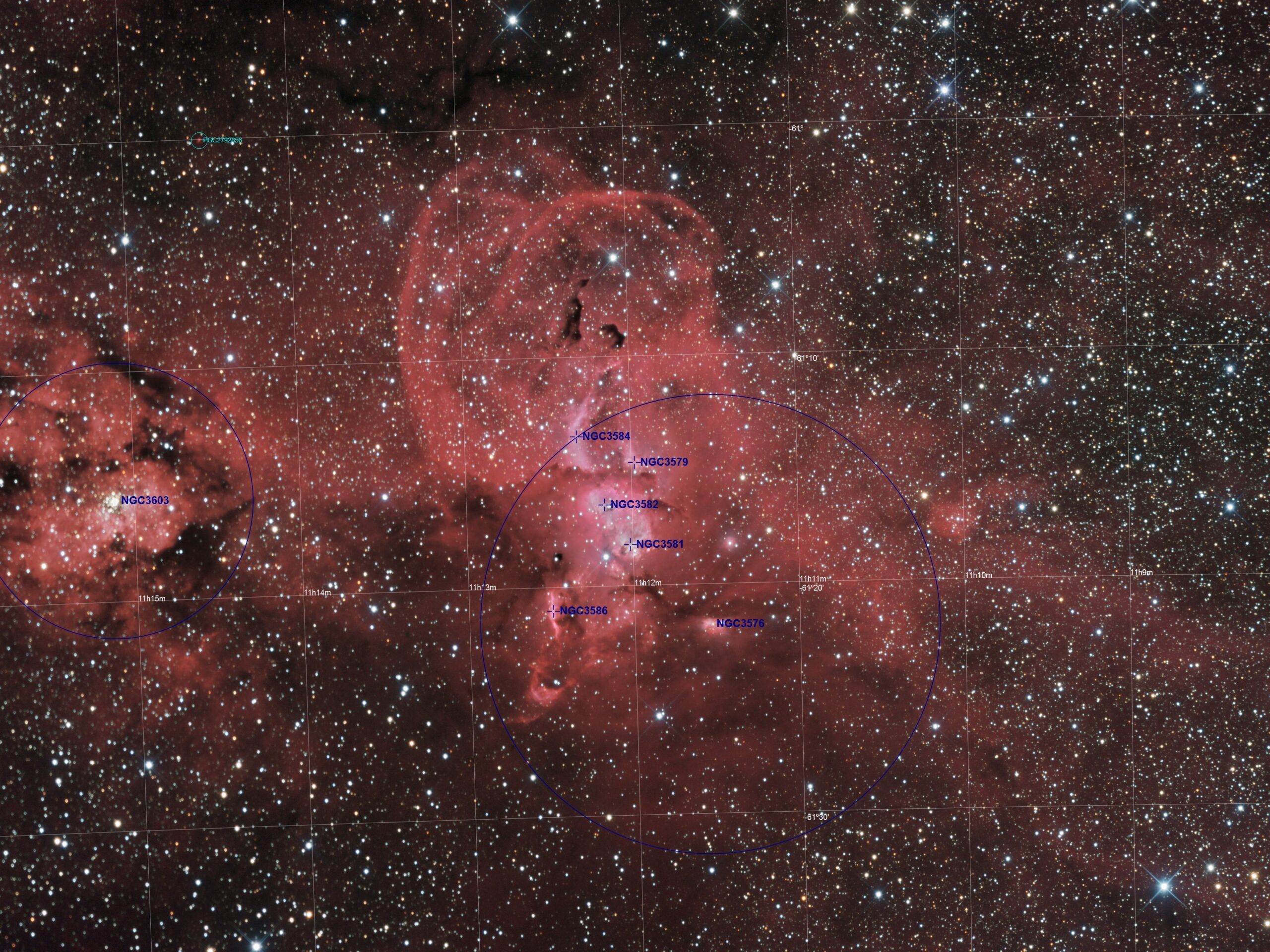
The images were taken with the following equipment:
- Location: Tivoli, Namibia
- Telescope: ASA 12″ Astrograph
- Focal length [mm]: 1076
- Focal ratio: 3.6
- Mount: ASA DDM85
- Camera: FLI Microline ML8300
- Filter: L:R:G:B:Hα
- Exposure time [min]: 60:40:40:40:90
- Resolution: 1.04″/px




Leave a reply