• Home
  • Blog
  • Astrophotography
    • Deep Sky
      • Galaxies (Galaxien)
      • Nebulae (Nebel)
      • Planetary Nebulae (Planetarische Nebel)
      • Globular Clusters (Kugelsternhaufen)
      • Open Clusters (Offene Sternhaufen)
      • Miscellaneous (Verschiedenes)
    • Solar System (Sonnensystem)
      • Comets (Kometen)
      • Moon (Mond)
      • Planets (Planeten)
      • Sun (Sonne)
  • Archiv

    • Mai 2026
    • April 2026
    • Dezember 2025
    • November 2025
    • Oktober 2025
    • September 2025
    • August 2025
    • Juli 2025
    • Juni 2025
    • Mai 2025
    • April 2025
    • März 2025
    • Januar 2025
    • November 2024
    • Oktober 2024
    • September 2024
    • Juli 2024
    • Juni 2024
    • Mai 2024
    • April 2024
    • März 2024
    • Februar 2024
    • Januar 2024
    • Dezember 2023
    • November 2023
    • Oktober 2023
    • September 2023
    • August 2023
    • Juli 2023
    • Juni 2023
    • Mai 2023
    • April 2023
    • März 2023
    • Februar 2023
    • Januar 2023
    • Dezember 2022
    • November 2022
    • Oktober 2022
    • September 2022
    • August 2022
    • Juni 2022
    • Mai 2022
    • April 2022
    • März 2022
    • Februar 2022
    • Januar 2022
    • Dezember 2021
    • November 2021
    • September 2021
    • August 2021
    • Juli 2021
    • März 2021
    • Februar 2021
    • November 2020
    • September 2020
    • August 2020
    • April 2020
    • März 2020
    • Februar 2020
    • Januar 2020
    • Dezember 2019
    • November 2019
    • Oktober 2019
    • September 2019
    • August 2019
    • Mai 2019
    • April 2019
    • März 2019
    • Dezember 2018
    • November 2018
    • September 2018
    • Juli 2018
    • Juni 2018
    • Mai 2018
    • April 2018
    • März 2018
    • Februar 2018
    • Januar 2018
    • Oktober 2017
    • Juli 2017
    • Januar 2017
    • September 2016
    • Mai 2016
    • März 2016
    • Oktober 2015
    • Mai 2015
    • März 2015
    • Februar 2015
    • September 2014
    • März 2014
    • Februar 2014
    • Oktober 2013
    • September 2013
    • April 2013
    • März 2013
    • November 2012
    • Juli 2012
    • Mai 2012
    • März 2012
    • Januar 2012
    • November 2011
    • Oktober 2011
    • September 2011
    • August 2011
    • April 2011
    • März 2011
    • Oktober 2010
    • September 2010
    • August 2010
    • Juli 2010
    • April 2010
    • Juli 2009
    • Juli 2008
    • Januar 2008
    • Oktober 2007
    • Juli 2007
    • Februar 2007
    • Juni 2006
    • August 2005
    • Januar 2005
  • Kategorien

    • Asterism
    • Astrophotography
    • Barnard
    • Comet
    • Galaxies
    • Globular Cluster
    • IC
    • Messier
    • Moon
    • Nebula
    • NGC
    • Open cluster
    • Photography
    • Planetary Nebula
    • Travel
  • Meta

    • Anmelden
    • Eintrags-Feed
    • Kommentar-Feed
    • WordPress.org
  • Privacy Policy
  • Impressum
  • Haftungsausschluss
  • Cookie-Richtlinie
  • Datenschutzerklärung

wonderfuluniverse.de
  • Home
  • Blog
  • Astrophotography
    • Deep Sky
      • Galaxies (Galaxien)
      • Nebulae (Nebel)
      • Planetary Nebulae (Planetarische Nebel)
      • Globular Clusters (Kugelsternhaufen)
      • Open Clusters (Offene Sternhaufen)
      • Miscellaneous (Verschiedenes)
    • Solar System (Sonnensystem)
      • Comets (Kometen)
      • Moon (Mond)
      • Planets (Planeten)
      • Sun (Sonne)

NGC 3521 from Telescope Live CHI-1-CMOS and Insight Observatory


In 2024, I received a high-quality dataset of the spiral galaxy NGC 3521 from Telescope Live, acquired with professional equipment in Chile. This was not my first encounter with the galaxy, however. Some years earlier, I had already received another dataset of NGC 3521 from the Insight Observatory, recorded with a telescope in New Mexico. Having access to data from two different observatories provided an excellent opportunity to compare imaging systems, observing conditions, and processing techniques while studying one of the most interesting spiral galaxies in the northern sky.

NGC 3521 is located in the constellation Leo at a distance of approximately 35 million light-years. It is classified as a flocculent spiral galaxy, meaning that its spiral structure is not organized into a few well-defined grand-design arms but instead consists of numerous fragmented and patchy spiral segments. This gives the galaxy a highly textured and somewhat chaotic appearance that becomes increasingly impressive in deep images.

One of the most striking features of NGC 3521 is its rich network of dark dust lanes that weave through the disk and partially obscure the bright stellar background. These dust structures create a remarkable three-dimensional appearance, especially where they overlap with luminous star-forming regions. The galaxy is also known for its extensive stellar halo and faint tidal debris, suggesting that it has undergone gravitational interactions or minor mergers in the past.

Deep observations reveal countless star-forming knots distributed throughout the spiral arms, along with subtle streams and shells surrounding the galaxy. These faint outer structures are of particular scientific interest because they preserve evidence of the galaxy’s evolutionary history and past interactions with smaller companions. Studies have shown that NGC 3521 possesses a complex stellar population, containing both very old stars and younger generations formed in more recent epochs.

Because of its combination of bright structure, intricate dust patterns, and faint outer features, NGC 3521 is considered one of the finest spiral galaxies for deep imaging. The datasets from Insight Observatory and Telescope Live allowed the galaxy to be explored in exceptional detail, revealing everything from the bright central bulge and fragmented spiral arms to the delicate halo structures extending far beyond the visible disk. The result showcases a galaxy whose seemingly chaotic appearance hides a rich and fascinating evolutionary history.

Data calibration and registration and the final processing was done with PixInsight. The result was as follows:
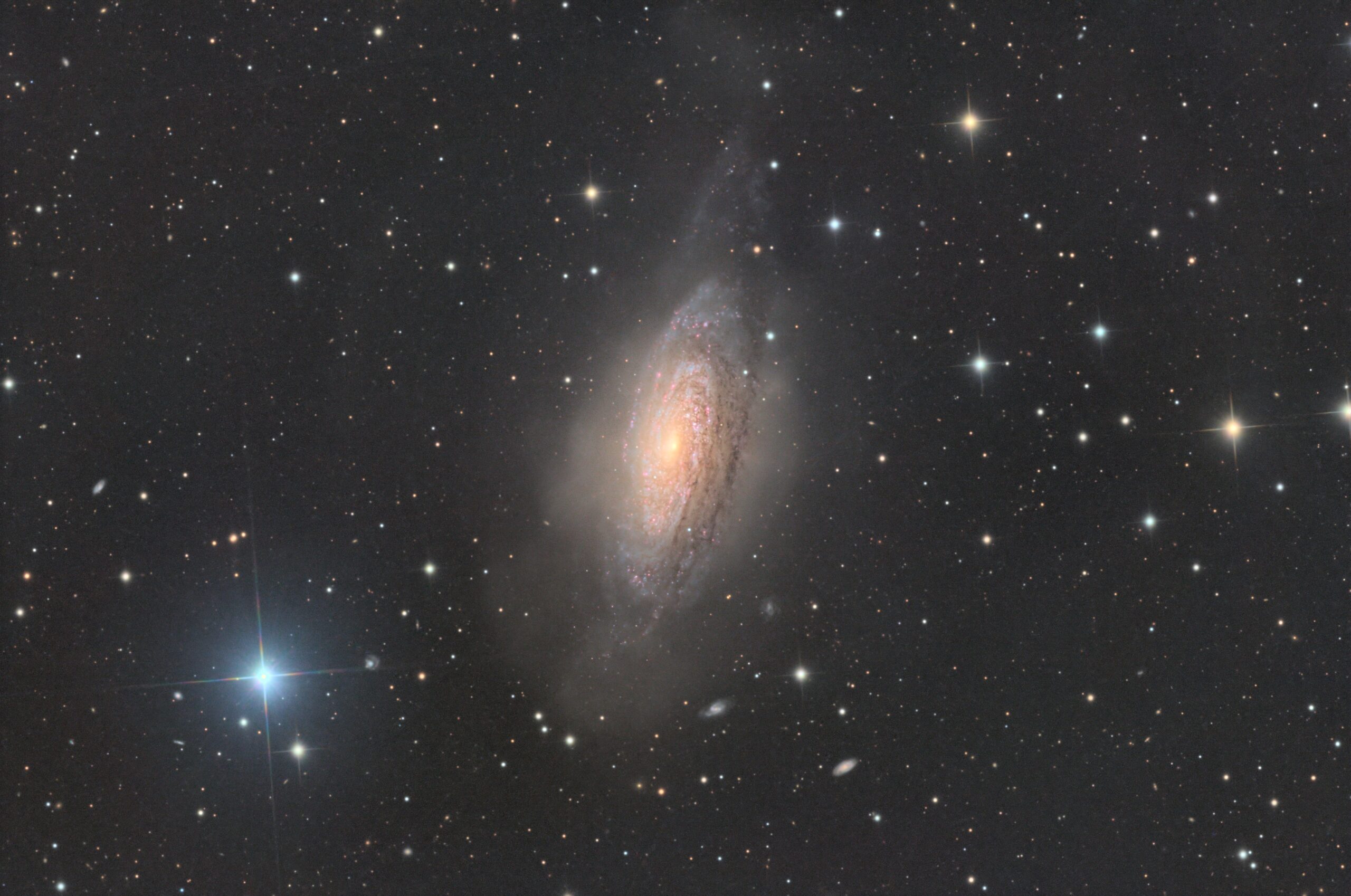
NGC 3521 - Telescope Live
NGC 3521 – Telescope Live, 2024
NGC 3521 annotated
NGC 3521 annotated

The faintest star in this image has an apparent magnitude of 23.5 magv (SDSS DR17).

Beside NGC 3521 there are a lot of background galaxies in the image.

The two highest redshift quasars [Flesh 2015] in the image are:
SDSS J110624.62-000233.7 z=2.5 magv=22.2 (SDSS DR17)
SDSS J110531.99+000653.6 z=2.22 magv=21.4 (SDSS DR17)


The images were taken with the following equipment:

  • Date: 2024
  • Location: El Sauce Observatory, Chile
  • Telescope/Lens: Planwave CDK 24
  • Focal length [mm]: 3962
  • Focal Ratio: 6.5
  • Mount: Mathis MI-1000/1250
  • Camera: QHY 600M Pro
  • Filter: LRGB
  • Exposure time [min]: 120:120:130:145
  • Resolution: 0,39″/px (bin 2)


For the 2021 data the calibration and registration and the final processing was done with PixInsight. The result was as follows:

NGC 3521
NGC 3521
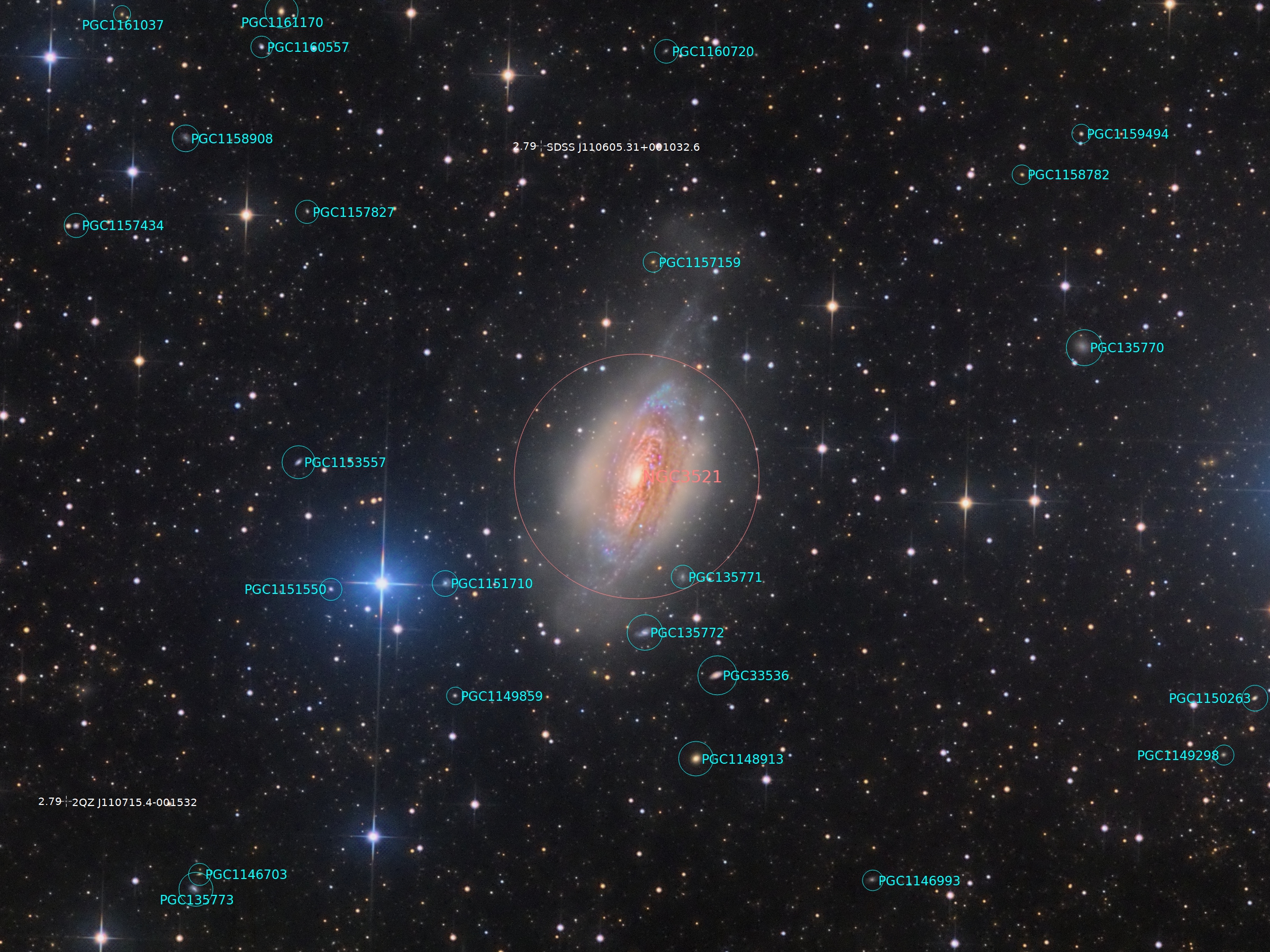
NGC 3521 annotated
NGC 3521 annotated

The faintest star in this image has an apparent magnitude of 22.4 magG (SDSS DR15).

Beside NGC 3521 there are a lot of background galaxies in the image. Furthermore I marked the two most distant quasars:

The two highest redshift quasars [Flesh 2015] in the image are:
SDSS J110605.31+001032.6 z=2.79 magG=21.1 (SDSS DR9)
2QZ J110715.4-001532 z=2.79 magG=20.2 (SDSS DR9)

The galaxy is close to the ecliptic, so some asteroids are visible in the image. The most prominent one is 2629 Rudra.

Asteroids near NGC 3521


The images were taken with the following equipment:

  • Date: 2021
  • Location: Pie Town, New Mexico
  • Telescope/Lens: Dreamscope 16″ f/3.7 Astrograph
  • Focal length [mm]: 1525
  • Focal Ratio: 3.75
  • Mount: Paramount ME
  • Camera: FLI Proline 16803
  • Filter: LRGB
  • Exposure time [min]: 160:75:75:75
  • Resolution: 1.23″/px


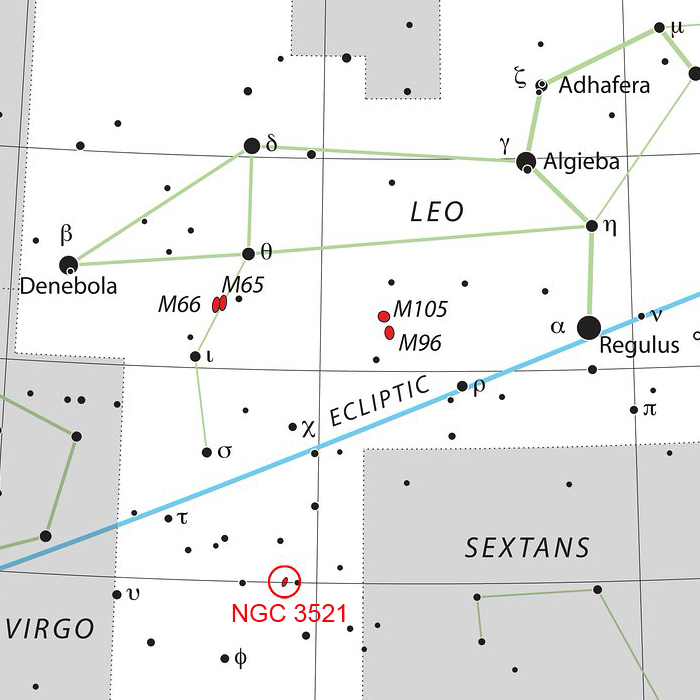
NGC 3521 Finder chart


Stephan Küppers


You might also like
Messier 13 (NGC 6205)
10. Mai 2026
Messier 106 (NGC 4258)
8. Mai 2026
Messier 51
2. Mai 2026

Leave a reply

Schreibe einen Kommentar Antwort abbrechen

Deine E-Mail-Adresse wird nicht veröffentlicht. Erforderliche Felder sind mit * markiert


© Stephan Küppers 2020-2022

Cookie-Zustimmung verwalten
Wir verwenden Cookies, um unsere Website und unseren Service zu optimieren.
Funktional Immer aktiv
Die technische Speicherung oder der Zugang ist unbedingt erforderlich für den rechtmäßigen Zweck, die Nutzung eines bestimmten Dienstes zu ermöglichen, der vom Teilnehmer oder Nutzer ausdrücklich gewünscht wird, oder für den alleinigen Zweck, die Übertragung einer Nachricht über ein elektronisches Kommunikationsnetz durchzuführen.
Vorlieben
Die technische Speicherung oder der Zugriff ist für den rechtmäßigen Zweck der Speicherung von Präferenzen erforderlich, die nicht vom Abonnenten oder Benutzer angefordert wurden.
Statistiken
Die technische Speicherung oder der Zugriff, der ausschließlich zu statistischen Zwecken erfolgt. Die technische Speicherung oder der Zugriff, der ausschließlich zu anonymen statistischen Zwecken verwendet wird. Ohne eine Vorladung, die freiwillige Zustimmung deines Internetdienstanbieters oder zusätzliche Aufzeichnungen von Dritten können die zu diesem Zweck gespeicherten oder abgerufenen Informationen allein in der Regel nicht dazu verwendet werden, dich zu identifizieren.
Marketing
Die technische Speicherung oder der Zugriff ist erforderlich, um Nutzerprofile zu erstellen, um Werbung zu versenden oder um den Nutzer auf einer Website oder über mehrere Websites hinweg zu ähnlichen Marketingzwecken zu verfolgen.
  • Optionen verwalten
  • Dienste verwalten
  • Verwalten von {vendor_count}-Lieferanten
  • Lese mehr über diese Zwecke
Einstellungen anzeigen
  • {title}
  • {title}
  • {title}