

NGC 3198 from my own „Sterntaucher“ observatory
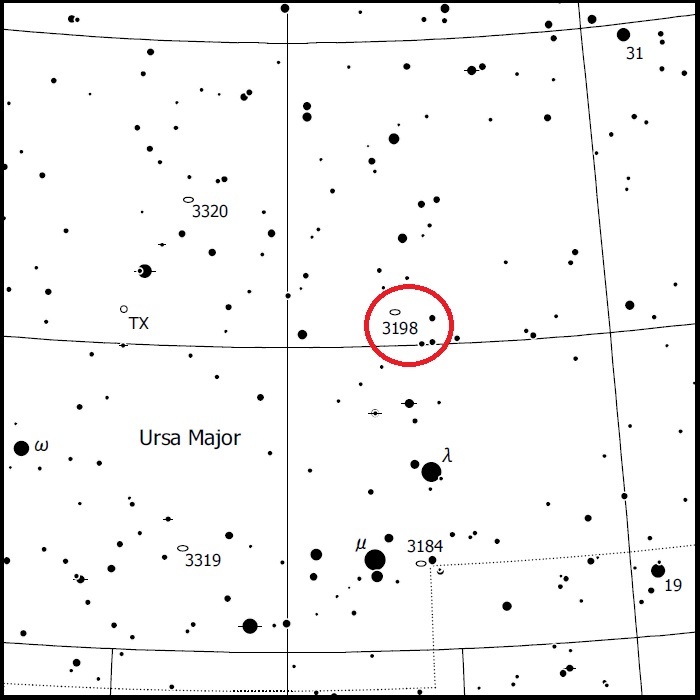
My next project in 2021 was the spiral galaxy NGC 3198, located in the constellation Ursa Major. I imaged this galaxy from my observatory and processed the data to reveal both its bright inner structure and the much fainter outer regions of the disk.
NGC 3198 is situated at a distance of approximately 45 million light-years and is classified as a barred spiral galaxy (SBc). It is viewed at a moderate inclination, allowing its spiral structure to be seen in considerable detail. Deep images reveal a bright central region surrounded by well-developed spiral arms containing numerous star-forming regions, dark dust lanes, and young stellar associations.
From a scientific perspective, NGC 3198 is one of the most important galaxies in the study of dark matter. Since the 1970s, astronomers have used detailed measurements of its rotation curve to investigate the distribution of mass within spiral galaxies. Instead of declining with increasing distance from the galactic center—as would be expected if only visible matter were present—the rotation speed remains nearly constant far into the outer disk. This behavior provides strong evidence for the existence of a massive and extended dark matter halo surrounding the galaxy.
Because of its relatively isolated nature and regular structure, NGC 3198 has become one of the classic benchmark galaxies for testing models of galactic dynamics and dark matter distribution. Radio observations of neutral hydrogen reveal that the gaseous disk extends far beyond the visible spiral arms, making it possible to trace the galaxy’s rotation to large distances from the center.
Deep imaging also reveals numerous bright H II regions scattered throughout the spiral arms, indicating ongoing star formation. These regions contrast beautifully with the dark dust lanes and the warmer yellowish stellar population concentrated toward the central bulge. Background galaxies visible throughout the field further emphasize the depth of the image and the immense scale of the universe beyond this nearby spiral.
NGC 3198 is therefore not only an attractive astrophotographic target but also one of the most significant galaxies in modern extragalactic astronomy, having played a key role in establishing the observational evidence for dark matter.
Data calibration and registration and the final processing was done with PixInsight. The RGB Data was upscaled to the luminance data. The result was as follows:
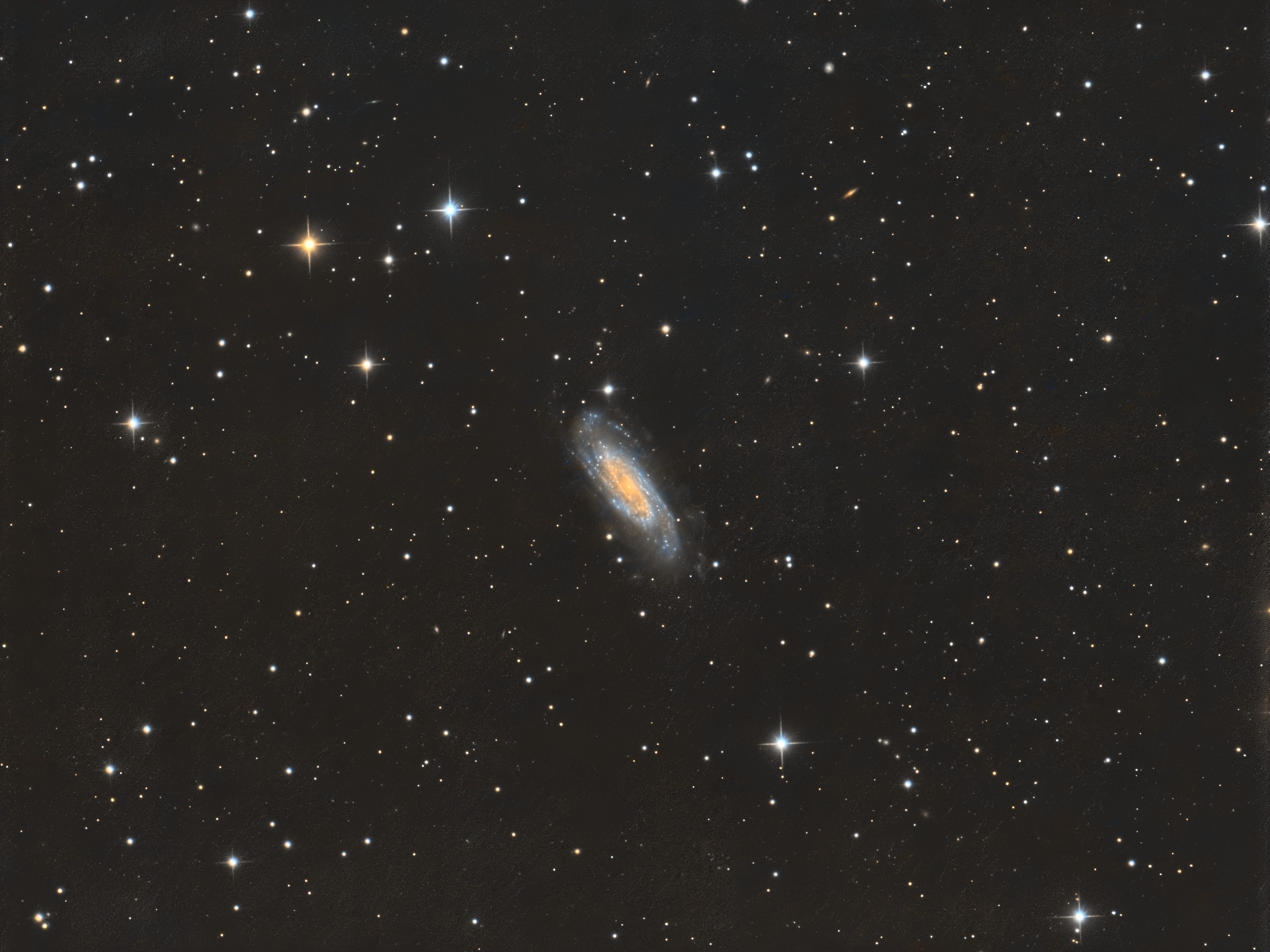
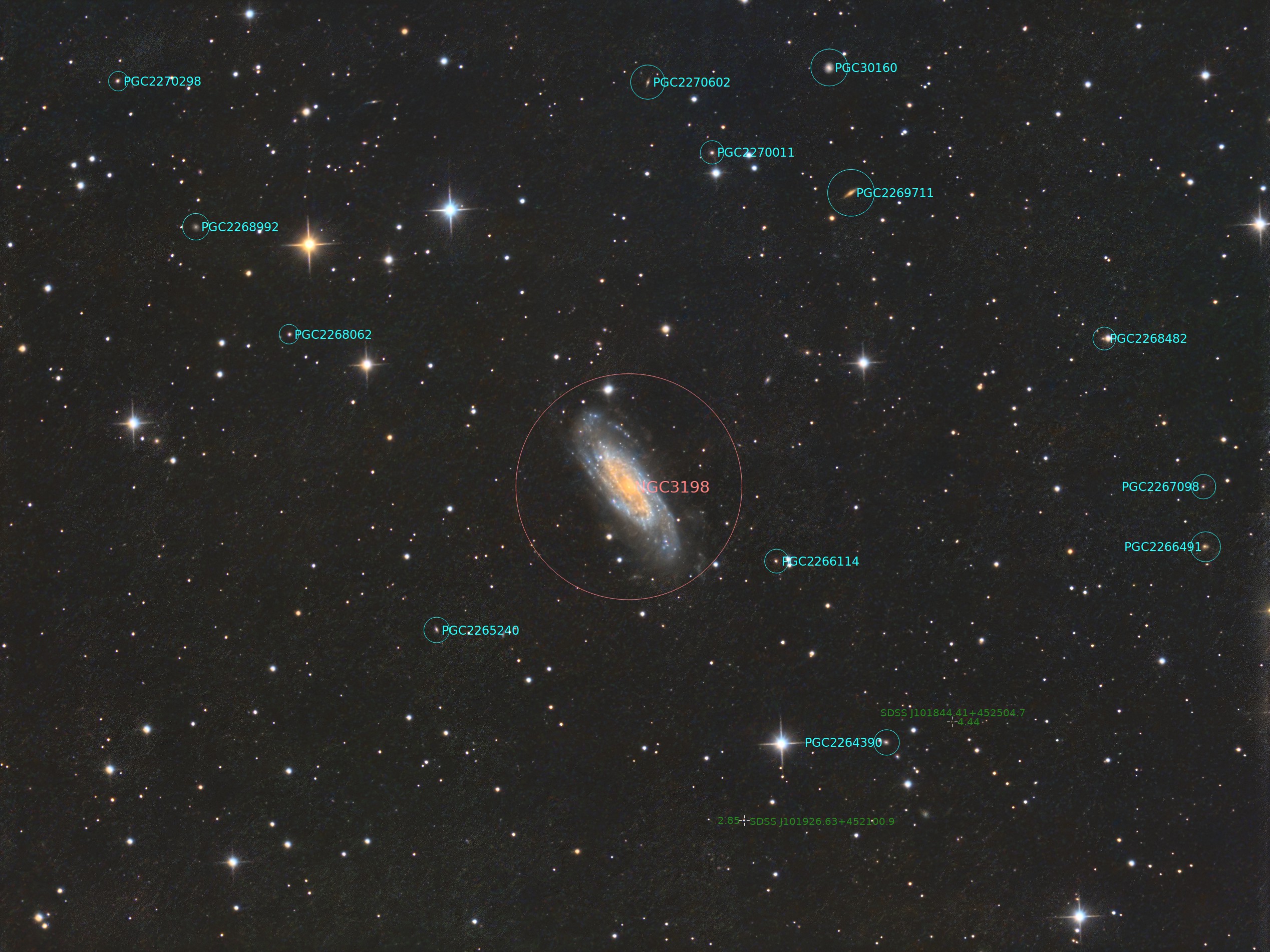
The faintest star in my image has an apparent magnitude of 21.3 magV (SDSS DR15).
The two highest redshift quasars [Flesh 2015] in the image are:
SDSS J101844.41+452504.7 z=4.44 magG=19.9 (Gaia DR2)
SDSS J101926.63+452100.9 z=2.85 magG=19.1 (Gaia DR2)
Here is an overview of the used equipment and the exposure times:
- Date: 2021
- Location: Krefeld
- Telescope/Lense: 10″ Newton ohne Namen – TSQ-65ED Apo
- Focal length [mm]: 1000 – 420
- Focal ratio: 3.9 – 6.5
- Mount: Skywatcher EQ8
- Camera: Moravian G2 8300 FW – Moravian G3 16200 FW
- Filter: CLS – RGB
- Exposure time [min]: 900 – 180:180:165
- Resolution: 1.11″/px – 2.95″/px


Leave a reply