• Home
  • Blog
  • Astrophotography
    • Deep Sky
      • Galaxies (Galaxien)
      • Nebulae (Nebel)
      • Planetary Nebulae (Planetarische Nebel)
      • Globular Clusters (Kugelsternhaufen)
      • Open Clusters (Offene Sternhaufen)
      • Miscellaneous (Verschiedenes)
    • Solar System (Sonnensystem)
      • Comets (Kometen)
      • Moon (Mond)
      • Planets (Planeten)
      • Sun (Sonne)
  • Archiv

    • Mai 2026
    • April 2026
    • Dezember 2025
    • November 2025
    • Oktober 2025
    • September 2025
    • August 2025
    • Juli 2025
    • Juni 2025
    • Mai 2025
    • April 2025
    • März 2025
    • Januar 2025
    • November 2024
    • Oktober 2024
    • September 2024
    • Juli 2024
    • Juni 2024
    • Mai 2024
    • April 2024
    • März 2024
    • Februar 2024
    • Januar 2024
    • Dezember 2023
    • November 2023
    • Oktober 2023
    • September 2023
    • August 2023
    • Juli 2023
    • Juni 2023
    • Mai 2023
    • April 2023
    • März 2023
    • Februar 2023
    • Januar 2023
    • Dezember 2022
    • November 2022
    • Oktober 2022
    • September 2022
    • August 2022
    • Juni 2022
    • Mai 2022
    • April 2022
    • März 2022
    • Februar 2022
    • Januar 2022
    • Dezember 2021
    • November 2021
    • September 2021
    • August 2021
    • Juli 2021
    • März 2021
    • Februar 2021
    • November 2020
    • September 2020
    • August 2020
    • April 2020
    • März 2020
    • Februar 2020
    • Januar 2020
    • Dezember 2019
    • November 2019
    • Oktober 2019
    • September 2019
    • August 2019
    • Mai 2019
    • April 2019
    • März 2019
    • Dezember 2018
    • November 2018
    • September 2018
    • Juli 2018
    • Juni 2018
    • Mai 2018
    • April 2018
    • März 2018
    • Februar 2018
    • Januar 2018
    • Oktober 2017
    • Juli 2017
    • Januar 2017
    • September 2016
    • Mai 2016
    • März 2016
    • Oktober 2015
    • Mai 2015
    • März 2015
    • Februar 2015
    • September 2014
    • März 2014
    • Februar 2014
    • Oktober 2013
    • September 2013
    • April 2013
    • März 2013
    • November 2012
    • Juli 2012
    • Mai 2012
    • März 2012
    • Januar 2012
    • November 2011
    • Oktober 2011
    • September 2011
    • August 2011
    • April 2011
    • März 2011
    • Oktober 2010
    • September 2010
    • August 2010
    • Juli 2010
    • April 2010
    • Juli 2009
    • Juli 2008
    • Januar 2008
    • Oktober 2007
    • Juli 2007
    • Februar 2007
    • Juni 2006
    • August 2005
    • Januar 2005
  • Kategorien

    • Asterism
    • Astrophotography
    • Barnard
    • Comet
    • Galaxies
    • Globular Cluster
    • IC
    • Messier
    • Moon
    • Nebula
    • NGC
    • Open cluster
    • Photography
    • Planetary Nebula
    • Travel
  • Meta

    • Anmelden
    • Eintrags-Feed
    • Kommentar-Feed
    • WordPress.org
  • Privacy Policy
  • Impressum
  • Haftungsausschluss
  • Cookie-Richtlinie
  • Datenschutzerklärung

wonderfuluniverse.de
  • Home
  • Blog
  • Astrophotography
    • Deep Sky
      • Galaxies (Galaxien)
      • Nebulae (Nebel)
      • Planetary Nebulae (Planetarische Nebel)
      • Globular Clusters (Kugelsternhaufen)
      • Open Clusters (Offene Sternhaufen)
      • Miscellaneous (Verschiedenes)
    • Solar System (Sonnensystem)
      • Comets (Kometen)
      • Moon (Mond)
      • Planets (Planeten)
      • Sun (Sonne)

NGC 3132 (Southern Ring Nebula)


Winner Image in the Telescope Live Contest December 2023

I imaged the planetary nebula NGC 3132 twice over the years under the excellent southern skies of Namibia and Chile. My first image was taken in 2015 during a stay at the astrofarm Tivoli in Namibia, where the dark skies provided ideal conditions for recording the delicate outer structures of this famous planetary nebula. Several years later, in 2021, I received a high-quality dataset from Telescope Live, acquired with professional equipment in Chile. The modern dataset revealed significantly finer detail in both the bright inner shell and the faint outer regions of the nebula.

The data set was used for the monthly Telescope Live contest and the resulting image was chosen as winner image in the expert tier.

NGC 3132 is located in the constellation Vela at a distance of approximately 2,000 light-years. It is one of the brightest and most frequently imaged planetary nebulae in the southern sky and is commonly known as the Eight-Burst Nebula. The nickname originates from the appearance of bright radial structures that seem to emerge from the central region, giving the nebula a characteristic flower-like or multi-lobed appearance.

For many years, NGC 3132 was thought to be a relatively simple spherical shell of gas. However, modern observations have shown that its true three-dimensional structure is considerably more complex. The nebula appears to be shaped more like an elongated bipolar or hourglass structure viewed at an angle rather than a simple sphere. This geometry helps explain the intricate patterns, arcs, and brightness variations visible in deep images.

At the center lies a fascinating binary star system. The hotter component is the white dwarf responsible for ionizing the surrounding gas, while the companion star is easily visible in many images. Interactions within the binary system are thought to have played an important role in shaping the nebula’s complex morphology. Such binary interactions are increasingly recognized as a key mechanism in the formation of many planetary nebulae.

Deep images reveal strong emission from hydrogen, oxygen, and other ionized elements. The bright blue-green regions are dominated by [O III] emission, while hydrogen contributes reddish structures in color images. Fainter outer shells and filamentary features testify to multiple episodes of mass loss during the final evolutionary stages of the progenitor star.

Comparing my 2015 image from Tivoli with the professional Telescope Live dataset from 2021 provides an interesting look at both the advances in imaging technology and the extraordinary detail hidden within this beautiful planetary nebula. NGC 3132 remains one of the most attractive and scientifically interesting planetary nebulae visible in the southern hemisphere.

Data calibration and registration and the final processing was done with PixInsight. The result was as follows:

NGC 3132, Telescope Live, Chile, 2021

The faintest star in this image has an apparent magnitude of approx. 20.6 magG (GAIA DR2).


The images were taken with the following equipment (Telescope Live CHI-3):

  • Date: 2021
  • Location: El Sauce Observatory, Chile
  • Telescope/Lens: ASA RC-1000AZ
  • Focal length [mm]: 6780
  • Focal ratio: 6.8
  • Mount: ASA Alt-Az DDM
  • Camera: FLI Proline 16803
  • Filter: LRGB
  • Exposure time [min]: 20:20:20:20
  • Resolution: 0.274″/px


For the 2015 data the calibration and registration and the final processing was done with PixInsight. The result was as follows:

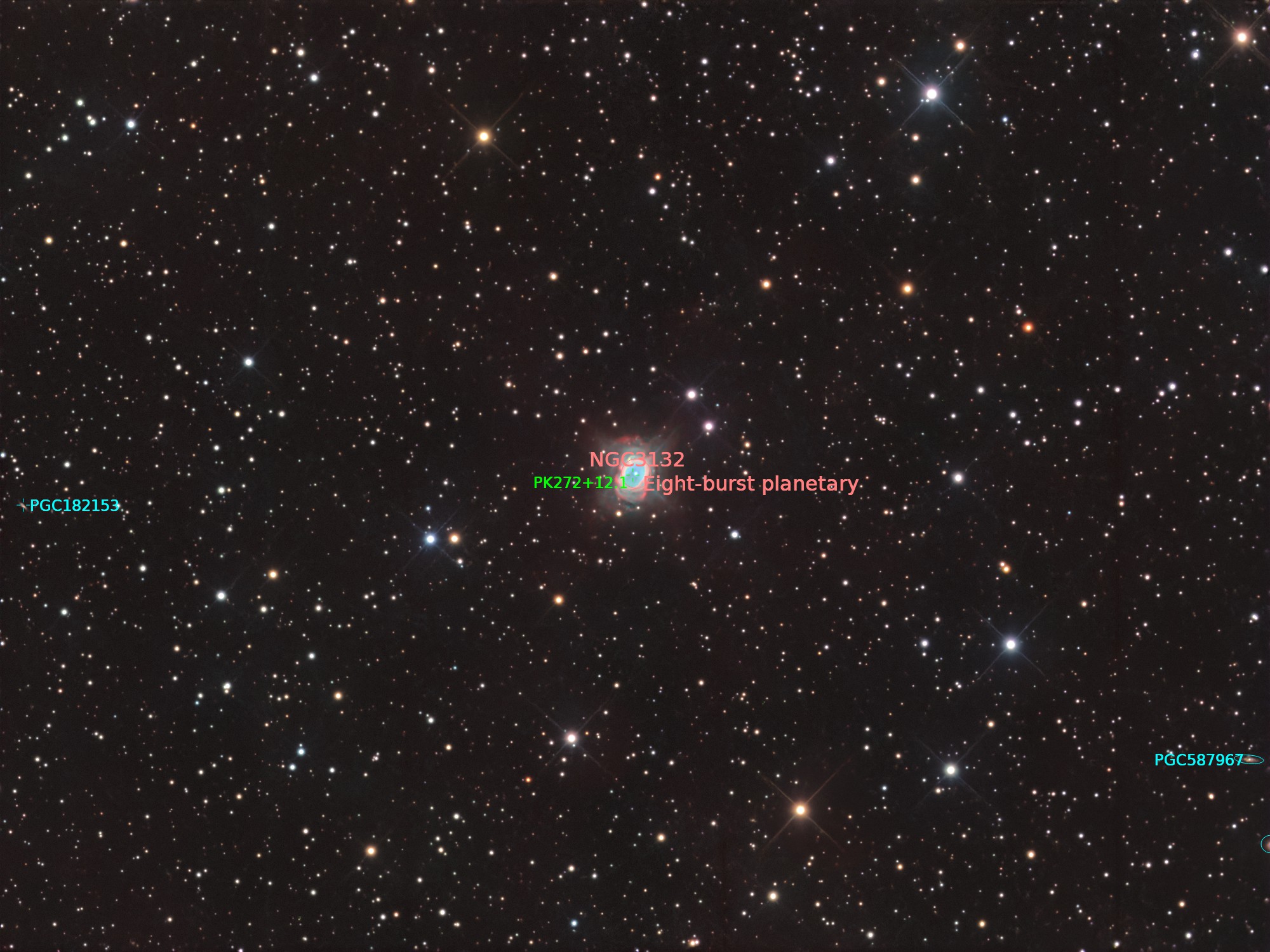
NGC 3132, Tivoli, Namibia, 2015
NGC 3132 annotated
NGC 3132 annotated


The images were taken with the following equipment:

  • Date: 2015
  • Location: Astrofarm, Tivoli, Namibia
  • Telescope/Lens: ASA 12″ Astrograph
  • Focal length [mm]: 1076
  • Focal ratio: 3.6
  • Mount: ASA DDM85
  • Camera: FLI Microline ML 8300
  • Filter: R:G:B:Hα:[OIII]
  • Exposure time [min]: 30:30:30:240:115
  • Resolution: 1.04″/px


NGC 3132 Finder chart


Stephan Küppers


You might also like
Messier 13 (NGC 6205)
10. Mai 2026
Messier 106 (NGC 4258)
8. Mai 2026
Messier 51
2. Mai 2026

Leave a reply

Schreibe einen Kommentar Antwort abbrechen

Deine E-Mail-Adresse wird nicht veröffentlicht. Erforderliche Felder sind mit * markiert


© Stephan Küppers 2020-2022

Cookie-Zustimmung verwalten
Wir verwenden Cookies, um unsere Website und unseren Service zu optimieren.
Funktional Immer aktiv
Die technische Speicherung oder der Zugang ist unbedingt erforderlich für den rechtmäßigen Zweck, die Nutzung eines bestimmten Dienstes zu ermöglichen, der vom Teilnehmer oder Nutzer ausdrücklich gewünscht wird, oder für den alleinigen Zweck, die Übertragung einer Nachricht über ein elektronisches Kommunikationsnetz durchzuführen.
Vorlieben
Die technische Speicherung oder der Zugriff ist für den rechtmäßigen Zweck der Speicherung von Präferenzen erforderlich, die nicht vom Abonnenten oder Benutzer angefordert wurden.
Statistiken
Die technische Speicherung oder der Zugriff, der ausschließlich zu statistischen Zwecken erfolgt. Die technische Speicherung oder der Zugriff, der ausschließlich zu anonymen statistischen Zwecken verwendet wird. Ohne eine Vorladung, die freiwillige Zustimmung deines Internetdienstanbieters oder zusätzliche Aufzeichnungen von Dritten können die zu diesem Zweck gespeicherten oder abgerufenen Informationen allein in der Regel nicht dazu verwendet werden, dich zu identifizieren.
Marketing
Die technische Speicherung oder der Zugriff ist erforderlich, um Nutzerprofile zu erstellen, um Werbung zu versenden oder um den Nutzer auf einer Website oder über mehrere Websites hinweg zu ähnlichen Marketingzwecken zu verfolgen.
  • Optionen verwalten
  • Dienste verwalten
  • Verwalten von {vendor_count}-Lieferanten
  • Lese mehr über diese Zwecke
Einstellungen anzeigen
  • {title}
  • {title}
  • {title}