

NGC 2997
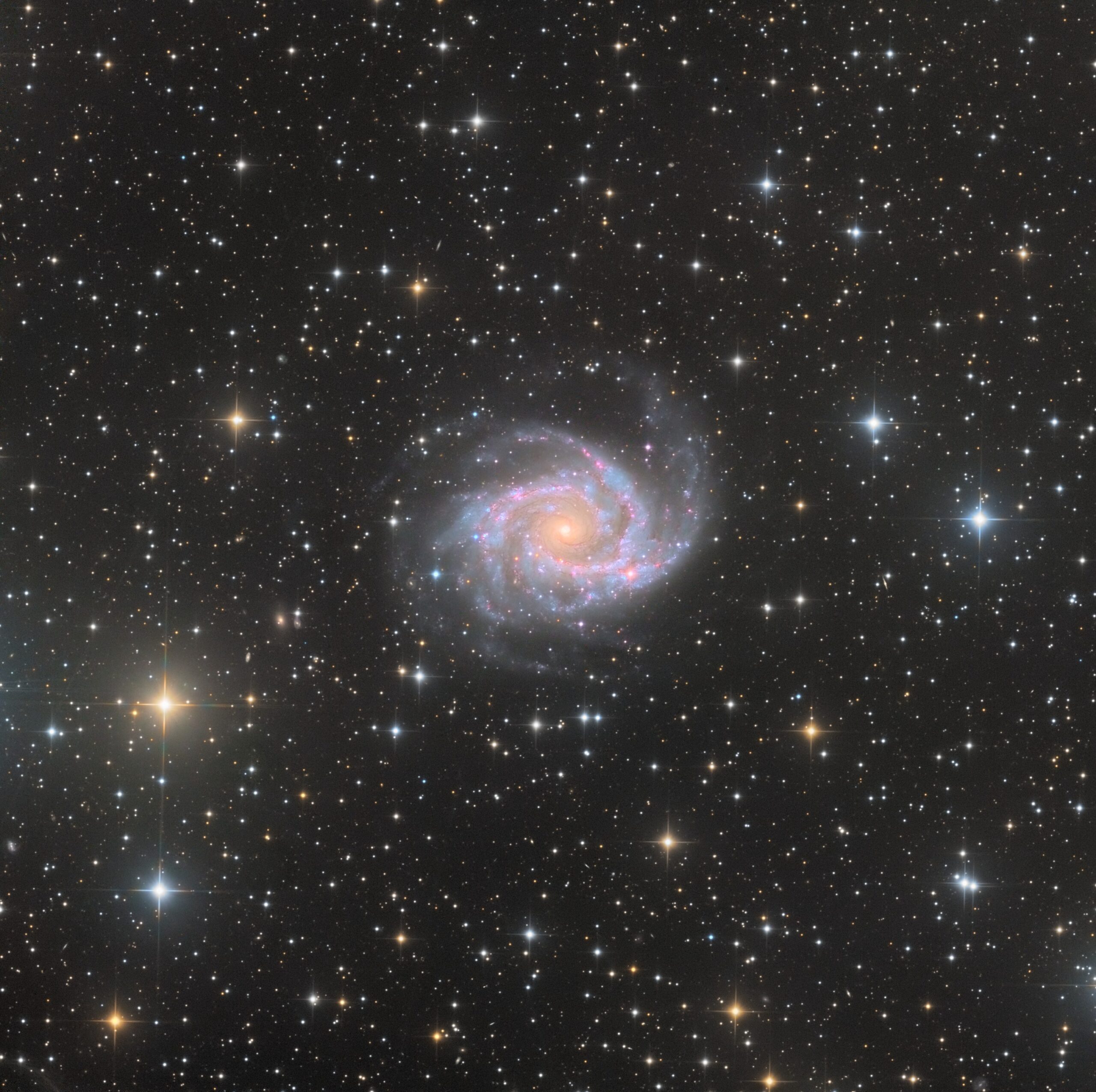
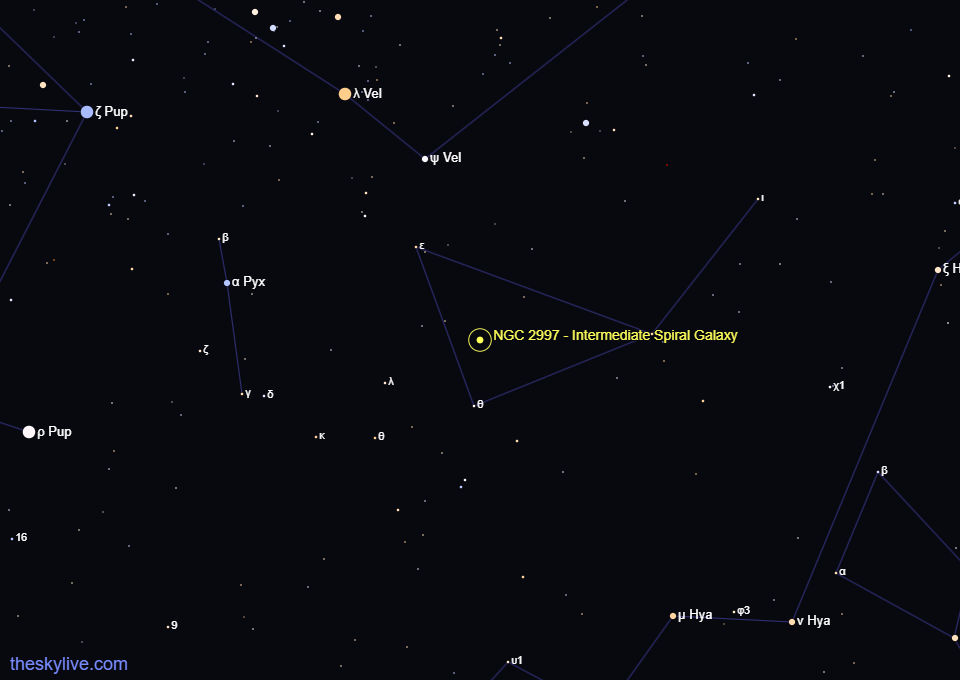
From time to time I obtain data sets from remote observatories. One of my favorite providers is Telescope Live with telescopes in e.g. Chile, Australia and Spain. One of the data sets I received, was data from the galaxy NGC 2997, located in the constellation Antlia.
NGC 2997 is one of the finest examples of a grand-design spiral galaxy in the southern sky. Situated at a distance of approximately 40 million light-years, it spans nearly 100,000 light-years and exhibits a remarkably symmetrical spiral pattern. Its well-defined arms emerge from a bright central region and wind gracefully outward, containing numerous star-forming complexes, young stellar associations, and dark dust lanes.
Unlike many spiral galaxies that possess a strong central bar, NGC 2997 is classified as an unbarred spiral galaxy (SAc). This makes its highly organized spiral structure particularly interesting, as the formation and maintenance of such prominent arms must be driven primarily by density waves within the galactic disk rather than by a bar-induced dynamical mechanism. Deep images reveal a wealth of fine detail, including fragmented dust clouds, luminous H II regions, and subtle stellar streams throughout the disk.
One of the most striking characteristics of NGC 2997 is its intense star formation activity. The spiral arms are populated by numerous bright blue star clusters and glowing hydrogen clouds, many of which are visible even in amateur images. These stellar nurseries contain massive young stars whose ultraviolet radiation ionizes the surrounding gas, producing the characteristic reddish emission associated with H II regions.
The galaxy has also been the site of several observed supernovae, demonstrating that star formation remains active on a galactic scale. Multi-wavelength studies have revealed extensive reservoirs of gas and dust distributed throughout the disk, providing the raw material for future generations of stars. Radio observations further indicate large-scale magnetic fields aligned with the spiral structure, offering valuable insight into the dynamics of spiral galaxies.
The excellent Telescope Live dataset allowed for detailed processing of both the bright inner regions and the faint outer extensions of the galaxy. Deep exposures reveal delicate dust lanes near the nucleus, intricate spiral arm structure, and numerous background galaxies scattered throughout the field. The resulting image highlights not only the beauty of NGC 2997 but also the complex astrophysical processes that continue to shape this impressive southern spiral galaxy.
Data calibration and registration and the final processing was done with PixInsight. The result was as follows:
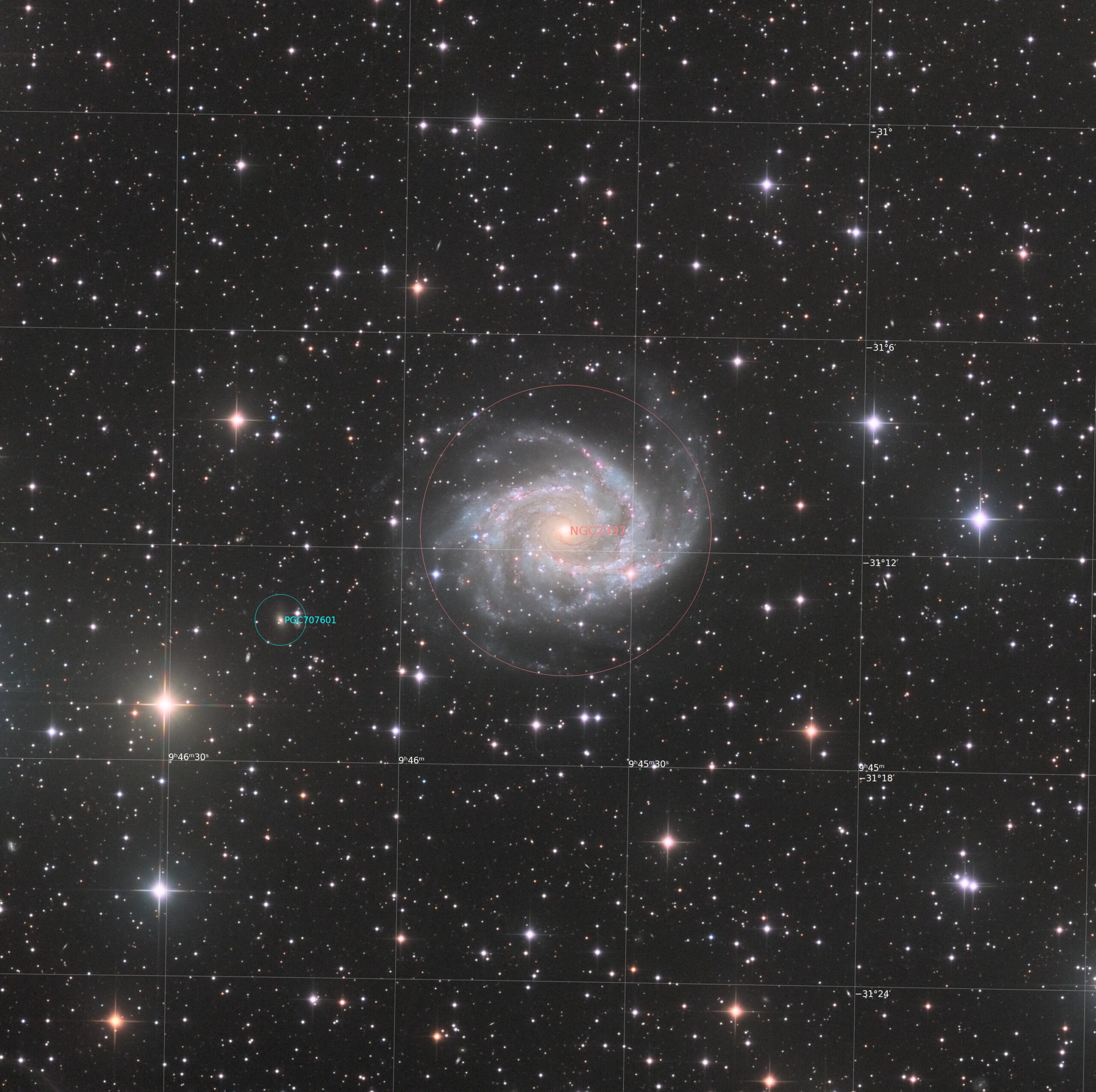
The images were taken with the following equipment (Telescope Live CHI-1):
- Date: 2021
- Telescope/Lens: Planwave CDK24
- Focal length [mm]: 3900
- Focal ratio: 6.5
- Mount: Mathis MI-1000/1250
- Camera: FLI Proline 9000
- Filter: LRGB
- Exposure time [min]: 140:130:120:120
- Resolution: 0.62″/px



Leave a reply