

NGC 2903 from my own backyard
In 2014, I imaged the spiral galaxy NGC 2903 from my backyard using a CCD camera. Despite the challenges posed by suburban skies, the long integration time and the high sensitivity of the CCD system allowed me to capture a wealth of detail in this bright and highly structured galaxy.
NGC 2903 is located in the constellation Leo at a distance of approximately 30 million light-years. It is classified as a barred spiral galaxy (SBbc) and is often regarded as one of the finest galaxies in the northern sky that is not included in the Messier catalog. With a diameter of roughly 80,000 light-years, it is somewhat smaller than the Milky Way but exhibits a remarkably rich and active spiral structure.
One of the most striking features of NGC 2903 is its prominent central bar, which channels gas toward the inner regions of the galaxy and fuels intense star formation near the nucleus. Deep images reveal numerous bright H II regions scattered throughout the spiral arms, indicating ongoing stellar birth. These regions appear as bluish knots embedded within the galaxy’s complex network of dust lanes and star clouds.
The galaxy is also notable for its asymmetrical appearance. Although classified as a barred spiral, its spiral arms are not perfectly balanced, and subtle distortions can be detected in deep exposures. These irregularities may be related to past interactions with smaller satellite galaxies or the internal dynamical evolution of the disk.
From a scientific perspective, NGC 2903 is frequently studied as an example of a nearby star-forming barred spiral galaxy. Radio observations have revealed extensive reservoirs of neutral hydrogen gas, while infrared observations show vigorous star formation activity in the central regions. The galaxy hosts a rich population of young stellar clusters as well as an older stellar bulge that dominates the core.
Deep CCD imaging highlights the contrast between the warm yellowish central bulge, the dark dust lanes crossing the inner disk, and the bluish star-forming regions spread throughout the spiral arms. Even from a backyard observatory, NGC 2903 proves to be a rewarding target, offering an impressive amount of detail and providing a fascinating glimpse into the processes that shape spiral galaxies.
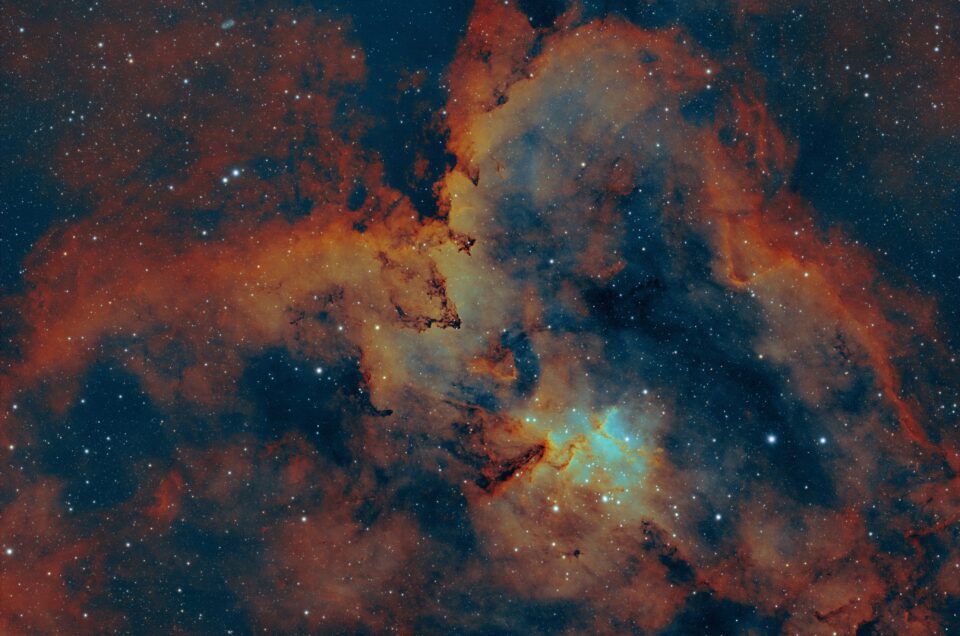
The data calibration and registration was done with DeepSkyStacker, the final image processing, were performed entirely in PixInsight. The result was as follows:


The images were taken with the following equipment:
- Date: 2014
- Location: Krefeld, Germany
- Telescope: 10″ Newton ohne Namen
- Focal length [mm]: 1000
- Focal ratio: 3.9
- Mount: Losmandy G11
- Camera: Moravian FW8300
- Filter: L:R:G:B
- Exposure time [min]: 302:80:80:80
- Resolution: 1.11″/px




Leave a reply