

Milky Way in Scorpius
I imaged the spectacular Milky Way in the constellation Scorpius twice over the years, both times using a DSLR camera with a telephoto lens under the exceptionally dark skies of Namibia. My first image was captured in 2005 during a stay at the Hakos Astrofarm, while the second was taken in 2008 at the Tivoli Astrofarm. Both images showcase one of the richest and most spectacular regions of the southern Milky Way, filled with brilliant star clouds, colorful emission nebulae, dark dust lanes, and numerous open star clusters.
The constellation Scorpius lies directly along the plane of the Milky Way and points toward the central regions of our Galaxy. Although the true Galactic Centre is located just across the border in Sagittarius, the Scorpius region offers one of the most impressive wide-field views of the inner Milky Way. Our line of sight passes through several spiral arms, resulting in an extraordinarily dense concentration of stars, interstellar dust, and star-forming regions.
Among the most prominent objects in this area are the bright open clusters Messier 6 and Messier 7, both visible to the naked eye under dark skies. The field also contains numerous smaller open clusters, glowing hydrogen nebulae, and extensive networks of dark molecular clouds that weave intricate patterns across the stellar background.
Wide-field photographs reveal the remarkable contrast between the brilliant star clouds and the dark dust lanes that obscure more distant parts of the Galactic disk. These dust clouds are composed of cold gas and microscopic dust grains and represent the raw material from which future generations of stars and planetary systems will eventually form. Their complex shapes create some of the most dramatic structures visible within the Milky Way.
The exceptional observing conditions in Namibia make this region particularly rewarding for astrophotography. With virtually no light pollution, excellent atmospheric transparency, and the southern Milky Way passing high overhead, even relatively simple equipment such as a DSLR camera and telephoto lens can record an astonishing amount of detail. Countless stars, subtle color variations, and faint interstellar clouds become visible in long-exposure images.
Comparing the images from 2005 and 2008 also illustrates my own progress in astrophotography. While both were captured with similar equipment, the later image benefited from greater experience in image acquisition and processing, resulting in improved detail, smoother tonal transitions, and a richer rendering of the Milky Way’s complex structure.
These two wide-field images remain among my favorite memories of observing from Namibia. They beautifully capture the breathtaking richness of the Scorpius Milky Way, where brilliant star clusters, glowing nebulae, and dark dust clouds combine to create one of the most magnificent panoramas visible in the night sky.
For the 2008 data the calibration and registration was done with DeepSkyStacker and the final processing was done with PixInsight. The result was as follows:
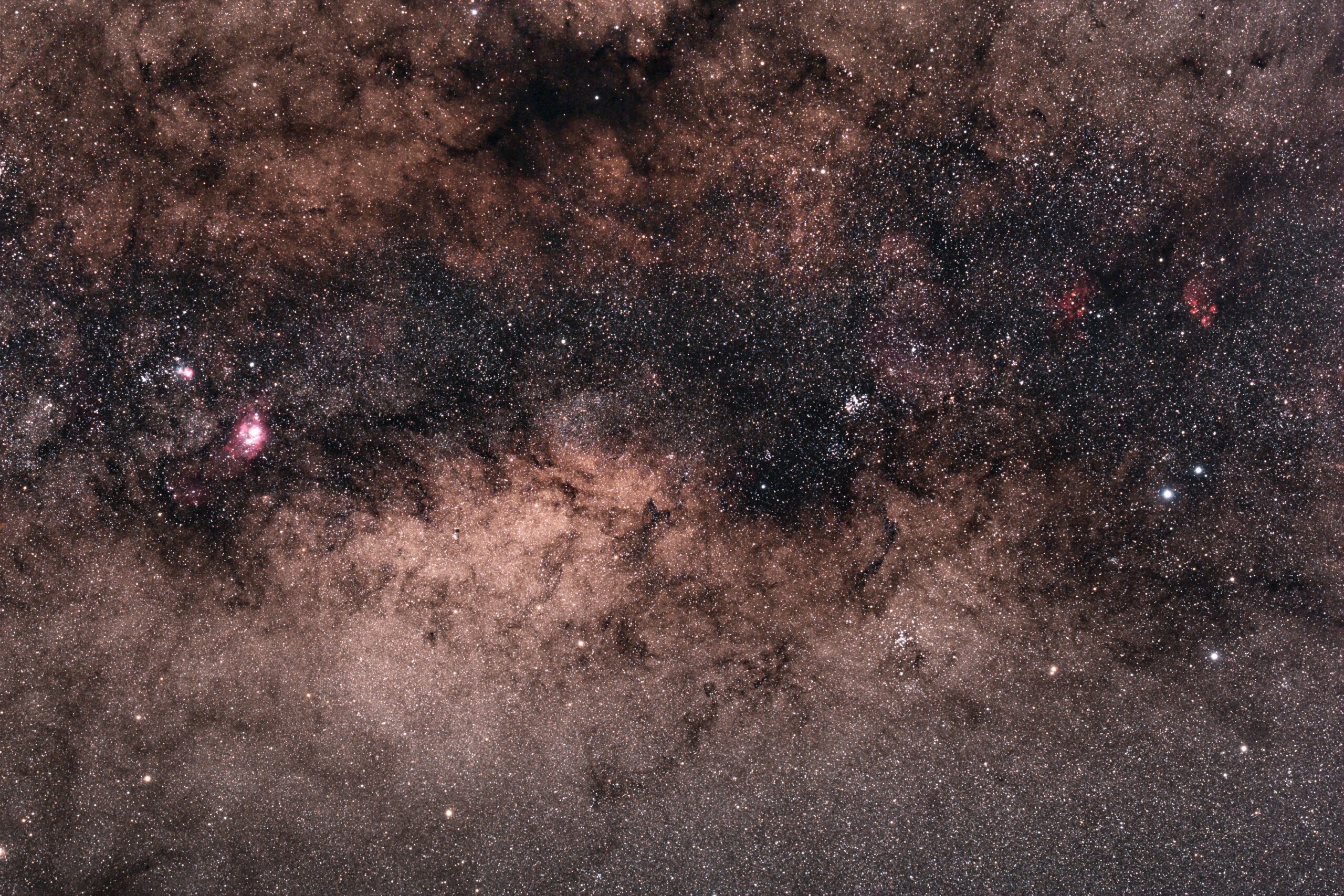
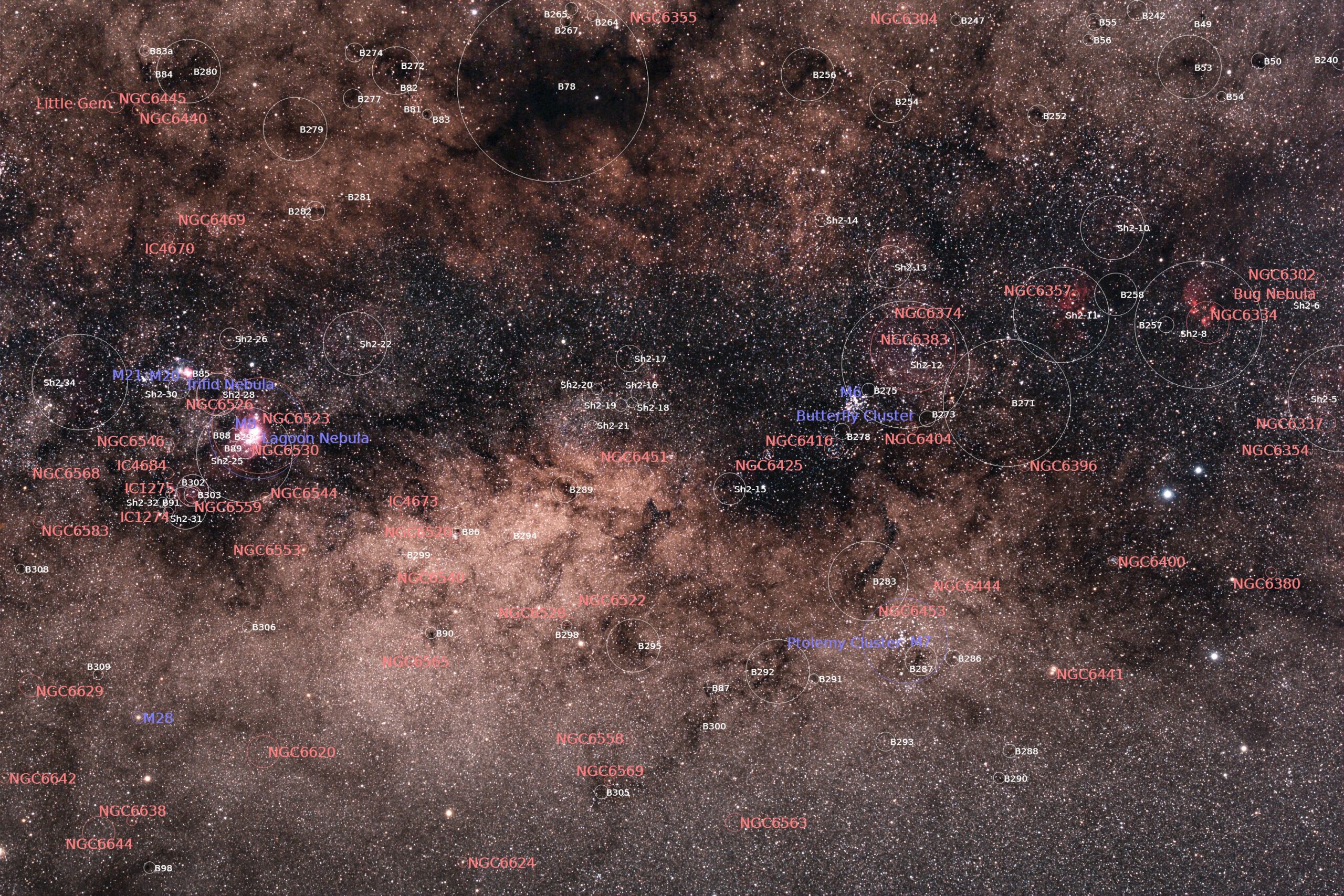
The images were taken with the following equipment:
- Date 2008
- Location: Tivoli, Namibia
- Telescope: Tamron 28-300 mmm lens
- Focal length [mm]: 70
- Focal ratio: 7.1
- Mount: Vixen Atlux
- Camera: Canon 300 Da
- Filter: OSC
- Exposure time [min]: 96
- Resolution: 25.3″/px
For the 2005 data the calibration and registration was done with DeepSkyStacker and the final processing was done with PixInsight. The result was as follows:

The images were taken with the following equipment:
- Date 2005
- Location: Hakos, Namibia
- Telescope: Tamron 28-300 mmm lens
- Focal length [mm]: 28
- Focal ratio: 4.5
- Mount: Liebscher
- Camera: Canon 300 Da
- Filter: OSC
- Exposure time [min]: 6
- Resolution: 54.5″/px



Leave a reply