

Milky Way in Sagittarius
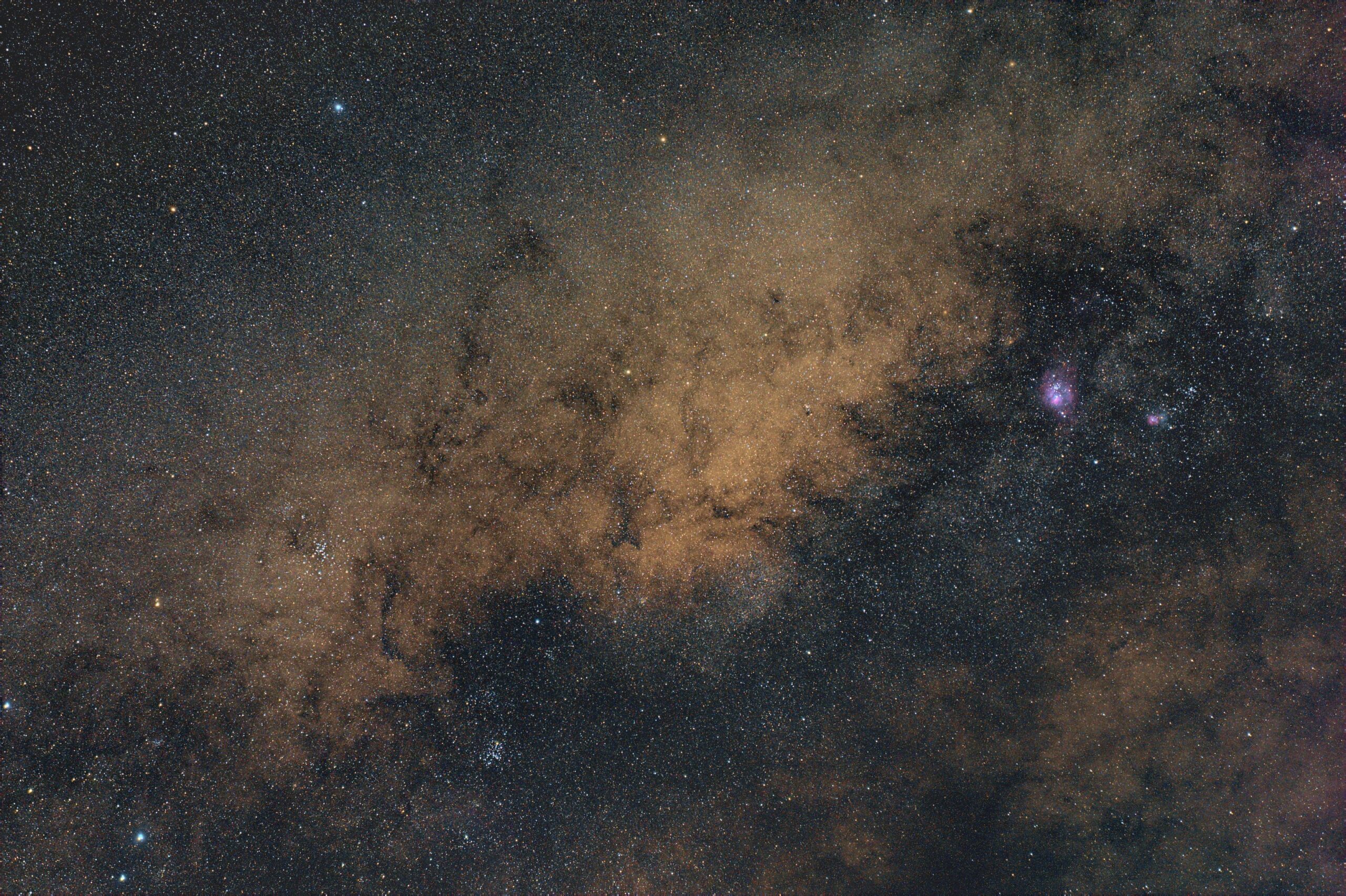
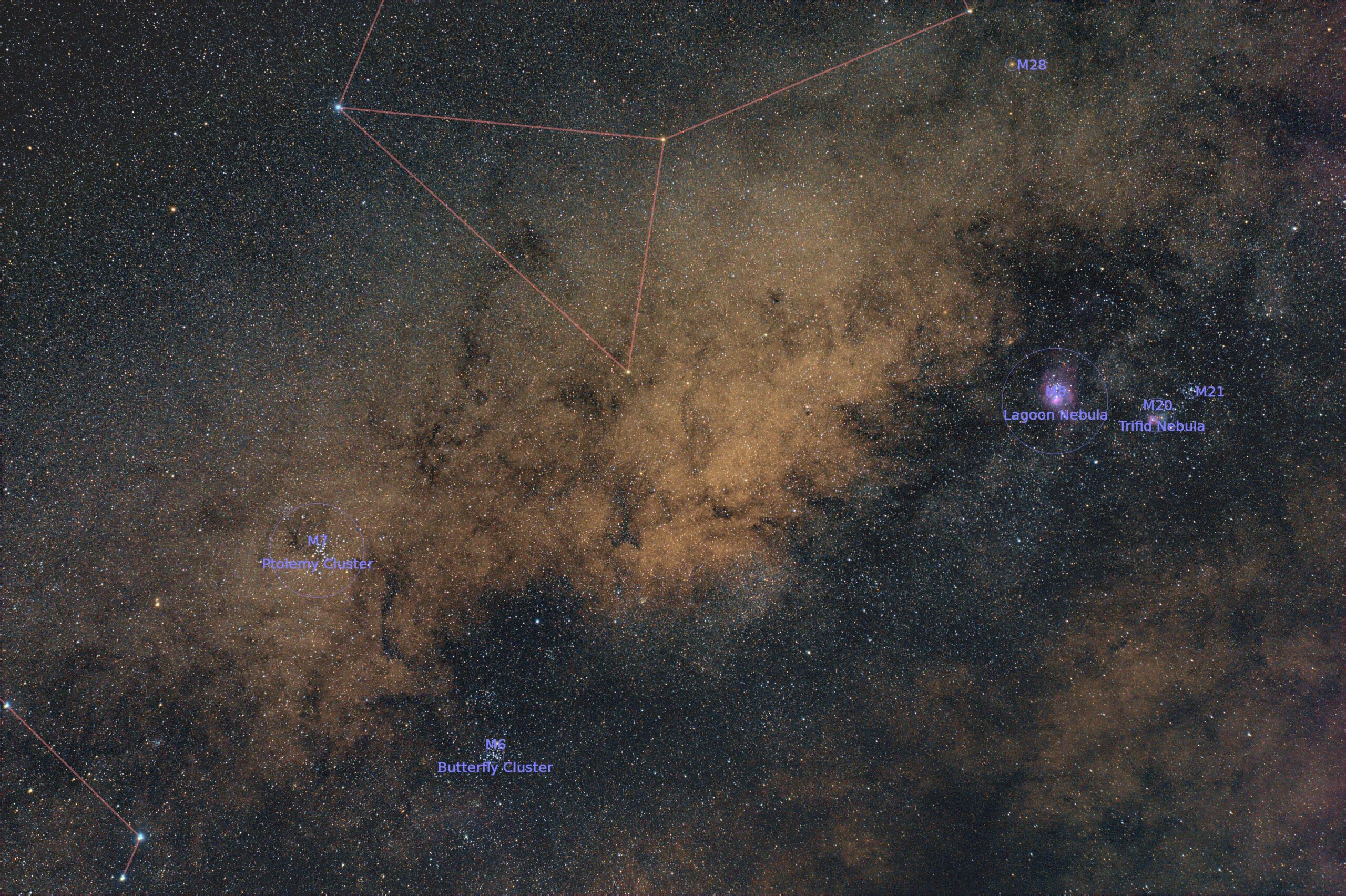
In 2005, during a stay at the Hakos Astrofarm in Namibia, I captured a wide-field image of the spectacular central Milky Way using my DSLR camera and a telephoto lens. The image spans the region between the famous emission nebula Messier 8 and the bright open clusters Messier 6 and Messier 7. Under the exceptionally dark skies of Namibia, the dense star fields, glowing nebulae, and dark dust clouds of the southern Milky Way could be recorded in stunning detail, making this one of my earliest and most memorable wide-field astrophotographs.
This region lies in the constellations Sagittarius and Scorpius, looking directly toward the Galactic Centre of the Milky Way. Although the true center of our Galaxy is hidden behind enormous amounts of interstellar dust, this line of sight passes through several of the Milky Way’s spiral arms and contains one of the richest concentrations of stars, nebulae, and star clusters visible anywhere in the night sky.
The Lagoon Nebula (M8), located about 4,000 light-years away, is one of the Milky Way’s largest and brightest H II regions, where massive young stars are actively forming. Nearby lies the Trifid Nebula (Messier 20), whose striking combination of emission, reflection, and dark nebulae makes it one of the most beautiful objects in the summer sky. The surrounding region is filled with numerous other nebulae, dark molecular clouds, and open star clusters.
Toward the lower part of the field, the brilliant open clusters Messier 6 and Messier 7 stand out against the rich stellar background. Both clusters are only a few hundred million years old and contain numerous hot blue stars. Their proximity on the sky creates a spectacular contrast with the glowing hydrogen clouds and dark dust lanes that dominate the central Milky Way.
Wide-field images of this region reveal not only the bright deep-sky objects but also the complex network of dark nebulae that weave through the Galactic plane. These dense clouds of interstellar dust absorb the light from more distant stars, creating dramatic silhouettes against the brilliant background of the Milky Way. They are also the birthplaces of future generations of stars and planetary systems.
The exceptional transparency and darkness of the skies at Hakos allowed the faint outer regions of the Milky Way to be recorded with remarkable clarity using relatively simple equipment. A DSLR camera combined with a telephoto lens provided the ideal field of view to capture the immense richness of this section of our Galaxy, producing an image that beautifully illustrates why the southern skies are considered among the finest in the world for wide-field astrophotography.
Looking back, this 2005 image represents one of the earliest highlights of my astrophotographic journey. It not only documents the breathtaking beauty of the Milky Way between M8, M6, and M7, but also reminds me of the unforgettable experience of observing beneath the pristine skies of Namibia, where the Galaxy stretches across the horizon in extraordinary brilliance.
For the 2008 data the calibration and registration was done with DeepSkyStacker and the final processing was done with PixInsight. The result was as follows:
The images were taken with the following equipment:
- Date 2005
- Location: Hakos, Namibia
- Telescope: Tamron 28-300 mmm lens
- Focal length [mm]: 70
- Focal ratio: 4.5
- Mount: Liebscher
- Camera: Canon 300 Da
- Filter: OSC
- Exposure time [min]: 10
- Resolution: 22.4″/px



Leave a reply