

HCG 68 and NGC 5371 from my own „Sterntaucher“ observatory
In 2019, I imaged Hickson Compact Group 68 from my observatory in Krefeld using my dual-rig setup. The luminance data were acquired with a higher-resolution telescope. Meanwhile, RGB color information was recorded simultaneously with a second instrument. This approach allowed the final image to combine high-resolution detail with accurate color representation, revealing the intricate structures of the galaxies that make up this fascinating compact group.
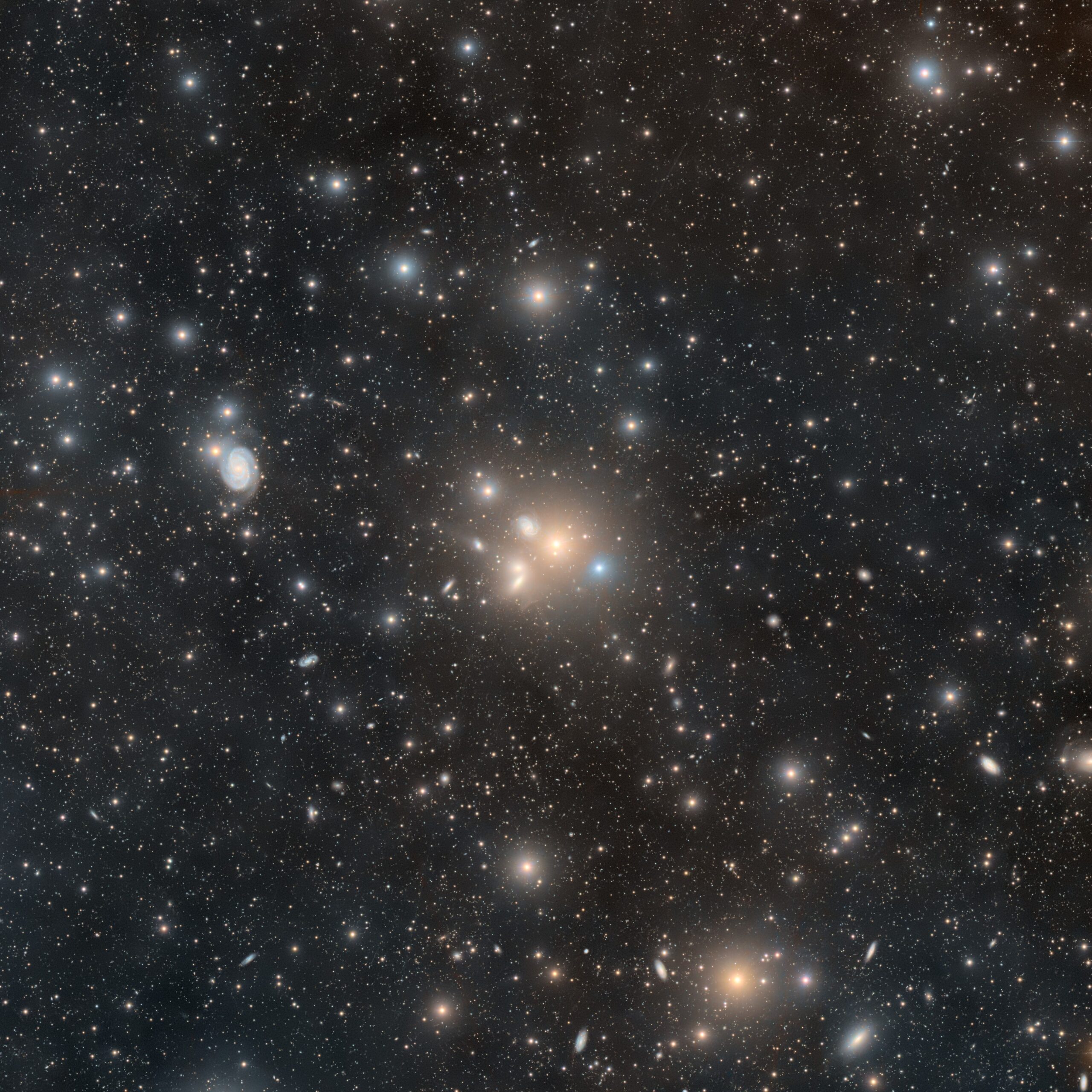
One year earlier, in 2018, I had received a wide-field dataset of the same region from Deep Sky West. The wide-field image provided valuable context by showing the galaxy group within its larger surroundings. It highlighted numerous additional galaxies scattered across the field. Together, the two datasets offered complementary perspectives: the Deep Sky West image emphasizing the group’s environment while the 2019 dual-rig image focused on the finer structural details of its member galaxies.
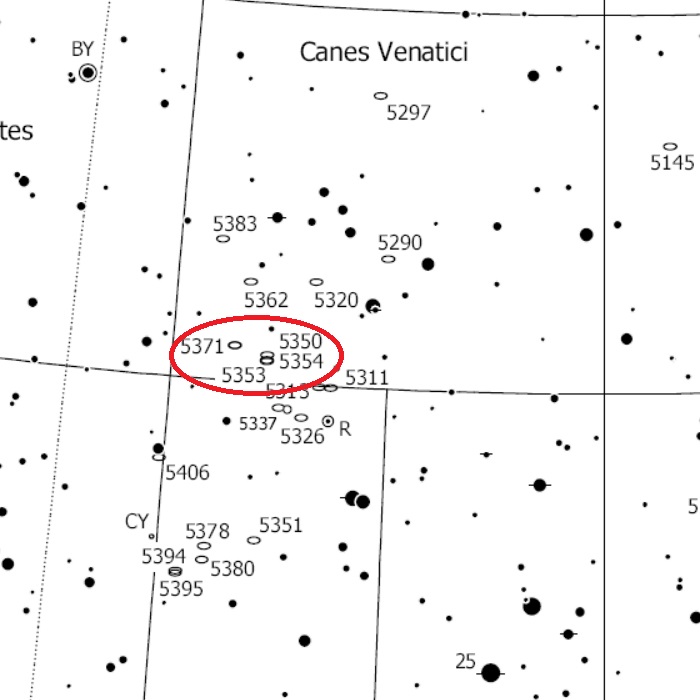
Hickson Compact Group 68, often abbreviated HCG 68, is located in the constellation Canes Venatici at a distance of approximately 100 million light-years. It is one of the most attractive and best-known compact galaxy groups in the northern sky. The group is dominated by the galaxies NGC 5353, NGC 5354, NGC 5350, NGC 5355, and NGC 5358.
Compact galaxy groups are particularly interesting because their members lie relatively close together and interact gravitationally over long periods of time. Such interactions can distort galactic structures. They can trigger bursts of star formation and eventually lead to mergers. HCG 68 therefore provides astronomers with an excellent laboratory for studying the effects of galactic encounters and the long-term evolution of galaxies in dense environments.
The largest member, NGC 5350, is a beautiful barred spiral galaxy with prominent dust lanes and active star-forming regions. In contrast, NGC 5353 and NGC 5354 are more evolved systems dominated by older stellar populations. Their close proximity suggests that gravitational interactions have played an important role in shaping the group over billions of years.
Another prominent object visible in both datasets is NGC 5371, located a short distance from the core of HCG 68. Although not considered a member of the compact group itself, NGC 5371 is one of the most impressive galaxies in the wider field. It is situated at a distance of approximately 100 million light-years and is a large barred spiral galaxy with a bright central bar and well-developed spiral arms rich in star-forming regions. Deep images reveal numerous knots of young stars embedded within the arms, along with delicate dust structures extending throughout the disk.
The combination of the wide-field Deep Sky West dataset from 2018 and the high-resolution dual-rig image from 2019 provides a comprehensive view of this remarkable galaxy group. Together, the images highlight both the beauty of the individual galaxies and the dynamic gravitational relationships that connect them, offering a fascinating glimpse into the ongoing evolution of galaxies in a crowded cosmic neighborhood.
For my 2019 data the calibration and registration and the final processing was done with PixInsight. The RGB Data was upscaled to the luminance data. The result was as follows:
For my 2019 data, the calibration, registration, and final processing were done with PixInsight. The RGB data was upscaled to the luminance data. The result was as follows:
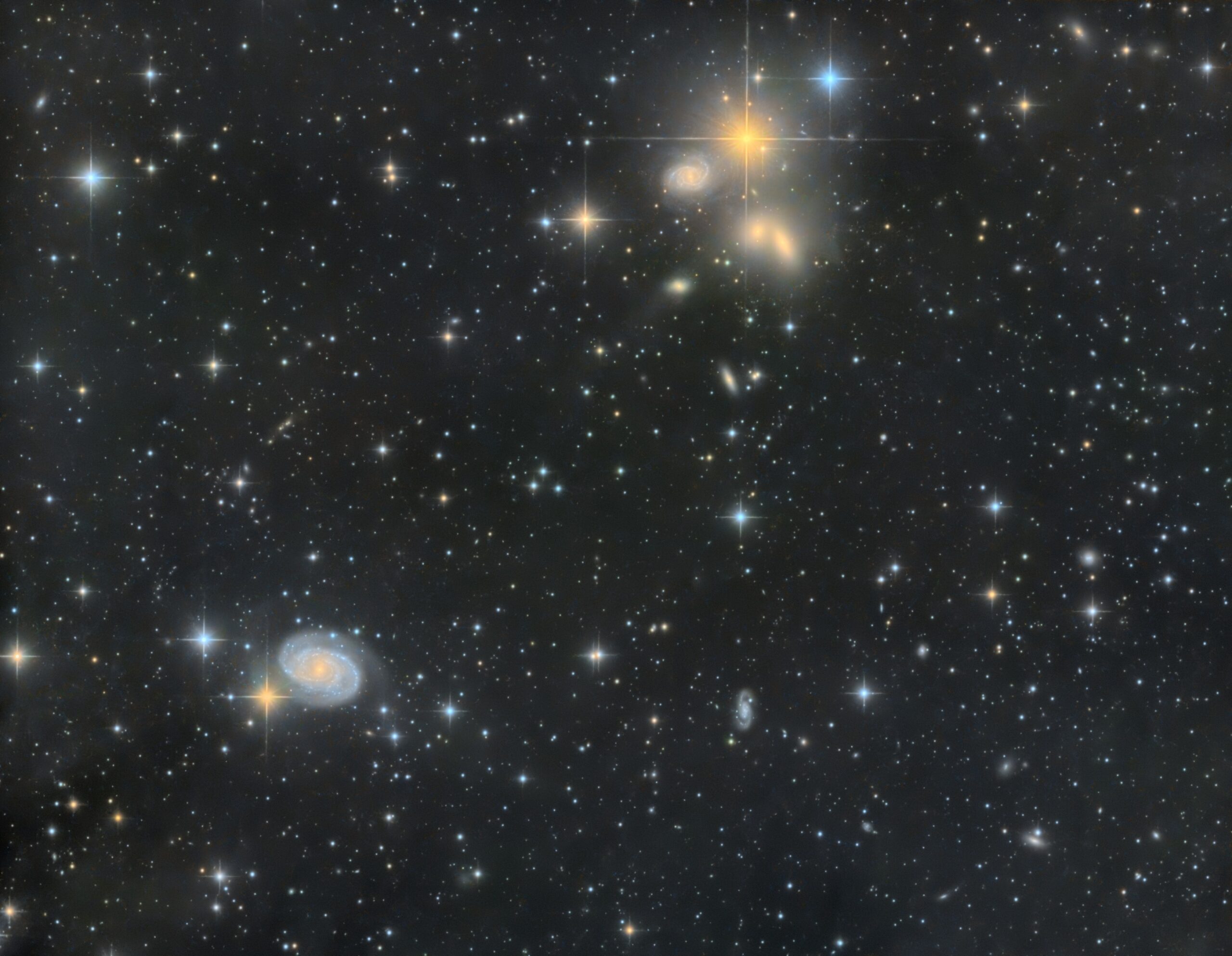
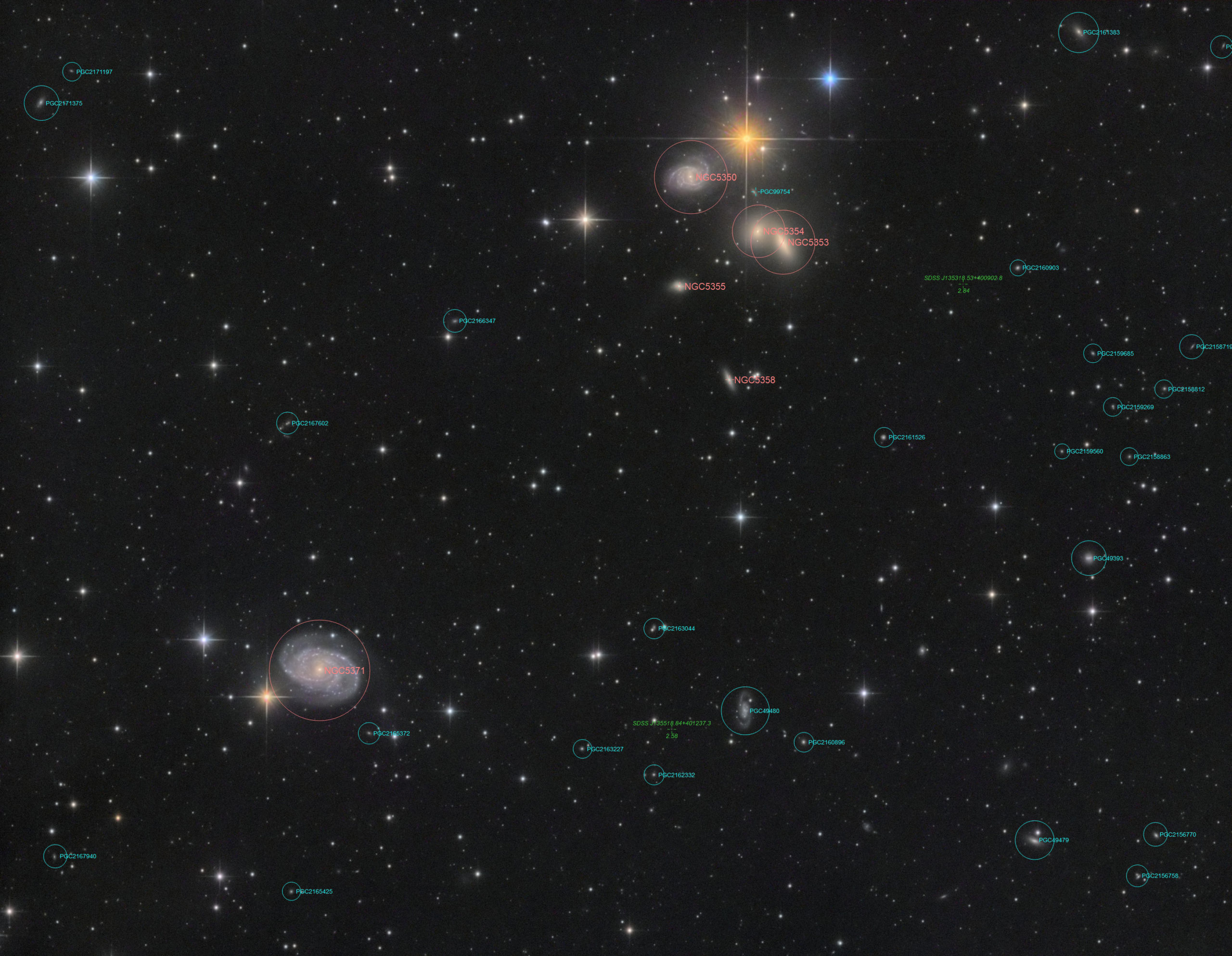
The faintest star in my image has an apparent magnitude of 21.7 magG (SDSS DR15).
The two highest redshift quasars [Flesh 2015] in the image are:
SDSS J135318.53+400902.8 z=2.84 magG=21.0 (Gaia DR2)
SDSS J135518.84+401237.3 z=2.58 magG=20.6 (Gaia DR2)
Here is an overview of the used equipment and the exposure times:
- Date: 2019
- Location: Krefeld, Germany
- Telescope/Lens: 10″ Newton ohne Namen – TSQ-65ED Apo
- Focal length [mm]: 1000 – 420
- Focal ratio: 3.9 – 6.5
- Mount: Skywatcher EQ8
- Camera: Moravian G2 8300 FW – QSI 583ws
- Filter: L – RGB
- Exposure time [min]: 860 – 200:200:240
- Resolution: 1.11″/px – 2.63″/px
For the DSW data the calibration and registration and the final processing was done with PixInsight. The result was as follows:
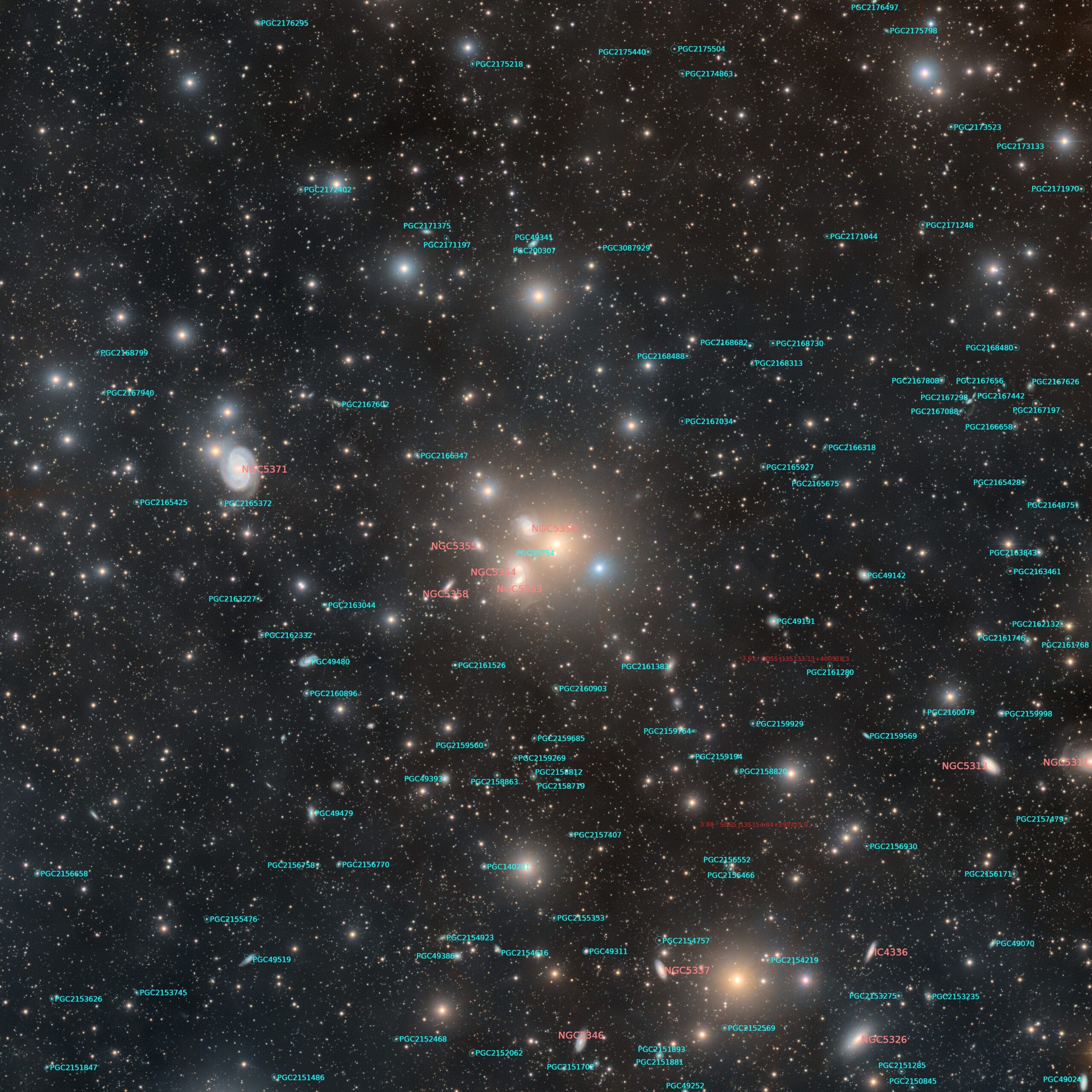
The field proved to be particularly rich in distant background objects. During the annotation process, numerous quasars were identified behind the galaxies of HCG 68 and NGC 5371. Since displaying all of them would have overcrowded the image, I chose to label only the two quasars with the highest measured redshifts.
The two highest redshift quasars [Flesh 2015] in the image are:
SDSS J135154.84+395425.8 z=3.88 magG=21.9 (SDSS 16)
SDSS J135133.13+400928.3 z=3.61 magG=21.4 (SDSS 16)
Here is an overview of the used equipment and the exposure times:
For the DSW data, the calibration, registration, and final processing were also done with PixInsight. The result was as follows:
- Date: 2018
- Location: Rowe, New Mexico
- Telescope/Lens: Astrophysics RH 305
- Focal length [mm]: 1159
- Focal ratio: 3.8
- Mount: Paramount ME
- Camera: SBIG STX 16803
- Filter: L – RG
- Exposure time [min]: 120:90:60
- Resolution: 1.66″/px



Leave a reply