

WR 134 from my „Jade“ observatory
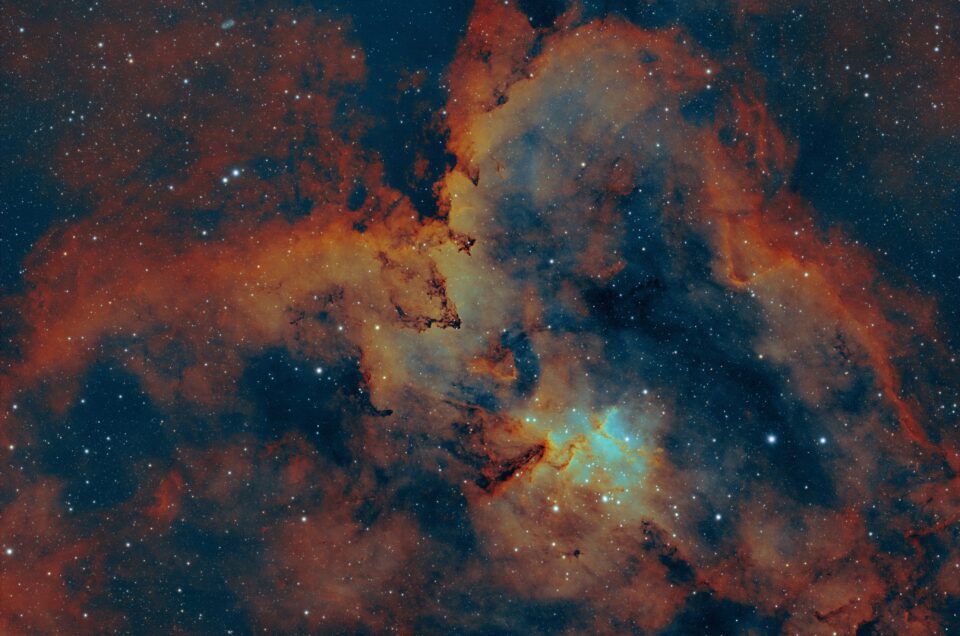
I have imaged the remarkable Wolf–Rayet nebula WR 134 on two occasions, separated by eight years and using two generations of imaging technology. The first image was captured in 2017 from my observatory in Krefeld with a CCD camera, while the most recent observations were obtained in 2025 from my observatory in Varel using a modern CMOS camera. Revisiting the same target after nearly a decade provided an excellent opportunity to compare advances in detector technology, image acquisition, and processing techniques, resulting in a significantly deeper and more detailed portrayal of this fascinating stellar environment.
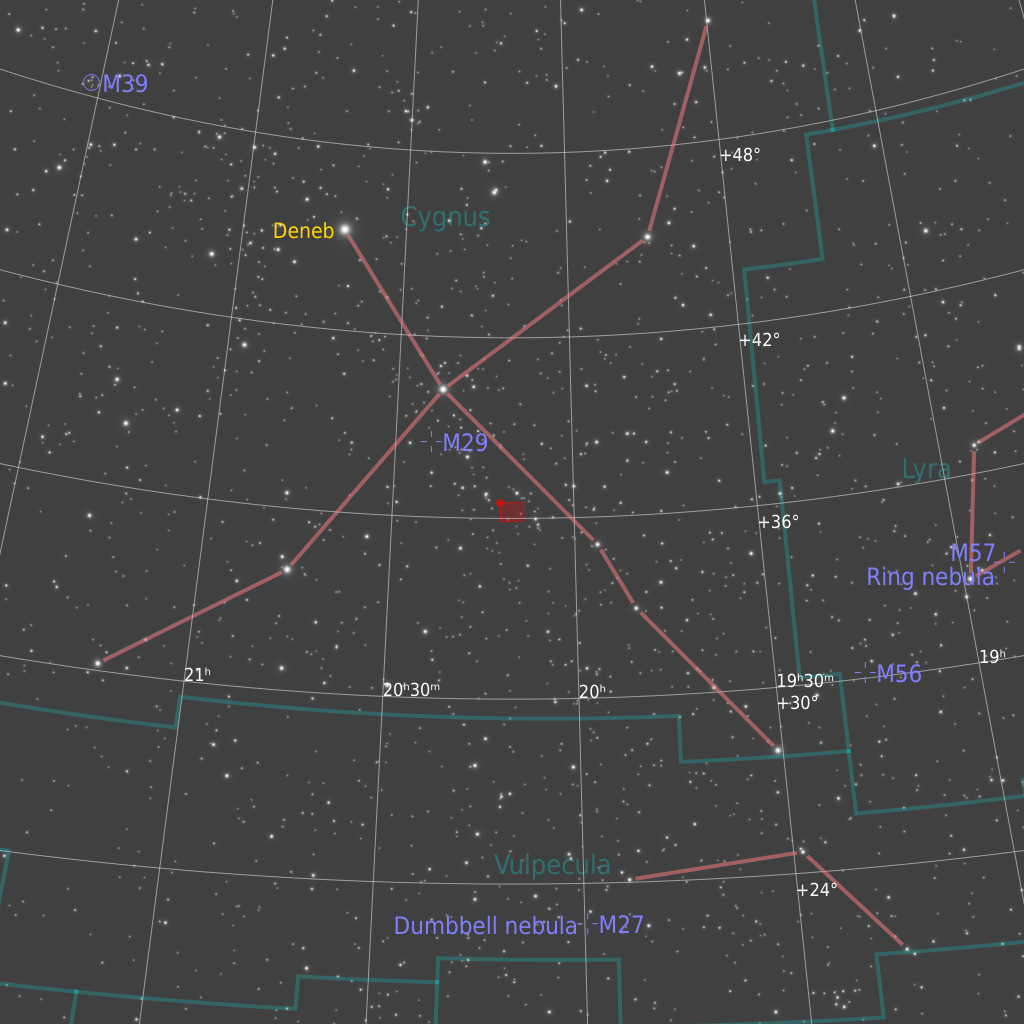
WR 134 and Sh2-104 are part of a striking Cygnus field that shows how massive stars can reshape their surroundings. WR 134 is a hot, massive Wolf–Rayet star, roughly 6,000 light-years away, with fierce stellar winds and a very high luminosity of about 400,000 times the Sun. Sh2-104 is another emission nebula in the same general area of Cygnus, and wide-field images often show it as a faint bubble-like structure in the same rich summer Milky Way backdrop.
WR 134 is a classic example of a WN-type Wolf–Rayet star, meaning its spectrum is dominated by nitrogen emission lines rather than ordinary stellar absorption features. These stars are short-lived, extremely hot, and losing mass at extraordinary rates through powerful winds. In WR 134’s case, the wind is strong enough to create a surrounding shell or arc of gas, visible in narrowband images as a blue or teal structure shaped by the star’s outflow colliding with ambient material.
The star is also variable, with brightness changes on short and longer timescales. That variability likely reflects a combination of rotation, wind structure, and possibly binarity, though the exact cause has been debated. In other words, WR 134 is not just bright; it is physically restless, with a complex atmosphere and an evolving wind geometry.
Sh2-104 is a separate emission nebula in Cygnus, but it appears in the same broad field as WR 134 in deep images. It is described as a bubble-like H II region, meaning it is a cloud of ionized hydrogen shaped by nearby massive stars and their winds. Unlike WR 134 itself, which is a stellar source driving a shell, Sh2-104 is more of a larger ionized gas structure in the background of the same region.
The two objects are useful together because they illustrate different stages and scales of stellar feedback. WR 134 is a single evolved massive star whose wind is actively carving its environment. Sh2-104 is a broader nebular bubble, likely shaped by the cumulative influence of massive stars, radiation, and expanding gas. When seen in the same image, they make a natural comparison between a point-like engine and a larger cloud response.
This region of Cygnus is especially rich in emission nebulae, and the background distances are often quoted around 5,000 to 6,000 light-years. That places WR 134 and Sh2-104 in the same general part of the Galaxy, though not necessarily in the exact same physical structure. The area is popular with astrophotographers because narrowband filters bring out delicate hydrogen and oxygen emission, revealing arcs, shells, and faint bubbles that are almost invisible in normal light.
Together, WR 134 and Sh2-104 show how massive stars influence the interstellar medium. WR 134 represents a very late, unstable evolutionary stage of a massive star, while Sh2-104 shows what a larger ionized nebula can look like when shaped by stellar radiation and winds. Studying them helps astronomers understand how feedback from massive stars drives bubbles, shells, and eventual enrichment of the Galaxy.
This is the image from 2025. Data calibration, registration and the final processing was done with PixInsight. The result was as follows:
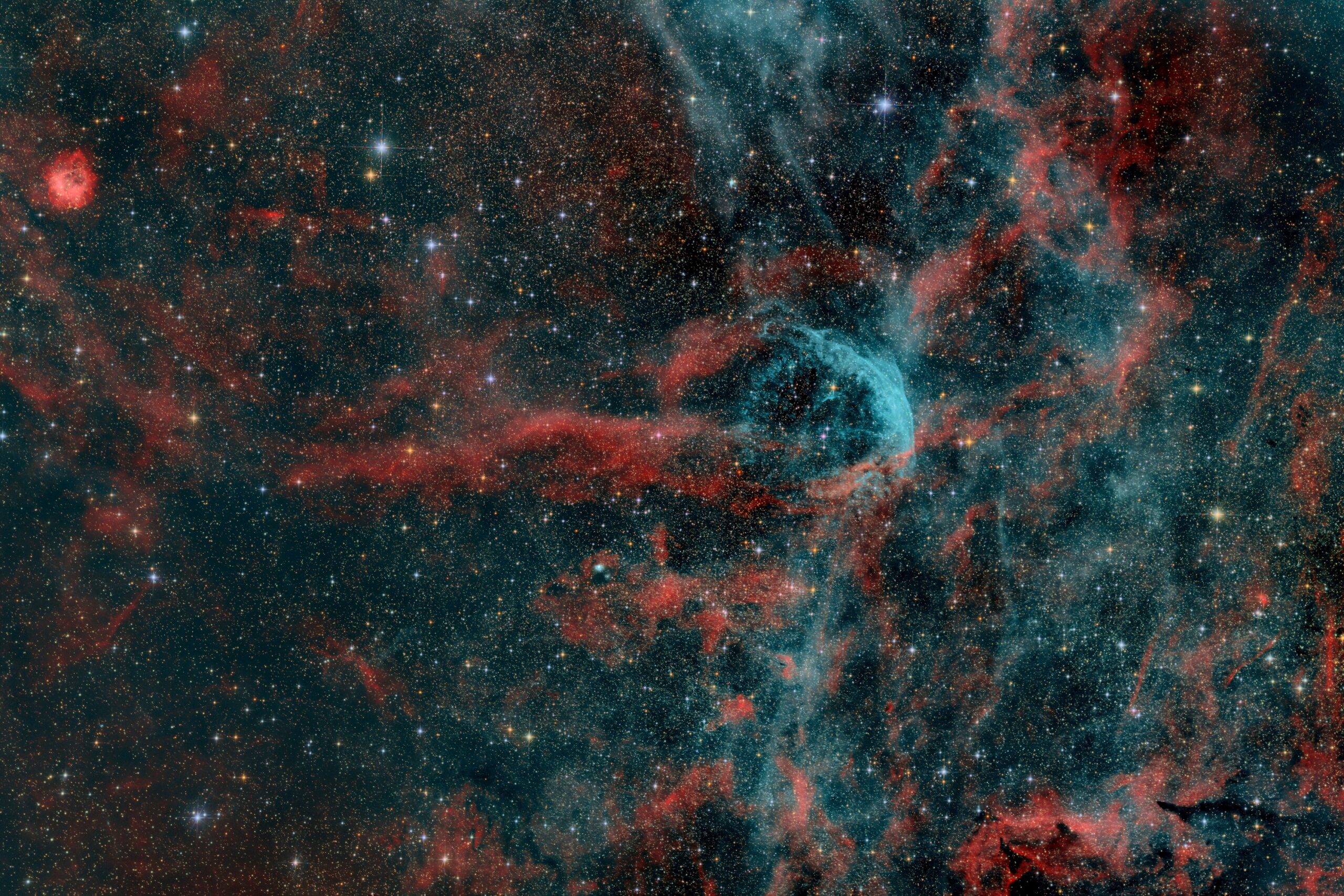
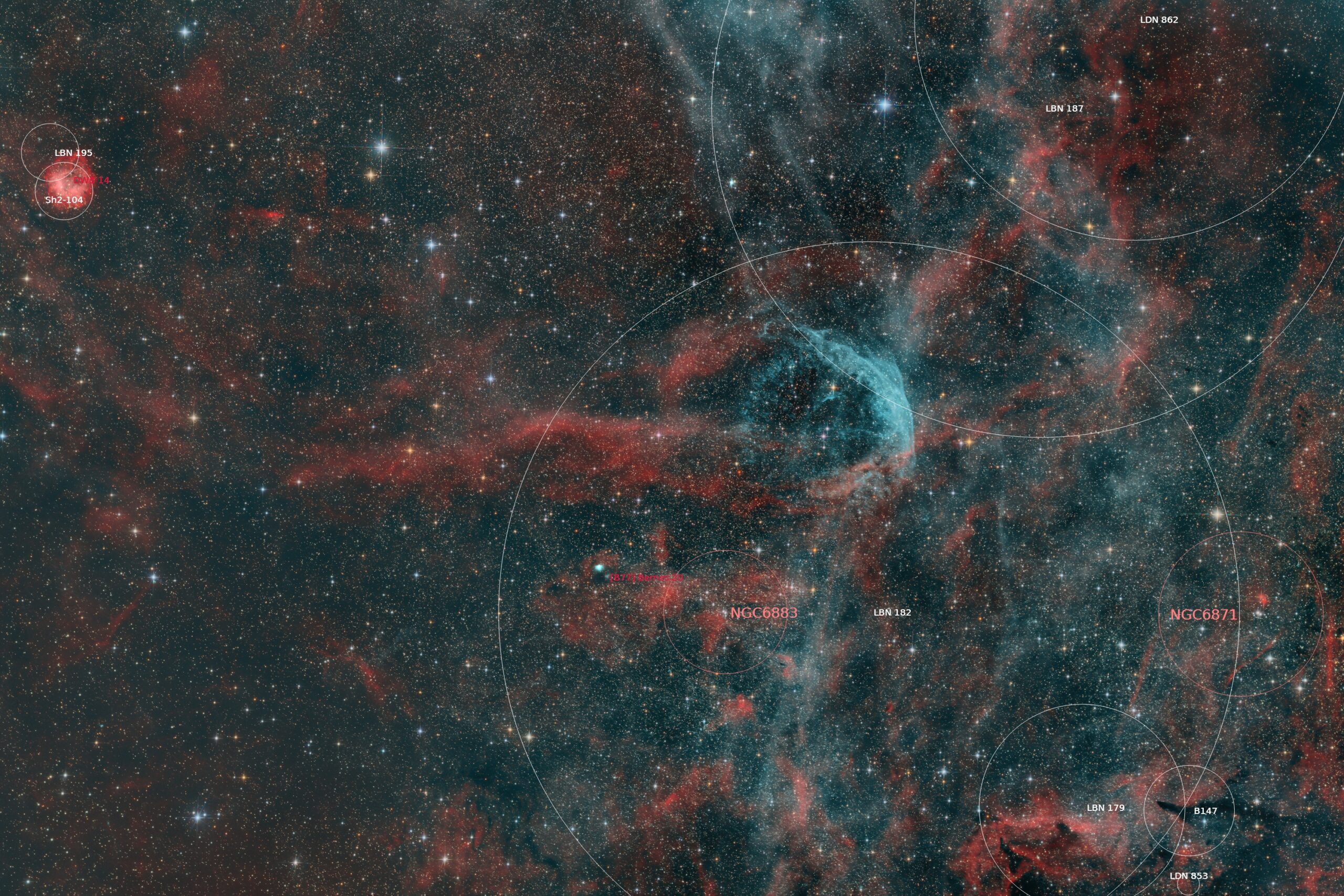
Here is an overview of the used equipment and the exposure times:
- Date: July and August 2025
- Location: Varel
- Telescope/Lense: 6″ Lacerta Newton
- Focal length [mm]: 450
- Focal ratio: 3
- Mount: Skywatcher EQ 8
- Camera: Lacerta Deepsky 2600 M
- Autoguiding: Off-Axis with ZWO Asi 120 MM Mini
- Filter: R:G:B:[Hα]:[OIII]
- Exposure time [min]: 85:80:85:250:300
- Resolution: 1.72/px
This is the image from 2017. Data calibration, registration and the final processing was done with PixInsight. The result was as follows:
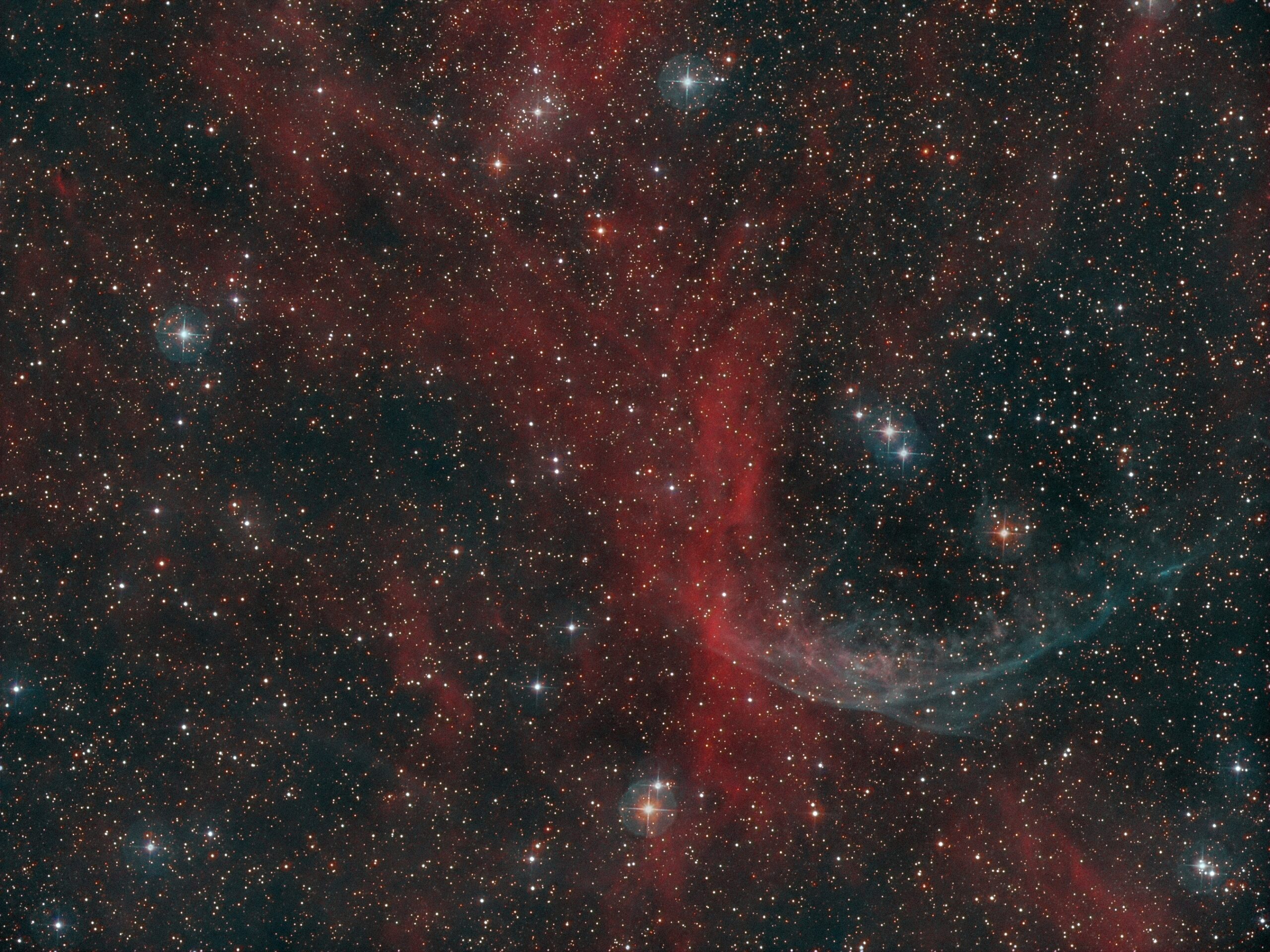
Here is an overview of the used equipment and the exposure times:
- Date: 2017
- Location: Krefeld
- Telescope/Lense: 10″ Newton ohne Namen – TS 65mm Apo
- Focal length [mm]: 1000 – 450
- Focal ratio: 3.9 – 6.5
- Mount: Skywatcher EQ 8
- Camera: Moravian 8300FW – QSI 583WS
- Filter: [Hα]:[OIII] – R:G:B
- Exposure time [min]: 170:360 – 185:180:335
- Resolution: 1.11″/px



Leave a reply