

vdB 31 from remote
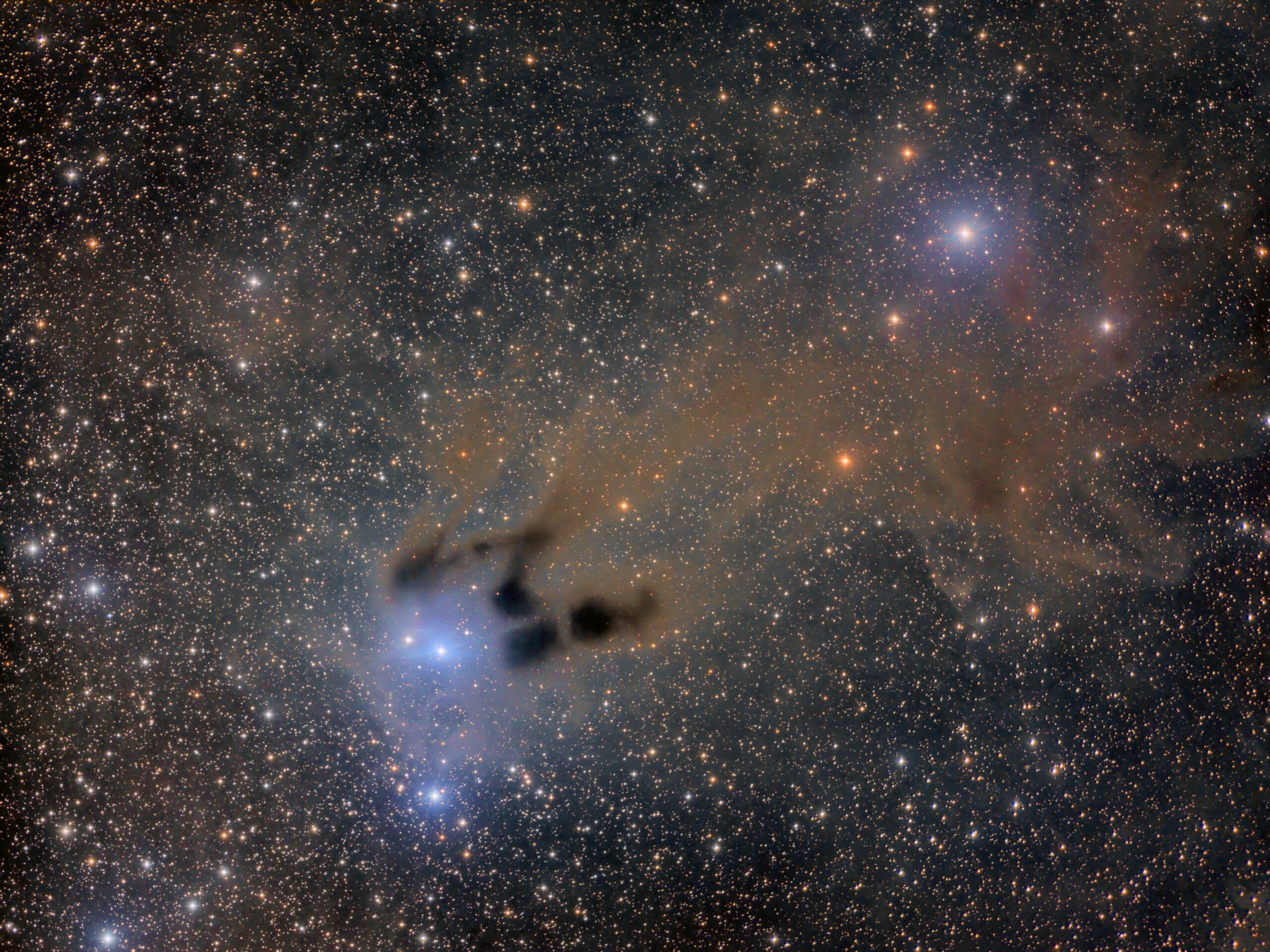
I have been subscribing to data from the Deep Sky West (DSW) Observatory in New Mexico for some time. DSW offers several fully equipped telescopes, providing high-quality remote datasets for astrophotographers. One of the datasets I received featured the reflection nebula vdB 31 along with the surrounding dark nebulae located in the constellation Auriga.
VdB 31 is a bright reflection nebula in Auriga, famous for surrounding the young Herbig Ae/Be star AB Aurigae. It is the 31st entry in Sidney van den Bergh’s 1966 catalog of reflection nebulae and is often shown together with the dark clouds Barnard 26, 27, and 28.
Unlike an emission nebula, VdB 31 does not shine because gas is ionized. Instead, dust grains scatter the light of AB Aurigae, and because dust scatters blue light more efficiently than red, the nebula looks strikingly blue. The nebula is part of a much larger dusty environment in Auriga, with dark clouds nearby that block background starlight. Those dark lanes and the blue reflection nebula make the region look like a carefully arranged cosmic still life.
AB Aurigae is the real engine behind the scene. It is a young, hot star surrounded by a flattened dusty disk, and Hubble observations have shown spiral structure in that disk, suggesting planet formation may be underway. That makes VdB 31 interesting for two reasons at once: it is a beautiful reflection nebula, and it is connected to one of the best-studied protoplanetary systems nearby. In that sense, the nebula is a visible signpost for an actively forming planetary system.
AB Aurigae, and therefore VdB 31, lies at about 470 light-years from Earth. At that distance, the whole visible complex would span roughly eight light-years across. That is huge compared with the star itself, but still compact enough that the bright blue nebula, dark dust patches, and embedded star all fit into a single wide field. Because of its relatively nearby distance, VdB 31 is a good object for studying how dust reflects starlight in detail.
Astronomers value VdB 31 because it combines three important ingredients: a young star, a protoplanetary disk, and surrounding interstellar dust. The reflection nebula tells us about dust geometry and scattering, while the disk around AB Aurigae gives clues to planet formation. The nearby Barnard dark clouds add another layer by showing where opaque dust lies in front of background stars. Together they create a very rich target for both astrophotography and star-formation research.
The resulting image reveals the delicate bluish glow of the reflection nebula contrasted against the intricate dark lanes of interstellar dust, highlighting the subtle interplay of light and shadow in this richly structured region of Auriga.
The data calibration, registration, and final image processing were all performed in PixInsight.

The images were taken with the following equipment:
- Location: Rowe, New Mexico
- Telescope/Lens: Takahashi FSQ_106
- Focal length [mm]: 530
- Focal ratio: 5
- Mount: Paramount MyT
- Camera: QSI 683-WSG-8
- Filter: L:R:G:B
- Exposure time [min]: 310:370:330:250
- Resolution: 2.08″/px




Leave a reply