

vdB 152 and PK111+11.1 from remote
From time to time, I obtain imaging datasets from professional remote observatories around the world. One of my preferred providers is Insight Observatory, whose high-quality instrumentation and excellent observing sites make it possible to image even the faintest deep-sky objects. In 2023, I received two complementary datasets of the beautiful reflection nebula vdB 152. One was acquired with a CCD camera at the observatory in New Mexico, while the second was captured using a modern CMOS camera at another facility in the United States. Processing both datasets provided an interesting opportunity to compare the characteristics of the two detector technologies while producing a detailed final image.
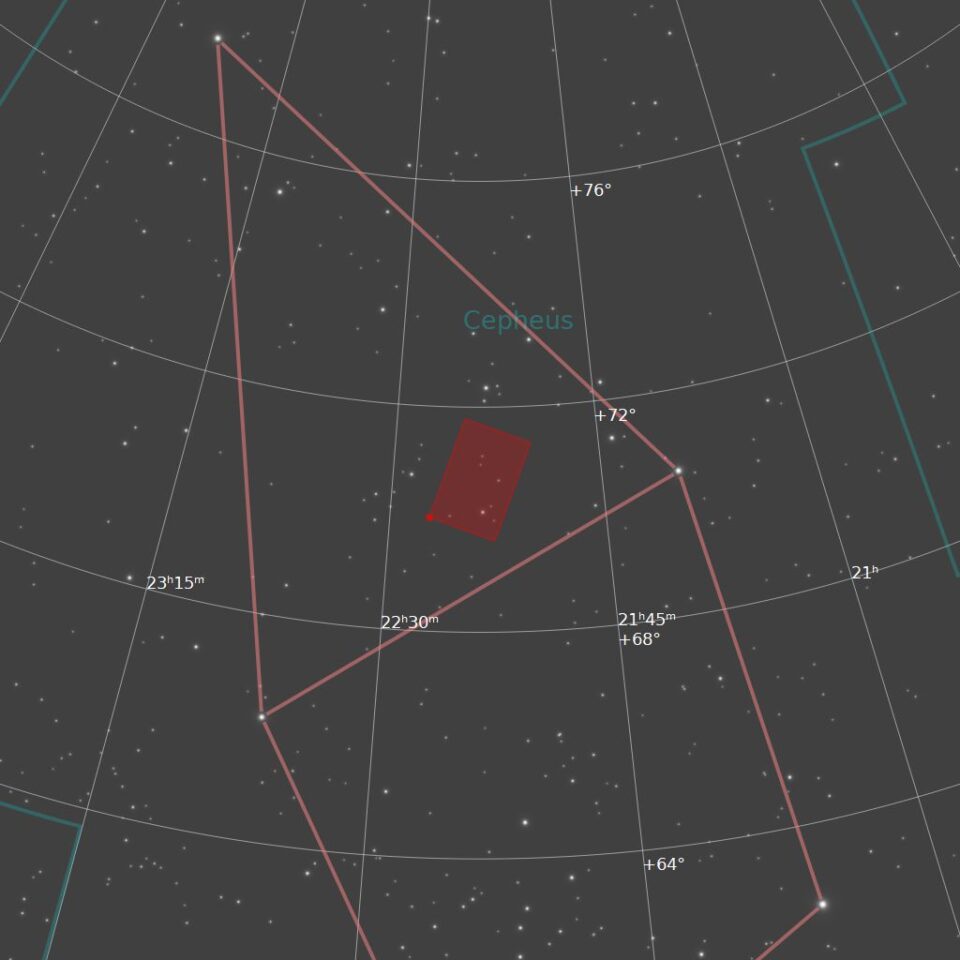
vdB 152 is a small but beautiful reflection nebula in Cepheus, often nicknamed the Wolf’s Cave Nebula or the Capercaillie because of its dark, animal-like silhouette. It sits at the edge of the Cepheus Flare, a dusty and gas-rich region where interstellar clouds, young stars, and dark globules create a very active star-forming environment.
The nebula is illuminated by the star SAO 10287, also cataloged as BD +69 1231, a bright star embedded in the cloud. Reflection nebulae do not shine by themselves; they glow because nearby starlight is scattered by tiny dust grains, which is why vdB 152 looks blue in many images. The surrounding cloud is Barnard 175, a dark nebula that blocks background starlight and helps give the region its dramatic contrast.
vdB 152 lies about 1,300 to 1,400 light-years away in Cepheus. It was first noticed by August Kopff in 1908 and later cataloged by Sidney van den Bergh in his reflection nebula catalog. Van den Bergh classified it as a Type I reflection nebula, meaning the illuminating star is embedded inside the cloud rather than sitting off to the side.
PK111+11.1 is a planetary nebula in the same general field, also known as Dengel-Hartl 5. It is much smaller and more compact than vdB 152, but in deep wide-field images it can be seen as a separate, distinct object in the upper-left area of the scene. Planetary nebulae are not related to planets; they are the glowing shells of gas shed by dying Sun-like stars, later ionized by the hot remnant core.
In this field, PK111+11.1 adds an extra layer of evolutionary contrast: beside a dust-scattered reflection nebula and a dark molecular cloud, there is also the remnant of a star reaching the end of its life. That mix is part of what makes the region so rich to observe and image.
The area around vdB 152 is crowded with more than just these two objects. There is also the supernova remnant SNR G110.3+11.3 crossing the field, and the Wolf’s Cave region includes a small Herbig-Haro object and other faint dust structures in some deep images. That means one wide frame can show the birth, life, and death of stars all in the same celestial neighborhood: new stars forming in dust, stars reflecting light off nearby clouds, and dead stars leaving behind ionized shells.
vdB 152 is useful because it helps astronomers study how dust scatters light, how dense clouds hide or reveal star formation, and how embedded stars interact with their surroundings. PK111+11.1 adds an evolved stellar endpoint to the same image, making the field a neat example of how different kinds of nebulae can coexist in projection. For astrophotographers, the combination of blue reflection light, dark dust, faint red supernova filaments, and the tiny planetary nebula makes the region especially rewarding.
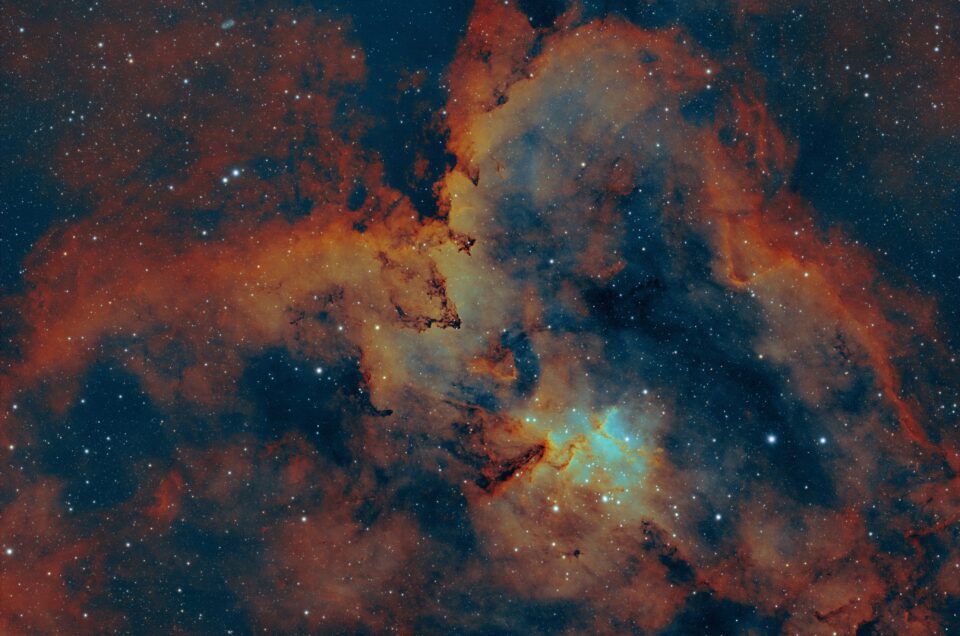
For the USA data the calibration, registration and the final processing was done with PixInsight. The result was as follows:
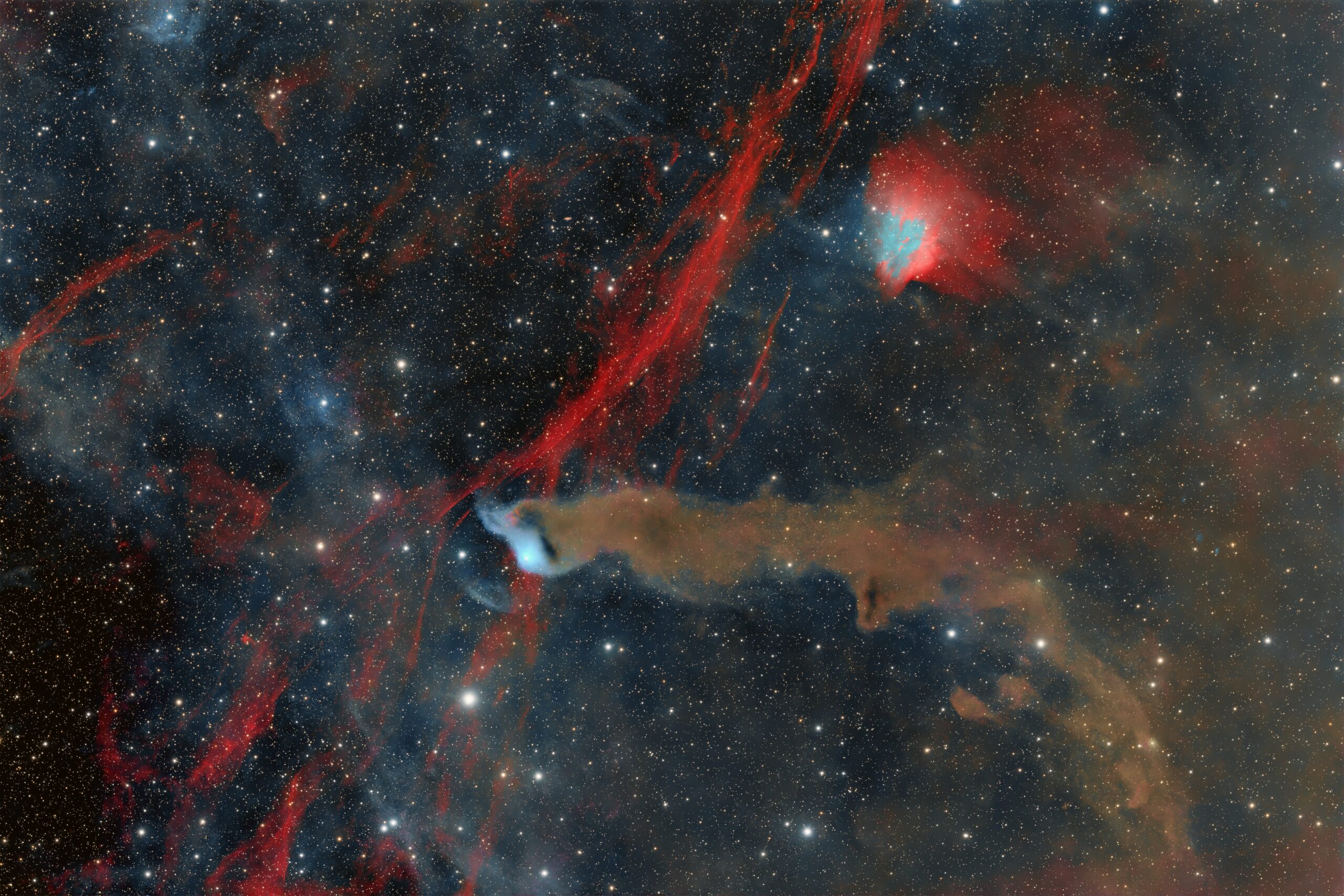
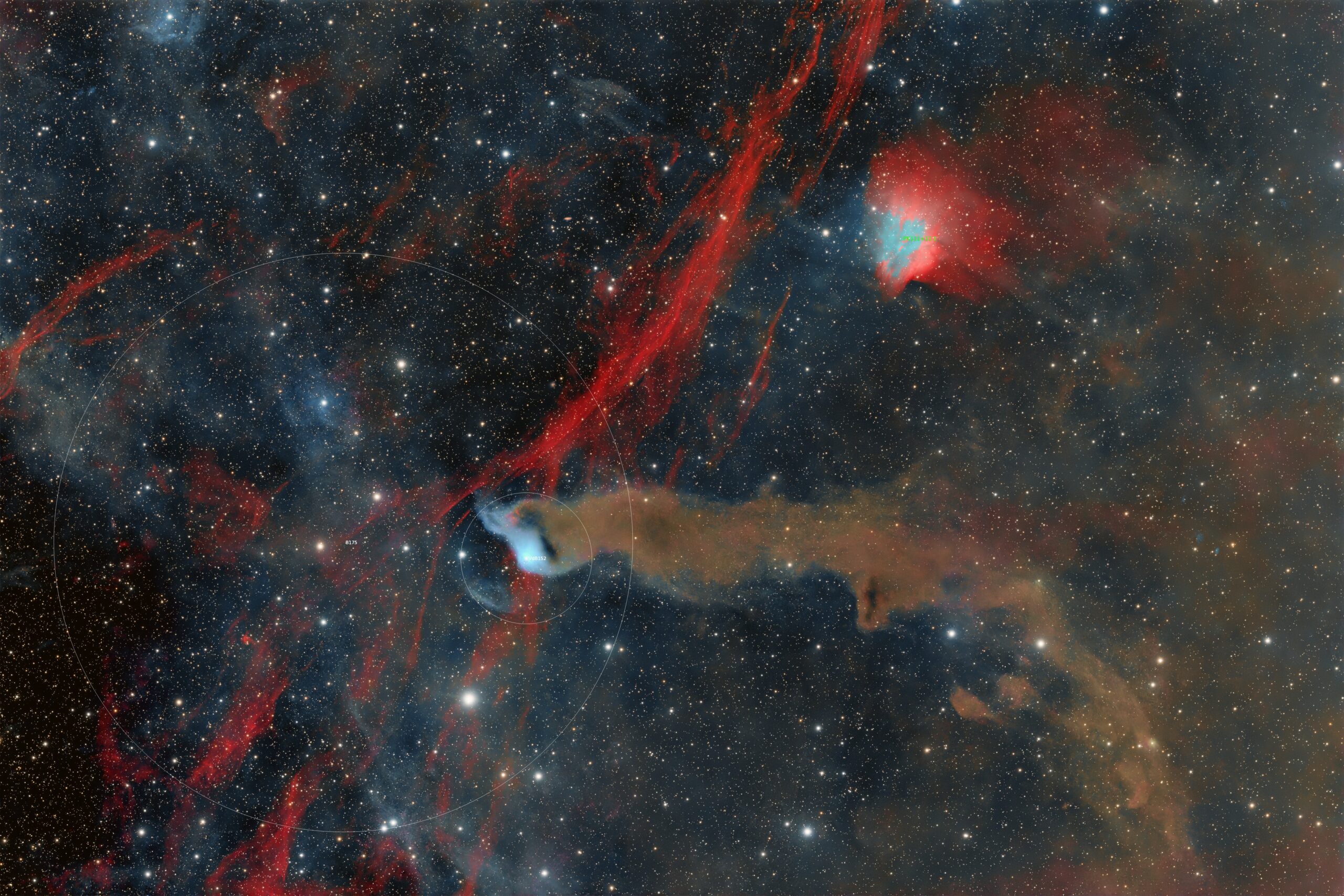
The images were taken with the following equipment:
- Date: 2023
- Location: USA
- Telescope/Lense: Skywatcher Esprit 100
- Focal length [mm]: 500
- Focal ratio: 5
- Mount: Paramount ME
- Camera: Skywatcher EQ6R-Pro
- Filter: L:R:G:B:Ha:[OIII]
- Exposure time [min]: 498:85:90:78:1150:340
- Resolution: 1.23″/px
Data calibration and registration and the final processing was done with PixInsight. The result was as follows:
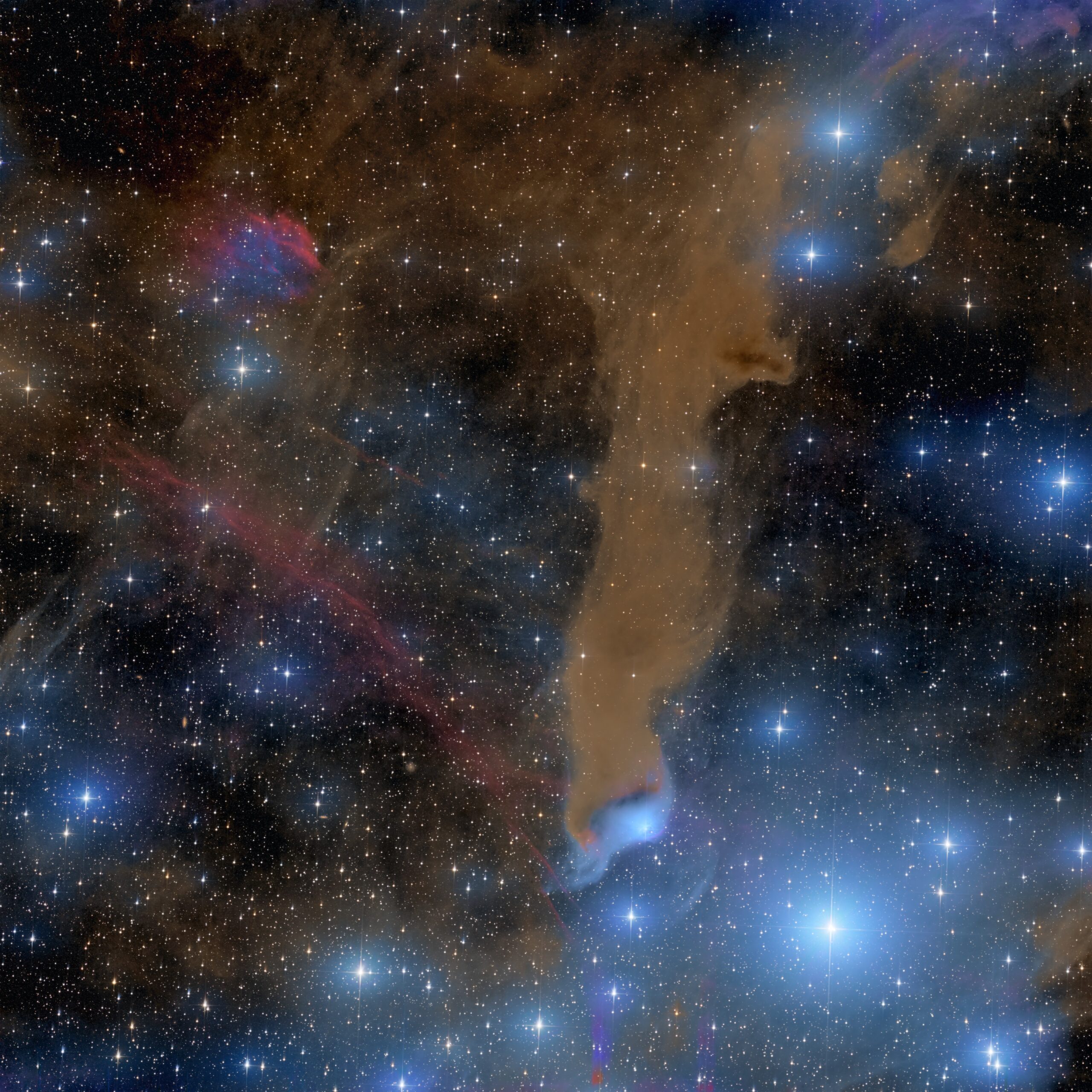
The images were taken with the following equipment:
- Location: Pie Town, New Mexico
- Telescope/Lense: Dreamscope 16″ f/3.7 Astrograph
- Focal length [mm]: 1525
- Focal ratio: 3.75
- Mount: Paramount ME
- Camera: FLI Proline 16803
- Filter: L:R:G:B
- Exposure time [min]: 75:65:65:65
- Resolution: 1.23″/px



Leave a reply