

vdB 14 and vdB 15 from my Jade Observatory
In 2025, I captured deep images of vdB 14 and vdB 15 from my Jade Observatory.
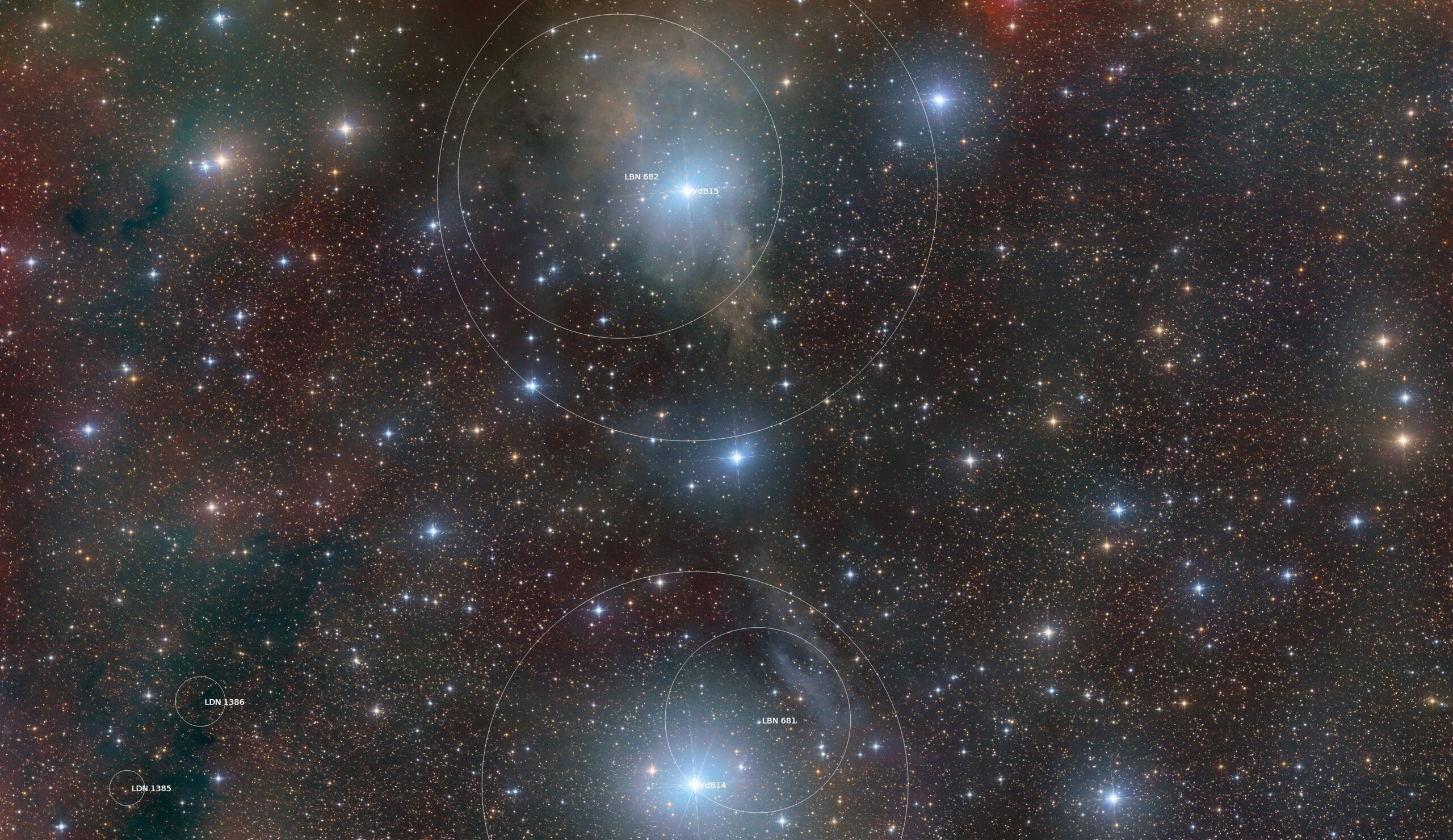
VdB 14 and VdB 15 are a pair of faint reflection nebulae in Camelopardalis, the Giraffe, embedded in a larger dust cloud in the Milky Way’s Local Arm and part of the van den Bergh (vdB) catalog of reflection nebulae. They are usually described together because they sit close to each other on the sky and are lit by nearby hot, blue stars from the Camelopardalis OB1 association.
Unlike emission nebulae, reflection nebulae do not glow from ionized gas; they shine by scattering starlight off tiny dust grains. That is why VdB 14 and VdB 15 look blue in many images. VdB 15 is the larger cloud on the left, wrapping around the brighter star C Cam, while VdB 14 is the smaller, sickle-shaped nebula on the right near B Cam.
The pair lies about 2,600 light-years away and is part of a much larger star-forming environment in Camelopardalis. The field is dusty enough that star counts drop off noticeably in some directions, which shows how much intervening material is present. That dusty environment is also why faint emission and reflection structures appear together in the same region.
These nebulae are interesting because they sit in a complex where massive, young stars, dust clouds, and weak emission structures all overlap. Astronomers and astrophotographers value them as a clean example of blue reflection nebulosity illuminated by bright stars in a rich dusty background. They are also relatively obscure targets, so deep images often reveal more structure than casual surveys do.
Data calibration, registration and the final processing was done with PixInsight. The result was as follows:

The images were taken with the following equipment:
- Date: 2025
- Location: Varel, Germany
- Telescope: 6″ Lacerta Newton
- Focal length [mm]: 450
- Focal ratio: 3
- Mount: Skywatcher EQ8
- Camera: Lacerta DeepSkyPro 2600
- Filter: L:R:G:B:Hα
- Exposure time [min]: 180:245:240:230:180
- Resolution: 1.72″/px



Leave a reply