• Home
  • Blog
  • Astrophotography
    • Deep Sky
      • Galaxies (Galaxien)
      • Nebulae (Nebel)
      • Planetary Nebulae (Planetarische Nebel)
      • Globular Clusters (Kugelsternhaufen)
      • Open Clusters (Offene Sternhaufen)
      • Miscellaneous (Verschiedenes)
    • Solar System (Sonnensystem)
      • Comets (Kometen)
      • Moon (Mond)
      • Planets (Planeten)
      • Sun (Sonne)
  • Archiv

    • Juli 2026
    • Juni 2026
    • Mai 2026
    • April 2026
    • Dezember 2025
    • November 2025
    • Oktober 2025
    • September 2025
    • August 2025
    • Juli 2025
    • Juni 2025
    • Mai 2025
    • April 2025
    • März 2025
    • Januar 2025
    • Dezember 2024
    • November 2024
    • Oktober 2024
    • September 2024
    • August 2024
    • Juli 2024
    • Juni 2024
    • Mai 2024
    • April 2024
    • März 2024
    • Februar 2024
    • Januar 2024
    • November 2023
    • Oktober 2023
    • September 2023
    • August 2023
    • Juli 2023
    • Juni 2023
    • Mai 2023
    • April 2023
    • März 2023
    • Februar 2023
    • Januar 2023
    • Dezember 2022
    • November 2022
    • Oktober 2022
    • September 2022
    • August 2022
    • Juni 2022
    • Mai 2022
    • April 2022
    • März 2022
    • Februar 2022
    • Januar 2022
    • Dezember 2021
    • November 2021
    • September 2021
    • August 2021
    • Juli 2021
    • März 2021
    • Februar 2021
    • November 2020
    • September 2020
    • August 2020
    • April 2020
    • März 2020
    • Februar 2020
    • Januar 2020
    • Dezember 2019
    • November 2019
    • Oktober 2019
    • September 2019
    • August 2019
    • Mai 2019
    • April 2019
    • März 2019
    • Dezember 2018
    • November 2018
    • Oktober 2018
    • September 2018
    • Juni 2018
    • Mai 2018
    • April 2018
    • März 2018
    • Februar 2018
    • Januar 2018
    • Oktober 2017
    • Juli 2017
    • Juni 2017
    • Januar 2017
    • Dezember 2016
    • September 2016
    • Mai 2016
    • März 2016
    • November 2015
    • Oktober 2015
    • Juli 2015
    • Mai 2015
    • März 2015
    • Februar 2015
    • September 2014
    • August 2014
    • März 2014
    • Februar 2014
    • Oktober 2013
    • September 2013
    • August 2013
    • April 2013
    • März 2013
    • November 2012
    • August 2012
    • Juli 2012
    • Mai 2012
    • März 2012
    • Januar 2012
    • November 2011
    • Oktober 2011
    • September 2011
    • August 2011
    • April 2011
    • März 2011
    • Oktober 2010
    • September 2010
    • August 2010
    • Juli 2010
    • April 2010
    • Juli 2009
    • Juli 2008
    • Januar 2008
    • Oktober 2007
    • Juli 2007
    • Februar 2007
    • Juni 2006
    • Oktober 2005
    • September 2005
    • August 2005
    • Januar 2005
  • Kategorien

    • Asterism
    • Astrophotography
    • Barnard
    • Comet
    • Galaxies
    • Globular Cluster
    • IC
    • Messier
    • Moon
    • Nebula
    • NGC
    • Open cluster
    • Photography
    • Planetary Nebula
    • Travel
  • Meta

    • Anmelden
    • Eintrags-Feed
    • Kommentar-Feed
    • WordPress.org
  • Privacy Policy
  • Impressum
  • Haftungsausschluss
  • Cookie-Richtlinie
  • Datenschutzerklärung

wonderfuluniverse.de
  • Home
  • Blog
  • Astrophotography
    • Deep Sky
      • Galaxies (Galaxien)
      • Nebulae (Nebel)
      • Planetary Nebulae (Planetarische Nebel)
      • Globular Clusters (Kugelsternhaufen)
      • Open Clusters (Offene Sternhaufen)
      • Miscellaneous (Verschiedenes)
    • Solar System (Sonnensystem)
      • Comets (Kometen)
      • Moon (Mond)
      • Planets (Planeten)
      • Sun (Sonne)

Sharpless 82 – from remote


In 2025, I received a high-quality LRGB dataset of Sharpless-82 from Hellas Sky on the island of Crete. The data were made available to participants in the Hellas Sky Summer Contest, offering an excellent opportunity to process professional-grade astronomical data acquired under the exceptionally dark skies of southern Greece. The deep LRGB dataset reveals the nebula’s intricate emission structures while preserving the natural colors of the dense Milky Way star fields surrounding it.

Sh2-82 is a compact, mixed emission–reflection nebula in the constellation Sagitta, often nicknamed the Little Cocoon or Little Trifid Nebula because it resembles smaller versions of those famous objects.

Sh2-82 lies in the rich Milky Way star fields of Sagitta (the Arrow), in a heavily obscured region threaded with dark dust clouds. Its sky position is around right ascension 19h 29–30m and declination +18°, with an apparent size of only several arcminutes, making it much smaller than nebulae like the Trifid or the larger Cocoon. Distance estimates cluster around roughly 3,500–4,000 light‑years, placing it on the inner edge of the Orion (or Sagittarius) spiral arm of our Galaxy. The nebula is catalogued under several alternative designations, including LBN 29 and Bernes 17, and appears in lists of star‑forming regions as entry 843 in Avedisova’s catalogue.

Physically, Sh2-82 is an H II region embedded in a dark molecular cloud, wrapped in a reflection nebula; in other words, it is an active star‑forming pocket of gas and dust. The bright red emission core is produced by hydrogen gas ionized by the intense ultraviolet radiation of a hot, young, massive star at the center. That star is HD 231616, a blue main‑sequence or giant B0.5 star with a visual magnitude around 10, which provides most of the ionizing flux for the nebula.

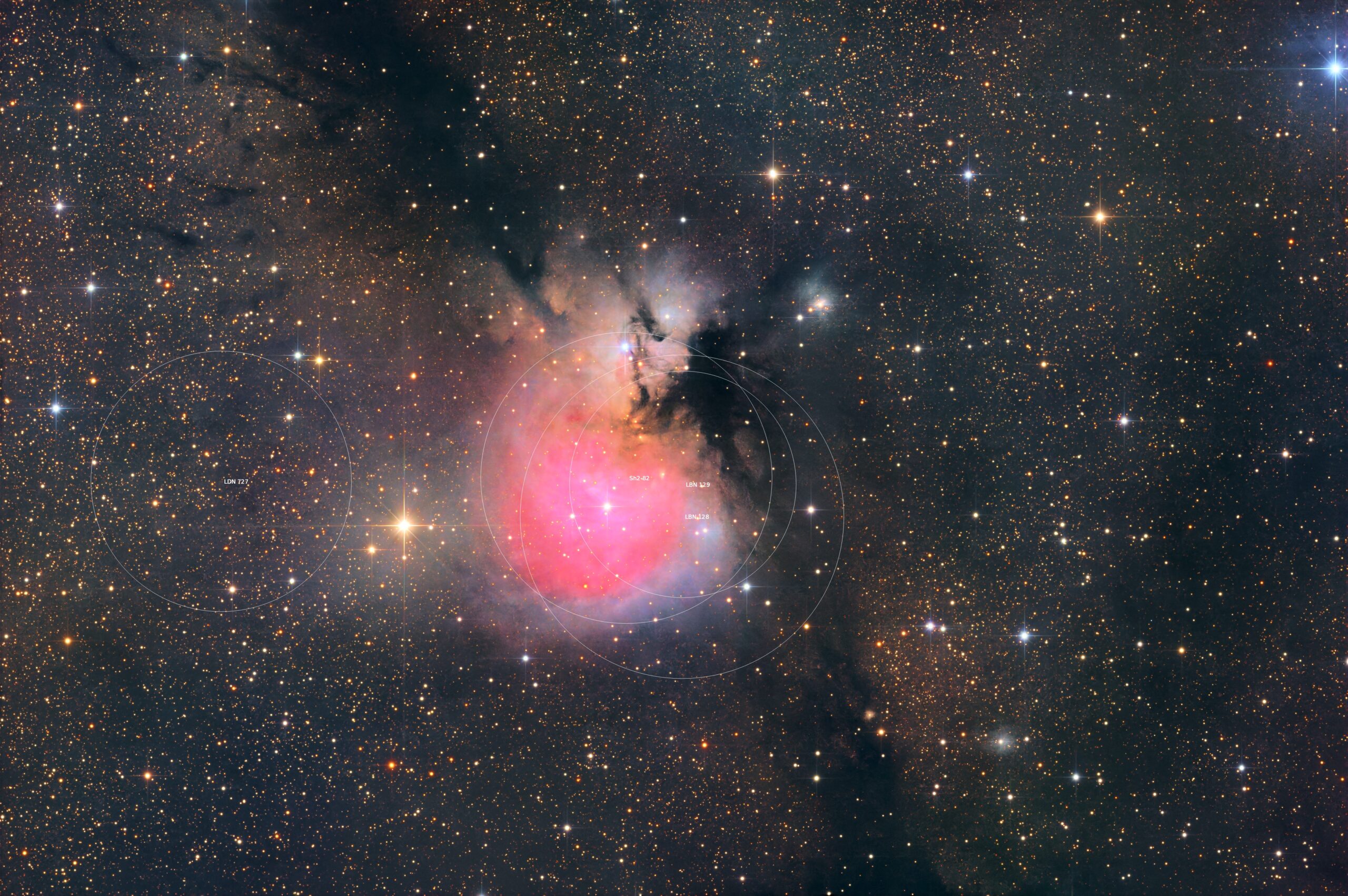
Surrounding the emission region is a bluish reflection component, created when starlight is scattered by dust grains in the foreground dark cloud, notably the Lynds dark nebula LDN 727. This reflected light forms a cocoon‑like halo that bulges more strongly on one side, giving rise to the “Little Cocoon” nickname and to visual comparisons with IC 5146 (the Cocoon Nebula) and M20 (the Trifid Nebula).

Observations at infrared and radio wavelengths show that Sh2-82 hosts ongoing star formation. Several infrared sources have been detected within the cloud, including one object catalogued as IRAS 19282+1814 that coincides with methanol maser emission, a classic sign of a deeply embedded massive protostar. Compact radio sources of small angular diameter have also been identified, which further indicates that young stellar objects and dense ionized regions are developing inside the nebula. In broader Galactic context, Sh2-82 lies near the OB association Vulpecula OB4, a group of young, hot stars thought to have formed from the same large molecular complex.

Visually and in images, Sh2-82 shows a bright, roughly circular emission core about 5–9 arcminutes across, wrapped in a more diffuse, asymmetric reflection halo and crossed by nearby dark dust lanes. Deep photographs reveal a striking mix of red hydrogen emission, bluish reflection nebulosity, and silhouetted clouds, closely echoing the aesthetic of the larger Trifid Nebula but on a much smaller scale.

For observers, Sh2-82 is a relatively challenging target because it is small and lies in a cluttered, dusty Milky Way field, but it rewards long‑exposure imaging, especially with hydrogen‑alpha and O III filters that emphasize its ionized gas structures. From mid‑northern latitudes, Sagitta is well placed on late‑summer and autumn evenings, and with a moderately large telescope and suitable filters you can record both the emission core and the soft reflection halo that give this nebula its “little cocoon” character.

The data the calibration, registration, and final processing were performed in PixInsight. The result was as follows:
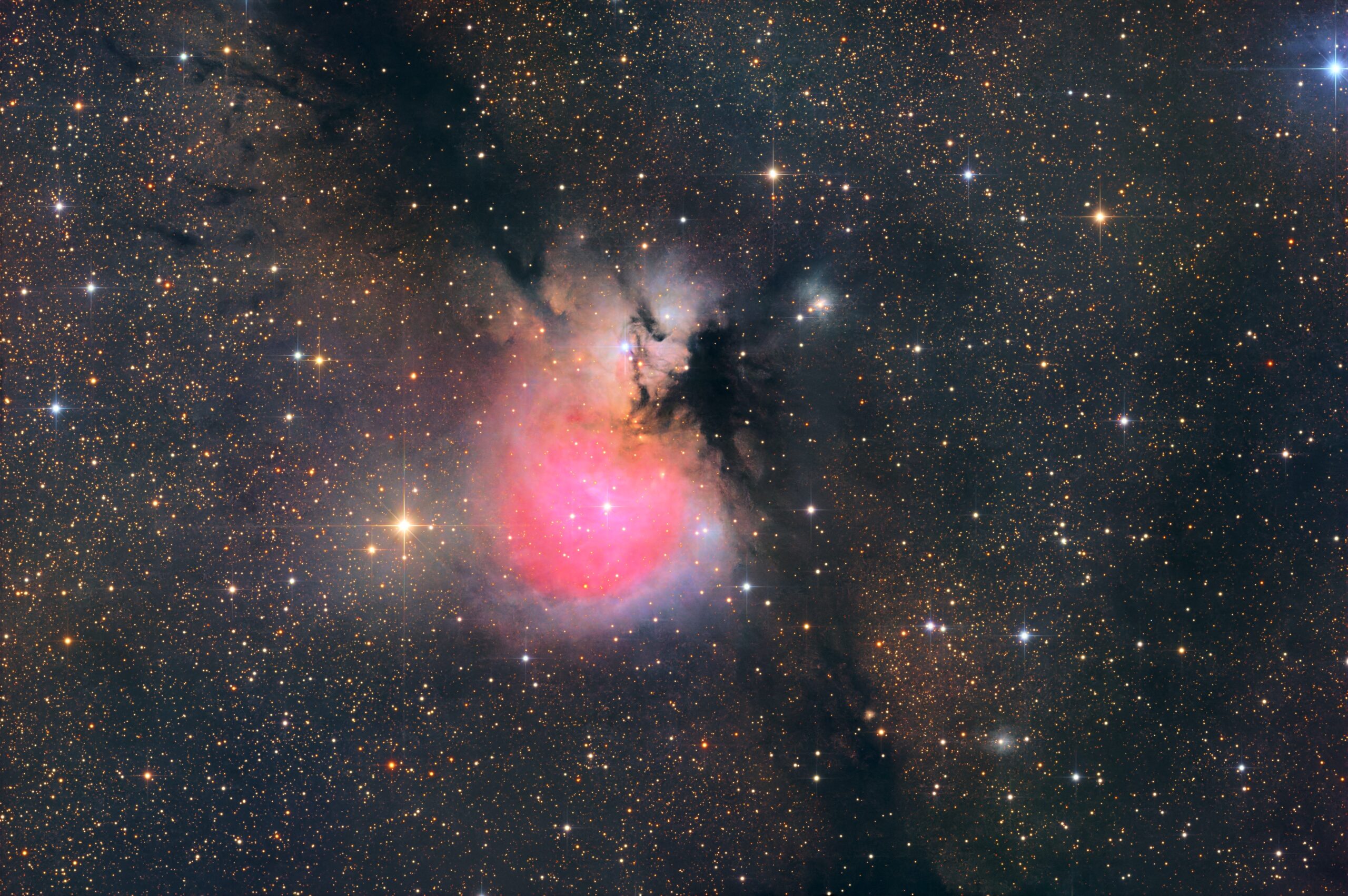
Sharpless 82, Hellas Sky, Crete, 2025
Sharpless 82 annotated


The images were taken with the following equipment:

  • Date: 2025
  • Location: Crete, Greece
  • Telescope/Lens: Planwave CDK 17
  • Focal length [mm]: 2939
  • Focal ratio: 6.8
  • Mount: 10Micron GM3000
  • Camera: QHY 600M Pro
  • Filter: LRGB
  • Exposure time [min]: 120:135:132:132
  • Resolution: 0.53″/px (bin 2)


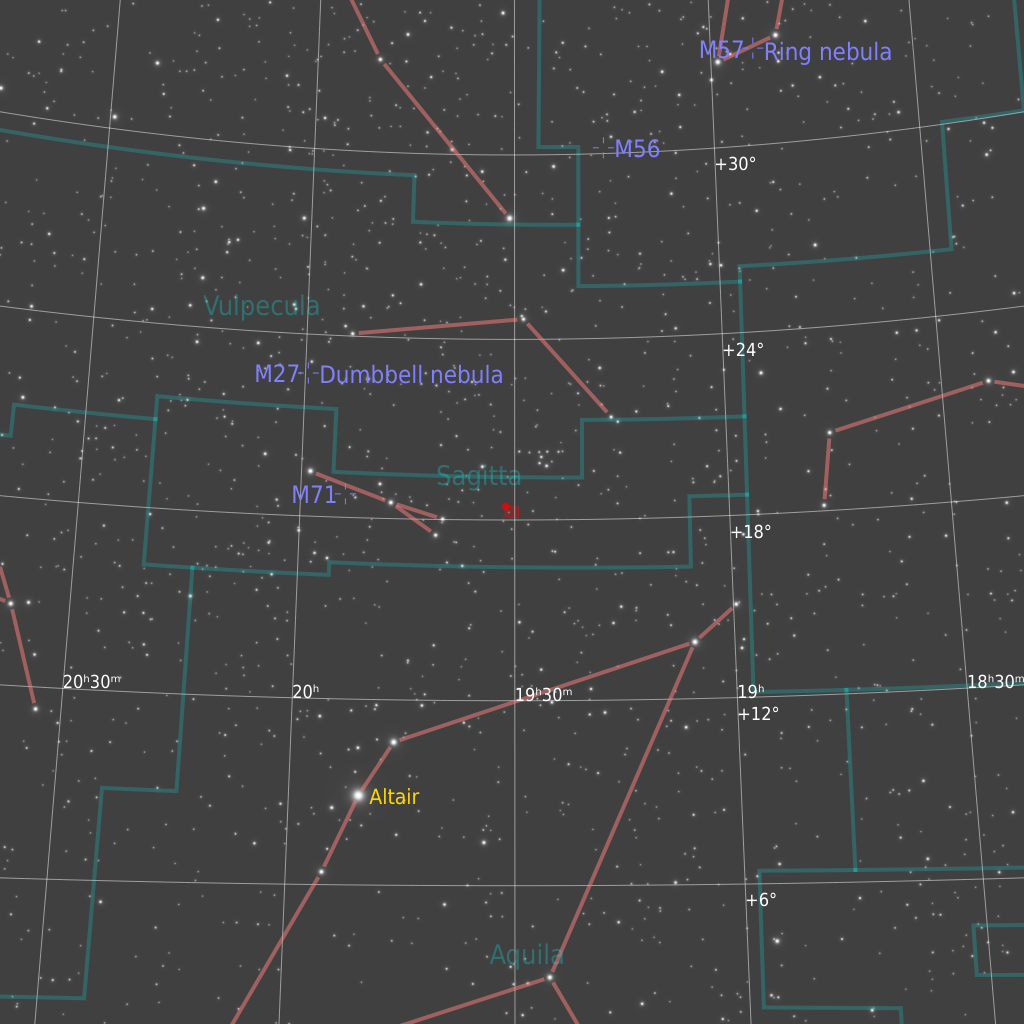
Sharpless 82 Finder Chart


Stephan Küppers


You might also like
IC 1318
15. Juli 2026
NGC 7000 with IC 5070
24. Juni 2026
Sh2-129, Outters 4
29. Mai 2026

Leave a reply

Schreibe einen Kommentar Antwort abbrechen

Deine E-Mail-Adresse wird nicht veröffentlicht. Erforderliche Felder sind mit * markiert


© Stephan Küppers 2020-2022

Cookie-Zustimmung verwalten
Wir verwenden Cookies, um unsere Website und unseren Service zu optimieren.
Funktional Immer aktiv
Die technische Speicherung oder der Zugang ist unbedingt erforderlich für den rechtmäßigen Zweck, die Nutzung eines bestimmten Dienstes zu ermöglichen, der vom Teilnehmer oder Nutzer ausdrücklich gewünscht wird, oder für den alleinigen Zweck, die Übertragung einer Nachricht über ein elektronisches Kommunikationsnetz durchzuführen.
Vorlieben
Die technische Speicherung oder der Zugriff ist für den rechtmäßigen Zweck der Speicherung von Präferenzen erforderlich, die nicht vom Abonnenten oder Benutzer angefordert wurden.
Statistiken
Die technische Speicherung oder der Zugriff, der ausschließlich zu statistischen Zwecken erfolgt. Die technische Speicherung oder der Zugriff, der ausschließlich zu anonymen statistischen Zwecken verwendet wird. Ohne eine Vorladung, die freiwillige Zustimmung deines Internetdienstanbieters oder zusätzliche Aufzeichnungen von Dritten können die zu diesem Zweck gespeicherten oder abgerufenen Informationen allein in der Regel nicht dazu verwendet werden, dich zu identifizieren.
Marketing
Die technische Speicherung oder der Zugriff ist erforderlich, um Nutzerprofile zu erstellen, um Werbung zu versenden oder um den Nutzer auf einer Website oder über mehrere Websites hinweg zu ähnlichen Marketingzwecken zu verfolgen.
  • Optionen verwalten
  • Dienste verwalten
  • Verwalten von {vendor_count}-Lieferanten
  • Lese mehr über diese Zwecke
Einstellungen anzeigen
  • {title}
  • {title}
  • {title}