• Home
  • Blog
  • Astrophotography
    • Deep Sky
      • Galaxies (Galaxien)
      • Nebulae (Nebel)
      • Planetary Nebulae (Planetarische Nebel)
      • Globular Clusters (Kugelsternhaufen)
      • Open Clusters (Offene Sternhaufen)
      • Miscellaneous (Verschiedenes)
    • Solar System (Sonnensystem)
      • Comets (Kometen)
      • Moon (Mond)
      • Planets (Planeten)
      • Sun (Sonne)
  • Archiv

    • Juli 2026
    • Juni 2026
    • Mai 2026
    • April 2026
    • Dezember 2025
    • November 2025
    • Oktober 2025
    • September 2025
    • August 2025
    • Juli 2025
    • Juni 2025
    • Mai 2025
    • April 2025
    • März 2025
    • Januar 2025
    • Dezember 2024
    • November 2024
    • Oktober 2024
    • September 2024
    • August 2024
    • Juli 2024
    • Juni 2024
    • Mai 2024
    • April 2024
    • März 2024
    • Februar 2024
    • Januar 2024
    • November 2023
    • Oktober 2023
    • September 2023
    • August 2023
    • Juli 2023
    • Juni 2023
    • Mai 2023
    • April 2023
    • März 2023
    • Februar 2023
    • Januar 2023
    • Dezember 2022
    • November 2022
    • Oktober 2022
    • September 2022
    • August 2022
    • Juni 2022
    • Mai 2022
    • April 2022
    • März 2022
    • Februar 2022
    • Januar 2022
    • Dezember 2021
    • November 2021
    • September 2021
    • August 2021
    • Juli 2021
    • März 2021
    • Februar 2021
    • November 2020
    • September 2020
    • August 2020
    • April 2020
    • März 2020
    • Februar 2020
    • Januar 2020
    • Dezember 2019
    • November 2019
    • Oktober 2019
    • September 2019
    • August 2019
    • Mai 2019
    • April 2019
    • März 2019
    • Dezember 2018
    • November 2018
    • September 2018
    • Juni 2018
    • Mai 2018
    • April 2018
    • März 2018
    • Februar 2018
    • Januar 2018
    • Oktober 2017
    • Juli 2017
    • Juni 2017
    • Januar 2017
    • September 2016
    • Mai 2016
    • März 2016
    • November 2015
    • Oktober 2015
    • Juli 2015
    • Mai 2015
    • März 2015
    • Februar 2015
    • September 2014
    • August 2014
    • März 2014
    • Februar 2014
    • Oktober 2013
    • September 2013
    • August 2013
    • April 2013
    • März 2013
    • November 2012
    • August 2012
    • Juli 2012
    • Mai 2012
    • März 2012
    • Januar 2012
    • November 2011
    • Oktober 2011
    • September 2011
    • August 2011
    • April 2011
    • März 2011
    • Oktober 2010
    • September 2010
    • August 2010
    • Juli 2010
    • April 2010
    • Juli 2009
    • Juli 2008
    • Januar 2008
    • Oktober 2007
    • Juli 2007
    • Februar 2007
    • Juni 2006
    • Oktober 2005
    • September 2005
    • August 2005
    • Januar 2005
  • Kategorien

    • Asterism
    • Astrophotography
    • Barnard
    • Comet
    • Galaxies
    • Globular Cluster
    • IC
    • Messier
    • Moon
    • Nebula
    • NGC
    • Open cluster
    • Photography
    • Planetary Nebula
    • Travel
  • Meta

    • Anmelden
    • Eintrags-Feed
    • Kommentar-Feed
    • WordPress.org
  • Privacy Policy
  • Impressum
  • Haftungsausschluss
  • Cookie-Richtlinie
  • Datenschutzerklärung

wonderfuluniverse.de
  • Home
  • Blog
  • Astrophotography
    • Deep Sky
      • Galaxies (Galaxien)
      • Nebulae (Nebel)
      • Planetary Nebulae (Planetarische Nebel)
      • Globular Clusters (Kugelsternhaufen)
      • Open Clusters (Offene Sternhaufen)
      • Miscellaneous (Verschiedenes)
    • Solar System (Sonnensystem)
      • Comets (Kometen)
      • Moon (Mond)
      • Planets (Planeten)
      • Sun (Sonne)

Sharpless 73 – from remote


In 2025, I received a high-quality LRGB dataset of Sh2-73 from Hellas Sky on the island of Crete. The data were made freely available to participants in the Hellas Sky Summer Contest, providing an excellent opportunity to process professional-grade astronomical images acquired under the exceptionally dark skies of southern Greece. The deep LRGB dataset offered outstanding image quality, allowing the nebula’s delicate structures and the rich surrounding star field to be reproduced with remarkable detail and natural color.

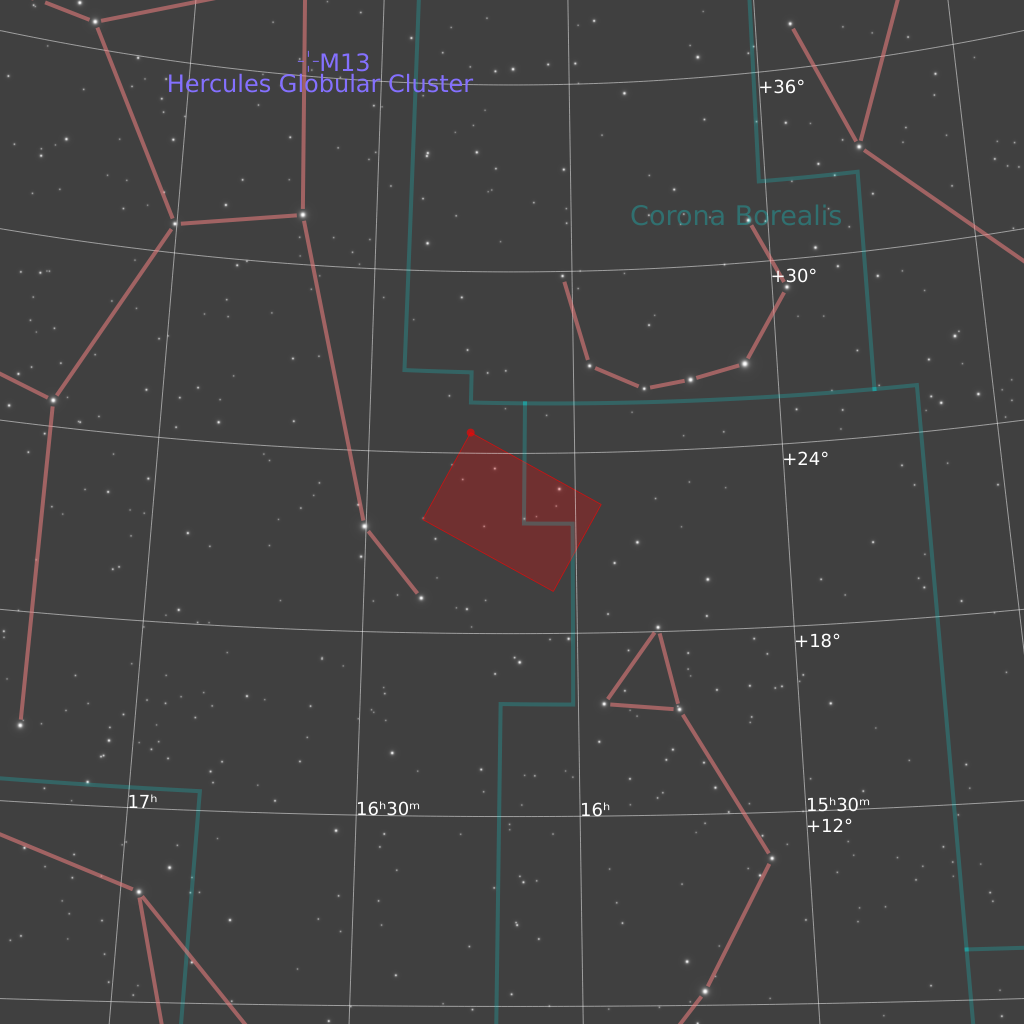
Sh2-73 is a very faint, dusty nebula in the constellation Hercules, now understood to be part of the high‑latitude “galactic cirrus” rather than a classic bright emission nebula.

Sh2-73 appears in the Sharpless catalog of nebulae, where it was originally listed as an emission nebula, but that classification turned out to be incorrect. It is also known under other designations, notably LBN 105 (or sometimes LBN 105–106) and MBM 40 in catalogues of faint reflection and dark clouds. The nebula lies in Hercules near the western side of the constellation, close to the borders with Serpens Caput and Corona Borealis, in a region of sky that looks quite sparse in bright stars. Its central coordinates are around right ascension 16h 07–11m and declination +21° 52′, giving it a high galactic latitude of about 45°, well above the plane of the Milky Way.

On the sky, Sh2-73 covers an area larger than the full Moon, with a quoted apparent diameter of roughly 75 arcminutes, though its edges are very ill‑defined because of the extremely low surface brightness. Distance estimates place the cloud among the nearer interstellar structures: on the order of 200 parsecs (about 650 light‑years) from the Sun, which makes it one of the closest known high‑latitude dust clouds. Mass estimates for the associated MBM 40 cloud suggest some tens of solar masses of gas and dust, roughly in the range 20–40 times the mass of the Sun.

The key to understanding Sh2-73 is that it is not shining on its own, nor is it being lit by a single nearby hot star. Instead, it is a cold molecular and dusty cloud that reflects and scatters the combined light of the entire Milky Way, the so‑called integrated radiation field from the galactic disk. Nebulae of this type are known as Integrated Flux Nebulae (IFN), a term popularized by astrophotographer Steve Mandel, and Sh2-73 is often cited as a textbook example of this class. In professional parlance, such structures are commonly grouped under the label galactic cirrus, an analogy with thin, wispy clouds in Earth’s atmosphere.

Because there is no strong ionizing radiation source nearby, there is no H II region and no obvious star‑formation activity inside the cloud at present. The dust instead acts like a faint fog, slightly brightening the sky background and subtly reddening the light of more distant galaxies that appear through it. Careful imaging of Sh2-73 reveals numerous background galaxies and even quasars whose colors and brightness are affected by this foreground dust, and deep observations have identified several dozen quasars in fields overlapping the nebula.

Visually, Sh2-73 is extremely challenging: it is essentially invisible to the eye even in large amateur telescopes, because its surface brightness is far below what the human eye can pick up against the natural sky glow. Long‑exposure wide‑field astrophotography under dark skies is required to record it, and imagers often devote many hours to bring out the delicate filaments from the background noise. On processed images, the nebula appears as a very faint, looping or hairpin‑shaped veil of light, sometimes described as resembling a bent pin or the mouth of a catfish.

For observers in mid‑northern latitudes, Sh2-73 is best placed from spring through early autumn, roughly March to September, when Hercules is high in the evening sky. From your location in northern Germany, it culminates well above the horizon on spring and summer nights, but photographing it still demands very dark conditions, fast optics, and aggressive image processing to tease out the IFN from sky background and light pollution

The data the calibration, registration, and final processing were performed in PixInsight. The result was as follows:
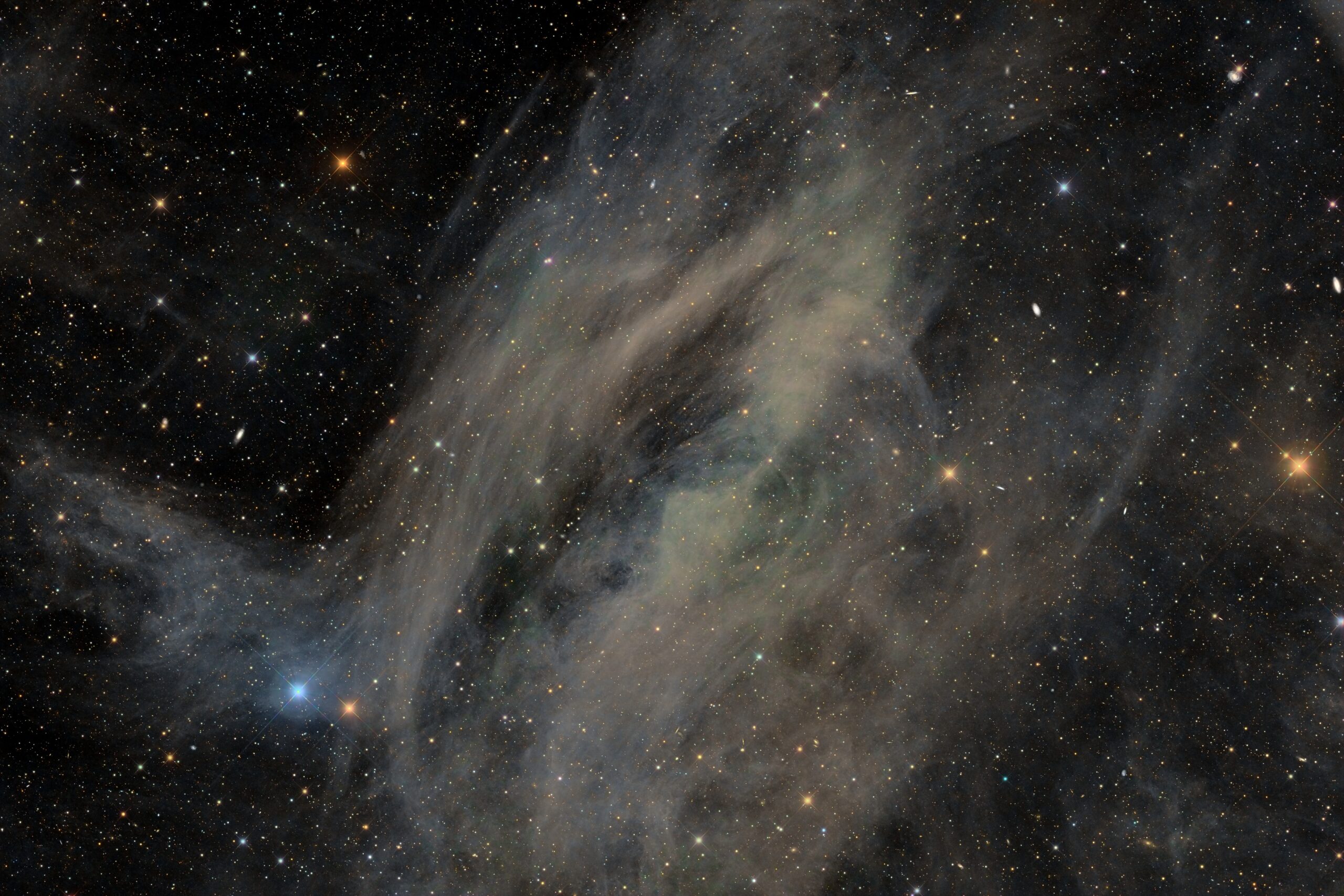
Sharpless 73, Hellas Sky, Crete, 2025
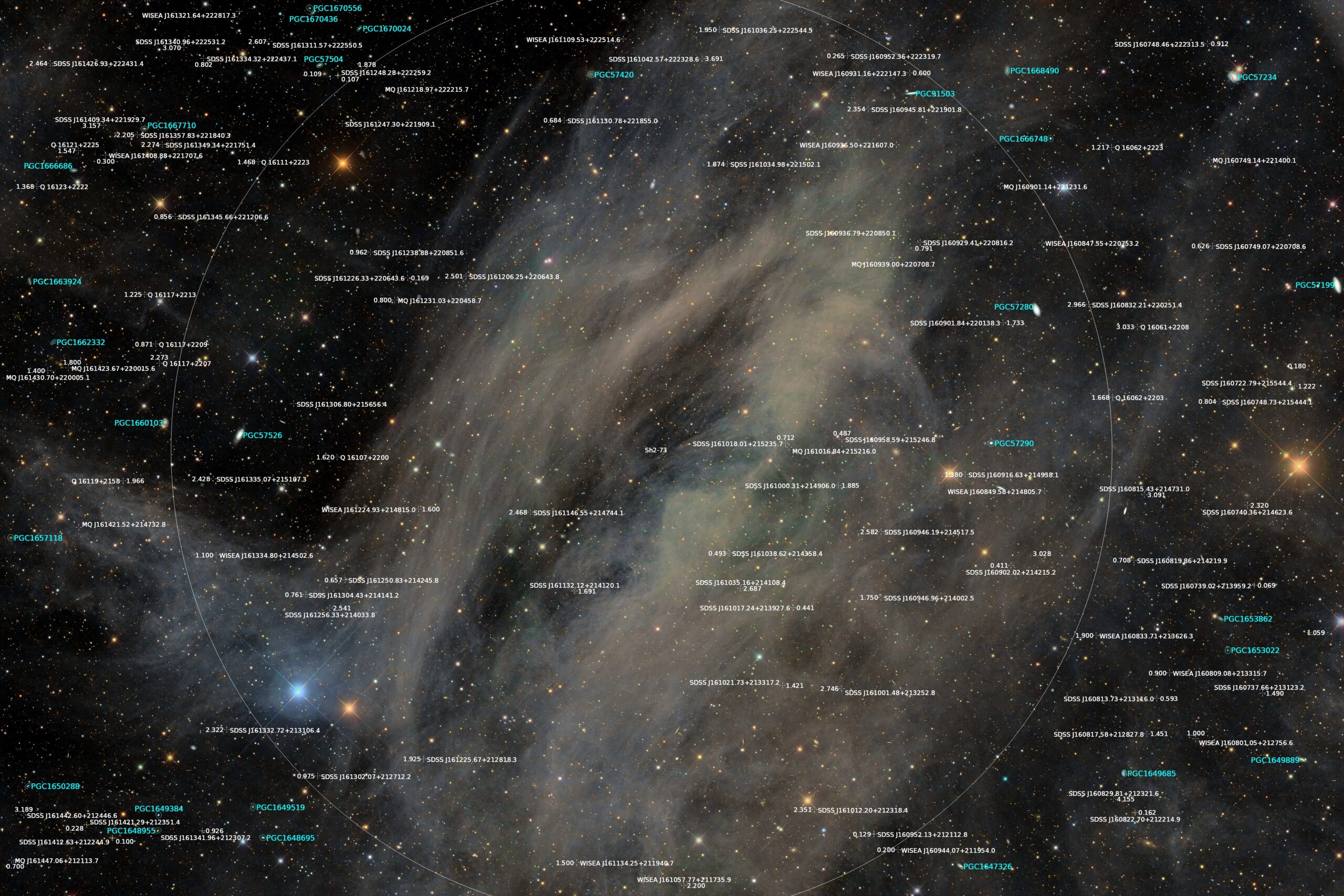
Sharpless 73 annotated

The image also contains numerous background galaxies and quasars, adding considerable depth far beyond the stars and nebulae of our own Milky Way. The two most distant identified quasars in the field are:

  • SDSS J160829.81+212321.6 with a redshift of z=4.155 and an apparent magnitude of 21.79 [SDSS 16]
  • SDSS J161042.57+222328.6 with a redshift of z=3.691 and an apparent magnitude of 21.09 [SDSS 16]


The images were taken with the following equipment:

  • Date: 2025
  • Location: Crete, Greece
  • Telescope/Lens: Planwave DR 350
  • Focal length [mm]: 1050
  • Focal ratio: 3
  • Mount: 10Micron GM3000
  • Camera: QHY 600M Pro
  • Filter: LRGB
  • Exposure time [min]: 579:288:231:237
  • Resolution: 1.49″/px (bin 2)


Sharpless 73 Finder Chart


Stephan Küppers


You might also like
IC 1318
15. Juli 2026
NGC 7000 with IC 5070
24. Juni 2026
NGC 7023 (Iris Nebula) and LBN 468
25. Mai 2026

Leave a reply

Schreibe einen Kommentar Antwort abbrechen

Deine E-Mail-Adresse wird nicht veröffentlicht. Erforderliche Felder sind mit * markiert


© Stephan Küppers 2020-2022

Cookie-Zustimmung verwalten
Wir verwenden Cookies, um unsere Website und unseren Service zu optimieren.
Funktional Immer aktiv
Die technische Speicherung oder der Zugang ist unbedingt erforderlich für den rechtmäßigen Zweck, die Nutzung eines bestimmten Dienstes zu ermöglichen, der vom Teilnehmer oder Nutzer ausdrücklich gewünscht wird, oder für den alleinigen Zweck, die Übertragung einer Nachricht über ein elektronisches Kommunikationsnetz durchzuführen.
Vorlieben
Die technische Speicherung oder der Zugriff ist für den rechtmäßigen Zweck der Speicherung von Präferenzen erforderlich, die nicht vom Abonnenten oder Benutzer angefordert wurden.
Statistiken
Die technische Speicherung oder der Zugriff, der ausschließlich zu statistischen Zwecken erfolgt. Die technische Speicherung oder der Zugriff, der ausschließlich zu anonymen statistischen Zwecken verwendet wird. Ohne eine Vorladung, die freiwillige Zustimmung deines Internetdienstanbieters oder zusätzliche Aufzeichnungen von Dritten können die zu diesem Zweck gespeicherten oder abgerufenen Informationen allein in der Regel nicht dazu verwendet werden, dich zu identifizieren.
Marketing
Die technische Speicherung oder der Zugriff ist erforderlich, um Nutzerprofile zu erstellen, um Werbung zu versenden oder um den Nutzer auf einer Website oder über mehrere Websites hinweg zu ähnlichen Marketingzwecken zu verfolgen.
  • Optionen verwalten
  • Dienste verwalten
  • Verwalten von {vendor_count}-Lieferanten
  • Lese mehr über diese Zwecke
Einstellungen anzeigen
  • {title}
  • {title}
  • {title}