• Home
  • Blog
  • Astrophotography
    • Deep Sky
      • Galaxies (Galaxien)
      • Nebulae (Nebel)
      • Planetary Nebulae (Planetarische Nebel)
      • Globular Clusters (Kugelsternhaufen)
      • Open Clusters (Offene Sternhaufen)
      • Miscellaneous (Verschiedenes)
    • Solar System (Sonnensystem)
      • Comets (Kometen)
      • Moon (Mond)
      • Planets (Planeten)
      • Sun (Sonne)
  • Archiv

    • Juli 2026
    • Juni 2026
    • Mai 2026
    • April 2026
    • Dezember 2025
    • November 2025
    • Oktober 2025
    • September 2025
    • August 2025
    • Juli 2025
    • Juni 2025
    • Mai 2025
    • April 2025
    • März 2025
    • Januar 2025
    • Dezember 2024
    • November 2024
    • Oktober 2024
    • September 2024
    • Juli 2024
    • Juni 2024
    • Mai 2024
    • April 2024
    • März 2024
    • Februar 2024
    • Januar 2024
    • November 2023
    • Oktober 2023
    • September 2023
    • August 2023
    • Juli 2023
    • Juni 2023
    • Mai 2023
    • April 2023
    • März 2023
    • Februar 2023
    • Januar 2023
    • Dezember 2022
    • November 2022
    • Oktober 2022
    • September 2022
    • August 2022
    • Juni 2022
    • Mai 2022
    • April 2022
    • März 2022
    • Februar 2022
    • Januar 2022
    • Dezember 2021
    • November 2021
    • September 2021
    • August 2021
    • Juli 2021
    • März 2021
    • Februar 2021
    • November 2020
    • September 2020
    • August 2020
    • April 2020
    • März 2020
    • Februar 2020
    • Januar 2020
    • Dezember 2019
    • November 2019
    • Oktober 2019
    • September 2019
    • August 2019
    • Mai 2019
    • April 2019
    • März 2019
    • Dezember 2018
    • November 2018
    • September 2018
    • Juni 2018
    • Mai 2018
    • April 2018
    • März 2018
    • Februar 2018
    • Januar 2018
    • Oktober 2017
    • Juli 2017
    • Juni 2017
    • Januar 2017
    • September 2016
    • Mai 2016
    • März 2016
    • November 2015
    • Oktober 2015
    • September 2015
    • Juli 2015
    • Mai 2015
    • März 2015
    • Februar 2015
    • September 2014
    • August 2014
    • März 2014
    • Februar 2014
    • Oktober 2013
    • September 2013
    • August 2013
    • April 2013
    • März 2013
    • November 2012
    • August 2012
    • Juli 2012
    • Mai 2012
    • März 2012
    • Januar 2012
    • November 2011
    • Oktober 2011
    • September 2011
    • August 2011
    • April 2011
    • März 2011
    • Oktober 2010
    • September 2010
    • August 2010
    • Juli 2010
    • April 2010
    • Juli 2009
    • Juli 2008
    • Januar 2008
    • Oktober 2007
    • Juli 2007
    • Februar 2007
    • Juni 2006
    • Oktober 2005
    • September 2005
    • August 2005
    • Januar 2005
  • Kategorien

    • Asterism
    • Astrophotography
    • Barnard
    • Comet
    • Galaxies
    • Globular Cluster
    • IC
    • Messier
    • Moon
    • Nebula
    • NGC
    • Open cluster
    • Photography
    • Planetary Nebula
    • Travel
  • Meta

    • Anmelden
    • Eintrags-Feed
    • Kommentar-Feed
    • WordPress.org
  • Privacy Policy
  • Impressum
  • Haftungsausschluss
  • Cookie-Richtlinie
  • Datenschutzerklärung

wonderfuluniverse.de
  • Home
  • Blog
  • Astrophotography
    • Deep Sky
      • Galaxies (Galaxien)
      • Nebulae (Nebel)
      • Planetary Nebulae (Planetarische Nebel)
      • Globular Clusters (Kugelsternhaufen)
      • Open Clusters (Offene Sternhaufen)
      • Miscellaneous (Verschiedenes)
    • Solar System (Sonnensystem)
      • Comets (Kometen)
      • Moon (Mond)
      • Planets (Planeten)
      • Sun (Sonne)

Sharpless 64


In 2015, during a stay at the Tivoli Astrofarm in Namibia, I imaged the emission nebula Sharpless 64 using the equipment of a rented observatory. The image was acquired in HRGB, combining deep Hα exposures with broadband RGB data to reveal both the faint hydrogen emission and the rich stellar background of the southern Milky Way. The exceptionally dark Namibian skies and excellent atmospheric conditions made it possible to record the delicate structure of this relatively faint nebula with remarkable clarity.

Located in the constellation Scorpius, Sh2-64 is an H II region situated within one of the Milky Way’s richest star-forming environments. The nebula lies several thousand light-years from Earth and forms part of the extensive network of emission nebulae and molecular clouds that trace the Galaxy’s spiral arms. Although less famous than neighboring nebulae such as the Cat’s Paw or Lobster Nebula, Sh2-64 is an attractive target for deep wide-field astrophotography because of its subtle structure and its location within the dense southern Milky Way.

The nebula shines through the ionization of hydrogen gas by nearby O- and B-type stars. Their intense ultraviolet radiation excites the surrounding gas, producing the characteristic Hα emission that dominates the nebula. Deep images reveal a complex pattern of diffuse hydrogen clouds, bright ionization fronts, and dark dust lanes that are continuously being shaped by stellar winds and radiation from these young, massive stars.

The Hα data recorded for this image greatly enhance the visibility of the faint emission, while the RGB exposures preserve the natural colors of the countless stars scattered across the field. This HRGB combination provides both a scientifically informative and aesthetically pleasing representation of the region, emphasizing the contrast between the glowing hydrogen clouds and the dense Milky Way star fields.

The surrounding area is rich in dark molecular clouds and numerous small star-forming regions. These dense clouds represent the raw material from which future generations of stars will eventually emerge, illustrating the continuous cycle of stellar birth and evolution within our Galaxy. Deep images also reveal many faint background galaxies, adding another layer of depth beyond the foreground stars of the Milky Way.

The HRGB image obtained in 2025 beautifully captures this relatively little-known nebula within its rich Galactic environment. Imaging from the pristine skies of the Tivoli Astrofarm with the equipment of a rented observatory made it possible to reveal subtle hydrogen structures that are extremely difficult to detect from light-polluted locations. The result is a detailed portrait of another fascinating star-forming region in the southern sky and a valuable addition to my growing collection of southern emission nebulae.

All data calibration, registration, and final image processing were performed in PixInsight
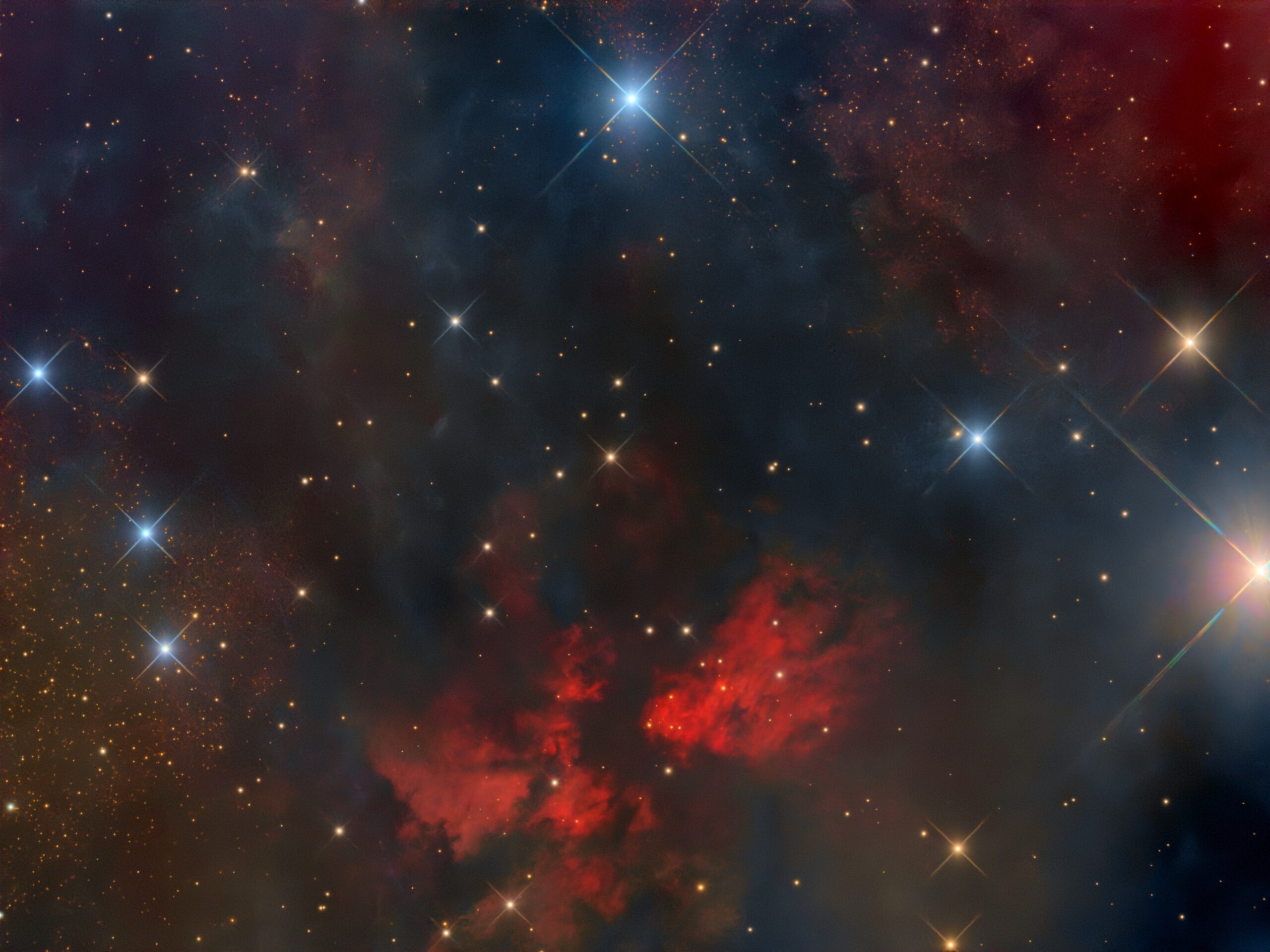
Sharpless 64, Tivoli, Namibia, 2015


The images were taken with the following equipment:

  • Location: Tivoli, Namibia
  • Telescope: ASA 12″ Astrograph
  • Focal length [mm]: 1076
  • Focal ratio: 3.6
  • Mount: ASA DDM85
  • Camera: FLI Microline ML8300
  • Filter: Hα:R:G:B
  • Exposure time [min]: 145:55:50:55
  • Resolution: 1.04″/px


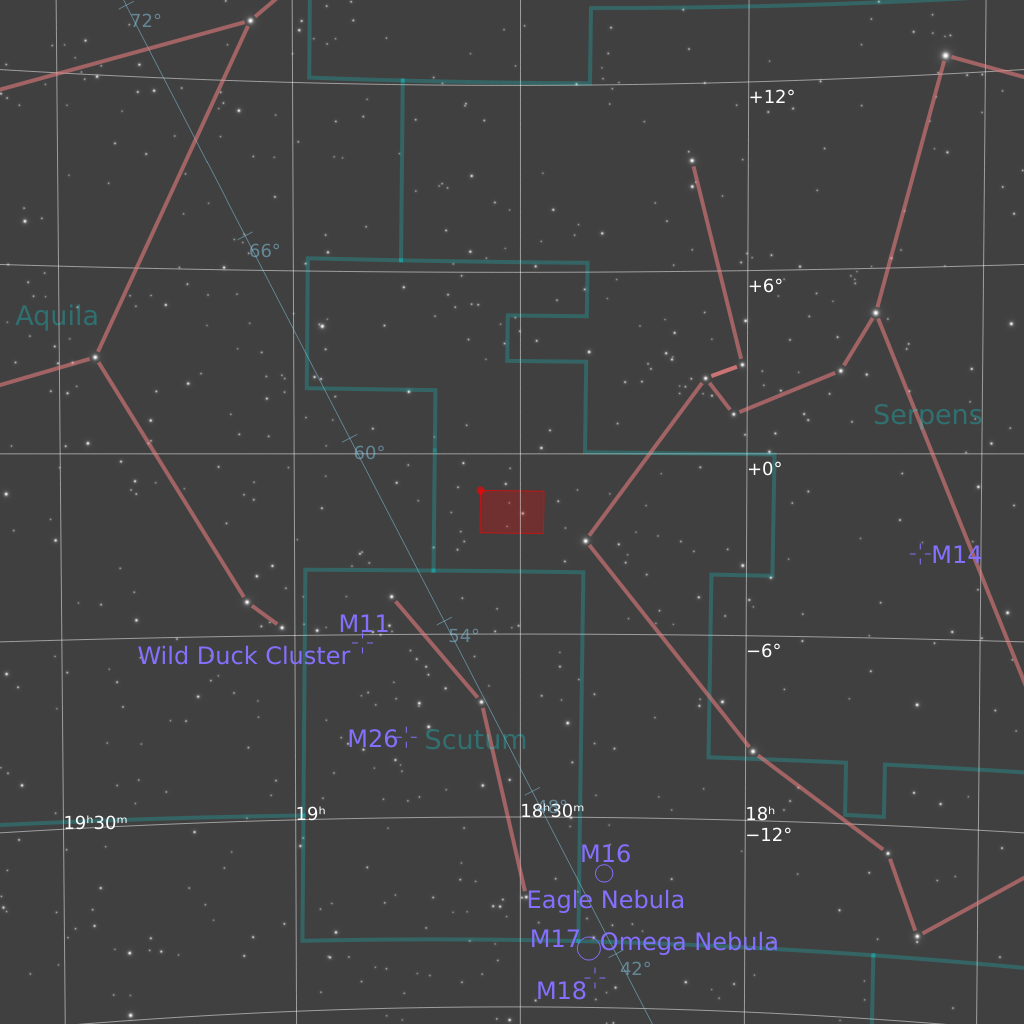
Sharpless 64 Finder Chart

Stephan Küppers


You might also like
IC 1318
15. Juli 2026
NGC 7000 with IC 5070
24. Juni 2026
NGC 7023 (Iris Nebula) and LBN 468
25. Mai 2026

Leave a reply

Schreibe einen Kommentar Antwort abbrechen

Deine E-Mail-Adresse wird nicht veröffentlicht. Erforderliche Felder sind mit * markiert


© Stephan Küppers 2020-2022

Cookie-Zustimmung verwalten
Wir verwenden Cookies, um unsere Website und unseren Service zu optimieren.
Funktional Immer aktiv
Die technische Speicherung oder der Zugang ist unbedingt erforderlich für den rechtmäßigen Zweck, die Nutzung eines bestimmten Dienstes zu ermöglichen, der vom Teilnehmer oder Nutzer ausdrücklich gewünscht wird, oder für den alleinigen Zweck, die Übertragung einer Nachricht über ein elektronisches Kommunikationsnetz durchzuführen.
Vorlieben
Die technische Speicherung oder der Zugriff ist für den rechtmäßigen Zweck der Speicherung von Präferenzen erforderlich, die nicht vom Abonnenten oder Benutzer angefordert wurden.
Statistiken
Die technische Speicherung oder der Zugriff, der ausschließlich zu statistischen Zwecken erfolgt. Die technische Speicherung oder der Zugriff, der ausschließlich zu anonymen statistischen Zwecken verwendet wird. Ohne eine Vorladung, die freiwillige Zustimmung deines Internetdienstanbieters oder zusätzliche Aufzeichnungen von Dritten können die zu diesem Zweck gespeicherten oder abgerufenen Informationen allein in der Regel nicht dazu verwendet werden, dich zu identifizieren.
Marketing
Die technische Speicherung oder der Zugriff ist erforderlich, um Nutzerprofile zu erstellen, um Werbung zu versenden oder um den Nutzer auf einer Website oder über mehrere Websites hinweg zu ähnlichen Marketingzwecken zu verfolgen.
  • Optionen verwalten
  • Dienste verwalten
  • Verwalten von {vendor_count}-Lieferanten
  • Lese mehr über diese Zwecke
Einstellungen anzeigen
  • {title}
  • {title}
  • {title}