

Sh2-308 (Dolphin-Head Nebula)
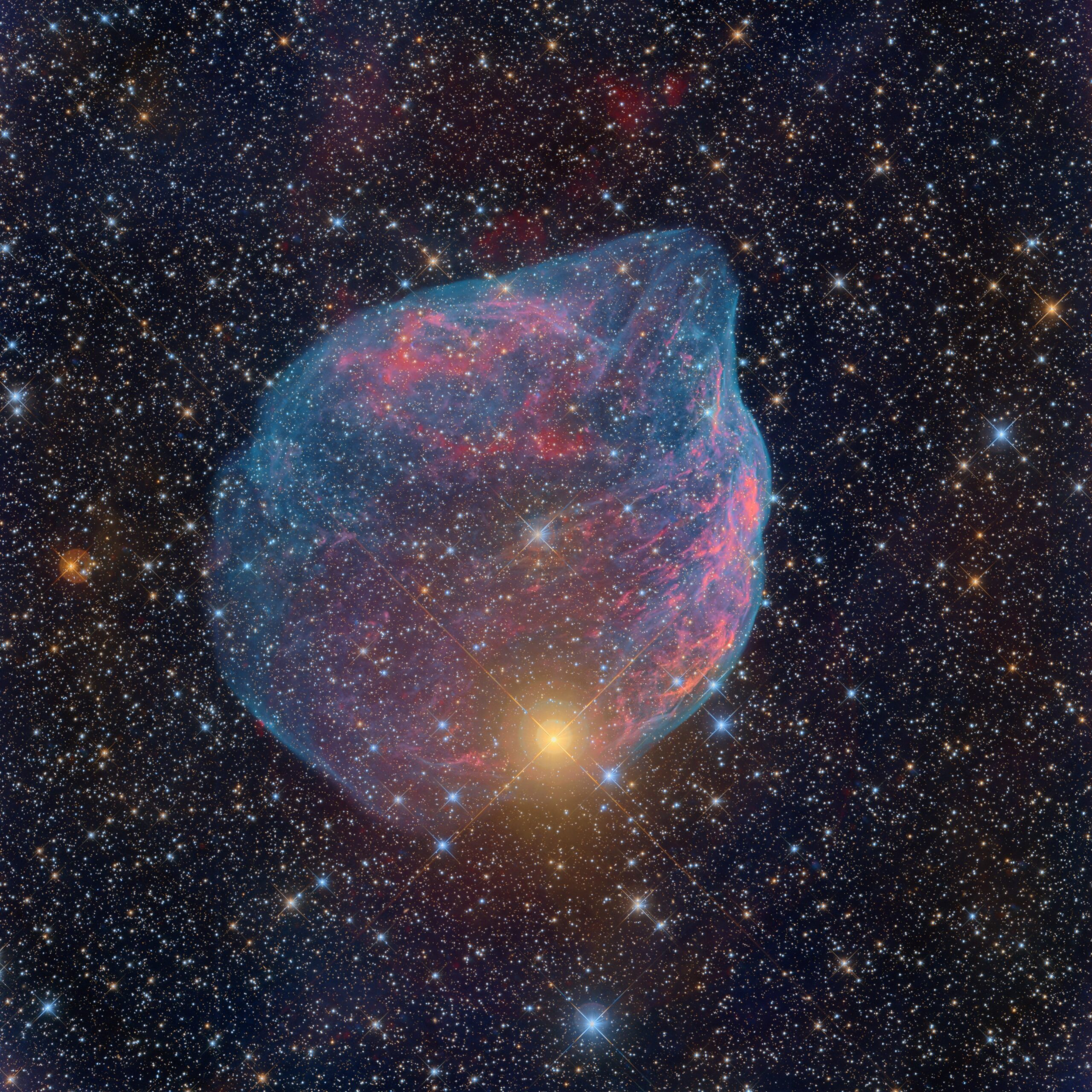
In 2022, I imaged the magnificent Sh2-308 from the Tivoli Astrofarm in Namibia, using an RGBHO imaging approach under the exceptionally dark skies of the Kalahari fringe.
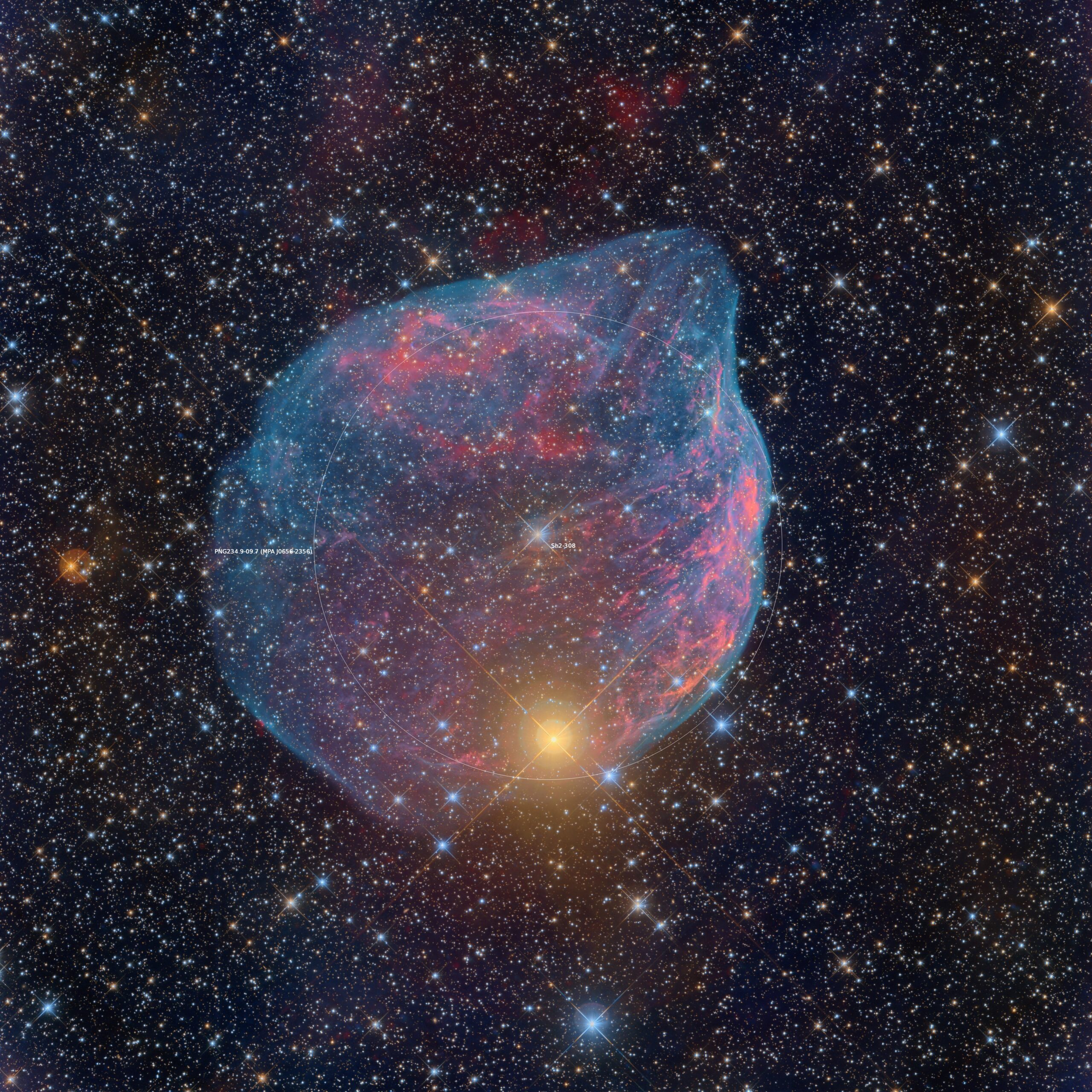
Sh2-308 is the Dolphin Head Nebula, a large bubble of ionized gas in Canis Major that surrounds the Wolf–Rayet star EZ Canis Majoris, also known as WR 6. It is one of those objects that looks delicate in images but is actually the aftermath of extremely violent stellar winds from a very massive, evolved star.
Astronomically, Sh2-308 is an H II region, meaning its glow comes mainly from hydrogen gas ionized by intense ultraviolet radiation. The central star, EZ Canis Majoris, is in a brief pre-supernova Wolf–Rayet phase, which means it has already shed its outer hydrogen layers and is exposing much hotter, heavier elements underneath. That kind of star loses material at enormous speed, and those winds are what inflated the bubble we see today.
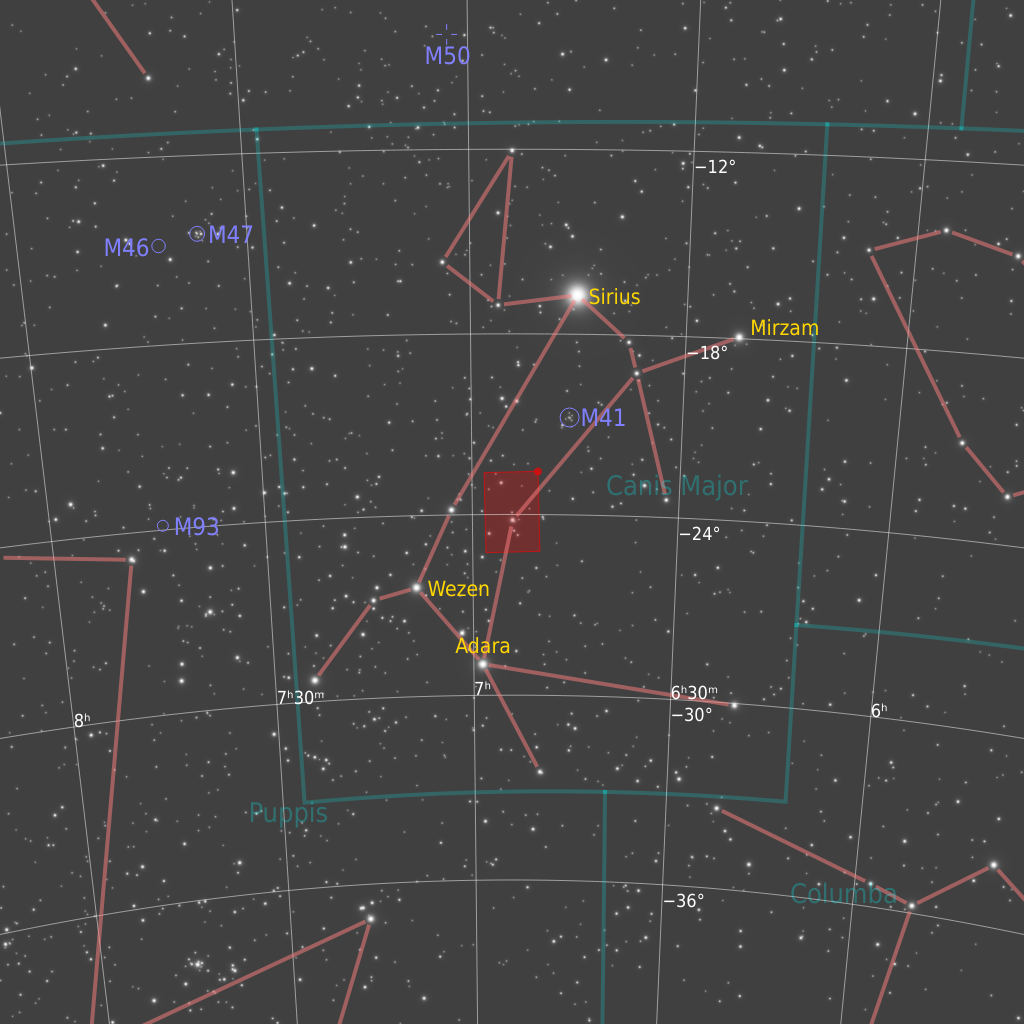
The nebula lies in the southern sky about 8 degrees from Sirius. Its distance is somewhat uncertain, with estimates ranging from about 1,875 light-years to roughly 5,870 light-years, though a commonly cited value is around 4,530 light-years. At that distance, the bubble spans about 60 light-years across, or a bit more than the apparent width of the Full Moon on the sky. That makes it physically huge even though it often looks like a faint, compact arc in photographs.
Sources describe the nebula as being about 70,000 years old. It formed when EZ Canis Majoris expelled material from an earlier evolutionary stage, and its faster Wolf–Rayet wind swept up that slower-moving gas into a shell. The result is a classic wind-blown bubble, where the center is relatively empty and the edges are brighter where gas is compressed and excited. In the strongest narrowband images, the shell is often dominated by oxygen emission, especially O III.
The nickname “Dolphin Head Nebula” comes from the shape the brightest portion takes in deep images. The star itself appears near the “eye,” while the bright curved rim suggests the head and snout of a dolphin in profile. This is one of the nicest examples of how astrophotographers and observers use visual analogy to make a faint object memorable.
Sh2-308 is valuable because it shows how Wolf–Rayet stars reshape their surroundings shortly before they explode as supernovae. The nebula lets astronomers study stellar winds, shock fronts, ionized gas, and the late stages of massive-star evolution in one object. Since the nebula is relatively nearby and large, it is also a good laboratory for comparing theoretical models of bubble formation with real data.
Data calibration and registration and the final processing was done with PixInsight. The result was as follows:
The images were taken with the following equipment:
- Date: 04/25/2022 to 04/29/2022
- Location: Tivoli, Namibia
- Telescope/Lense: ASA 16″ Astrograph
- Focal length [mm]: 1440
- Focal ratio: 3.6
- Mount: ASA DDM 85
- Camera: Moravian G4 16000
- Filter: Hα:[OIII]:R:G:B
- Exposure time [min]: 300:80:40:40:40
- Resolution: 1.29″/px



Leave a reply