

Sh2-282, Sh2-283, Sh2-284 and Sh2-280 from remote
From time to time, I enjoy processing datasets acquired by professional remote observatories around the world. One of my favorite providers is Telescope Live, whose network of robotic telescopes operates under some of the world’s finest observing conditions in locations such as Chile, Australia, and Spain. In 2025, I received an outstanding LRGB + Hα dataset of the emission nebulae Sh2-280, Sh2-282, Sh2-283 and Sh2-284 located in the constellation Monoceros.
Sh2-280 and the Sh2-282 to Sh2-284 nebulae form a small but interesting patch of the Monoceros sky, sitting south of the Rosette Nebula and embedded in the same broader star-forming environment. Sh2-280 is the most prominent of the group, while Sh2-282 is denser and more compact, and Sh2-284 is a dimmer, more diffuse patch with faint reddish gas around it. Together they show how one molecular cloud can produce several distinct-looking H II regions and ionized structures.
Sh2-280 is a large emission nebula in Monoceros, about 5,540 light-years away, and it lies roughly 2.5 degrees south of the Rosette Nebula. It is a classic H II region, meaning its gas is lit up by hot young stars rather than by its own internal light. The main ionizing source is HD 46573, an O7 main-sequence star, with additional contribution from HD 46847, a blue B0III giant on the northeast edge of the cloud. That ultraviolet radiation strips electrons from hydrogen atoms, creating the red glow that astrophotographers pick up so well in hydrogen-alpha filters.
Sh2-280 is also useful scientifically because it appears to sit in the same general galactic environment as the Rosette complex and Monoceros OB2 association. In other words, it is not an isolated cloud, but part of a larger neighborhood of gas, dust, and massive stars on the inner edge of the Perseus Arm. That makes it a good object for studying how massive stars reshape their surroundings and how star formation is organized in spiral-arm molecular clouds.
Sh2-282 lies southeast of Sh2-280 and is the more compact, denser nebula in the trio. A NOIRLab image describes it as an H II emission nebula whose red hydrogen gas is energized by bright blue stars around it, with pillar-like structures carved by radiation and stellar winds. One source notes that HD 47432, an O9.5 giant, is the main exciting star, and places the nebula at about 1,250 parsecs, or 4,075 light-years. That distance estimate is somewhat different from the larger Rosette-region values quoted for the broader complex, which is a reminder that cataloged Sharpless objects can be tricky and may have overlapping or uncertain distance assignments.
What makes Sh2-282 especially interesting is its texture: it is not just a smooth glow, but contains embedded structure that suggests feedback from nearby massive stars. Those carved features matter because they are evidence of ongoing interaction between radiation, winds, and the surrounding gas, the same basic process that shapes many star-forming regions across the Milky Way.
Sh2-283 is fainter still, appearing as one of the weaker nebular components in the field near Sh2-280 and Sh2-282. It is not as well documented individually as the brighter objects, but its presence reinforces the idea that this is a patchwork of ionized clouds rather than a single simple nebula. In wide-field views, Sh2-283 helps connect the brighter regions into one broader scene.
Sh2-284 is another dim emission nebula in this same Monoceros complex. The French Wikipedia summary says it is a large H II region, and that other nearby nebulae such as Sh2-283, Sh2-285, and Sh2-286 may be physically connected to it. It also notes that Sh2-284 contains the open cluster or OB association Do 25 at its center, with several O- and B-type stars contributing to ionization, and that the region is active in star formation with many infrared sources and masers. Another important detail is that a supernova remnant lies along the line of sight but is probably foreground and not physically tied to Sh2-284.
Taken together, these nebulae are a compact lesson in how massive stars interact with interstellar gas. Sh2-280 is the bright anchor, Sh2-282 is the textured dense core, Sh2-283 is the faint connecting piece, and Sh2-284 extends the story into a larger and more complex star-forming region. For observers, the field is rewarding because the objects differ in brightness, shape, and excitation; for astronomers, it is useful because it traces how one molecular environment can host multiple ionized pockets at different stages of evolution.
Data calibration and registration and the final processing was done with PixInsight. The result was as follows:

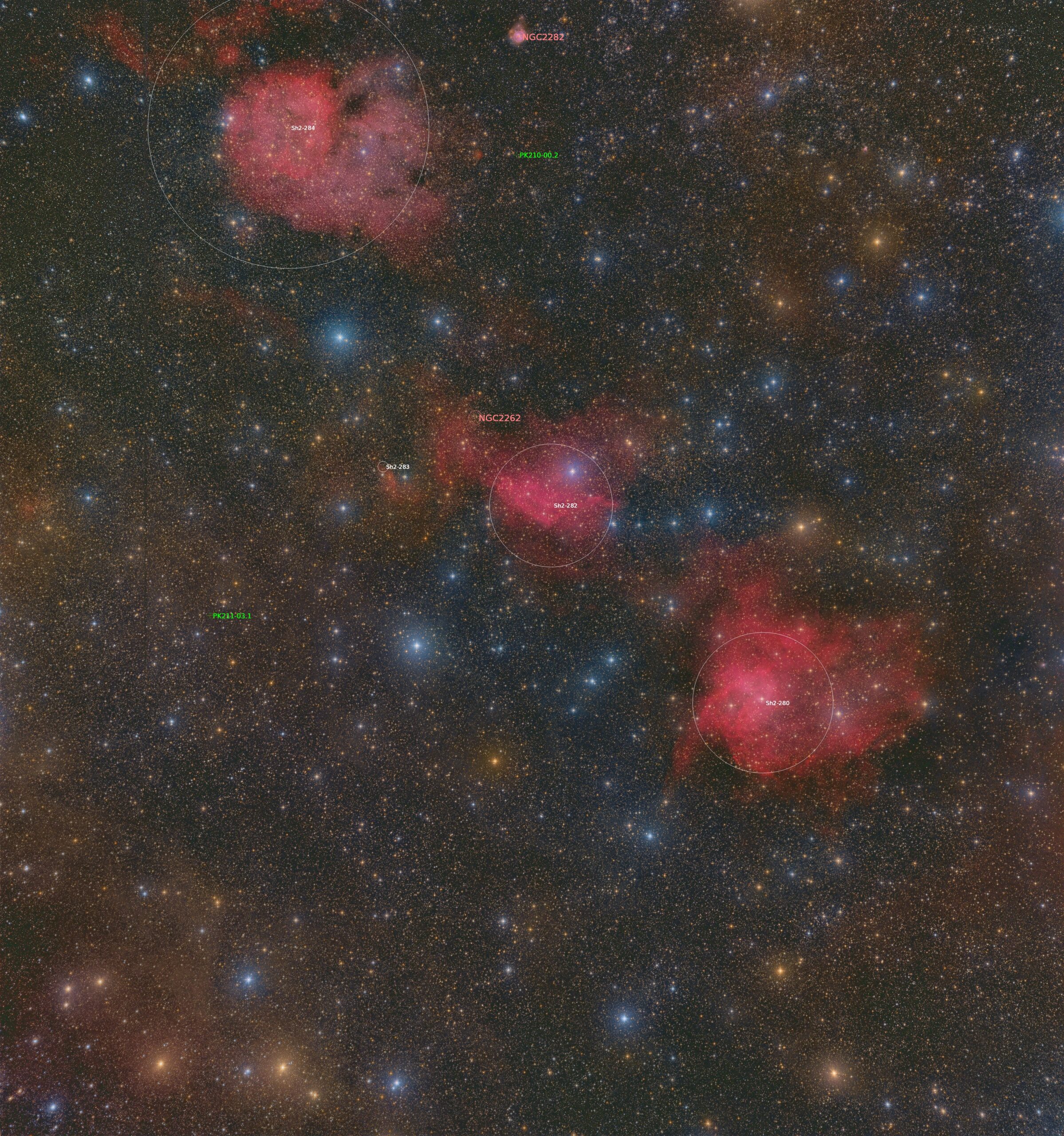
The images were taken with the following equipment (AUS-2 CCD, Telescope Live):
- Date: 2022
- Location: Heaven’s Mirror Observatory, Australia
- Telescope/Lense: Takahashi FSQ-106ED
- Focal length [mm]: 390
- Focal ratio: 3.6
- Mount: Paramount MX+
- Camera: FLI Proline 16803
- Filter: L:R:G:B:Hα
- Exposure time [min]: 110:120:110:120:120
- Resolution: 4.74″/px


Leave a reply