• Home
  • Blog
  • Astrophotography
    • Deep Sky
      • Galaxies (Galaxien)
      • Nebulae (Nebel)
      • Planetary Nebulae (Planetarische Nebel)
      • Globular Clusters (Kugelsternhaufen)
      • Open Clusters (Offene Sternhaufen)
      • Miscellaneous (Verschiedenes)
    • Solar System (Sonnensystem)
      • Comets (Kometen)
      • Moon (Mond)
      • Planets (Planeten)
      • Sun (Sonne)
  • Archiv

    • Juli 2026
    • Juni 2026
    • Mai 2026
    • April 2026
    • Februar 2026
    • Januar 2026
    • Dezember 2025
    • November 2025
    • Oktober 2025
    • September 2025
    • August 2025
    • Juli 2025
    • Juni 2025
    • Mai 2025
    • April 2025
    • März 2025
    • Januar 2025
    • Dezember 2024
    • November 2024
    • Oktober 2024
    • September 2024
    • August 2024
    • Juli 2024
    • Juni 2024
    • Mai 2024
    • April 2024
    • März 2024
    • Februar 2024
    • Januar 2024
    • November 2023
    • Oktober 2023
    • September 2023
    • August 2023
    • Juli 2023
    • Juni 2023
    • Mai 2023
    • April 2023
    • März 2023
    • Februar 2023
    • Januar 2023
    • Dezember 2022
    • November 2022
    • Oktober 2022
    • September 2022
    • August 2022
    • Juli 2022
    • Juni 2022
    • Mai 2022
    • April 2022
    • März 2022
    • Februar 2022
    • Januar 2022
    • Dezember 2021
    • November 2021
    • September 2021
    • August 2021
    • Juli 2021
    • März 2021
    • Februar 2021
    • November 2020
    • September 2020
    • August 2020
    • April 2020
    • März 2020
    • Februar 2020
    • Januar 2020
    • Dezember 2019
    • November 2019
    • Oktober 2019
    • September 2019
    • August 2019
    • Mai 2019
    • April 2019
    • März 2019
    • Dezember 2018
    • November 2018
    • Oktober 2018
    • September 2018
    • Juni 2018
    • Mai 2018
    • April 2018
    • März 2018
    • Februar 2018
    • Januar 2018
    • Oktober 2017
    • Juli 2017
    • Juni 2017
    • Januar 2017
    • Dezember 2016
    • September 2016
    • Mai 2016
    • März 2016
    • November 2015
    • Oktober 2015
    • Juli 2015
    • Mai 2015
    • März 2015
    • Februar 2015
    • September 2014
    • August 2014
    • März 2014
    • Februar 2014
    • Oktober 2013
    • September 2013
    • August 2013
    • April 2013
    • März 2013
    • November 2012
    • August 2012
    • Juli 2012
    • Mai 2012
    • März 2012
    • Januar 2012
    • November 2011
    • Oktober 2011
    • September 2011
    • August 2011
    • April 2011
    • März 2011
    • Oktober 2010
    • September 2010
    • August 2010
    • Juli 2010
    • April 2010
    • Juli 2009
    • Juli 2008
    • Januar 2008
    • Oktober 2007
    • Juli 2007
    • März 2007
    • Februar 2007
    • Juni 2006
    • Oktober 2005
    • September 2005
    • August 2005
    • Januar 2005
  • Kategorien

    • Asterism
    • Astrophotography
    • Barnard
    • Comet
    • Galaxies
    • Globular Cluster
    • IC
    • Messier
    • Moon
    • Nebula
    • NGC
    • Open cluster
    • Photography
    • Planetary Nebula
    • Travel
  • Meta

    • Anmelden
    • Eintrags-Feed
    • Kommentar-Feed
    • WordPress.org
  • Privacy Policy
  • Impressum
  • Haftungsausschluss
  • Cookie-Richtlinie
  • Datenschutzerklärung

wonderfuluniverse.de
  • Home
  • Blog
  • Astrophotography
    • Deep Sky
      • Galaxies (Galaxien)
      • Nebulae (Nebel)
      • Planetary Nebulae (Planetarische Nebel)
      • Globular Clusters (Kugelsternhaufen)
      • Open Clusters (Offene Sternhaufen)
      • Miscellaneous (Verschiedenes)
    • Solar System (Sonnensystem)
      • Comets (Kometen)
      • Moon (Mond)
      • Planets (Planeten)
      • Sun (Sonne)

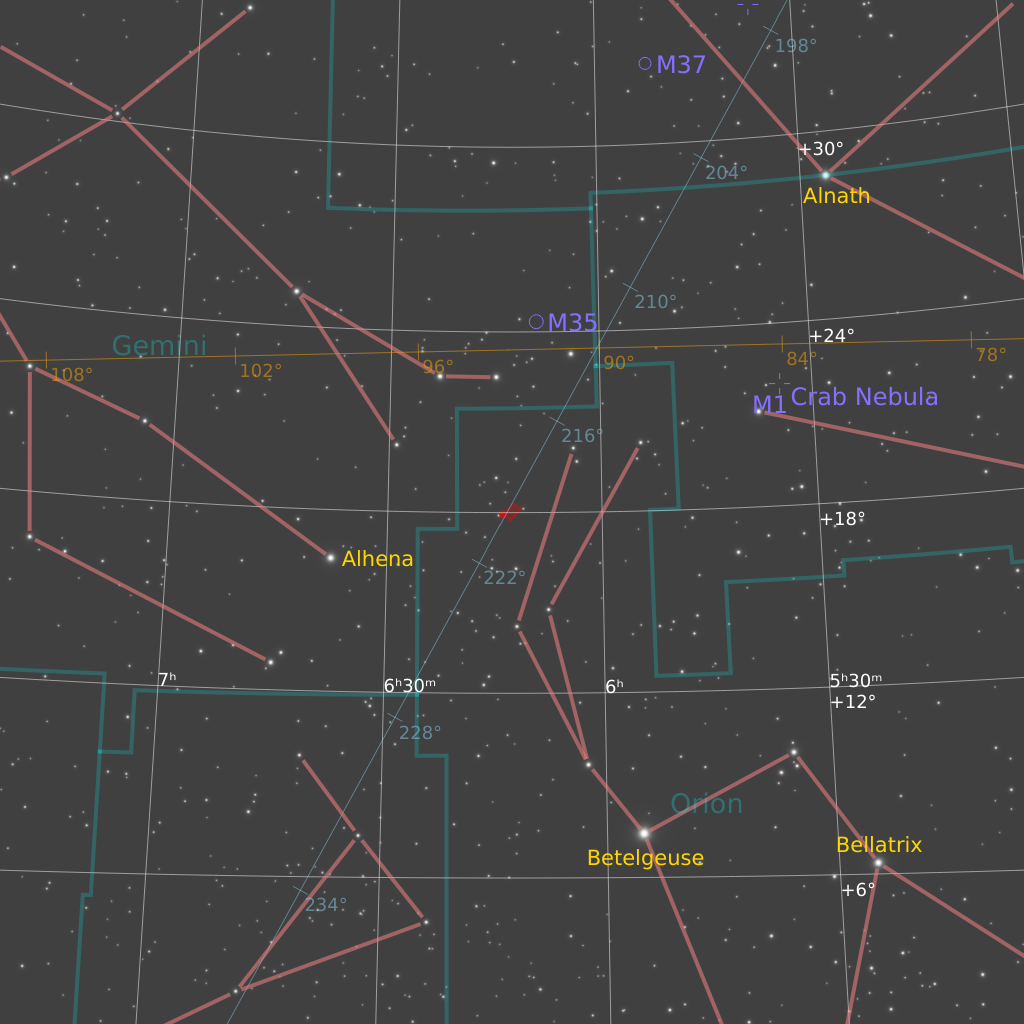
Sh2-254 – Sh2-258 from remote


In 2025, I had the opportunity to process a high-quality one-shot color (OSC) dataset of the remarkable Sharpless nebula complex Sh2-254 to Sh2-258, provided by Telescope Live and acquired under the pristine dark skies of the United States.

The Sh2-254 to Sh2-258 group is a compact complex of nebulae in Orion, often nicknamed the “Mushroom Nebula” because the brightest pieces form a mushroom-like shape in wide-field images. It is a star-forming region rather than a single nebula, and the five Sharpless objects appear close together on the sky even though they may not all be physically tied into one structure.

Sh2-254 is the largest and most diffuse member, Sh2-257 and Sh2-255 are the brightest, Sh2-256 is a smaller patch nearby, and Sh2-258 is a faint reflection nebula on the edge of the field. Sh2-255 is also cataloged as IC 2162, which is why some sources refer to the region by that more familiar name. In images, the brighter emission nebulae sit around a common field of stars and dust, giving the whole area a clustered, layered look.

The complex is generally placed at around 6,500 to 8,000 light-years away in the Orion direction, near the upper edge of the constellation. That puts it in the outer Milky Way rather than in a nearby neighborhood like Orion’s famous bright nebulae. Because of the distance and faintness, most detail comes from long-exposure imaging, especially in hydrogen-alpha light.

These are H II regions, so the red glow comes from ionized hydrogen around young, hot stars. One source identifies HD 253247 and HD 253327 as ionizing sources for parts of the complex, while another mentions LS 19 and a 2MASS source associated with smaller pieces. That means different pockets of gas are being lit by different stars, which is one reason the region is broken into several named Sharpless objects instead of one smooth nebula.

The group is interesting because the nebulae are close together on the sky but may not all be physically associated, making them a good case study in line-of-sight projection versus true spatial structure. Astronomers and imagers often compare their shapes and brightness in narrowband data to infer how dense the gas is and how strongly each source star is ionizing its surroundings. Sh2-258 is especially notable because it is faint and reflective rather than purely emissive, so it behaves differently from the red H II patches nearby.

Think of Sh2-254 through Sh2-258 as a small neighborhood of glowing clouds in Orion: one broad cloud, two brighter cores, a couple of smaller side clouds, and one faint reflection nebula. The region is a nice example of how star formation can produce a whole cluster of cataloged nebulae in one crowded patch of the sky.

Data calibration and registration and the final processing was done with PixInsight. The result was as follows:

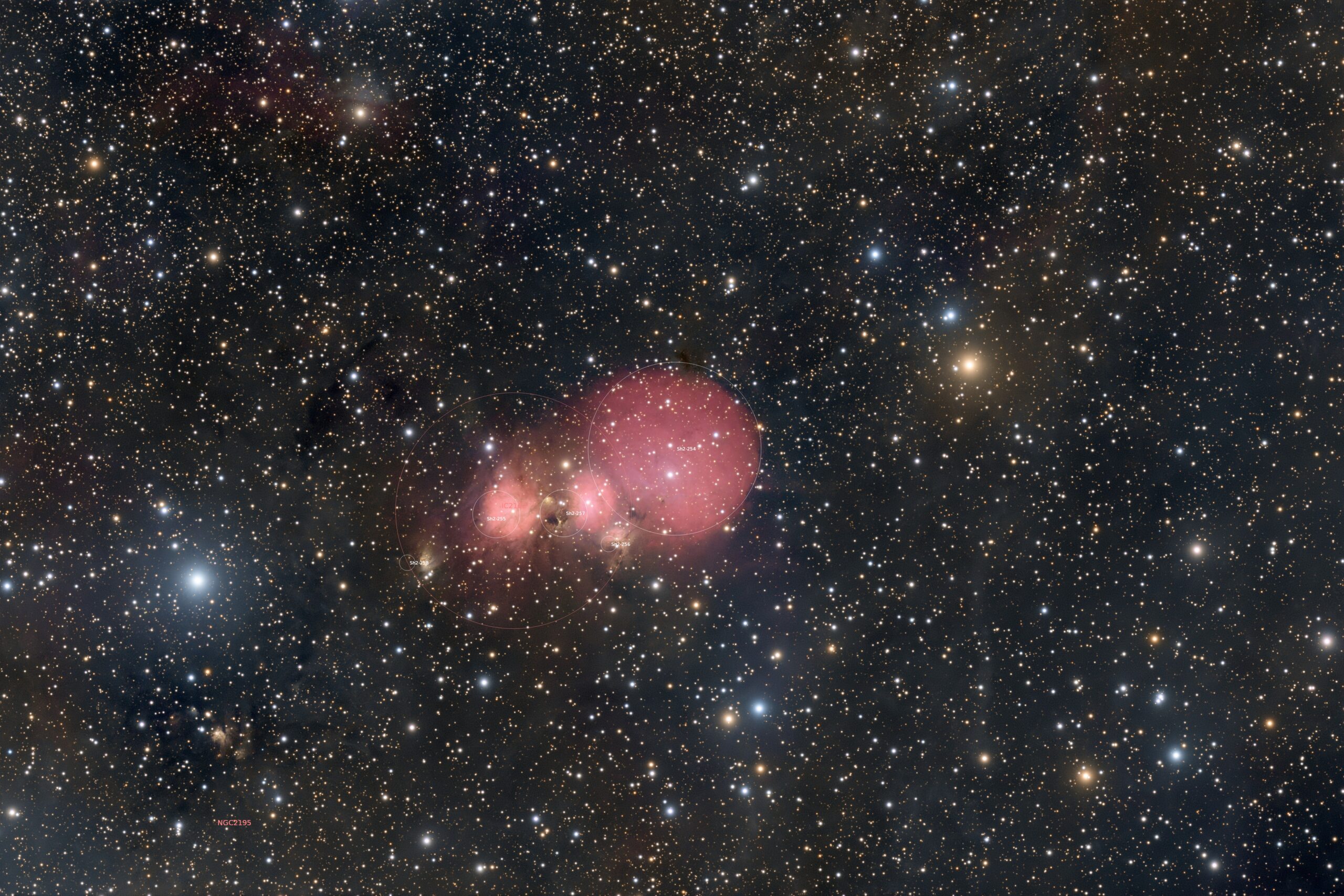
Sh2-254 - Sh2-258, Telescope Live; USA, 2025
Sh2-254 – Sh2-258, Telescope Live; USA, 2025
Sh2-254 - Sh2-258 annotated
Sh2-254 – Sh2-258 annotated


The images were taken with the following equipment (T17-1 CMOS, Telescope Live):

  • Date: 2025
  • Location: USA
  • Telescope/Lens: William Optics Fluorostar 132
  • Focal length [mm]: 910
  • Focal ratio: 6.9
  • Mount: Skywatcher EQ6-R Pro
  • Camera: ZWO ASI 2600MC Pro
  • Filter: OSC
  • Exposure time [min]: 650
  • Resolution: 0.85″/px


Sh2-254 Finder Chart


Stephan Küppers


You might also like
IC 1318
15. Juli 2026
NGC 7000 with IC 5070
24. Juni 2026
Sh2-129, Outters 4
29. Mai 2026

Leave a reply

Schreibe einen Kommentar Antwort abbrechen

Deine E-Mail-Adresse wird nicht veröffentlicht. Erforderliche Felder sind mit * markiert


© Stephan Küppers 2020-2022

Cookie-Zustimmung verwalten
Wir verwenden Cookies, um unsere Website und unseren Service zu optimieren.
Funktional Immer aktiv
Die technische Speicherung oder der Zugang ist unbedingt erforderlich für den rechtmäßigen Zweck, die Nutzung eines bestimmten Dienstes zu ermöglichen, der vom Teilnehmer oder Nutzer ausdrücklich gewünscht wird, oder für den alleinigen Zweck, die Übertragung einer Nachricht über ein elektronisches Kommunikationsnetz durchzuführen.
Vorlieben
Die technische Speicherung oder der Zugriff ist für den rechtmäßigen Zweck der Speicherung von Präferenzen erforderlich, die nicht vom Abonnenten oder Benutzer angefordert wurden.
Statistiken
Die technische Speicherung oder der Zugriff, der ausschließlich zu statistischen Zwecken erfolgt. Die technische Speicherung oder der Zugriff, der ausschließlich zu anonymen statistischen Zwecken verwendet wird. Ohne eine Vorladung, die freiwillige Zustimmung deines Internetdienstanbieters oder zusätzliche Aufzeichnungen von Dritten können die zu diesem Zweck gespeicherten oder abgerufenen Informationen allein in der Regel nicht dazu verwendet werden, dich zu identifizieren.
Marketing
Die technische Speicherung oder der Zugriff ist erforderlich, um Nutzerprofile zu erstellen, um Werbung zu versenden oder um den Nutzer auf einer Website oder über mehrere Websites hinweg zu ähnlichen Marketingzwecken zu verfolgen.
  • Optionen verwalten
  • Dienste verwalten
  • Verwalten von {vendor_count}-Lieferanten
  • Lese mehr über diese Zwecke
Einstellungen anzeigen
  • {title}
  • {title}
  • {title}