
• Home
  • Blog
  • Astrophotography
    • Deep Sky
      • Galaxies (Galaxien)
      • Nebulae (Nebel)
      • Planetary Nebulae (Planetarische Nebel)
      • Globular Clusters (Kugelsternhaufen)
      • Open Clusters (Offene Sternhaufen)
      • Miscellaneous (Verschiedenes)
    • Solar System (Sonnensystem)
      • Comets (Kometen)
      • Moon (Mond)
      • Planets (Planeten)
      • Sun (Sonne)
  • Archiv

    • Juli 2026
    • Juni 2026
    • Mai 2026
    • April 2026
    • Februar 2026
    • Dezember 2025
    • November 2025
    • Oktober 2025
    • September 2025
    • August 2025
    • Juli 2025
    • Juni 2025
    • Mai 2025
    • April 2025
    • März 2025
    • Januar 2025
    • Dezember 2024
    • November 2024
    • Oktober 2024
    • September 2024
    • August 2024
    • Juli 2024
    • Juni 2024
    • Mai 2024
    • April 2024
    • März 2024
    • Februar 2024
    • Januar 2024
    • November 2023
    • Oktober 2023
    • September 2023
    • August 2023
    • Juli 2023
    • Juni 2023
    • Mai 2023
    • April 2023
    • März 2023
    • Februar 2023
    • Januar 2023
    • Dezember 2022
    • November 2022
    • Oktober 2022
    • September 2022
    • August 2022
    • Juni 2022
    • Mai 2022
    • April 2022
    • März 2022
    • Februar 2022
    • Januar 2022
    • Dezember 2021
    • November 2021
    • September 2021
    • August 2021
    • Juli 2021
    • März 2021
    • Februar 2021
    • November 2020
    • September 2020
    • August 2020
    • April 2020
    • März 2020
    • Februar 2020
    • Januar 2020
    • Dezember 2019
    • November 2019
    • Oktober 2019
    • September 2019
    • August 2019
    • Mai 2019
    • April 2019
    • März 2019
    • Dezember 2018
    • November 2018
    • Oktober 2018
    • September 2018
    • Juni 2018
    • Mai 2018
    • April 2018
    • März 2018
    • Februar 2018
    • Januar 2018
    • Oktober 2017
    • Juli 2017
    • Juni 2017
    • Januar 2017
    • Dezember 2016
    • September 2016
    • Mai 2016
    • März 2016
    • November 2015
    • Oktober 2015
    • Juli 2015
    • Mai 2015
    • März 2015
    • Februar 2015
    • September 2014
    • August 2014
    • März 2014
    • Februar 2014
    • Oktober 2013
    • September 2013
    • August 2013
    • April 2013
    • März 2013
    • November 2012
    • August 2012
    • Juli 2012
    • Mai 2012
    • März 2012
    • Januar 2012
    • November 2011
    • Oktober 2011
    • September 2011
    • August 2011
    • April 2011
    • März 2011
    • Oktober 2010
    • September 2010
    • August 2010
    • Juli 2010
    • April 2010
    • Juli 2009
    • Juli 2008
    • Januar 2008
    • Oktober 2007
    • Juli 2007
    • Februar 2007
    • Juni 2006
    • Oktober 2005
    • September 2005
    • August 2005
    • Januar 2005
  • Kategorien

    • Asterism
    • Astrophotography
    • Barnard
    • Comet
    • Galaxies
    • Globular Cluster
    • IC
    • Messier
    • Moon
    • Nebula
    • NGC
    • Open cluster
    • Photography
    • Planetary Nebula
    • Travel
  • Meta

    • Anmelden
    • Eintrags-Feed
    • Kommentar-Feed
    • WordPress.org
  • Privacy Policy
  • Impressum
  • Haftungsausschluss
  • Cookie-Richtlinie
  • Datenschutzerklärung

wonderfuluniverse.de
  • Home
  • Blog
  • Astrophotography
    • Deep Sky
      • Galaxies (Galaxien)
      • Nebulae (Nebel)
      • Planetary Nebulae (Planetarische Nebel)
      • Globular Clusters (Kugelsternhaufen)
      • Open Clusters (Offene Sternhaufen)
      • Miscellaneous (Verschiedenes)
    • Solar System (Sonnensystem)
      • Comets (Kometen)
      • Moon (Mond)
      • Planets (Planeten)
      • Sun (Sonne)

Sh2-240 from my backyard


In 2016, together with my astrophotography companions Ralf Kreuels, Mark Schocke, and Michael Kunze, I embarked on an ambitious project to image the vast Spaghetti Nebula (Sh2-240), one of the largest known supernova remnants in the sky. Owing to its enormous angular size of nearly three degrees, the nebula was ideally suited for wide-field imaging with 200 mm telephoto lenses. We acquired extensive RGB data alongside narrowband Hα and OIII exposures, allowing us to reveal both the delicate filamentary hydrogen structures and the faint oxygen emission that traces the expanding shock front of the ancient supernova remnant.

The individual datasets were meticulously calibrated, registered, and combined into a single high-resolution composite that captured the remarkable complexity of this elusive object. The finished image was honored with publication in the Astronomy Photographer of the Year Book 2016, accompanying the prestigious competition organized by the Royal Observatory Greenwich. This recognition was a rewarding culmination of a truly collaborative effort and remains one of the highlights of our astrophotography work.

Sh2-240 is the Sharpless catalog name for the Spaghetti Nebula, also known as Simeis 147 or S147. It is a large, faint supernova remnant on the border of Taurus and Auriga, famous for its long, filamentary structure that really does look like tangled strands.

Unlike an emission nebula powered by young stars, Sh2-240 is the leftover shell of a supernova explosion. The blast happened long ago, and the expanding shock wave is still heating and ionizing the surrounding gas, which makes the nebula glow in narrowband images. This is why the object is scientifically interesting: it shows the later life of a massive star after the explosive end of its evolution.

The nebula is huge on the sky, covering about 3 degrees, which is around six full Moons across. At an estimated distance of roughly 3,000 to 4,500 light-years, that apparent size translates into an actual diameter of roughly 140 to 220 light-years, depending on which distance estimate is used. That makes it one of the larger and older supernova remnants still showing a recognizable structure in the Milky Way.

Most sources place its age at about 40,000 years. It was first discovered in 1952 at the Crimean Astrophysical Observatory by Grigori Shajn using a Schmidt camera and H-alpha filters. Later work identified it as a supernova remnant rather than an ordinary emission nebula, and studies have also found a pulsar in its interior, consistent with a collapsed stellar core left behind by the explosion.

Sh2-240 is one of those targets that astrophotographers love and casual observers often miss, because it is extremely faint. Its structure is made of thin loops and arcs, with glowing hydrogen and oxygen emission tracing the shock fronts where the remnant is plowing into interstellar gas. In images, the fine filaments give it a delicate, web-like appearance rather than a bright, compact shape.

Astronomers study Sh2-240 because it is a good laboratory for supernova remnant evolution, shock physics, and the interaction between ejecta and the interstellar medium. The remnant is old enough that its expansion has slowed and its structure has become intricate, but it is still young enough to preserve clear evidence of the original explosion. That balance makes it especially useful for comparing with better-known remnants like the Veil Nebula.

For the DSW data the calibration, registration and the final processing was done with PixInsight. The result was as follows:
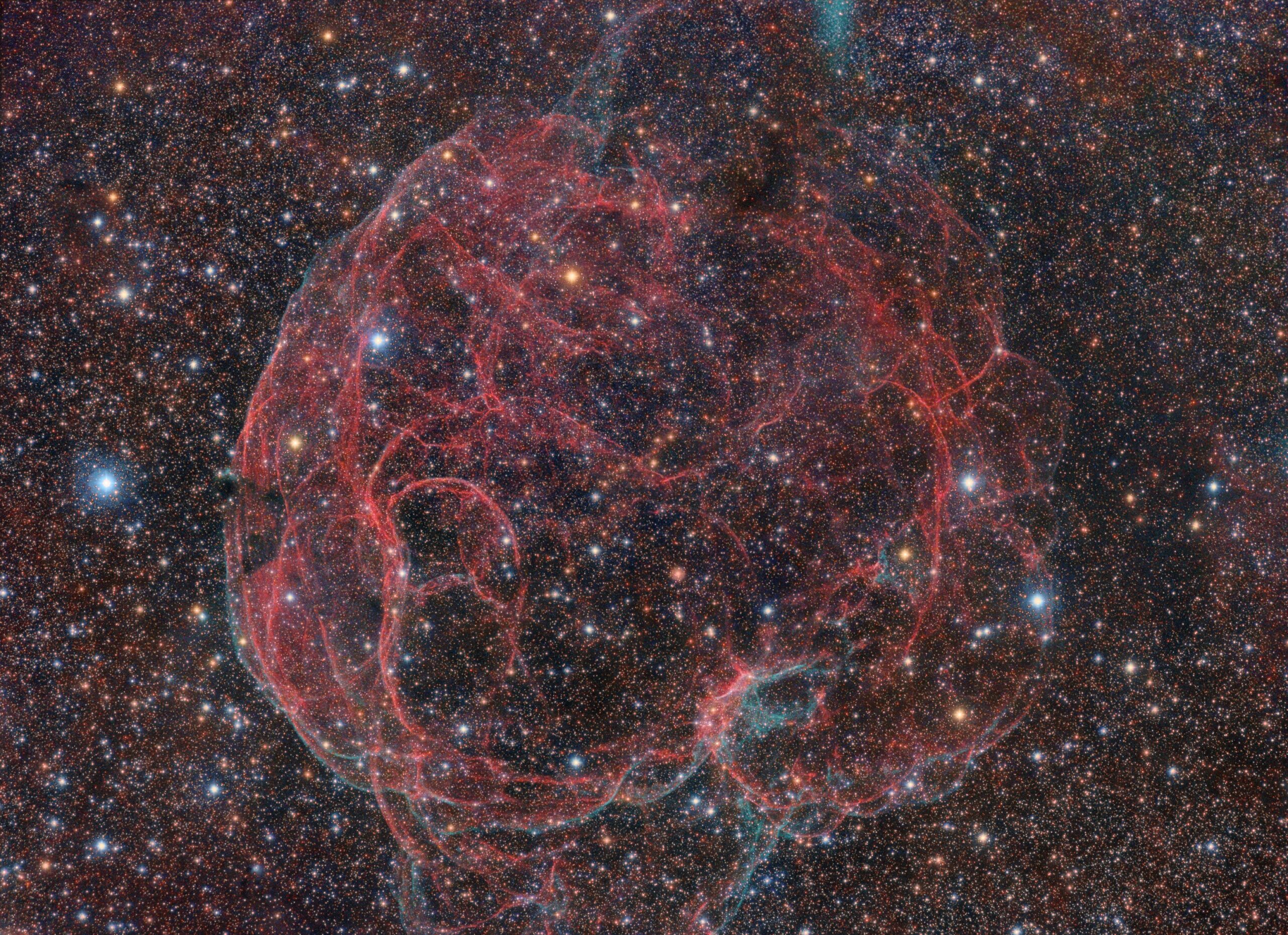
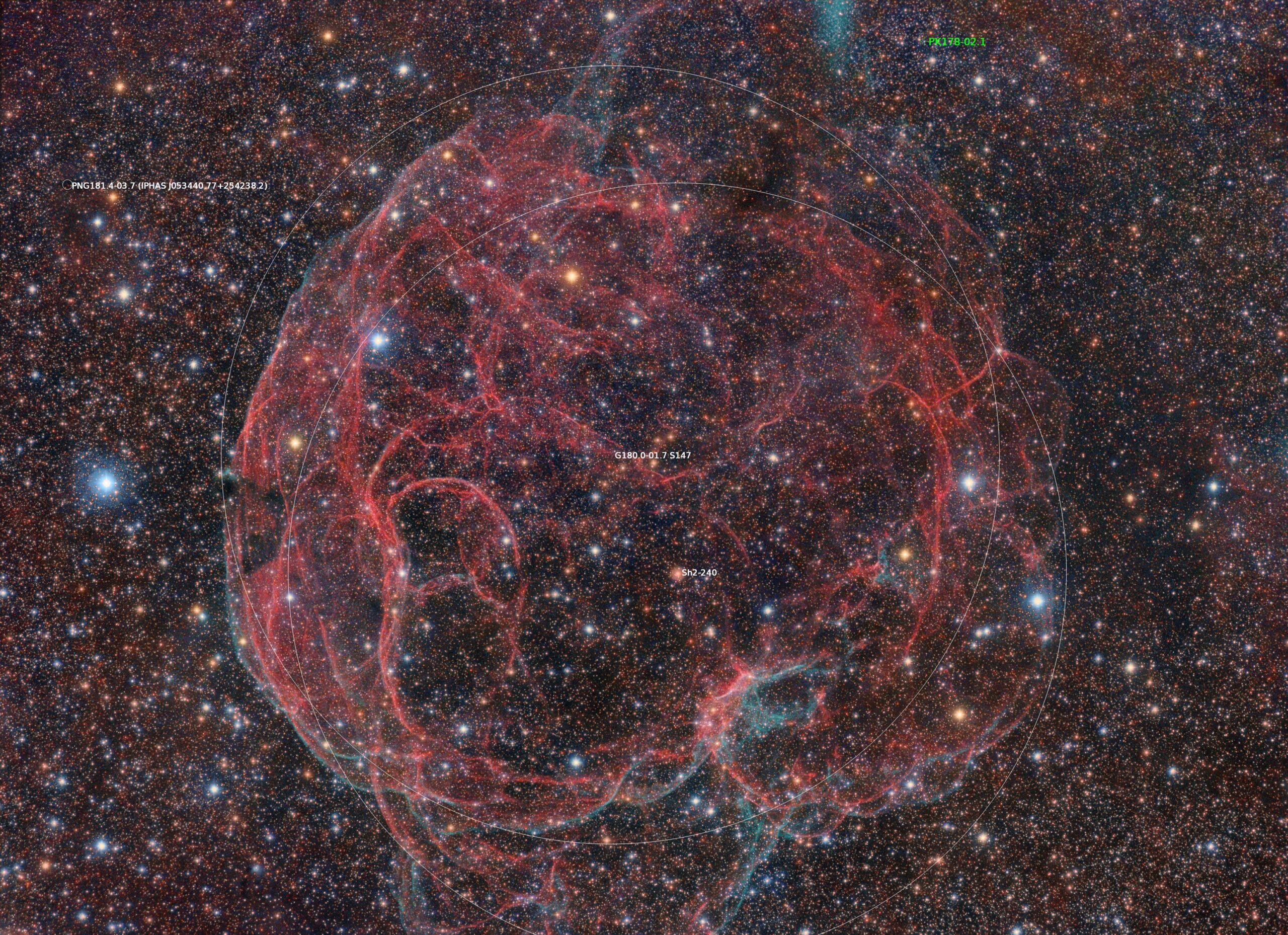
Sh2-240, Krefeld, 2016
Sh2-240 annotated
Sh2-240 annotated


Here is an overview of the used equipment and the exposure times (my contribution)

  • Date: 2016
  • Location: Krefeld
  • Telescope/Lense: Canon 200
  • Focal length [mm]: 200
  • Focal ratio: 4
  • Mount: Skywatcher NEQ6
  • Camera: Moravian 8300 FW
  • Filter: [OIII]
  • Exposure time [min]: 765
  • Resolution: 5.75″/px


Sh2-240 Finder Chart

Stephan Küppers


You might also like
IC 1318
15. Juli 2026
NGC 7000 with IC 5070
24. Juni 2026
Sh2-129, Outters 4
29. Mai 2026

Leave a reply

Schreibe einen Kommentar Antwort abbrechen

Deine E-Mail-Adresse wird nicht veröffentlicht. Erforderliche Felder sind mit * markiert


© Stephan Küppers 2020-2022

Cookie-Zustimmung verwalten
Wir verwenden Cookies, um unsere Website und unseren Service zu optimieren.
Funktional Immer aktiv
Die technische Speicherung oder der Zugang ist unbedingt erforderlich für den rechtmäßigen Zweck, die Nutzung eines bestimmten Dienstes zu ermöglichen, der vom Teilnehmer oder Nutzer ausdrücklich gewünscht wird, oder für den alleinigen Zweck, die Übertragung einer Nachricht über ein elektronisches Kommunikationsnetz durchzuführen.
Vorlieben
Die technische Speicherung oder der Zugriff ist für den rechtmäßigen Zweck der Speicherung von Präferenzen erforderlich, die nicht vom Abonnenten oder Benutzer angefordert wurden.
Statistiken
Die technische Speicherung oder der Zugriff, der ausschließlich zu statistischen Zwecken erfolgt. Die technische Speicherung oder der Zugriff, der ausschließlich zu anonymen statistischen Zwecken verwendet wird. Ohne eine Vorladung, die freiwillige Zustimmung deines Internetdienstanbieters oder zusätzliche Aufzeichnungen von Dritten können die zu diesem Zweck gespeicherten oder abgerufenen Informationen allein in der Regel nicht dazu verwendet werden, dich zu identifizieren.
Marketing
Die technische Speicherung oder der Zugriff ist erforderlich, um Nutzerprofile zu erstellen, um Werbung zu versenden oder um den Nutzer auf einer Website oder über mehrere Websites hinweg zu ähnlichen Marketingzwecken zu verfolgen.
  • Optionen verwalten
  • Dienste verwalten
  • Verwalten von {vendor_count}-Lieferanten
  • Lese mehr über diese Zwecke
Einstellungen anzeigen
  • {title}
  • {title}
  • {title}