

Sh2-235 from my own „Sterntaucher“ observatory
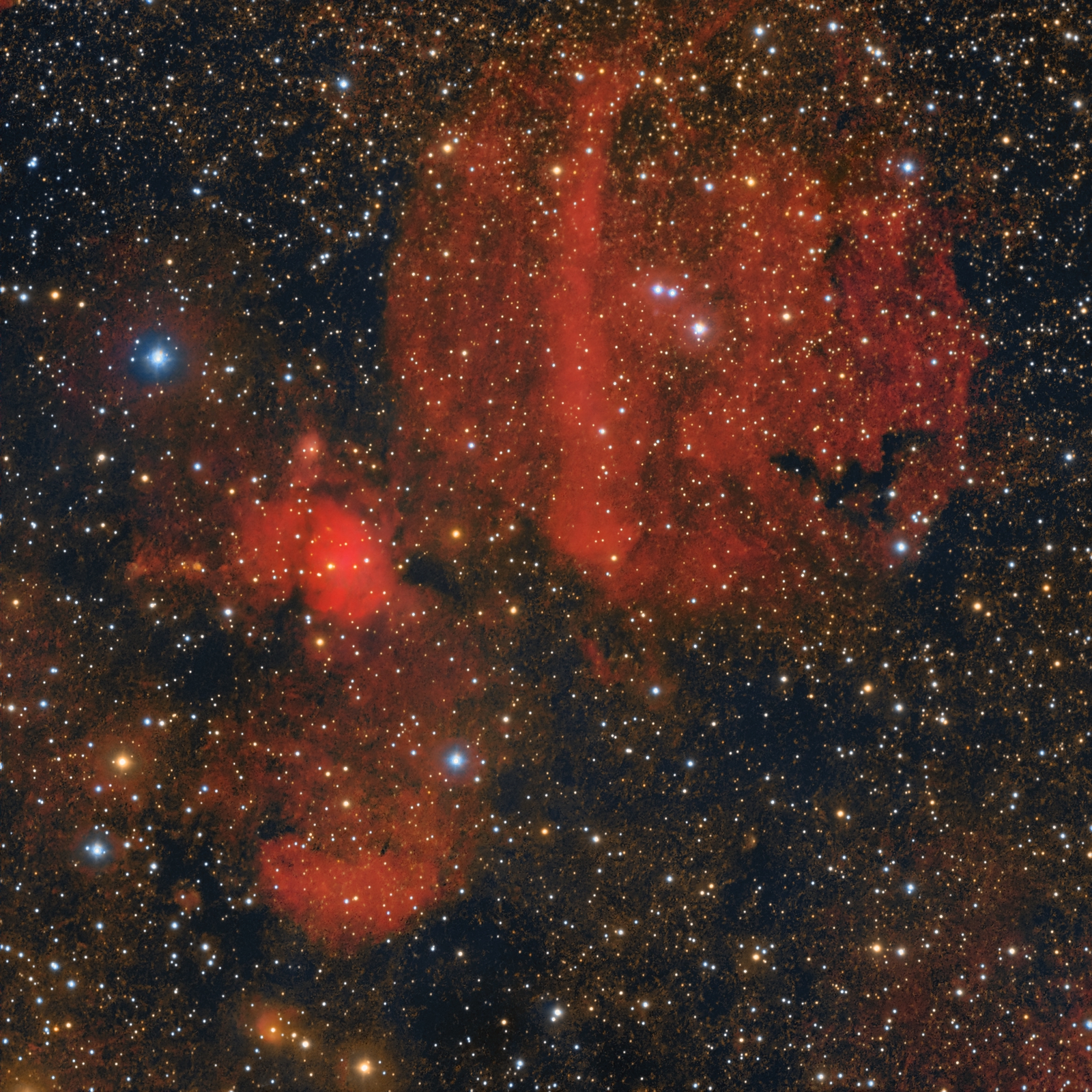
In 2019, I turned my attention to the rich emission nebula complex comprising Sh2-231, Sh2-232, Sh2-233, and Sh2-235 in the constellation Auriga. To capture both the intricate fine structures and the surrounding faint nebulosity, I employed my dual-rig imaging setup. A telescope with a longer focal length was dedicated to acquiring high-resolution Hα data, revealing the delicate filaments and ionized hydrogen clouds in exceptional detail. Simultaneously, a second telescope with a shorter focal length collected additional Hα and RGB data, providing a wider field of view that encompassed the entire nebular complex.
During post-processing, the wide-field Hα and RGB images were carefully upscaled and precisely matched to the scale of the high-resolution Hα master frame. This approach combined the sharpness and structural detail of the long focal length with the natural color information and expansive field of the shorter focal length, producing a seamless image that showcases both the intricate morphology and the broader astrophysical environment of these fascinating Sharpless nebulae.
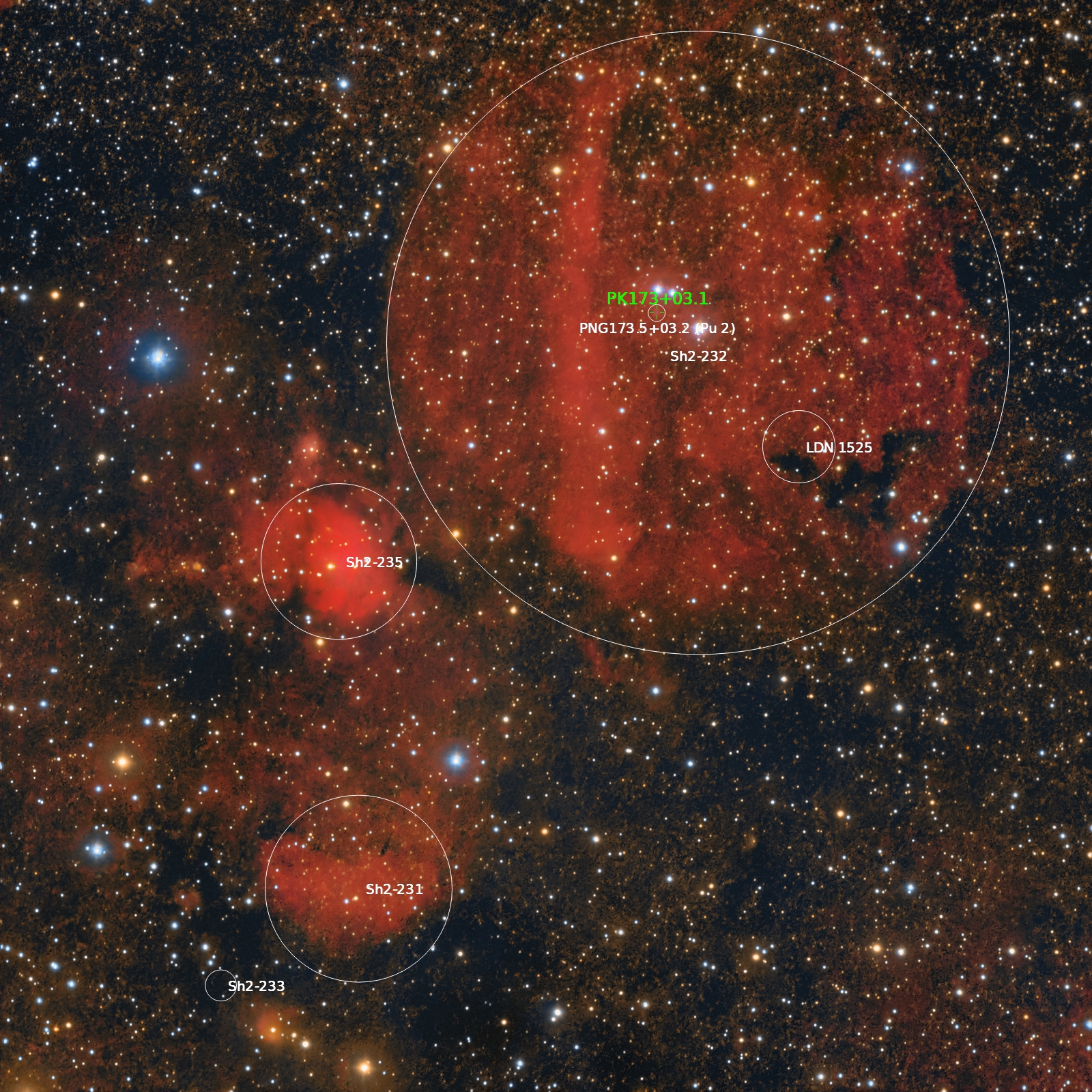
Sh2-231, Sh2-232, Sh2-233, and Sh2-235 are four cataloged emission nebulae in Auriga that are usually treated as parts of one larger H II complex rather than four completely separate systems. They sit inside a giant molecular cloud in the Perseus Arm of the Milky Way, at a distance of roughly 1,800 parsecs, or about 5,900 light-years.
These objects belong to the Sharpless catalog, which lists Galactic H II regions, meaning clouds of hydrogen gas ionized by nearby hot, young stars. In optical images they look like distinct nebulae, but radio and narrowband studies show that they are physically connected parts of a single star-forming region. That makes the group a useful example of how one large cloud can fragment into multiple visible nebulae.
Sh2-235 is usually described as the brightest member of the group, while Sh2-232 is the largest and most extended. Sh2-231 and Sh2-233 are fainter, smaller patches of emission nearby. In imaging, Sh2-235 often stands out because it has the strongest hydrogen-alpha signal, with only limited oxygen-III emission compared with the surrounding nebulosity.
The region is active in star formation, and infrared studies have found many young stellar objects embedded in or near Sh2-235. One source identifies the main ionizing star as BD +35 1201, an O9.5 V star, which is hot enough to keep the surrounding hydrogen gas glowing. That is the key mechanism behind H II regions: ultraviolet light from massive stars strips electrons from hydrogen atoms, and when those electrons recombine, the nebula emits the familiar red light of hydrogen-alpha.
Sh2-232 is sometimes nicknamed the “Great Pumpkin” because of its rounded shape in wide-field images. It also contains a small planetary nebula in projection near its center, cataloged as PN G173.5+03.2, which makes the field even more visually crowded and scientifically interesting. There is also mention in the literature of a misclassified nearby object associated with Sh2-235, showing how tricky these crowded Galactic regions can be to catalog cleanly.
Astronomers use this complex to study how giant molecular clouds form stars and how those stars then sculpt the gas around them. Observations across H-alpha, H-beta, [S II], and [N II] emission lines help map the three-dimensional structure and physical conditions of the ionized gas. In practical terms, the Sh2-231/232/233/235 region is a nice laboratory for comparing a bright compact H II region, a larger diffuse shell, and the dusty environment of a star-forming cloud.
Data calibration and registration and the final processing was done with PixInsight. The result was as follows:
Here is an overview of the used equipment and the exposure times:
- Date: 2019
- Location: Krefeld
- Telescope/Lense: 10″ Newton ohne Namen – TSQ-65ED Apo
- Focal length [mm]: 1000 – 420
- Focal ratio: 3.9 – 6.5
- Mount Skywatcher EQ8
- Camera: Moravian G2 8300 FW – Moravian G3 16200 FW
- Filter: Hα – Hα:RGB
- Exposure time [min]: 95 – 180:180:180:810
- Resolution: 1.11″/px – 2.95″/px




Leave a reply