• Home
  • Blog
  • Astrophotography
    • Deep Sky
      • Galaxies (Galaxien)
      • Nebulae (Nebel)
      • Planetary Nebulae (Planetarische Nebel)
      • Globular Clusters (Kugelsternhaufen)
      • Open Clusters (Offene Sternhaufen)
      • Miscellaneous (Verschiedenes)
    • Solar System (Sonnensystem)
      • Comets (Kometen)
      • Moon (Mond)
      • Planets (Planeten)
      • Sun (Sonne)
  • Archiv

    • Juli 2026
    • Juni 2026
    • Mai 2026
    • April 2026
    • Februar 2026
    • Januar 2026
    • Dezember 2025
    • November 2025
    • Oktober 2025
    • September 2025
    • August 2025
    • Juli 2025
    • Juni 2025
    • Mai 2025
    • April 2025
    • März 2025
    • Januar 2025
    • Dezember 2024
    • November 2024
    • Oktober 2024
    • September 2024
    • August 2024
    • Juli 2024
    • Juni 2024
    • Mai 2024
    • April 2024
    • März 2024
    • Februar 2024
    • Januar 2024
    • November 2023
    • Oktober 2023
    • September 2023
    • August 2023
    • Juli 2023
    • Juni 2023
    • Mai 2023
    • April 2023
    • März 2023
    • Februar 2023
    • Januar 2023
    • Dezember 2022
    • November 2022
    • Oktober 2022
    • September 2022
    • August 2022
    • Juli 2022
    • Juni 2022
    • Mai 2022
    • April 2022
    • März 2022
    • Februar 2022
    • Januar 2022
    • Dezember 2021
    • November 2021
    • September 2021
    • August 2021
    • Juli 2021
    • März 2021
    • Februar 2021
    • November 2020
    • September 2020
    • August 2020
    • April 2020
    • März 2020
    • Februar 2020
    • Januar 2020
    • Dezember 2019
    • November 2019
    • Oktober 2019
    • September 2019
    • August 2019
    • Mai 2019
    • April 2019
    • März 2019
    • Dezember 2018
    • November 2018
    • Oktober 2018
    • September 2018
    • Juni 2018
    • Mai 2018
    • April 2018
    • März 2018
    • Februar 2018
    • Januar 2018
    • Oktober 2017
    • Juli 2017
    • Juni 2017
    • Januar 2017
    • Dezember 2016
    • September 2016
    • Mai 2016
    • März 2016
    • November 2015
    • Oktober 2015
    • Juli 2015
    • Mai 2015
    • März 2015
    • Februar 2015
    • September 2014
    • August 2014
    • März 2014
    • Februar 2014
    • Oktober 2013
    • September 2013
    • August 2013
    • April 2013
    • März 2013
    • November 2012
    • August 2012
    • Juli 2012
    • Mai 2012
    • März 2012
    • Januar 2012
    • November 2011
    • Oktober 2011
    • September 2011
    • August 2011
    • April 2011
    • März 2011
    • Oktober 2010
    • September 2010
    • August 2010
    • Juli 2010
    • April 2010
    • Juli 2009
    • Juli 2008
    • Januar 2008
    • Oktober 2007
    • Juli 2007
    • März 2007
    • Februar 2007
    • Juni 2006
    • Oktober 2005
    • September 2005
    • August 2005
    • Januar 2005
  • Kategorien

    • Asterism
    • Astrophotography
    • Barnard
    • Comet
    • Galaxies
    • Globular Cluster
    • IC
    • Messier
    • Moon
    • Nebula
    • NGC
    • Open cluster
    • Photography
    • Planetary Nebula
    • Travel
  • Meta

    • Anmelden
    • Eintrags-Feed
    • Kommentar-Feed
    • WordPress.org
  • Privacy Policy
  • Impressum
  • Haftungsausschluss
  • Cookie-Richtlinie
  • Datenschutzerklärung

wonderfuluniverse.de
  • Home
  • Blog
  • Astrophotography
    • Deep Sky
      • Galaxies (Galaxien)
      • Nebulae (Nebel)
      • Planetary Nebulae (Planetarische Nebel)
      • Globular Clusters (Kugelsternhaufen)
      • Open Clusters (Offene Sternhaufen)
      • Miscellaneous (Verschiedenes)
    • Solar System (Sonnensystem)
      • Comets (Kometen)
      • Moon (Mond)
      • Planets (Planeten)
      • Sun (Sonne)

Sh2-187 from my own „Sterntaucher“ observatory


In 2020 I imaged Sharpless 187 (Sh2‑187) in LHaRGB from my own observatory using a dual rig, with a longer focal length for the L and H‑alpha channels and a wider field for the RGB data.

My LHaRGB imaging strategy leverages the strengths of both narrowband and broadband techniques. The longer‑focal‑length system for L and H‑alpha provides high spatial resolution and sensitivity to faint emission, allowing the small‑scale structure of the H II region to be captured: bright knots, filaments, and ionization fronts around the embedded stars. The H‑alpha frames isolate the line emission from ionized hydrogen, boosting contrast against the background and revealing the geometry of the ionized shell and any asymmetric features caused by density variations in the surrounding cloud.

The luminance (L) channel, often taken through a broad filter, enhances overall signal‑to‑noise and sharpness, helping to bring out fine detail in both the nebula and the star field when combined with RGB. The wider‑field RGB system, in turn, records natural star colors and the diffuse glow of reflection and emission outside the core, mapping the larger molecular and dust environment that Sh2‑187 inhabits.

When these datasets are combined into an LHaRGB image, the result is both aesthetically striking and scientifically informative. The H‑alpha data accentuate the bright core and filaments, giving the nebula a crisp, textured appearance, while the RGB data supply realistic star colors and the subtle hues of reflection nebulosity and scattered light. Dark lanes cut across the field, emphasizing the clumpy, inhomogeneous nature of the molecular cloud. Small embedded stars and possible young stellar objects show up as point sources embedded in or adjacent to the emission, hinting at the ongoing formation of a cluster within Sh2‑187.

Sh2-187 is a small but very active star‑forming region in Cassiopeia, a mix of emission, reflection, and dark nebulae embedded in a larger molecular cloud complex.

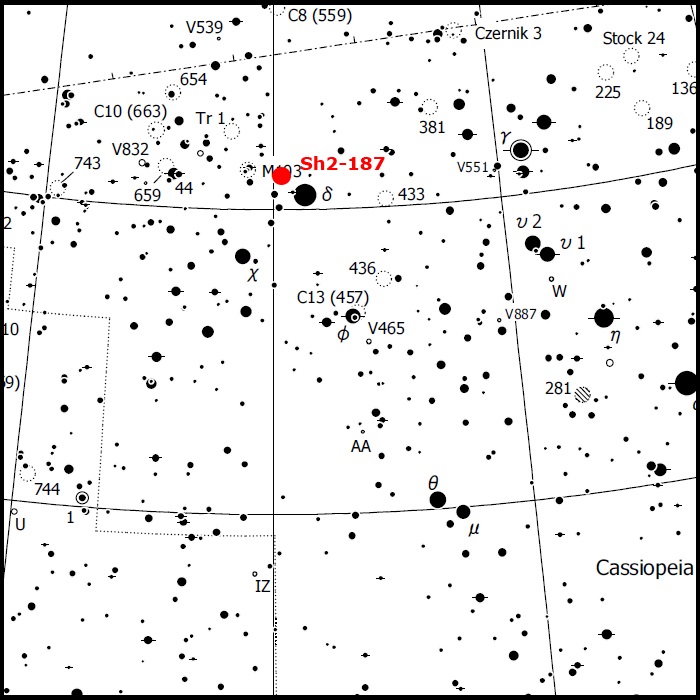
Sh2-187 lies in Cassiopeia, about 1.5° north of the star δ Cassiopeiae (Ruchbah), in a rich Milky Way field. It is a relatively compact nebula, only a few arcminutes across, surrounded by much more extended dark and molecular material that fills the wider field.

Distance estimates place Sh2‑187 at around 1,440 parsecs, roughly 4,700 light‑years from Earth. At that distance, the visible emission region is only a few light‑years across, but it sits inside a neutral hydrogen shell and molecular cloud with a mass of about 7,600 solar masses.

Physically, Sh2‑187 is an H II region and star‑forming “stellar nursery” embedded in that larger cold cloud. The central bright patch is mainly hydrogen‑alpha emission excited by young, hot stars, while reflection components and dark dust lanes trace the surrounding dusty material.

Infrared and radio observations show multiple signs of ongoing star formation. At least two strong infrared sources have been identified within Sh2‑187, notably S 187 IRS and IRAS 01202+6133, which mark deeply embedded protostars or very young stars still enshrouded in dust. There is also a molecular jet detected, indicating high‑velocity outflows from a young object interacting with the surrounding gas.

Age estimates of around 100,000–200,000 years make Sh2‑187 a very young star‑forming region on galactic timescales. It sits on the edge of a larger neutral hydrogen structure, and the configuration suggests that earlier generations of massive stars may have compressed part of this cloud, triggering the current burst of star formation.

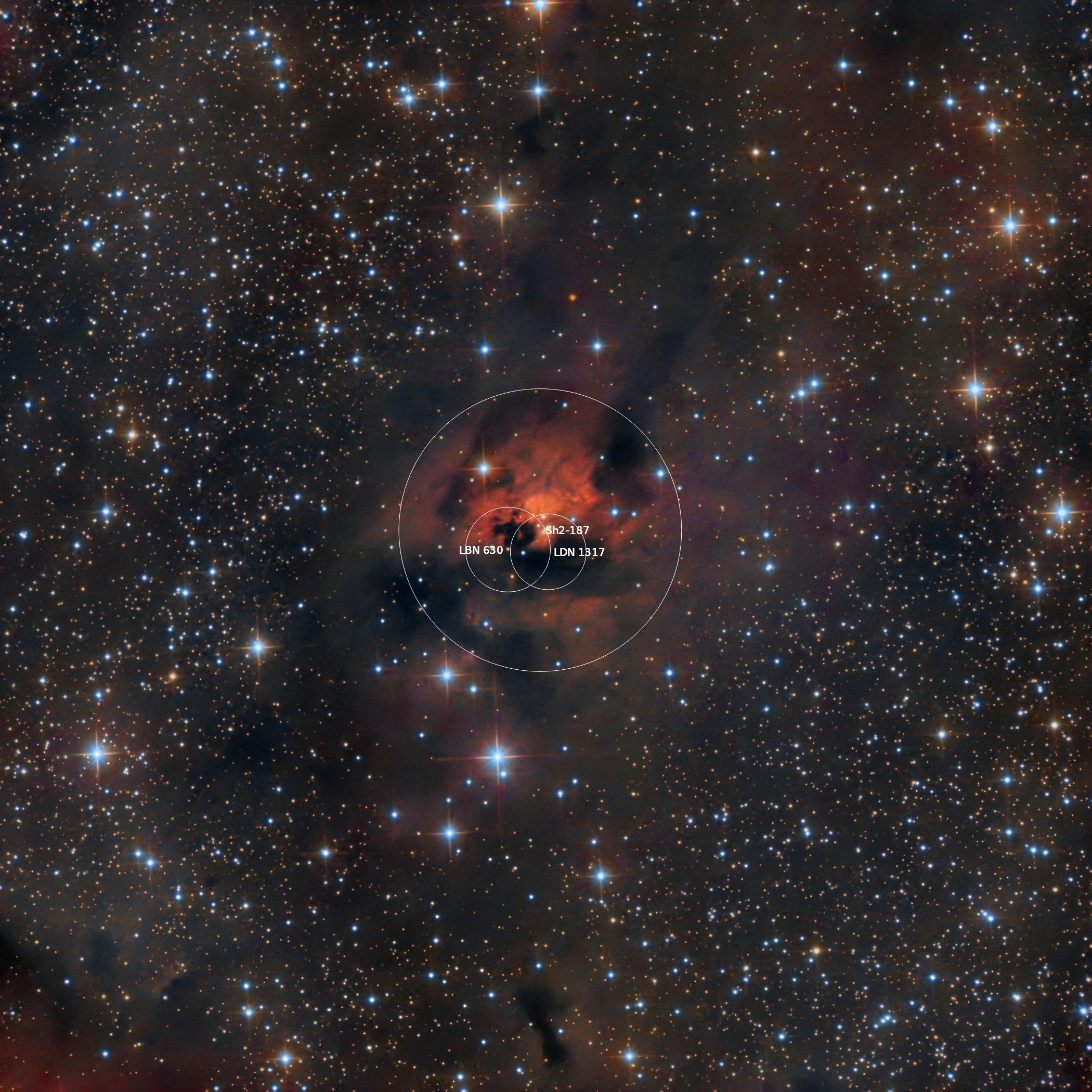
The bright emission is wrapped in a complex of dark nebulae catalogued in the Lynds Dark Nebula (LDN) list, including LDN 1317 and neighbouring clouds like LDN 1314 and 1316. These appear in your images as dark patches and filaments that partially obscure the background star field and frame the glow of Sh2‑187 itself.

The combination of glowing gas, reflection patches, heavy extinction and embedded infrared sources makes Sh2‑187 a good example of a small, embedded H II region just “switching on” inside a much larger cold molecular complex.

Data calibration and registration and the final processing was done with PixInsight. The RGB Data was upscaled to the luminance data. The result was as follows:
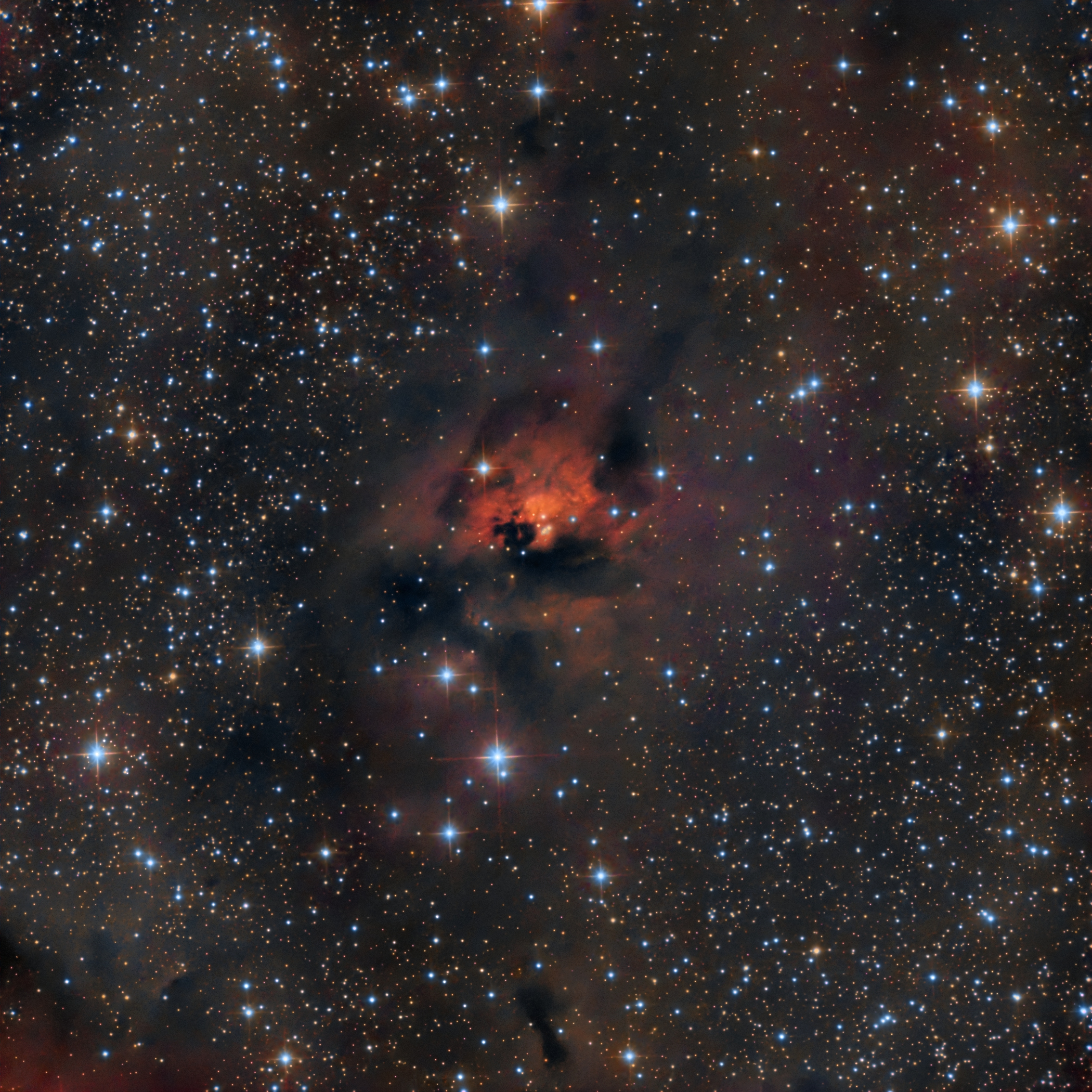
Sh2-187, Krefeld, 2020
Sh2-187 annotated
Sh2-187 annotated


Here is an overview of the used equipment and the exposure times:

  • Date: September 2020
  • Location: Krefeld
  • Telescope/Lense: 10″ Newton ohne Namen – TSQ-65ED Apo
  • Focal length [mm]: 1000 – 420
  • Focal ratio: 3.9 – 6.5
  • Mount: Skywatcher EQ8
  • Camera: Moravian G2 8300 FW – Moravian G3 16200 FW
  • Filter: CLS:Hα – R:G:B
  • Exposure time [min]: 543:470 – 290:450:215
  • Resolution: 1.11″/px – 2.95″/px


Sh2-187 finder chart


Stephan Küppers


You might also like
IC 1318
15. Juli 2026
NGC 7000 with IC 5070
24. Juni 2026
Sh2-129, Outters 4
29. Mai 2026

Leave a reply

Schreibe einen Kommentar Antwort abbrechen

Deine E-Mail-Adresse wird nicht veröffentlicht. Erforderliche Felder sind mit * markiert


© Stephan Küppers 2020-2022

Cookie-Zustimmung verwalten
Wir verwenden Cookies, um unsere Website und unseren Service zu optimieren.
Funktional Immer aktiv
Die technische Speicherung oder der Zugang ist unbedingt erforderlich für den rechtmäßigen Zweck, die Nutzung eines bestimmten Dienstes zu ermöglichen, der vom Teilnehmer oder Nutzer ausdrücklich gewünscht wird, oder für den alleinigen Zweck, die Übertragung einer Nachricht über ein elektronisches Kommunikationsnetz durchzuführen.
Vorlieben
Die technische Speicherung oder der Zugriff ist für den rechtmäßigen Zweck der Speicherung von Präferenzen erforderlich, die nicht vom Abonnenten oder Benutzer angefordert wurden.
Statistiken
Die technische Speicherung oder der Zugriff, der ausschließlich zu statistischen Zwecken erfolgt. Die technische Speicherung oder der Zugriff, der ausschließlich zu anonymen statistischen Zwecken verwendet wird. Ohne eine Vorladung, die freiwillige Zustimmung deines Internetdienstanbieters oder zusätzliche Aufzeichnungen von Dritten können die zu diesem Zweck gespeicherten oder abgerufenen Informationen allein in der Regel nicht dazu verwendet werden, dich zu identifizieren.
Marketing
Die technische Speicherung oder der Zugriff ist erforderlich, um Nutzerprofile zu erstellen, um Werbung zu versenden oder um den Nutzer auf einer Website oder über mehrere Websites hinweg zu ähnlichen Marketingzwecken zu verfolgen.
  • Optionen verwalten
  • Dienste verwalten
  • Verwalten von {vendor_count}-Lieferanten
  • Lese mehr über diese Zwecke
Einstellungen anzeigen
  • {title}
  • {title}
  • {title}