

Sh2-173 from remote
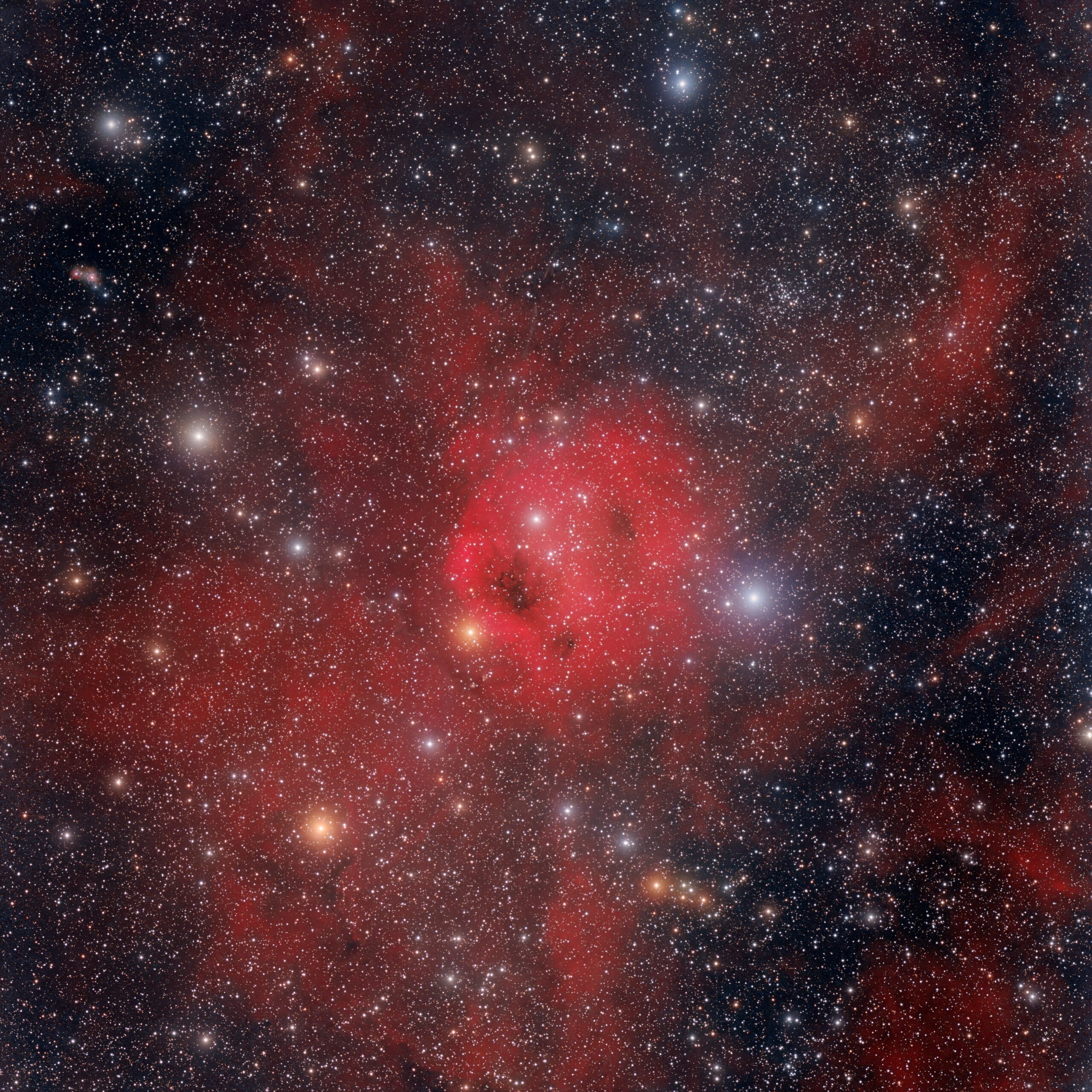
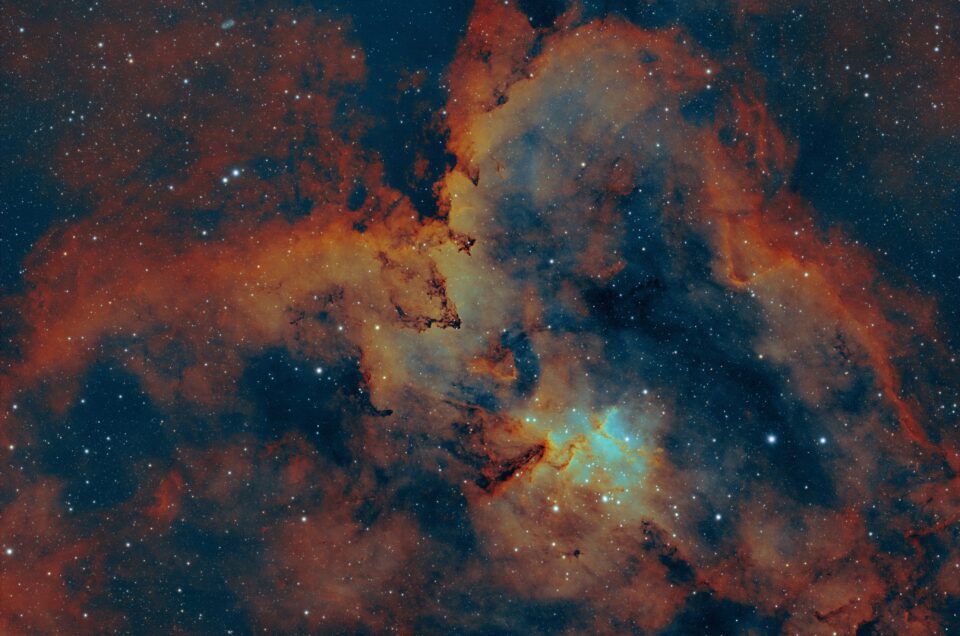
In 2018 I received a RGBHaOIIISII dataset of Sharpless 173 (Sh2‑173) from Deep Sky West (DSW), taken under the dark, high‑altitude skies of New Mexico, and from it I produced both a RGBHOO and an SHO rendition of this fascinating nebula.
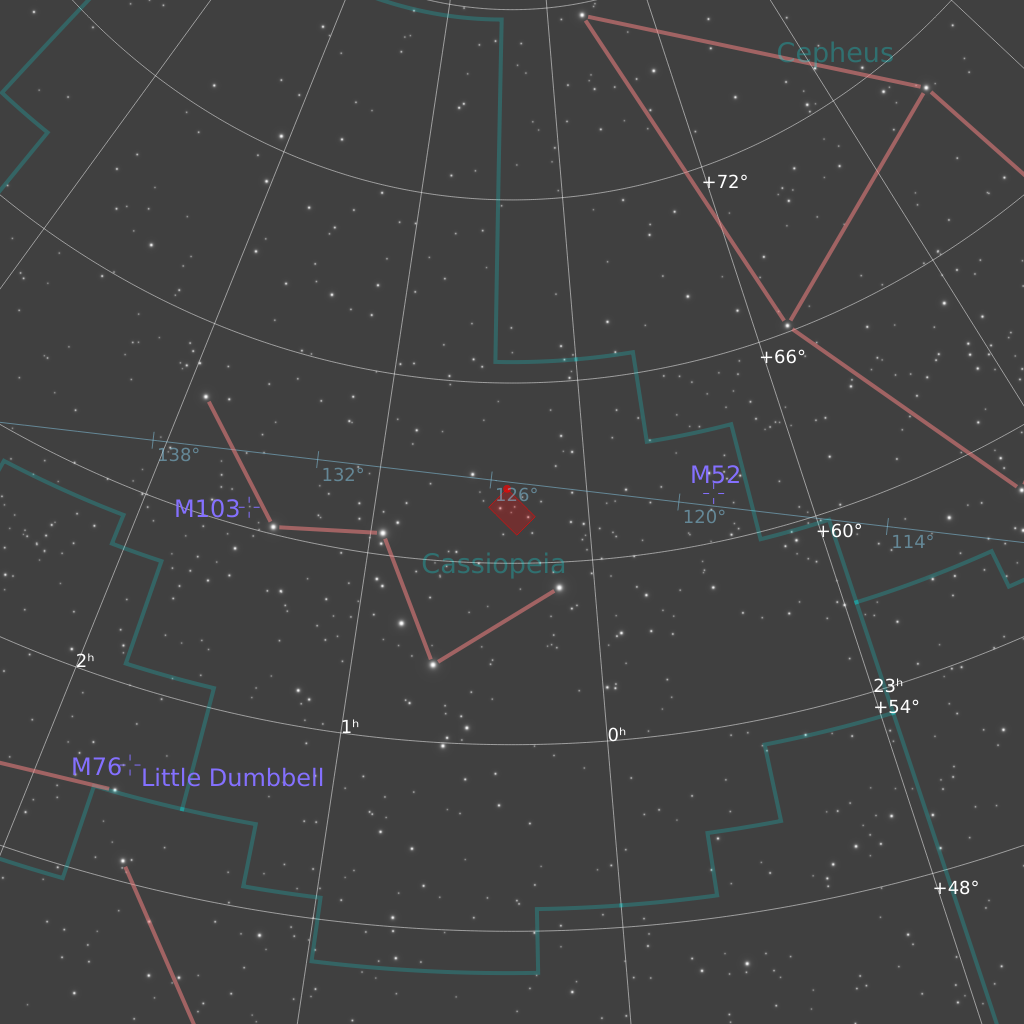
My dataset, combining RGB, H‑alpha, O III and S II, is well matched to the physical complexity of Sh2‑173. The broadband RGB frames record stellar continuum and the integrated light of the nebula, placing Sh2‑173 within the dense Cassiopeia star fields roughly three degrees north of Caph (β Cassiopeiae), at the western end of the familiar “W” asterism. However, the red emission is so faint that long exposures through standard filters barely reveal it, and the detailed structure emerges only when narrowband H‑alpha is added.
H‑alpha isolates the ionized hydrogen, highlighting the main body of the H II region and its fine filaments and arcs; O III traces higher‑excitation zones around the hottest stars and shock fronts but is relatively weak in this nebula compared to H‑alpha and S II; S II emphasizes denser, partially ionized zones and interfaces where shocks and radiation fronts compress the gas.
In my RGBHOO processing, H‑alpha is blended with RGB and O III (often mapped to green and blue), producing a relatively natural‑looking image that still accentuates the nebular emission. This approach allows the true star colors from the RGB data to coexist with an enhanced view of the gas, showing Sh2‑173 as a faint, reddish cloud with subtle teal or blue highlights around energetic regions. The RGBHOO image helps distinguish the nebula from the star background while maintaining a visually intuitive color balance: stars retain realistic hues, and the nebula’s structure appears gently boosted rather than heavily stylized.
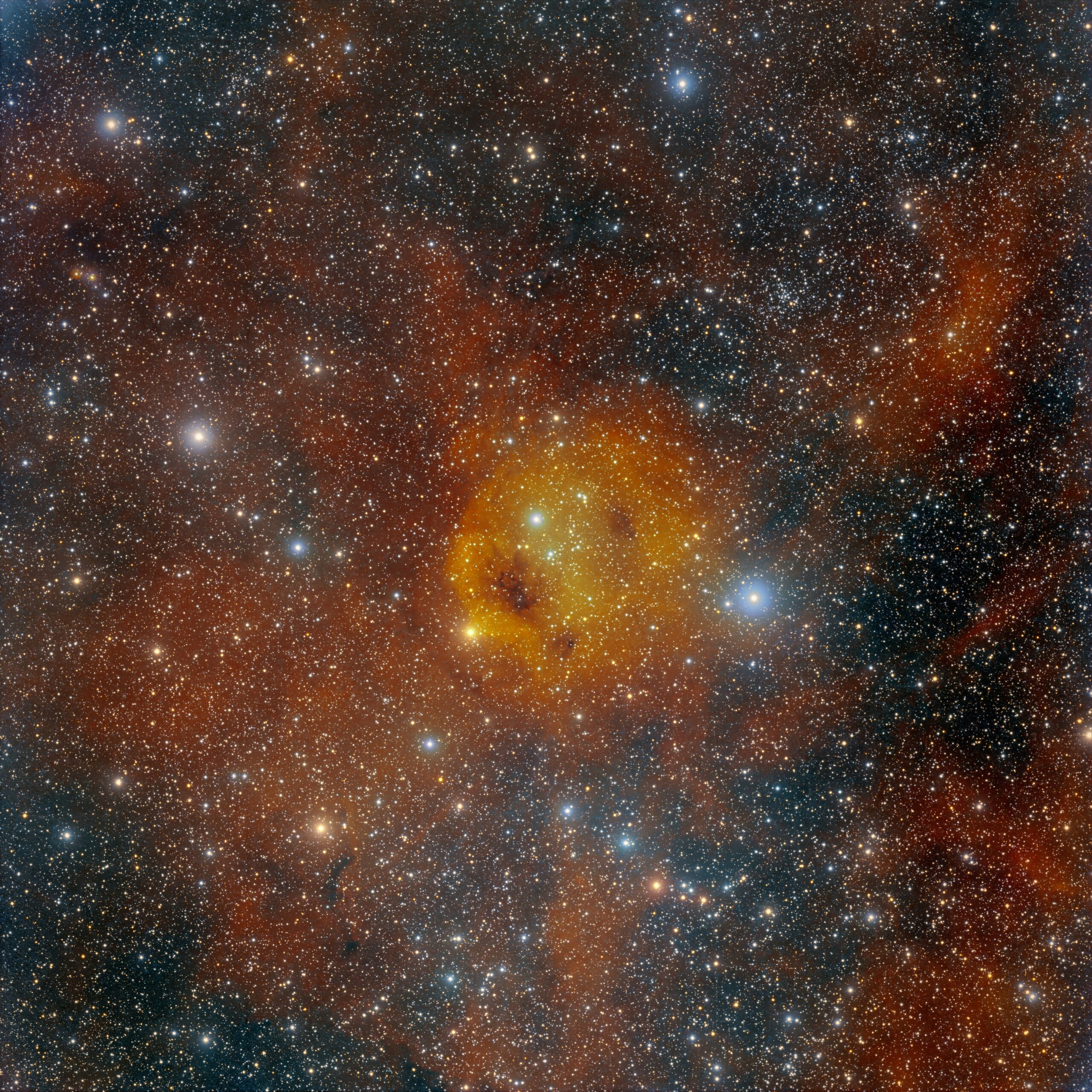
In contrast, my SHO version employs the “Hubble palette,” mapping S II to red, H‑alpha to green, and O III to blue, which exaggerates differences in ionization state and chemical composition. In this representation, regions rich in sulfur appear in warm tones, the bulk hydrogen emission forms greenish structures, and oxygen‑dominated zones show as blue patches or rims, revealing gradients and substructures that are difficult to see in RGB or simple HOO alone.
Sh2-173 is a very faint emission nebula (H II region) in Cassiopeia, often nicknamed the “Phantom of the Opera” Nebula because its shape and dust lanes resemble a ghostly mask.
Sh2-173 lies about 3° north‑north‑east of β Cassiopeiae (Caph), the westernmost star of Cassiopeia’s “W”, and just southwest of the 5th‑magnitude blue‑white star 12 Cassiopeiae. Its apparent size on the sky is roughly 25′×20′, so it is a moderately small patch of nebulosity in a rich star field. Because it sits at a high northern declination, it is circumpolar from much of the northern hemisphere (remaining above the horizon all night at mid‑northern latitudes), while from the southern hemisphere it is only visible from tropical regions and very low above the northern horizon.
Sh2‑173 is part of the Perseus spiral arm of the Milky Way, at a distance of about 2.5–2.7 kpc, i.e. roughly 8,800 light‑years. With a diameter of about 77 light‑years, it is a relatively compact H II region compared to giant complexes, but still a substantial bubble of ionized gas.
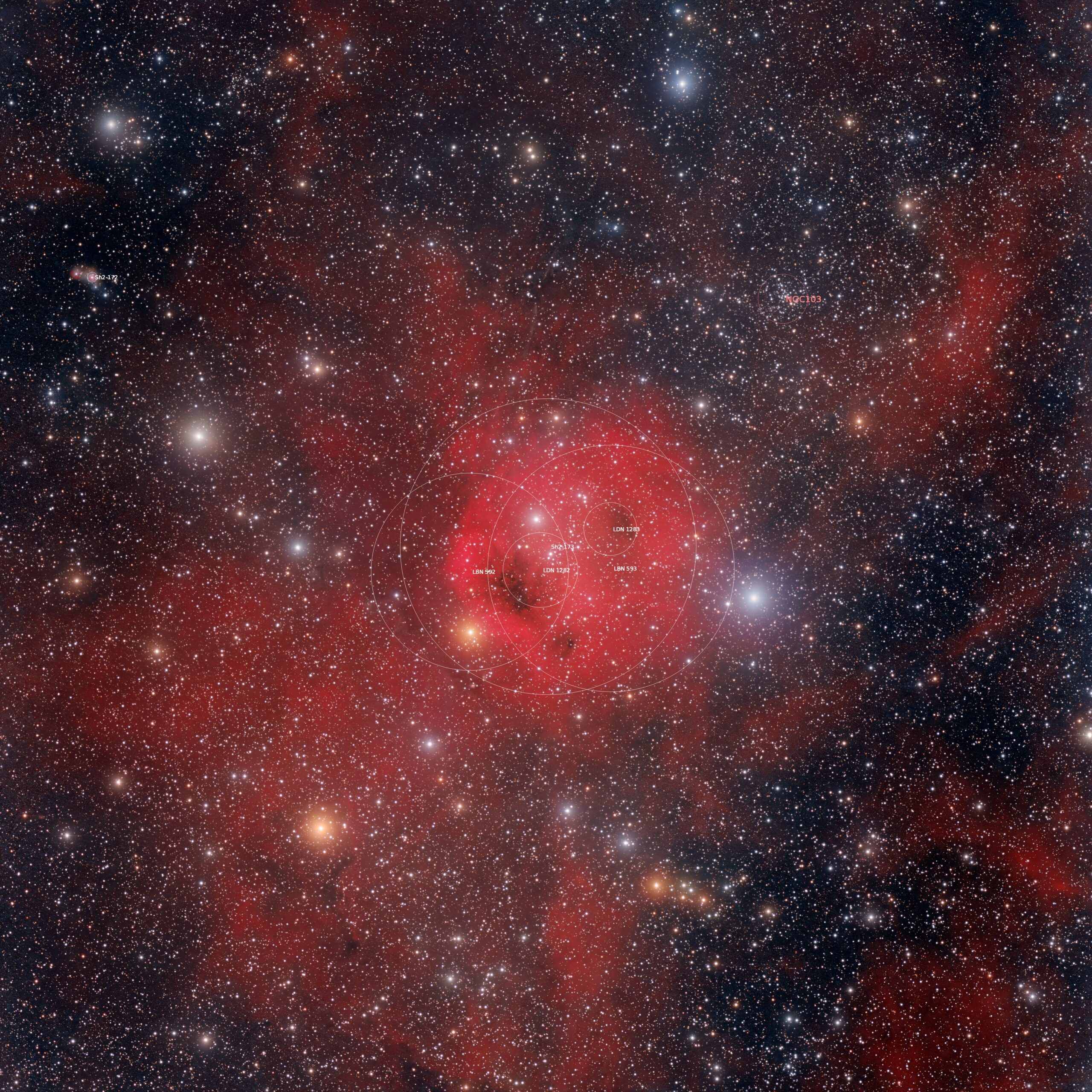
Physically, Sh2‑173 is an H II region: a cloud of hydrogen gas ionized by ultraviolet radiation from nearby hot, young stars. It lies in the vicinity of the OB association Cassiopeia OB5, which contains massive stars, open clusters, and neighbouring nebulae such as Sh2‑172 and Sh2‑177, all interacting with a large superbubble of about 380 parsecs in diameter created by stellar winds from high‑mass stars.
Within Sh2‑173 itself, at least seven hot stars are identified as the main ionizing sources, with the hottest being BD+60 39, a blue O9V star. The region hosts many young stars and has been studied as part of a larger star‑forming complex connected to Cas OB5, including nearby open clusters like NGC 103, the radio source KR 98, and the dark nebula LDN 1282.
Multiwavelength work—optical, radio continuum, HI, and infrared—shows that Sh2‑173 is a genuinely young H II region, with an age estimated around 0.6–1.0 million years, while the surrounding large HI shell is older, about 5±1 million years. This supports the idea that Sh2‑173 is part of a hierarchical system of structures where earlier generations of massive stars created the large shell, and the younger H II region and its star formation developed along its dense edge.
Sh2‑173 is associated with active and possibly triggered star formation. A study using infrared point‑source catalogues identified about 46 young stellar object (YSO) candidates projected on the surrounding molecular clouds. The morphology—with an H II region bordered by a photodissociation region and encircled by molecular material—fits the picture of an expanding ionized bubble compressing nearby gas and potentially inducing new star formation in the shell.
The nebula itself is expanding at roughly 16 km/s, indicating that stellar winds and radiation from the central OB stars are pushing outward into the ambient medium. Over time, this feedback helps shape the local interstellar medium and may contribute to the multi‑generation, hierarchical structure seen in the Perseus arm around Cas OB5.
For the DSW data the calibration, registration and the final processing was done with PixInsight. The result was as follows:
Here is an overview of the used equipment and the exposure times
- Date: 2018
- Location: Rowe, New Mexico
- Telescope/Lense: Astrophysics RH305
- Focal length [mm]: 1158
- Focal ratio: 3.8
- Mount: Paramount ME
- Camera: SBIG STX 16803
- Filter: RGBHα[OIII][SII]
- Exposure time [min]: 240:240:190:720:270:180
- Resolution: 1.66″/px



Leave a reply