

Sh2-171 and Sh2-170 from my backyard and remote
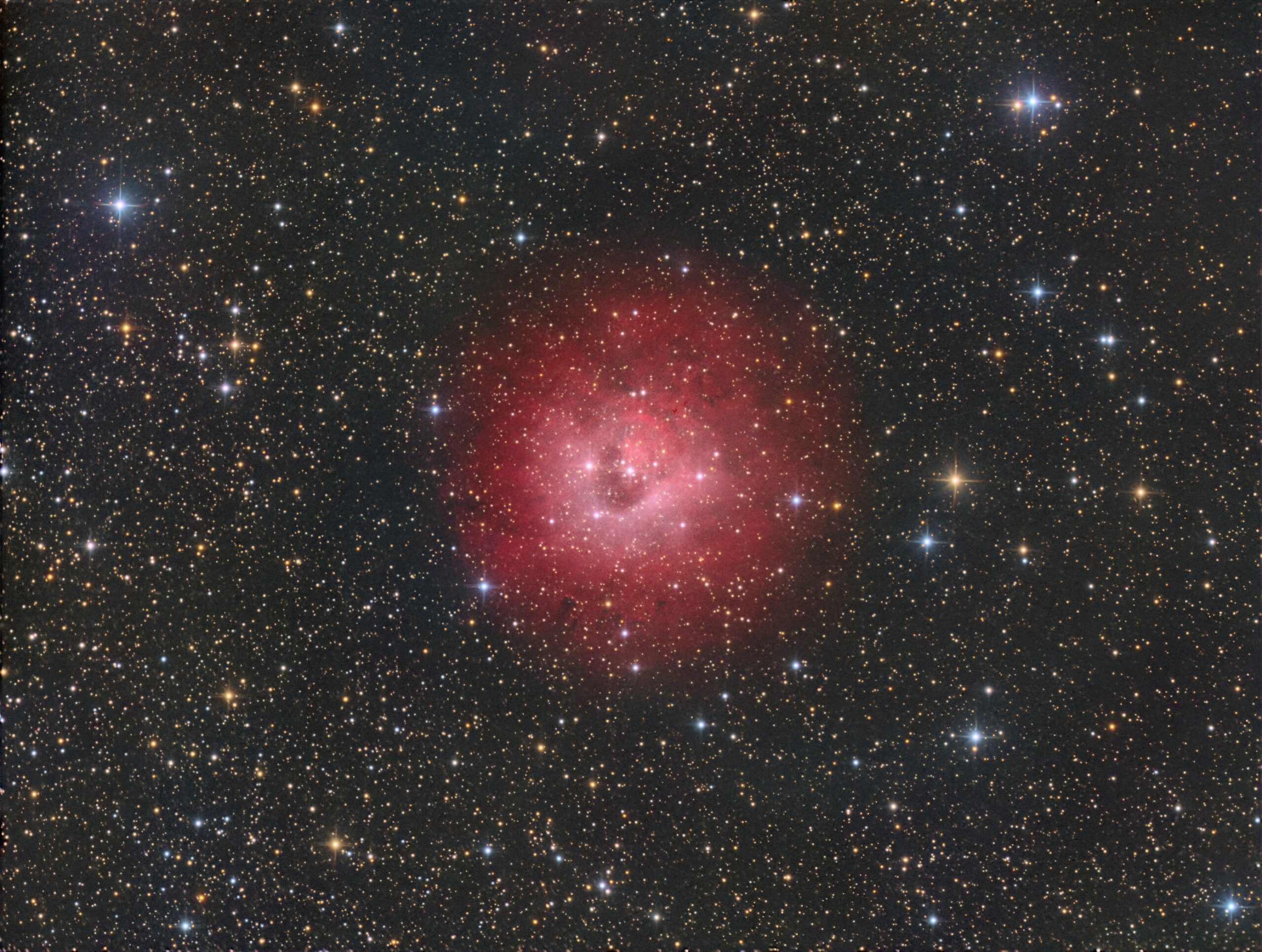
In 2015 I imaged Sharpless 170 (Sh2‑170) from my backyard in Krefeld in RGB, H‑alpha and O III. In 2016 I extended this project by using a telephoto lens to capture both Sh2‑171 and Sh2‑170 in H‑alpha and O III from the same location. In 2018 I added a deep, multi‑filter dataset of Sh2‑171 from Deep Sky West (DSW) in New Mexico, taken in RGB, H‑alpha, O III and S II, which allowed a far more detailed and scientifically informative view of this complex star‑forming region.
Sh2‑170 is a compact H II region, a bubble of ionized hydrogen gas powered by the radiation of at least one young, massive star. In broadband RGB, the nebula appears as a relatively small, reddish patch embedded in the rich star fields of the Milky Way, its glow dominated by the H‑alpha line at 656.3 nm. My separate H‑alpha and O III data isolate key physical components:
H‑alpha traces the bulk of the ionized hydrogen, outlining the main structure of the nebula and any bright rims or filaments, while the O III frames highlight regions of higher excitation around the hottest stars and shock fronts, where doubly ionized oxygen emits in the green‑blue part of the spectrum. Combining these channels, even from a light‑polluted backyard, lets you distinguish between denser, cooler gas and more strongly ionized zones, giving Sh2‑170 a more three‑dimensional appearance than RGB alone.
Sh2‑171, by contrast, is a larger and more complex emission nebula, often imaged together with the OB association and molecular clouds that surround it. It is also an H II region, but embedded in a broader network of gas and dust, with multiple ionizing stars and overlapping emission structures.
Capturing Sh2‑171 and Sh2‑170 together with a telephoto lens in 2016, using H‑alpha and O III, effectively turned my backyard into a survey instrument: the wider field reveals how these nebulae sit within the larger context of the Milky Way’s arm, tracing an extended star‑forming complex rather than isolated patches of glowing gas. In the narrowband data, Sh2‑171 likely shows brighter, more extensive H‑alpha emission, with O III accentuating compact cores, arcs, and interfaces where radiation or stellar winds have carved cavities or compressed the surrounding material.
The 2018 DSW dataset of Sh2‑171 in RGB, H‑alpha, O III and S II adds a crucial layer of scientific detail. Observing from New Mexico’s dark, high‑altitude skies gives cleaner, deeper data, with higher signal‑to‑noise in the faint outer regions of the nebula and the surrounding dust clouds. The inclusion of S II, a line emitted by singly ionized sulfur, allows to build a full “Hubble palette” (S II = red, H‑alpha = green, O III = blue) and to map differences in excitation and chemistry across the region.
In such a mapping, S II often emphasizes denser, partially ionized zones and shock‑dominated interfaces, H‑alpha traces the general body of ionized hydrogen, and O III highlights the most energetic, high‑temperature zones near the hottest stars or fast shocks. By examining the relative strengths and distributions of these three lines, you can infer where gas is being compressed, where ionization fronts are advancing into neutral material, and where the nebula is more quiescent.
Physically, both Sh2‑170 and Sh2‑171 belong to star‑forming complexes where massive stars have recently formed out of cold molecular clouds. These stars emit copious ultraviolet radiation that strips electrons from hydrogen atoms, creating the glowing H II regions you captured in your narrowband data. Their stellar winds and, eventually, supernova explosions drive turbulence and large‑scale flows in the surrounding medium, sometimes forming bubbles and shells that trigger new rounds of star formation in compressed layers of gas.
In a wide‑field view with my telephoto lens, the arrangement of bright emission patches, dark dust lanes, and scattered star clusters around Sh2‑171 and Sh2‑170 illustrates this feedback: bright nebular arcs mark active ionization fronts, dark clouds show where dense material still resists erosion, and embedded stars point to regions where the cloud has already fragmented into new stellar systems.
From an imaging perspective, the sequence of datasets I acquired between 2015 and 2018 demonstrates how different instruments, filters and sites complement each other. Backyard RGB and narrowband frames reveal the basic structure and color contrast of Sh2‑170 and Sh2‑171, even under less‑than‑perfect skies, while the telephoto Ha/O III mosaics capture their large‑scale context.
The deep DSW RGB‑Ha‑O III‑S II data of Sh2‑171 supply high‑quality signal and an extra emission line, enabling more sophisticated processing and a closer link to the underlying physics. Together, these observations show not only the aesthetic beauty of these Sharpless nebulae, but also the story of how clusters of massive stars shape, ionize and recycle the interstellar medium in one small corner of the Milky Way’s spiral arms.
For the DSW data the calibration, registration and the final processing was done with PixInsight. The result was as follows:
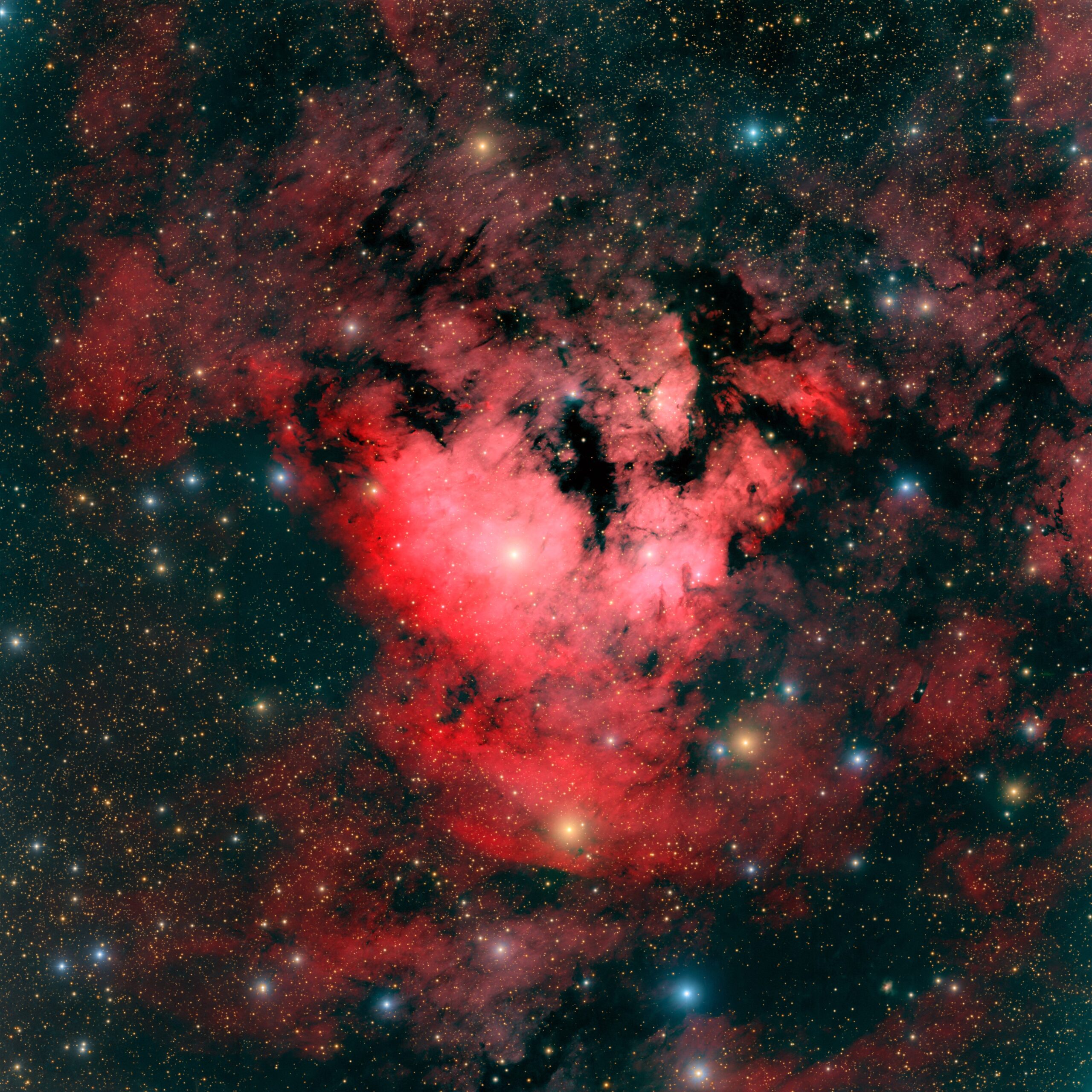
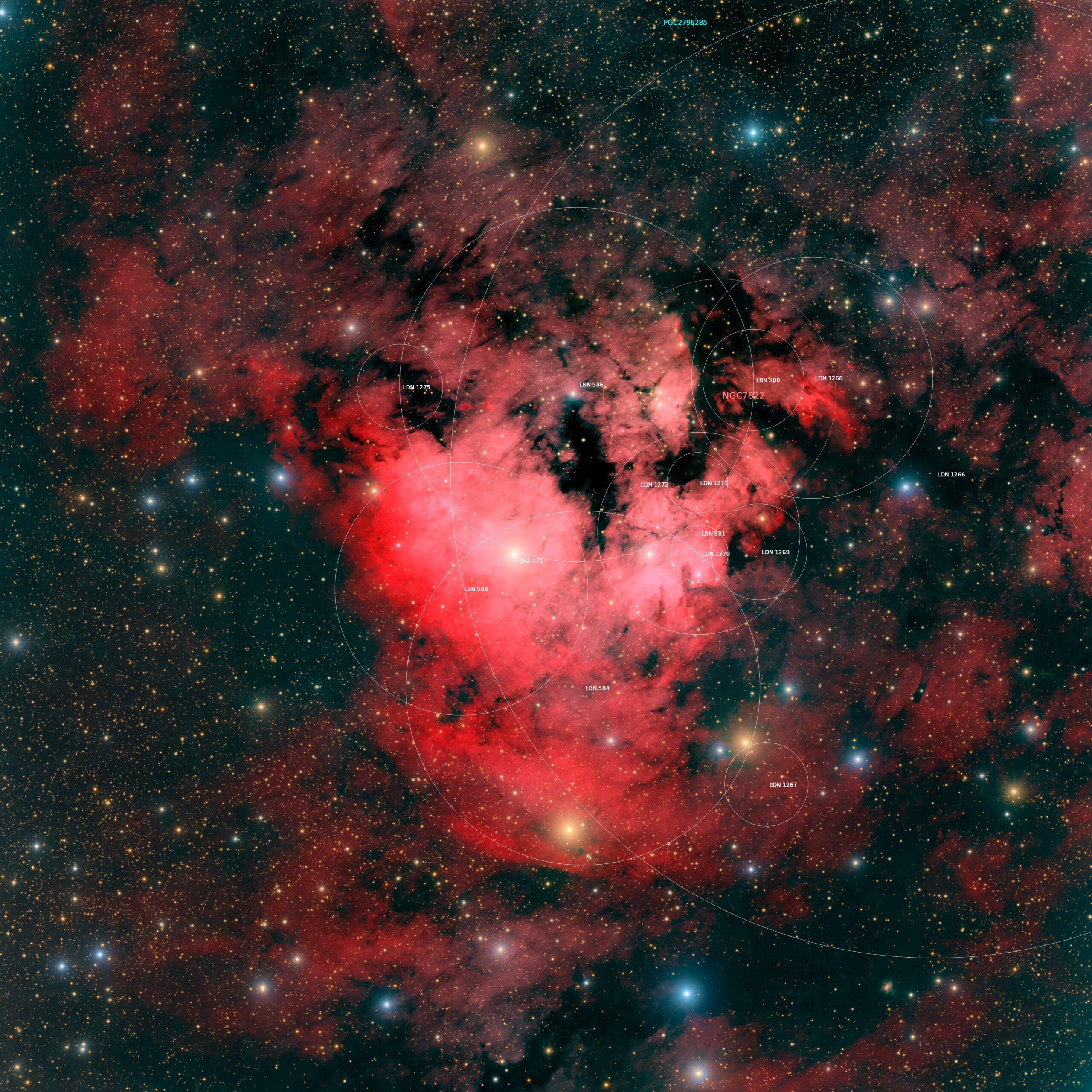
Here is an overview of the used equipment and the exposure times
- Date: 2018
- Location: Rowe, New Mexico
- Telescope/Lense: Astrophysics RH305
- Focal length [mm]: 1158
- Focal ratio: 3.8
- Mount: Paramount ME
- Camera: SBIG STX 16803
- Filter: RGBHα[OIII][SII]
- Exposure time [min]: 60:60:75:700:460:720
- Resolution: 1.66″/px
For the 2016 data the calibration, registration and the final processing was done with PixInsight. The result was as follows:
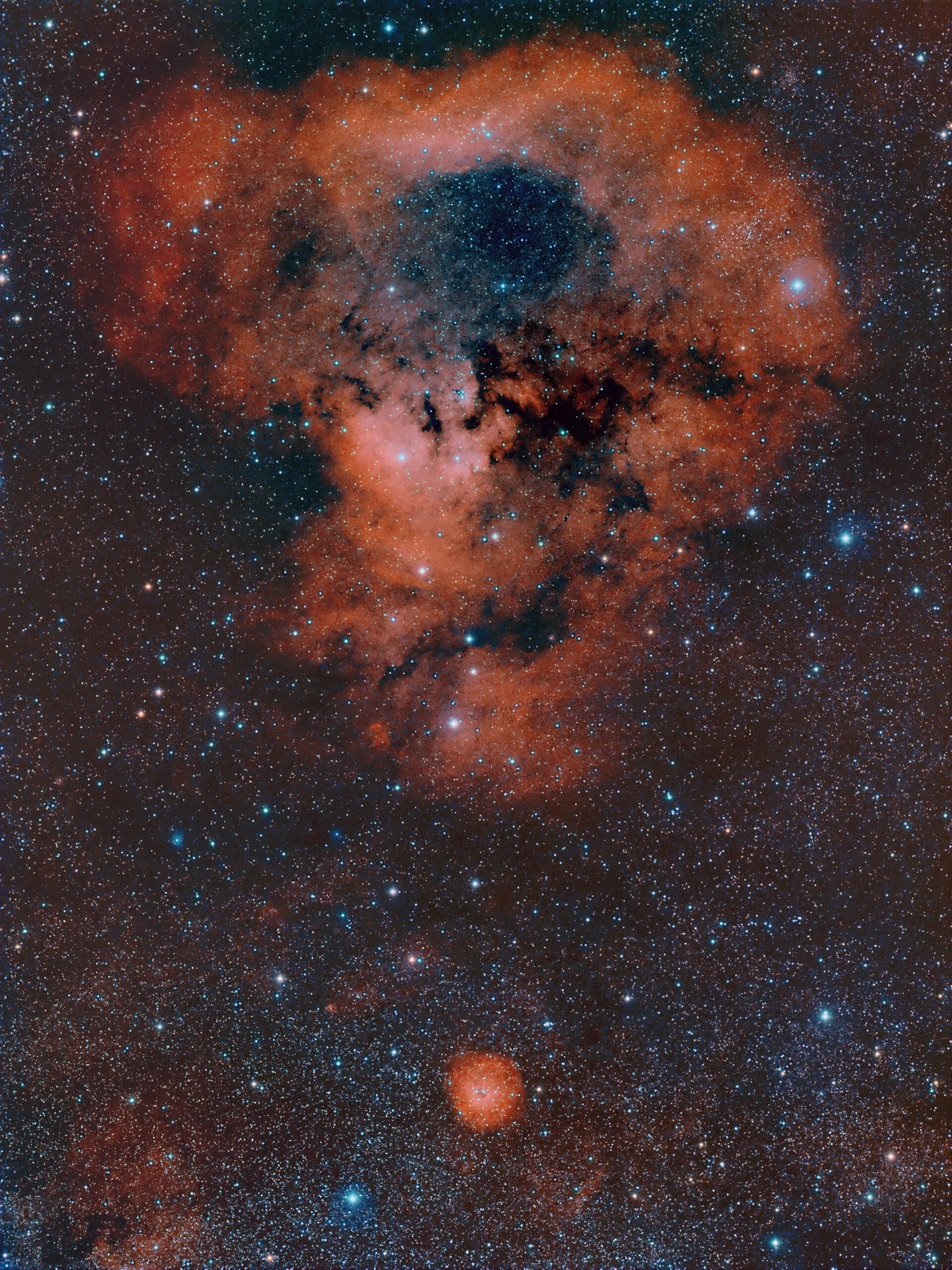
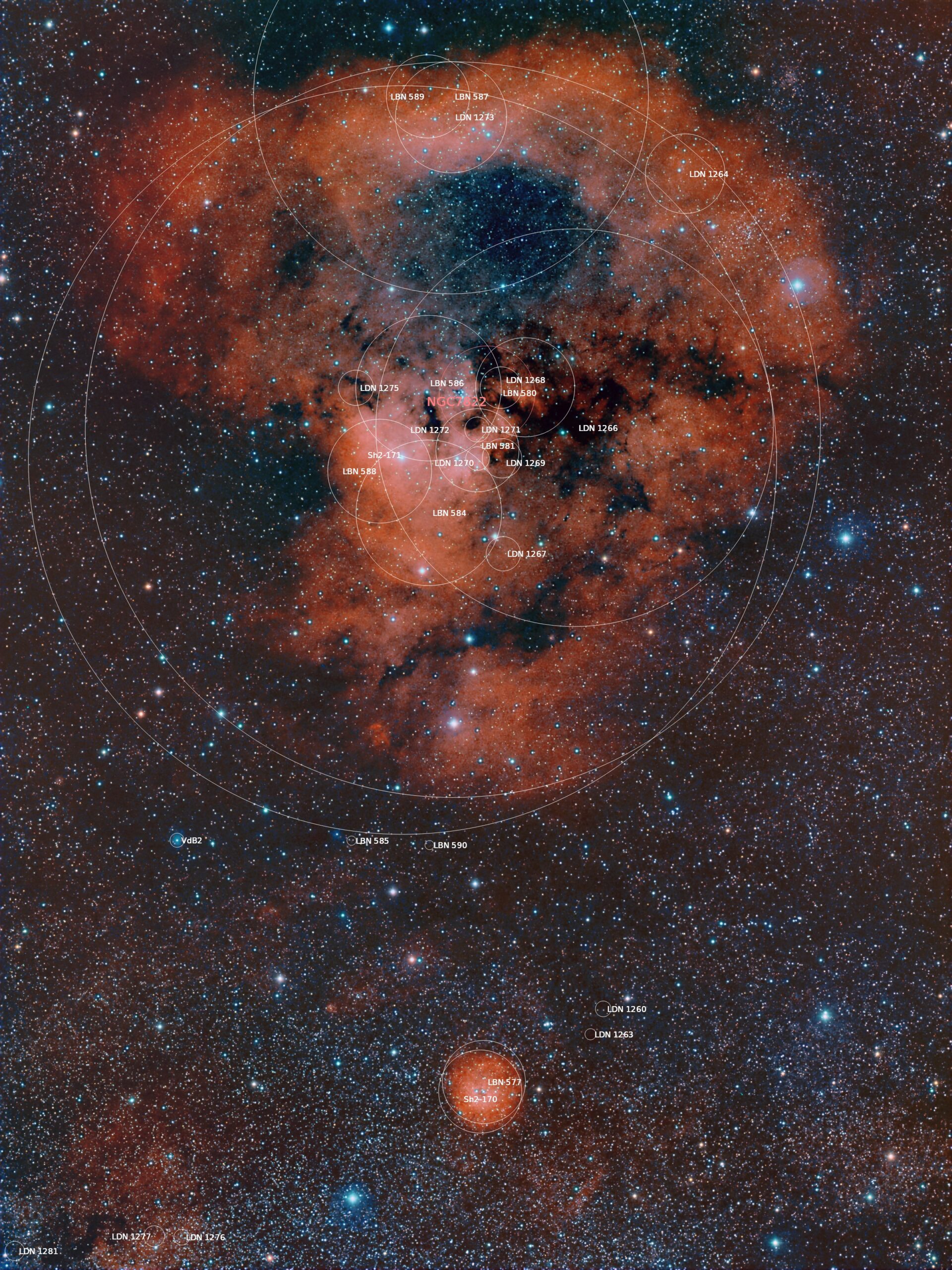
Here is an overview of the used equipment and the exposure times
- Date: 2016
- Location: Krefeld
- Telescope/Lense: Canon 200
- Focal length [mm]: 200
- Focal ratio: 4
- Mount: Skywatcher NEQ6
- Camera: Moravian 8300 FW
- Filter: Hα[OIII]
- Exposure time [min]: 340:250
- Resolution: 5.73″/px
For the 2015 data the calibration, registration and the final processing was done with PixInsight. The result was as follows:
Here is an overview of the used equipment and the exposure times
- Date: 2015
- Location: Krefeld
- Telescope/Lense: 10″ Newton ohne Namen
- Focal length [mm]: 1000
- Focal ratio: 3.9
- Mount: Losmandy G11
- Camera: Moravian 8300 FW
- Filter: RGBHα[OIII]
- Exposure time [min]: 60:60:60:380:110
- Resolution: 1.11″/px


Leave a reply