

Sh2-168 from my own „Sterntaucher“ observatory
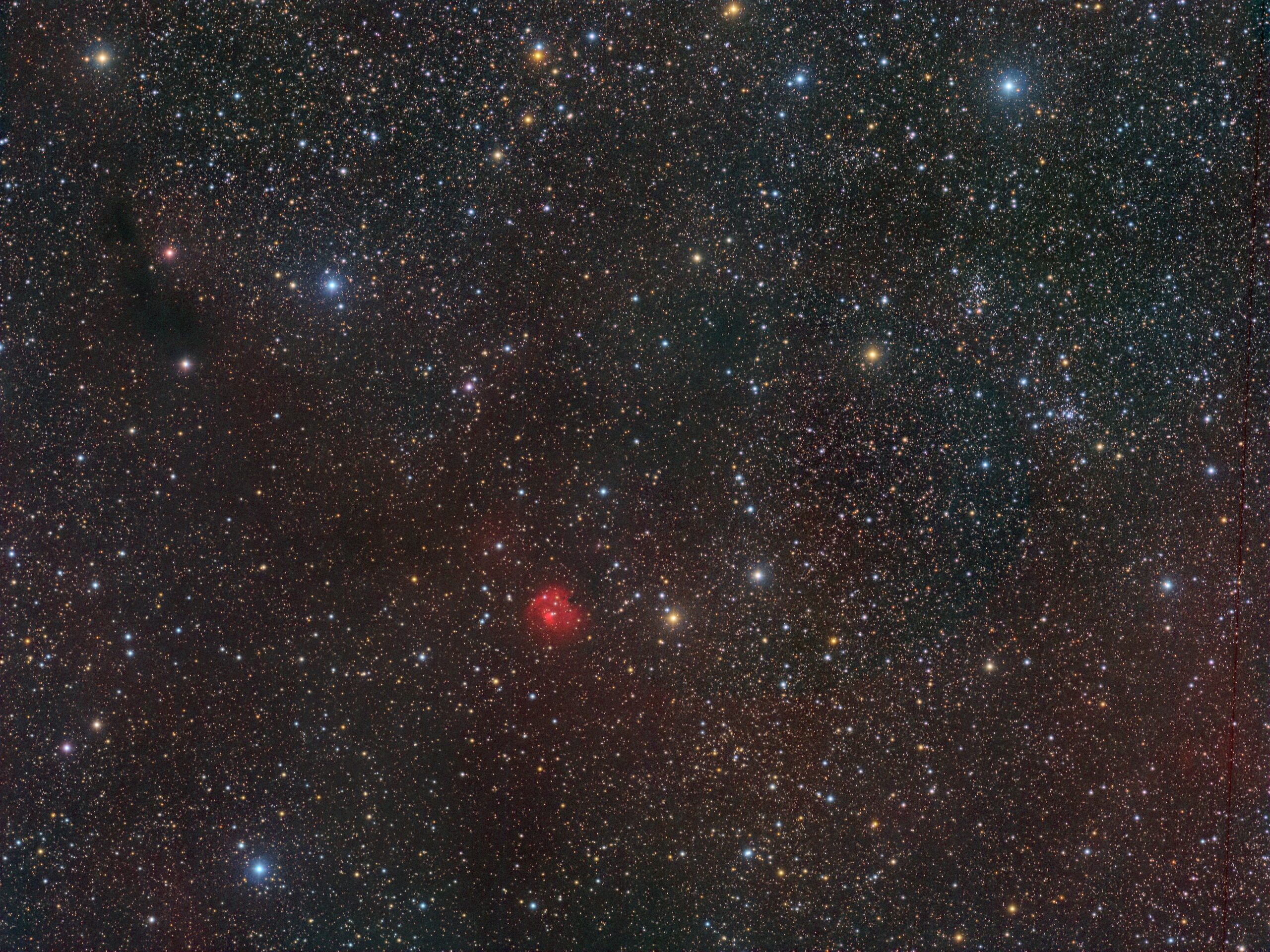
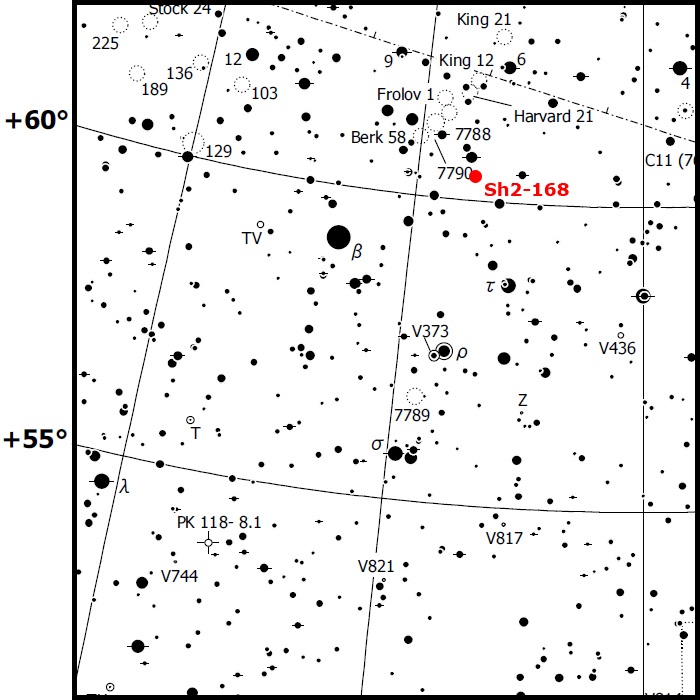
In 2019 I imaged Sh2-168 from my observatory in Krefeld using two identical telescopes equipped with different CCD cameras—one dedicated to capturing broadband RGB data and the other to recording H‑alpha emission—allowing me to produce both an HαRGB composite and a pure RGB rendition of this compact emission nebula. Sh2‑168 is an H II region located in the constellation Cassiopeia, not far from the western end of the familiar “W” asterism, roughly 2° west‑northwest of β Cassiopeiae (Caph). With a diameter of about 9–30 light‑years and a distance of around 11,500–12,000 light‑years, it resides in the Perseus spiral arm of the Milky Way, within a broader star‑forming complex associated with the OB association Cassiopeia OB5.
Physically, Sh2‑168 is a small, bright H II region where interstellar hydrogen gas is ionized by the intense ultraviolet radiation from a young, massive star embedded near its center. The principal ionizing source is the blue main‑sequence star LS I +60° 50 (also catalogued as LSI +50° 60 in some references), with a spectral type close to O9V or B0V, whose radiation creates a bubble of ionized gas that glows strongly in the H‑alpha line at 656.3 nm.
The nebula’s appearance in deep images is that of a compact, roundish emission cloud with a bright core and more diffuse outer regions, surrounded by a field of Milky Way stars. Its relatively small angular size makes high‑resolution imaging advantageous, and your setup with matched telescopes and different cameras is well‑suited to capturing both structural detail and accurate color.
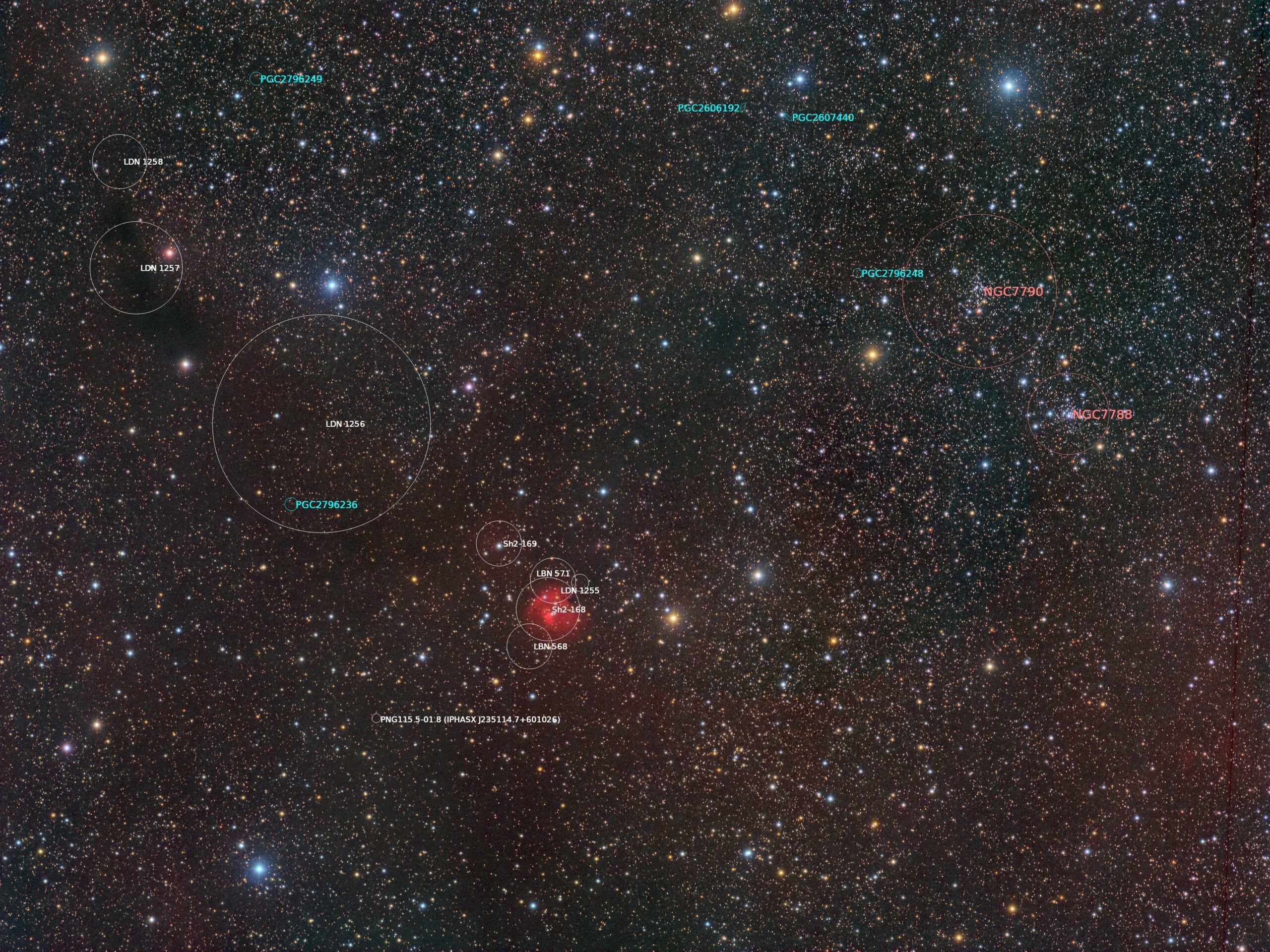
The environment around Sh2‑168 is part of an active star‑forming region shaped by the winds and radiation of massive stars in Cassiopeia OB5. This association includes several other Sharpless nebulae—such as Sh2‑172, Sh2‑173, and Sh2‑177—and is linked to a large superbubble of about 380 parsecs (over 1,200 light‑years) in diameter, produced by combined stellar winds and supernova explosions from earlier generations of massive stars.
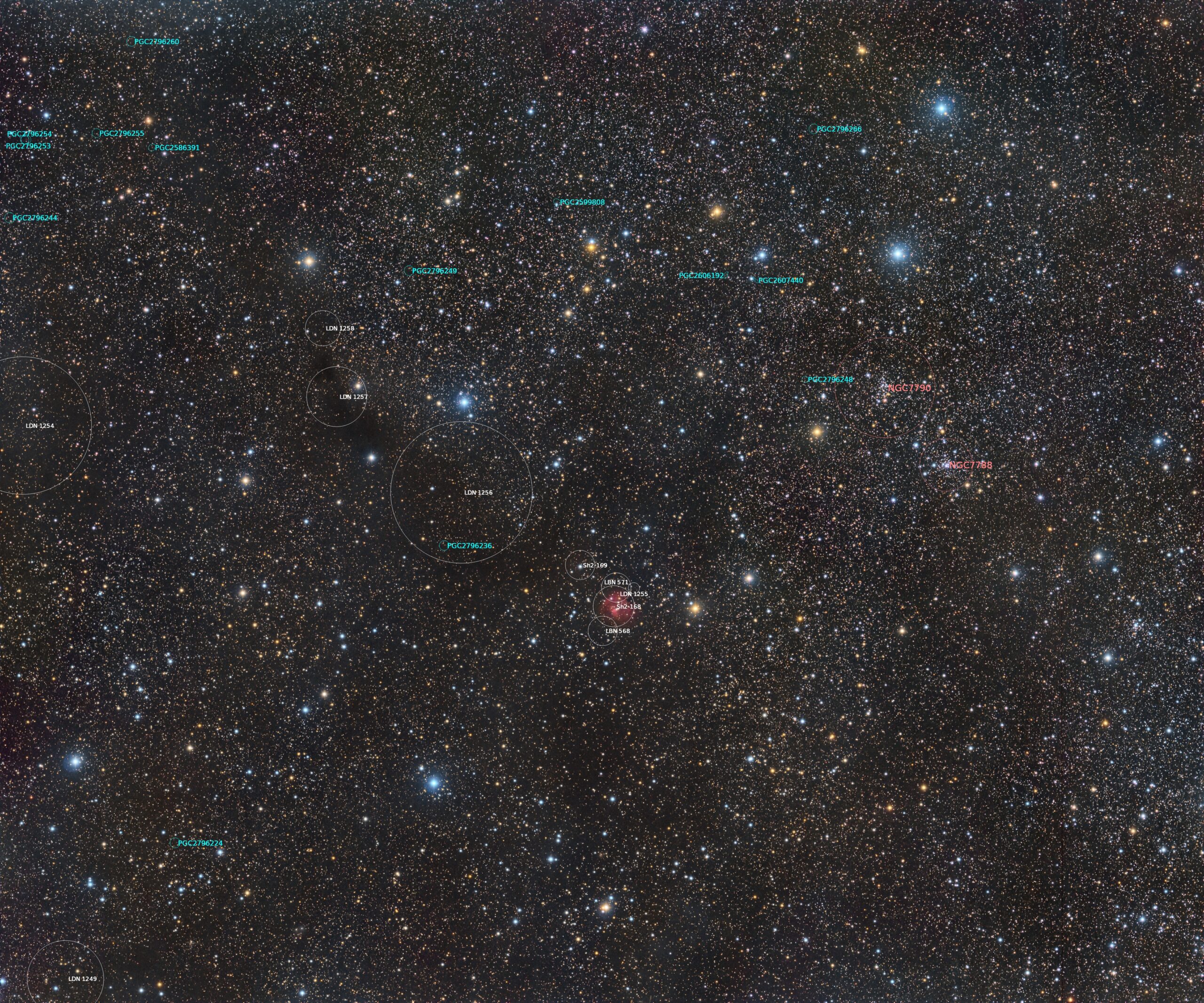
Sh2‑168 lies along the rim of this structure, where compressed gas and dust can promote new star formation. At a short distance to the south‑east of Sh2‑168 there is a much fainter emission patch, Sh2‑169, likely part of the same physical complex but appearing as a subtle extended glow in deep images. Together, these objects trace the ongoing transformation of the interstellar medium in this part of Cassiopeia.
Your HαRGB combination exploits the complementary strengths of narrowband and broadband imaging. The H‑alpha frames isolate the ionized hydrogen emission, dramatically enhancing the contrast of the nebular structure against the stellar background and sky glow. When blended with RGB data—typically by injecting H‑alpha into the red channel or using it as a luminance layer—you can reveal faint outer filaments, sharp ionization fronts, and small‑scale features in the nebula that may be nearly invisible in RGB alone.
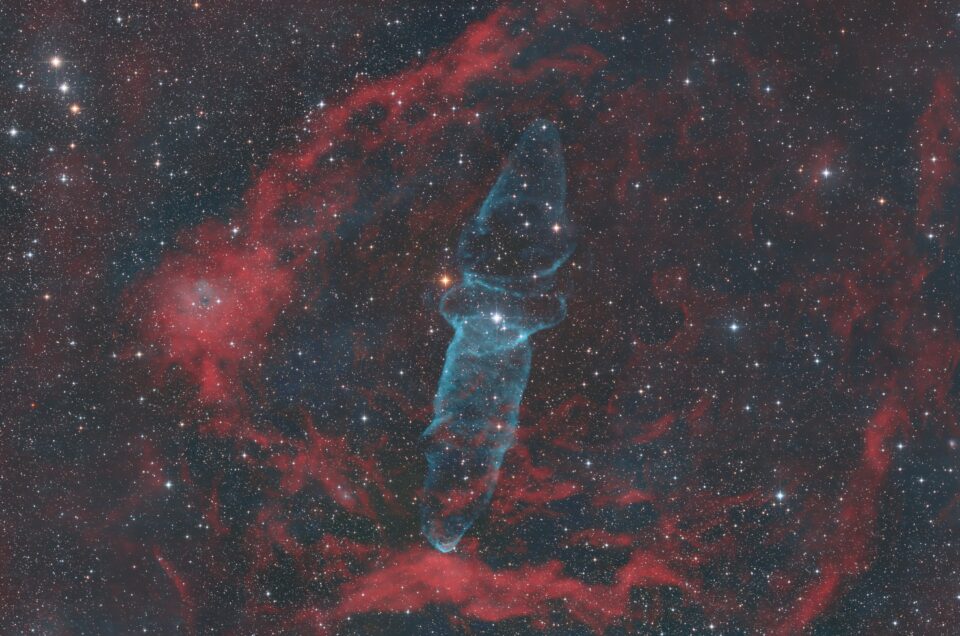
The RGB camera, in turn, records the continuum light from stars and any subtle contribution from other emission lines (such as H‑beta or [O III]) within the broad filters, providing natural star colors and the overall photometric context of the field. The resulting HαRGB image shows Sh2‑168 as a rich, deep red nebula with crisp boundaries and a three‑dimensional appearance, set against a colorful stellar background.
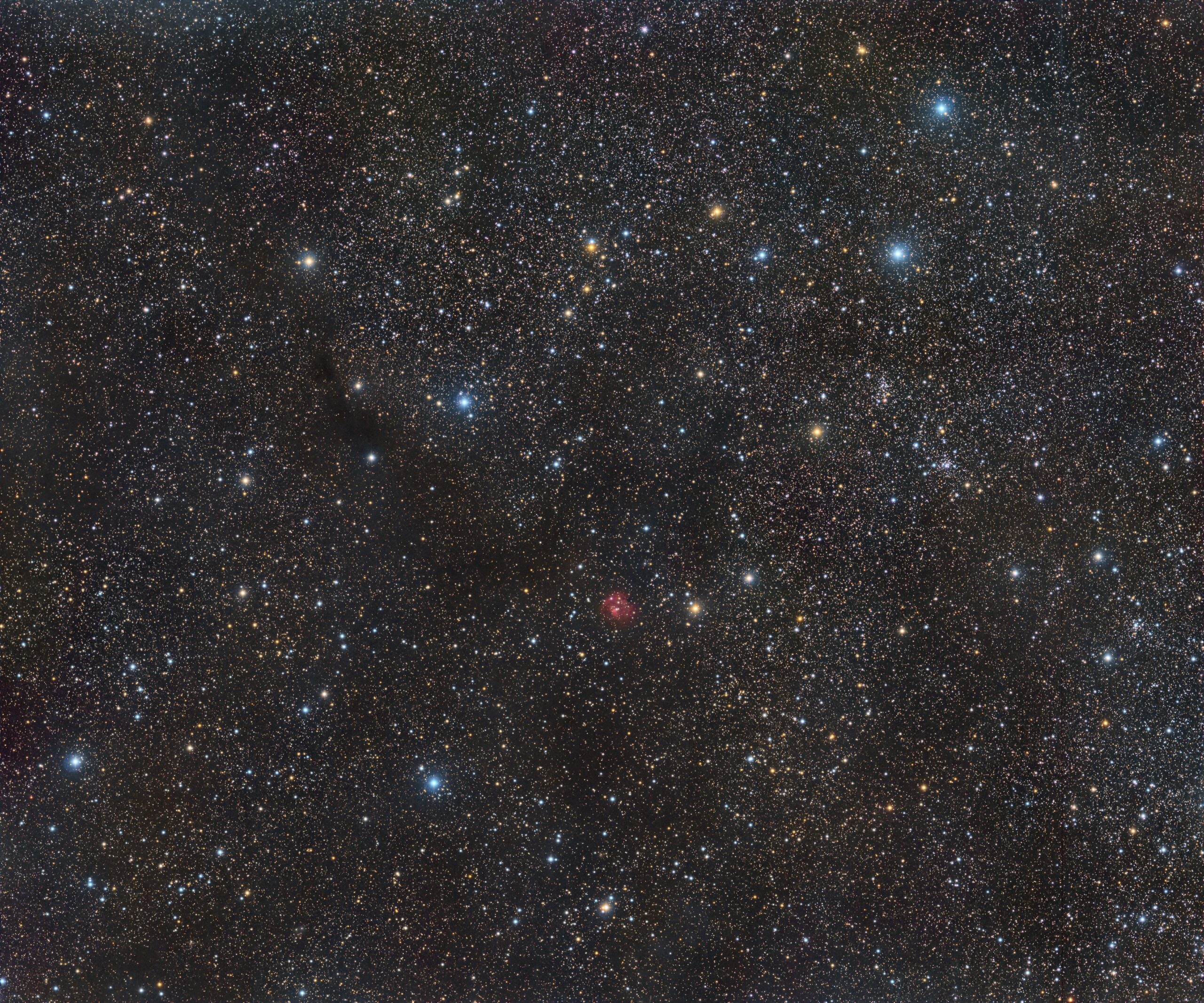
The RGB‑only version offers a complementary, more “visual” perspective: it approximates what might be seen through a large telescope with broadband filters, emphasizing star colors and the nebula’s integrated glow without the selective enhancement of H‑alpha. In this rendering, Sh2‑168 may appear softer and less contrasty, but the natural balance between nebular light and stellar continuum is preserved. Comparing the two versions—HαRGB and RGB—highlights the physical difference between line emission from ionized gas and continuum emission from stars. The HαRGB image emphasizes the gas physics and the role of the O‑type central star in shaping the nebula, while the RGB image conveys the broader stellar population and the placement of Sh2‑168 within the dense Cassiopeia star fields.
From a scientific standpoint, your dataset captures a compact H II region embedded in a larger star‑forming complex, illustrating the lifecycle of massive stars and their influence on surrounding gas. LS I +60° 50’s radiation creates the ionized bubble we see as Sh2‑168, while the larger Cassiopeia OB5 association and its superbubble drive the evolution of the region on kiloparsec scales. Imaging Sh2‑168 from Krefeld with dual‑telescope, dual‑camera instrumentation not only produces aesthetically compelling results but also documents how a single O‑type star can light up a pocket of the Perseus arm, marking one of the many small, glowing beacons that trace the Milky Way’s spiral structure.
Data calibration and registration and the final processing was done with PixInsight. The RGB Data was upscaled to the Hα data. The result was as follows:
Here is an overview of the used equipment and the exposure times:
- Date: October and November 2022
- Location: Krefeld
- Telescope/Lense: TSQ-65ED Apo
- Focal length [mm]: 420
- Focal ratio: 6.5
- Mount: Skywatcher EQ8
- Camera: Moravian G2 8300 FW – Moravian G3 16200 FW
- Filter: Hα – RGB
- Exposure time [min]: 500 – 180:200:180
- Resolution: 2.63″/px – 2.95″/px
Data calibration and registration and the final processing was done with PixInsight. The result was as follows:
Here is an overview of the used equipment and the exposure times:
- Date: October and November 2022
- Location: Krefeld
- Telescope/Lense: TSQ-65ED Apo
- Focal length [mm]: 420
- Focal ratio: 6.5
- Mount: Skywatcher EQ8
- Camera: Moravian G3 16200 FW
- Filter: RGB
- Exposure time [min]: 180:200:180
- Resolution: 2.95″/px


Leave a reply