

Sh2-155 from remote
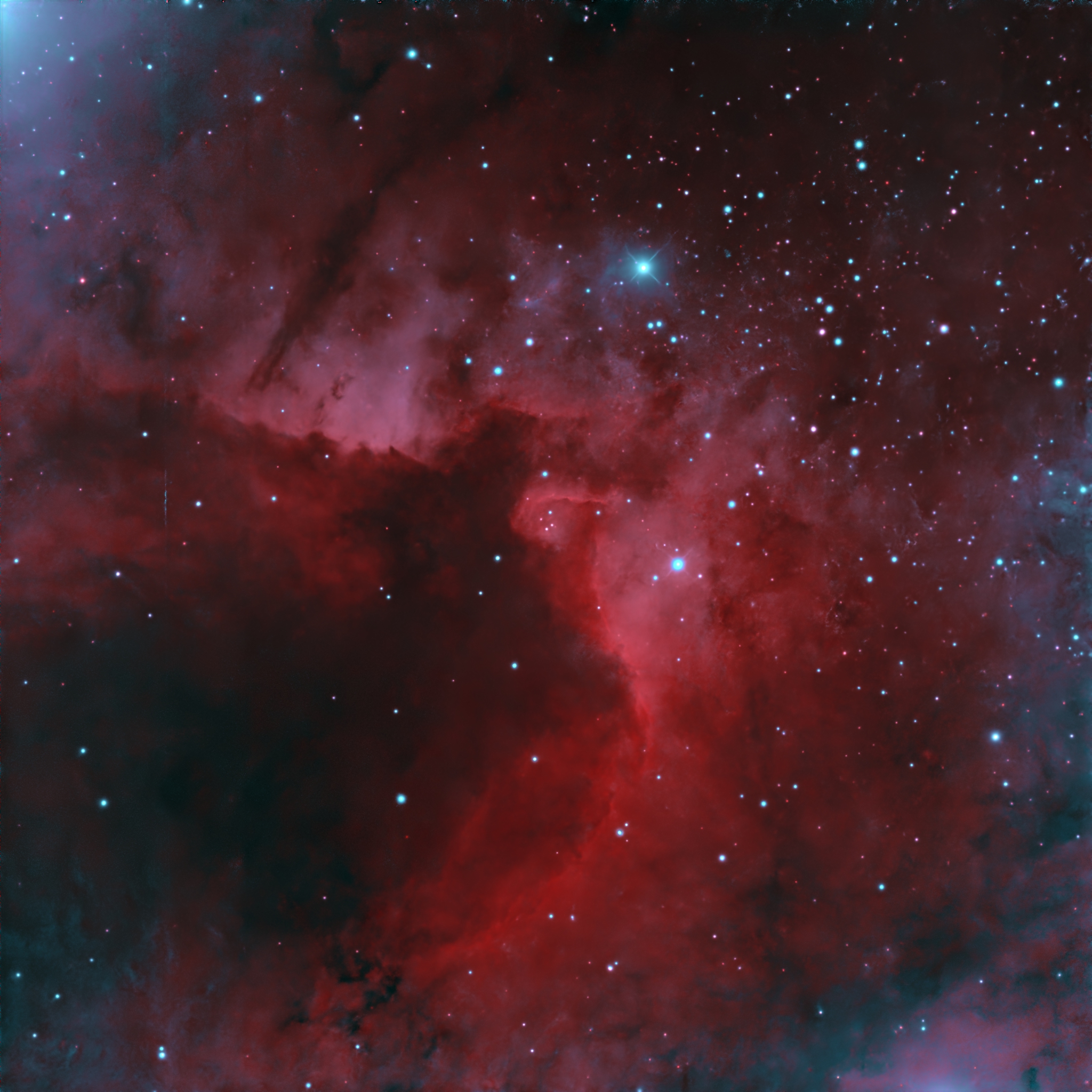
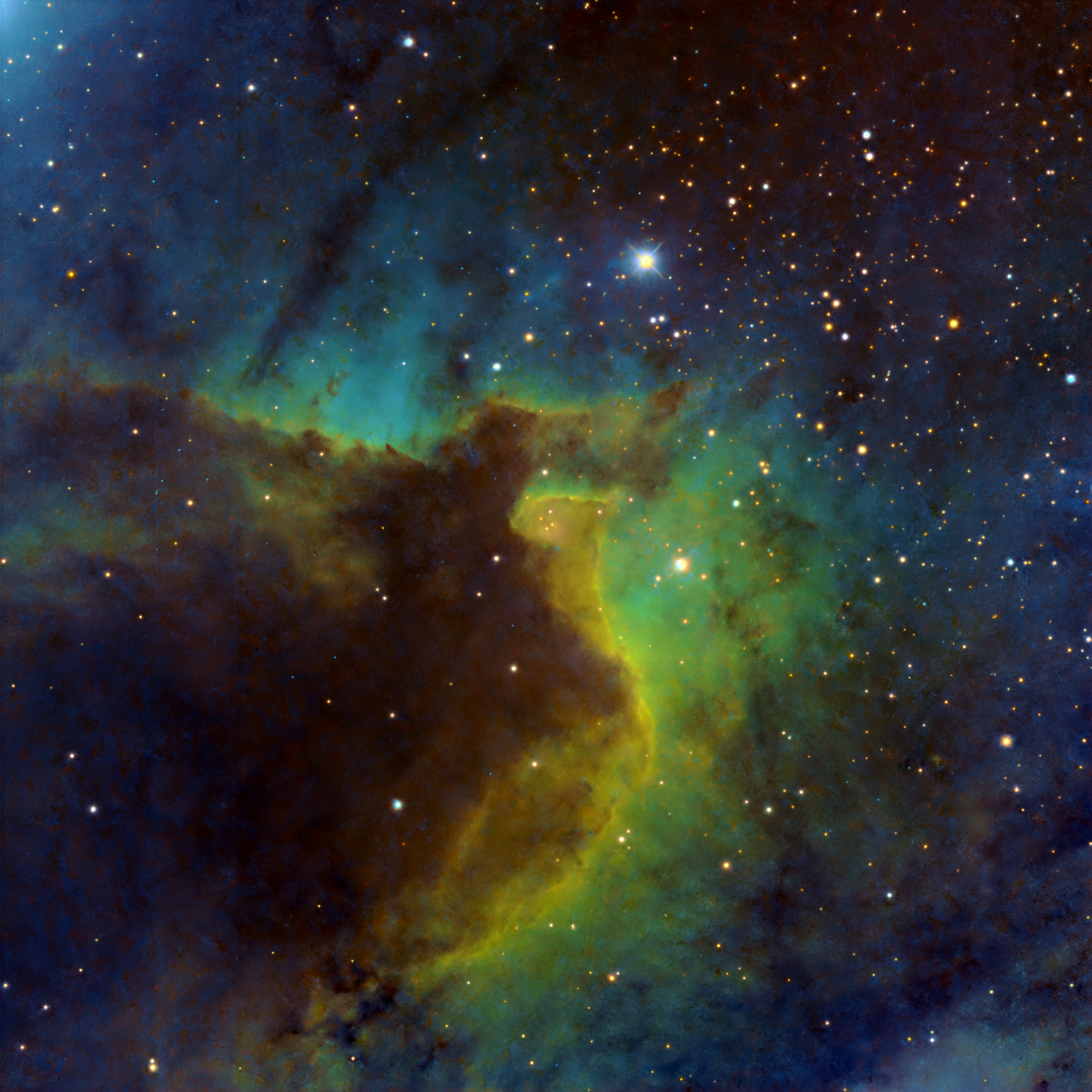
In 2021 I received a Hα-OIII‑SII dataset of Sharpless 155 (Sh2‑155) from Telescope Live, taken under the dark skies of Spain, from which I produced both an HOO and an SHO rendition of this intricate nebular complex. Sh2‑155, widely known as the Cave Nebula and also catalogued as Caldwell 9 and S155, is a diffuse emission nebula in the northern constellation Cepheus, embedded in a larger environment that combines emission, reflection, and dark nebulosity. It lies on the ionized edge of the Cepheus B molecular cloud, part of the broader Cepheus molecular complex, at a distance of roughly 2,400–2,700 light‑years from Earth, and spans on the order of several tens of light‑years across.
Physically, Sh2‑155 is an H II region—ionized hydrogen gas—where ongoing star formation is taking place, driven by the radiation from young, massive stars in the nearby Cep OB3 association. The nebula’s characteristic “cave” appearance arises from a curved arc of bright emission bordering a darker lane of dust, which visually resembles the mouth of a cavern carved into the glowing gas. This bright rim marks the interface where ultraviolet radiation from hot stars, particularly the O‑type star HD 217086, impinges on the surface of the dense Cepheus B cloud, ionizing and eroding it while simultaneously compressing the gas and potentially triggering the collapse of nearby clumps into new stars.
This HαOIII‑SII dataset isolates three key emission lines: hydrogen‑alpha from ionized hydrogen, doubly ionized oxygen (O III), and singly ionized sulfur (S II). In the HOO mapping, Ha is assigned to the red channel, with O III mapped to green and blue, emphasizing the contrast between the warm hydrogen regions and the cooler, high‑excitation oxygen structures around the brightest stars and ionization fronts.
In the SHO “Hubble palette” version, S II is mapped to red, Ha to green, and O III to blue, which reveals subtle chemical and excitation differences across the nebula: regions rich in sulfur, often closer to dense cores and shock fronts; broad hydrogen emission forming the main body of the Cave; and oxygen‑dominated zones closer to the hottest, most energetic stars.
Sh2‑155 does not exist in isolation but is part of a larger complex that includes reflection nebulae (such as vdB 155) and prominent dark clouds that thread across the field. Reflection nebulae appear as soft bluish patches where interstellar dust scatters starlight, while the dark features are thick concentrations of dust that absorb and block visible light, hiding background stars and emission regions.
In narrowband imaging, these structures show up as sharp, sculpted silhouettes against the glowing Hα, O III, and S II emission, allowing you to trace the density structure of the cloud and the geometry of the ionization front. The combination of emission, reflection, and absorption features makes Sh2‑155 an excellent laboratory for studying the interaction between massive stars and their natal clouds.
From a star‑formation perspective, Sh2‑155 is particularly interesting. X‑ray observations with ROSAT and Chandra, together with infrared data from Spitzer, have revealed numerous young stellar objects (YSOs) and T Tauri stars associated with the region, indicating a progression of stellar ages across the face of the cloud. Studies show that the embedded cluster Cep OB3b in the north‑western part of the nebula contains on the order of 2,000 stars, and that stellar ages tend to increase away from the ionization front, supporting the idea of “triggered” star formation: the radiation and winds from HD 217086 and other massive stars compress the nearby gas, initiating new waves of collapse and star birth.
Although Sh2‑155 is relatively faint visually and challenging for small telescopes, long‑exposure narrowband imaging such as this HαOIII‑SII dataset brings out its full complexity. The HOO version provides a more “natural” looking color balance that highlights the contrast between hydrogen‑dominated regions and oxygen‑rich filaments, while the SHO rendition exaggerates differences in ionization state and chemical abundance, revealing hidden structures and gradients that are otherwise hard to detect. Together, these processed images not only produce striking aesthetic results but also encode genuine physical information about the Cave Nebula’s gas composition, excitation conditions, and the way massive stars in Cep OB3 sculpt their surrounding molecular environment and drive ongoing star formation along the edge of the Cepheus B cloud.
The data calibration, Registration and final processing were all performed in PixInsight. The results were as follows:
Here is an overview of the used equipment and the exposure times:
- Date: 2022
- Location: Spain
- Telescope/Lense: Officina Stellare Pro RC700
- Focal length [mm]: 5600
- Focal ratio: 8
- Mount: Equatorial fork mount
- Camera: FLI PL 16803
- Filter: Hα:[OIII]:[SII]
- Exposure time [min]: 120:120:120
- Resolution: 0.66″/px bin 2



Leave a reply