• Home
  • Blog
  • Astrophotography
    • Deep Sky
      • Galaxies (Galaxien)
      • Nebulae (Nebel)
      • Planetary Nebulae (Planetarische Nebel)
      • Globular Clusters (Kugelsternhaufen)
      • Open Clusters (Offene Sternhaufen)
      • Miscellaneous (Verschiedenes)
    • Solar System (Sonnensystem)
      • Comets (Kometen)
      • Moon (Mond)
      • Planets (Planeten)
      • Sun (Sonne)
  • Archiv

    • Juli 2026
    • Juni 2026
    • Mai 2026
    • April 2026
    • Februar 2026
    • Januar 2026
    • Dezember 2025
    • November 2025
    • Oktober 2025
    • September 2025
    • August 2025
    • Juli 2025
    • Juni 2025
    • Mai 2025
    • April 2025
    • März 2025
    • Januar 2025
    • Dezember 2024
    • November 2024
    • Oktober 2024
    • September 2024
    • August 2024
    • Juli 2024
    • Juni 2024
    • Mai 2024
    • April 2024
    • März 2024
    • Februar 2024
    • Januar 2024
    • November 2023
    • Oktober 2023
    • September 2023
    • August 2023
    • Juli 2023
    • Juni 2023
    • Mai 2023
    • April 2023
    • März 2023
    • Februar 2023
    • Januar 2023
    • Dezember 2022
    • November 2022
    • Oktober 2022
    • September 2022
    • August 2022
    • Juli 2022
    • Juni 2022
    • Mai 2022
    • April 2022
    • März 2022
    • Februar 2022
    • Januar 2022
    • Dezember 2021
    • November 2021
    • September 2021
    • August 2021
    • Juli 2021
    • März 2021
    • Februar 2021
    • November 2020
    • September 2020
    • August 2020
    • April 2020
    • März 2020
    • Februar 2020
    • Januar 2020
    • Dezember 2019
    • November 2019
    • Oktober 2019
    • September 2019
    • August 2019
    • Mai 2019
    • April 2019
    • März 2019
    • Dezember 2018
    • November 2018
    • Oktober 2018
    • September 2018
    • Juni 2018
    • Mai 2018
    • April 2018
    • März 2018
    • Februar 2018
    • Januar 2018
    • Oktober 2017
    • Juli 2017
    • Juni 2017
    • Januar 2017
    • Dezember 2016
    • September 2016
    • Mai 2016
    • März 2016
    • November 2015
    • Oktober 2015
    • Juli 2015
    • Mai 2015
    • März 2015
    • Februar 2015
    • September 2014
    • August 2014
    • März 2014
    • Februar 2014
    • Oktober 2013
    • September 2013
    • August 2013
    • April 2013
    • März 2013
    • November 2012
    • August 2012
    • Juli 2012
    • Mai 2012
    • März 2012
    • Januar 2012
    • November 2011
    • Oktober 2011
    • September 2011
    • August 2011
    • April 2011
    • März 2011
    • Oktober 2010
    • September 2010
    • August 2010
    • Juli 2010
    • April 2010
    • Juli 2009
    • Juli 2008
    • Januar 2008
    • Oktober 2007
    • Juli 2007
    • März 2007
    • Februar 2007
    • Juni 2006
    • Oktober 2005
    • September 2005
    • August 2005
    • Januar 2005
  • Kategorien

    • Asterism
    • Astrophotography
    • Barnard
    • Comet
    • Galaxies
    • Globular Cluster
    • IC
    • Messier
    • Moon
    • Nebula
    • NGC
    • Open cluster
    • Photography
    • Planetary Nebula
    • Travel
  • Meta

    • Anmelden
    • Eintrags-Feed
    • Kommentar-Feed
    • WordPress.org
  • Privacy Policy
  • Impressum
  • Haftungsausschluss
  • Cookie-Richtlinie
  • Datenschutzerklärung

wonderfuluniverse.de
  • Home
  • Blog
  • Astrophotography
    • Deep Sky
      • Galaxies (Galaxien)
      • Nebulae (Nebel)
      • Planetary Nebulae (Planetarische Nebel)
      • Globular Clusters (Kugelsternhaufen)
      • Open Clusters (Offene Sternhaufen)
      • Miscellaneous (Verschiedenes)
    • Solar System (Sonnensystem)
      • Comets (Kometen)
      • Moon (Mond)
      • Planets (Planeten)
      • Sun (Sonne)

Sh2-133 from remote


In 2025 I received an LRGBHα dataset of the nebula complex Sh2‑133 and the nearby reflection nebula LBN 472 from Astrophotomarket, acquired under dark skies in Canada. Sh2‑133 is a faint emission nebula from the Sharpless catalog, located in the northern constellation Cepheus at approximately right ascension 21h 29m and declination 64° 18′, and lies at an estimated distance of about 2,600 light‑years from Earth. It forms part of a larger star‑forming region associated with the Cep OB2 stellar association, a group of massive, young, hot stars whose intense ultraviolet radiation ionizes the surrounding interstellar hydrogen, producing the characteristic red H‑alpha glow captured in the Hα channel of the dataset.

Sh2‑133 is primarily composed of ionized hydrogen gas (H II), along with dust and small amounts of heavier elements like oxygen, nitrogen, and sulfur, which influence the RGB color balance when combined with narrowband Ha data. The region likely hosts O- or early B-type stars that provide the necessary photon flux for gas ionization. Their radiation can trigger further star formation by compressing dense clumps and creating cavities and filaments in the nebula. The luminance (L) channel captures broad-band light, highlighting structures such as dark dust lanes, ionization fronts, and gradients, resulting in a high-contrast view of the nebular morphology.

As the energetic radiation from these stars interacts with the surrounding molecular cloud, it can trigger further star formation by compressing nearby dense clumps, while simultaneously carving out cavities and filaments in the nebula. Your luminance (L) channel, integrating broad‑band light, will emphasize these fine structures—dark dust lanes, ionization fronts, and subtle gradients—giving a high‑contrast view of the nebular morphology.

Adjacent to Sh2‑133 lies LBN 472, a blue reflection nebula catalogued by Beverly Lynds, which marks a region where dust clouds scatter light from nearby stars rather than emitting strongly themselves. Reflection nebulae like LBN 472 are dominated by small dust grains that preferentially scatter shorter‑wavelength (blue) light, which explains the strikingly cool, blue tones that appear most clearly in the B and G channels of your dataset. While Sh2‑133 traces areas of actively ionized gas, LBN 472 highlights the distribution and optical properties of dust in the region, providing a complementary window on the interstellar medium. Together, the emission and reflection components reveal a complex interplay between gas, dust, and radiation in this corner of Cepheus.

From an imaging standpoint, the LRGBHα combination is particularly powerful for this field. The Ha data isolates the 656.3 nm hydrogen recombination line, allowing you to enhance low‑contrast emission structures that might otherwise be lost in broad‑band noise, especially given Sh2‑133’s intrinsically faint surface brightness. The L channel boosts overall signal‑to‑noise and preserves fine detail, while the RGB channels record the natural color balance of both nebulae and stars: deep red from hydrogen emission in Sh2‑133, soft blue from scattered starlight in LBN 472, and a range of stellar colors that reflect different temperatures and evolutionary stages.

When processed carefully—using techniques such as continuum subtraction in the red channel or selective blending of Ha into the luminance and color data—the dataset can reveal the “fire and ice” character of the region: warm, glowing hydrogen clouds juxtaposed with cool, dusty reflection nebulosity.

Scientifically, your field captures a snapshot of ongoing stellar evolution. The OB stars of Cep OB2 are relatively young in cosmic terms, having recently emerged from the same molecular material that still surrounds parts of Sh2‑133. Their strong winds and radiation are shaping the nebula, eroding dense clumps and possibly exposing future generations of stars.

The dusty environment traced by LBN 472, in turn, provides the raw material from which new stars may form, while also obscuring and reddening the light from background objects. Imaging this region with an LRGBHa dataset acquired under dark Canadian skies gives both aesthetic and scientific value: the high quality data allow subtle structures to be teased out in processing, and the combination of emission and reflection features offers insight into how massive stars transform their natal clouds over time.

Data calibration and registration and the final processing was done with PixInsight. The result was as follows:
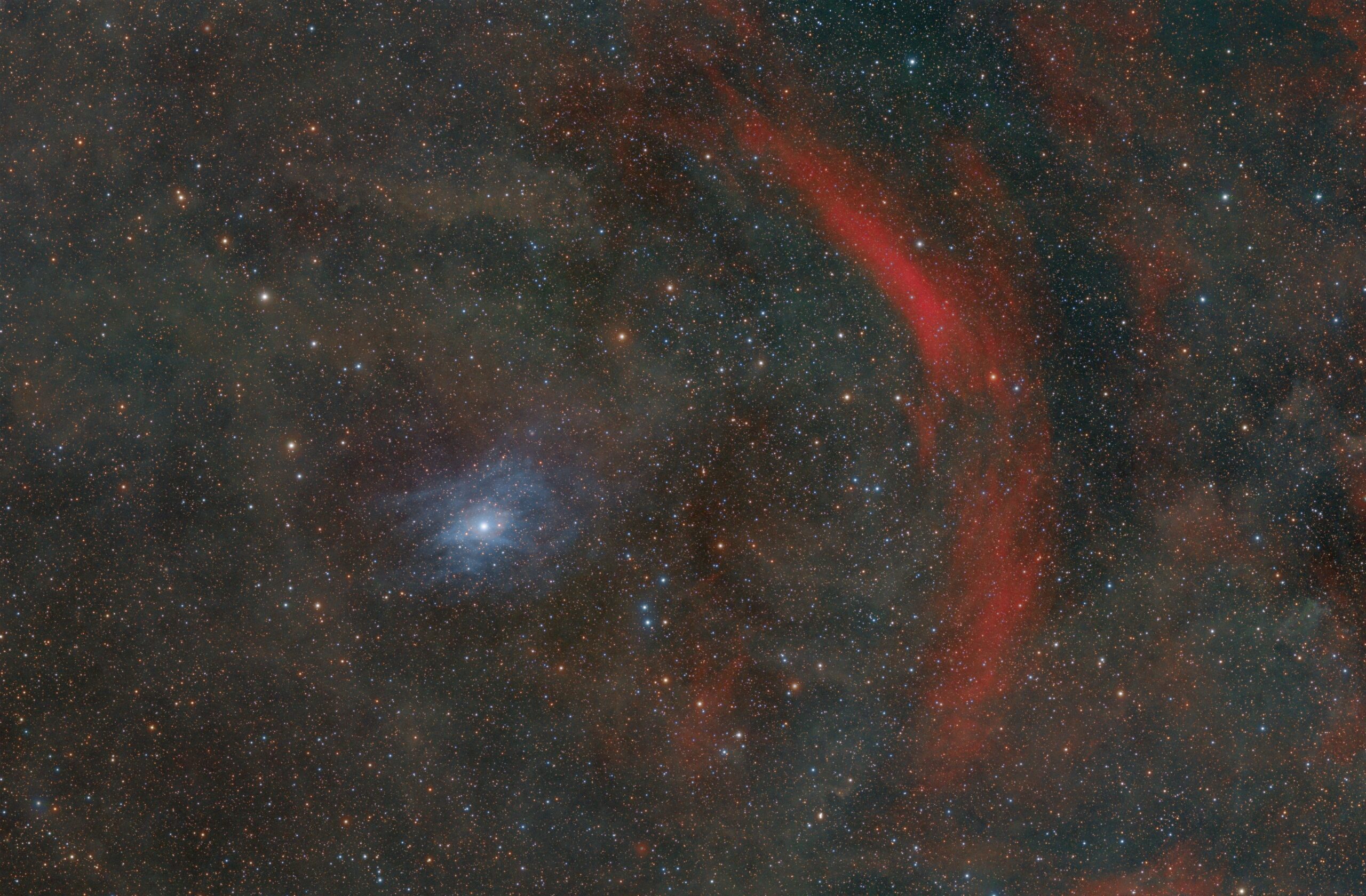
Sh2-133, Astrophotomarket, Canada, 2025
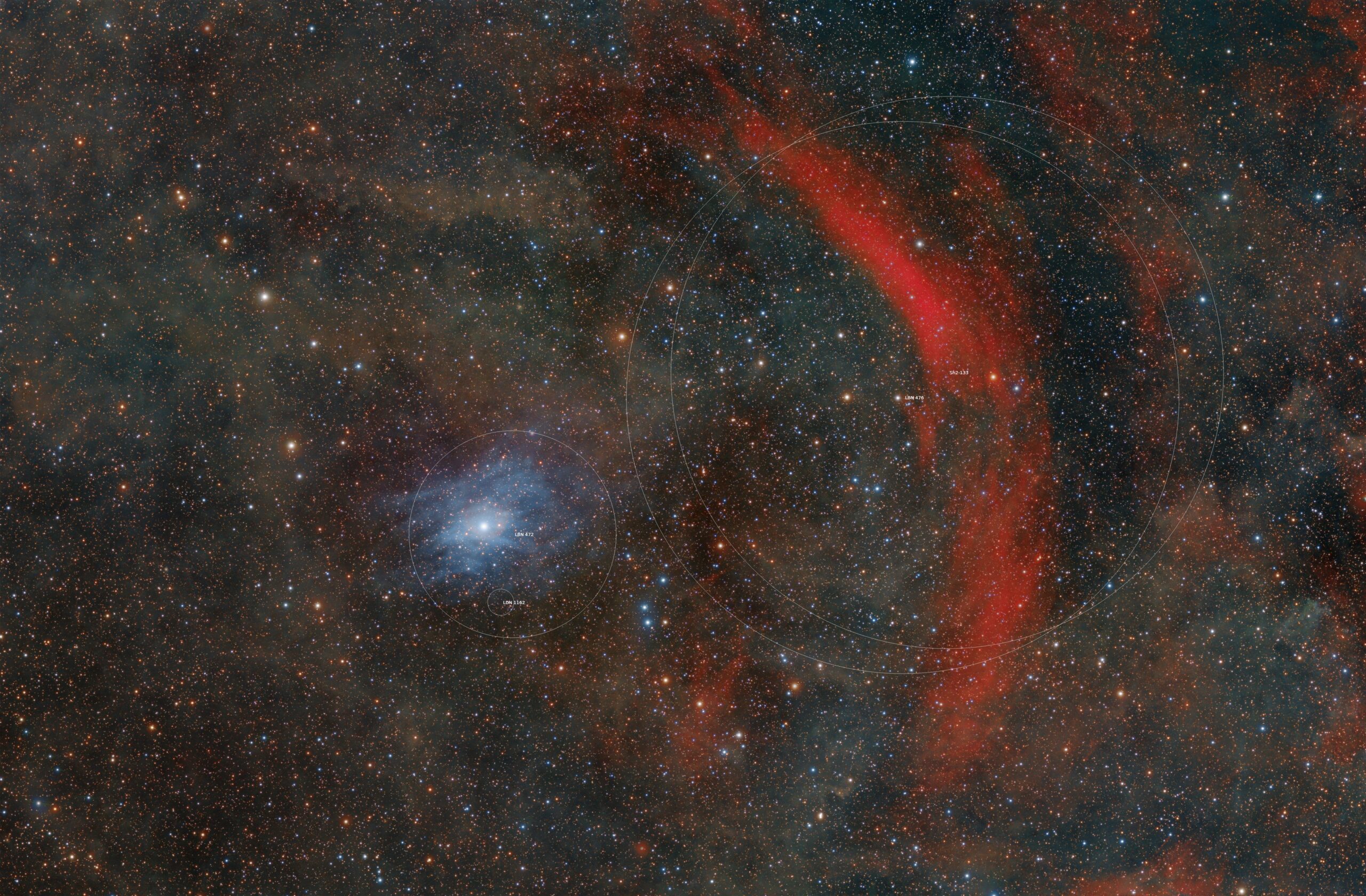
Sh2-133 annotated
Sh2-133 annotated


The images were taken with the following equipment:

  • Date: 2025
  • Location: Canada
  • Telescope/Lense: Askar 400 FRA
  • Focal length [mm]: 400
  • Focal ratio: 5.6
  • Mount:ZWO AM5
  • Camera: ZWO ASI 2600MM Pro
  • Filter: LRGBHα
  • Exposure time [min]: 1050:42:36:36:546
  • Resolution: 1.93″/px


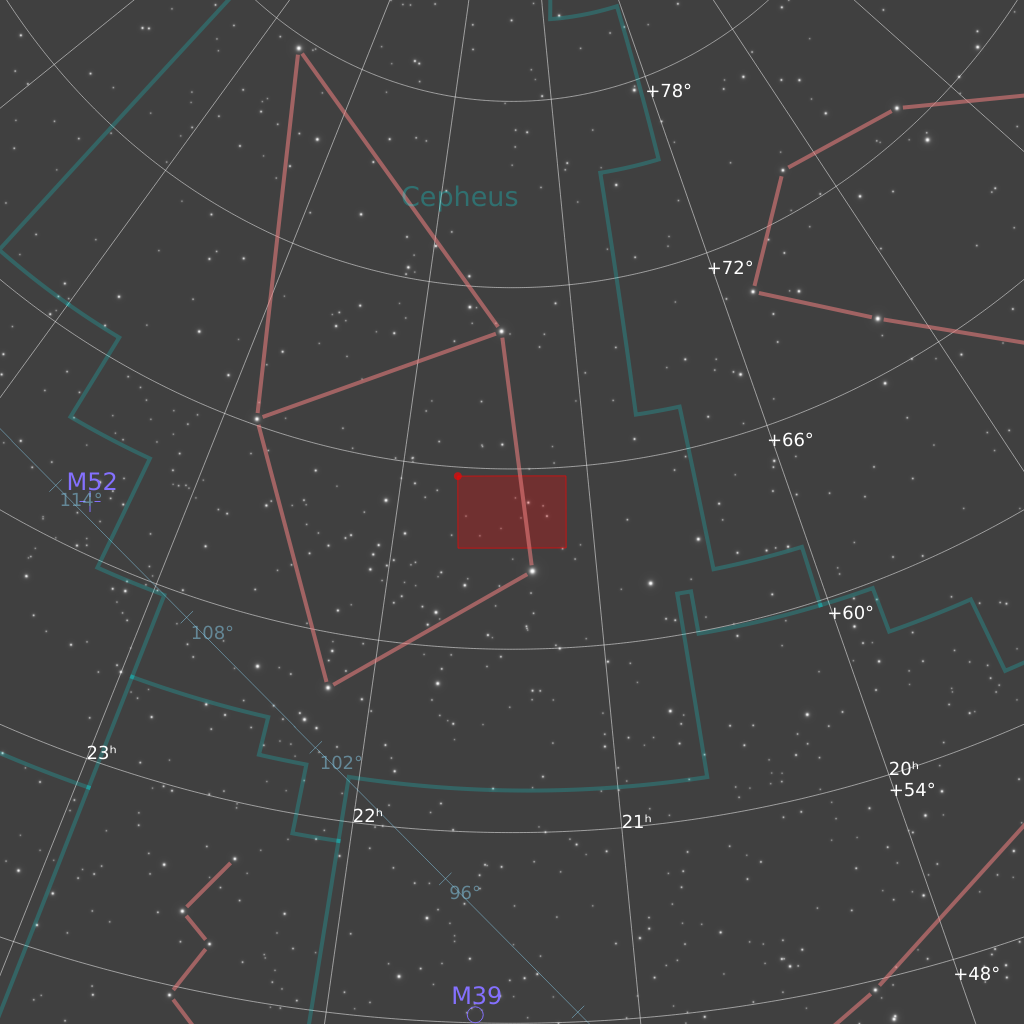
Sh2-133 Finder Chart


Stephan Küppers


You might also like
IC 1318
15. Juli 2026
NGC 7000 with IC 5070
24. Juni 2026
Sh2-129, Outters 4
29. Mai 2026

Leave a reply

Schreibe einen Kommentar Antwort abbrechen

Deine E-Mail-Adresse wird nicht veröffentlicht. Erforderliche Felder sind mit * markiert


© Stephan Küppers 2020-2022

Cookie-Zustimmung verwalten
Wir verwenden Cookies, um unsere Website und unseren Service zu optimieren.
Funktional Immer aktiv
Die technische Speicherung oder der Zugang ist unbedingt erforderlich für den rechtmäßigen Zweck, die Nutzung eines bestimmten Dienstes zu ermöglichen, der vom Teilnehmer oder Nutzer ausdrücklich gewünscht wird, oder für den alleinigen Zweck, die Übertragung einer Nachricht über ein elektronisches Kommunikationsnetz durchzuführen.
Vorlieben
Die technische Speicherung oder der Zugriff ist für den rechtmäßigen Zweck der Speicherung von Präferenzen erforderlich, die nicht vom Abonnenten oder Benutzer angefordert wurden.
Statistiken
Die technische Speicherung oder der Zugriff, der ausschließlich zu statistischen Zwecken erfolgt. Die technische Speicherung oder der Zugriff, der ausschließlich zu anonymen statistischen Zwecken verwendet wird. Ohne eine Vorladung, die freiwillige Zustimmung deines Internetdienstanbieters oder zusätzliche Aufzeichnungen von Dritten können die zu diesem Zweck gespeicherten oder abgerufenen Informationen allein in der Regel nicht dazu verwendet werden, dich zu identifizieren.
Marketing
Die technische Speicherung oder der Zugriff ist erforderlich, um Nutzerprofile zu erstellen, um Werbung zu versenden oder um den Nutzer auf einer Website oder über mehrere Websites hinweg zu ähnlichen Marketingzwecken zu verfolgen.
  • Optionen verwalten
  • Dienste verwalten
  • Verwalten von {vendor_count}-Lieferanten
  • Lese mehr über diese Zwecke
Einstellungen anzeigen
  • {title}
  • {title}
  • {title}