

Sh2-132 from my own „Sterntaucher“ observatory and remote
I have imaged Sh2-132 twice over the years, using two very different datasets that beautifully illustrate both the evolution of my own astrophotography and the versatility of modern astronomical imaging. My first encounter with this remarkable nebula came in 2018, when I received a high-quality SHO narrowband dataset from Deep Sky West (DSW) in New Mexico. Five years later, in 2023, I revisited the object from my own backyard observatory, this time producing a HaRGB image that combined narrowband hydrogen emission with natural broadband colour. Together, these two projects offered complementary perspectives on one of the Milky Way’s most spectacular star-forming regions.
Sh2-132 is a large, complex emission nebula in Cepheus, commonly called the Lion Nebula, powered by a group of very massive, evolved stars in the Perseus Arm of the Milky Way.
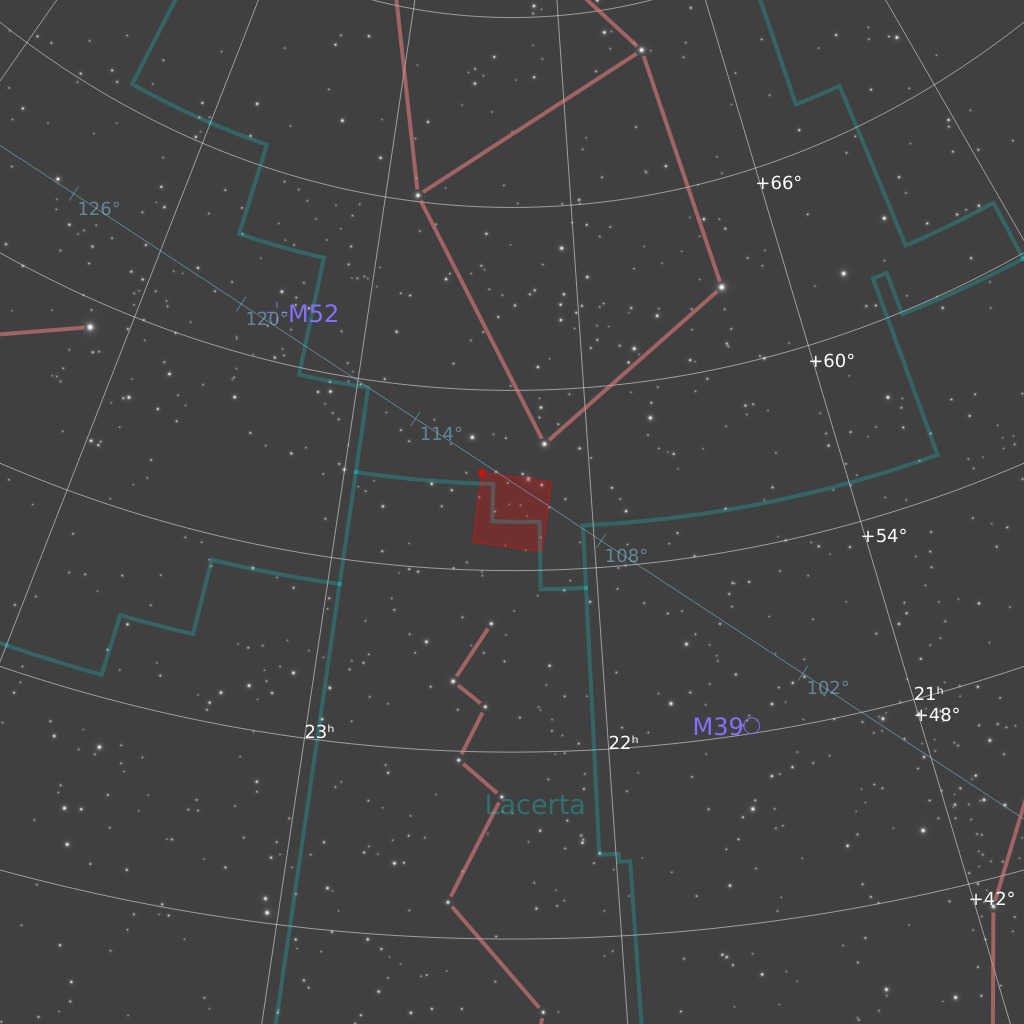
Sh2-132 lies on the southern edge of the constellation Cepheus, close to the border with Lacerta, right along the Galactic plane. It spans on the order of a degree or more on the sky (roughly 1°–1.3° across), making it nearly twice the apparent size of the full Moon and a classic wide‑field target.
Distance estimates place it at around 3,200 parsecs, roughly 10,000–10,400 light‑years away, which puts it in the Perseus spiral arm within the region of the Cepheus OB1 association. At that distance, its linear size is of order a few hundred light‑years; one recent description quotes about 230 light‑years across.
The nebula is ionized by a population of very hot, massive stars, including at least two Wolf–Rayet stars and several O‑ and B‑type stars. The two Wolf–Rayet stars are HD 211564 and HD 211853 (also catalogued as WR 152 and WR 153), and there is also an O8.5 V star plus about ten B‑type stars contributing to the ultraviolet radiation field.
Wolf–Rayet stars have powerful stellar winds and strong mass loss, and in Sh2‑132 these winds have blown bubbles in the surrounding gas. Around the O‑type star and one of the Wolf–Rayet stars is a radio‑bright bubble known as Shell B; a smaller shell, Shell A, hosts a K‑type star near its centre. These shells trace where stellar winds and radiation have carved cavities and compressed the interstellar medium.
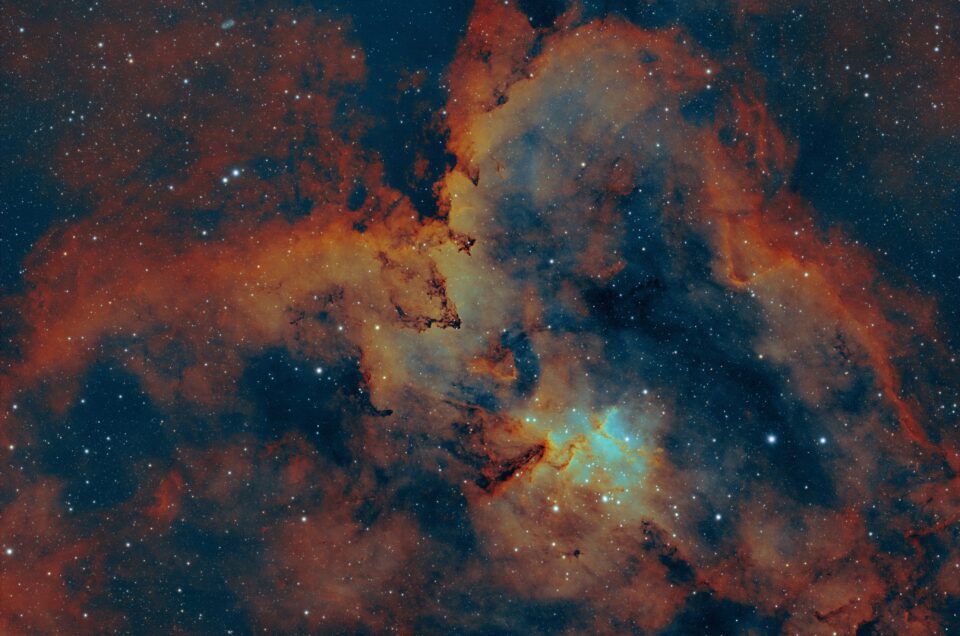
Sh2‑132 is primarily an H II region: ionized hydrogen glowing in Hα, often seen as rich orange or red in mapped‑colour images, with blue‑green patches tracing doubly ionized oxygen (O III). The nebula also contains numerous dark clouds and filaments, catalogued as Lynds dark nebulae LDN 1150, 1154, 1156, 1161 and 1162, which appear as dust lanes and dense knots silhouetted against the emission.
Radio, infrared and molecular observations show that Sh2‑132 contains ionized gas, molecular clouds and dust all interacting. Several infrared sources (nine in one survey) and at least one water maser (H₂O maser) have been detected in its direction, indicating embedded dense regions and past or ongoing star formation activity.
Chain star‑formation episodes are thought to have occurred in the nebula in the past: massive stars form, then their winds and radiation shape the gas, compressing some regions and triggering further star formation. Current work suggests that large‑scale star formation in Sh2‑132 may now be less active or temporarily “paused”, since there is limited evidence for very recent massive star birth compared to earlier epochs.
On deep astrophotos, Sh2‑132 shows a sculpted, lion‑like profile: bright Hα regions with intricate filaments, cavities and arcs, interwoven with dark dust lanes. The brightest areas tend to surround the Wolf–Rayet and O‑type stars, where UV radiation and winds are strongest, while fainter extended emission fills the wider field.
For your own image annotations, you can say that Sh2‑132 (the Lion Nebula) is a ∼10,000‑light‑year‑distant H II region in Cepheus, ionized by Wolf–Rayet stars HD 211564 and HD 211853 and associated O/B stars in the Cepheus OB1 association, with wind‑blown shells, dark Lynds clouds, and past star‑formation activity traced by infrared sources and an H₂O maser.
For the 2023 data the calibration, registration and the final processing was done with PixInsight. The result was as follows:
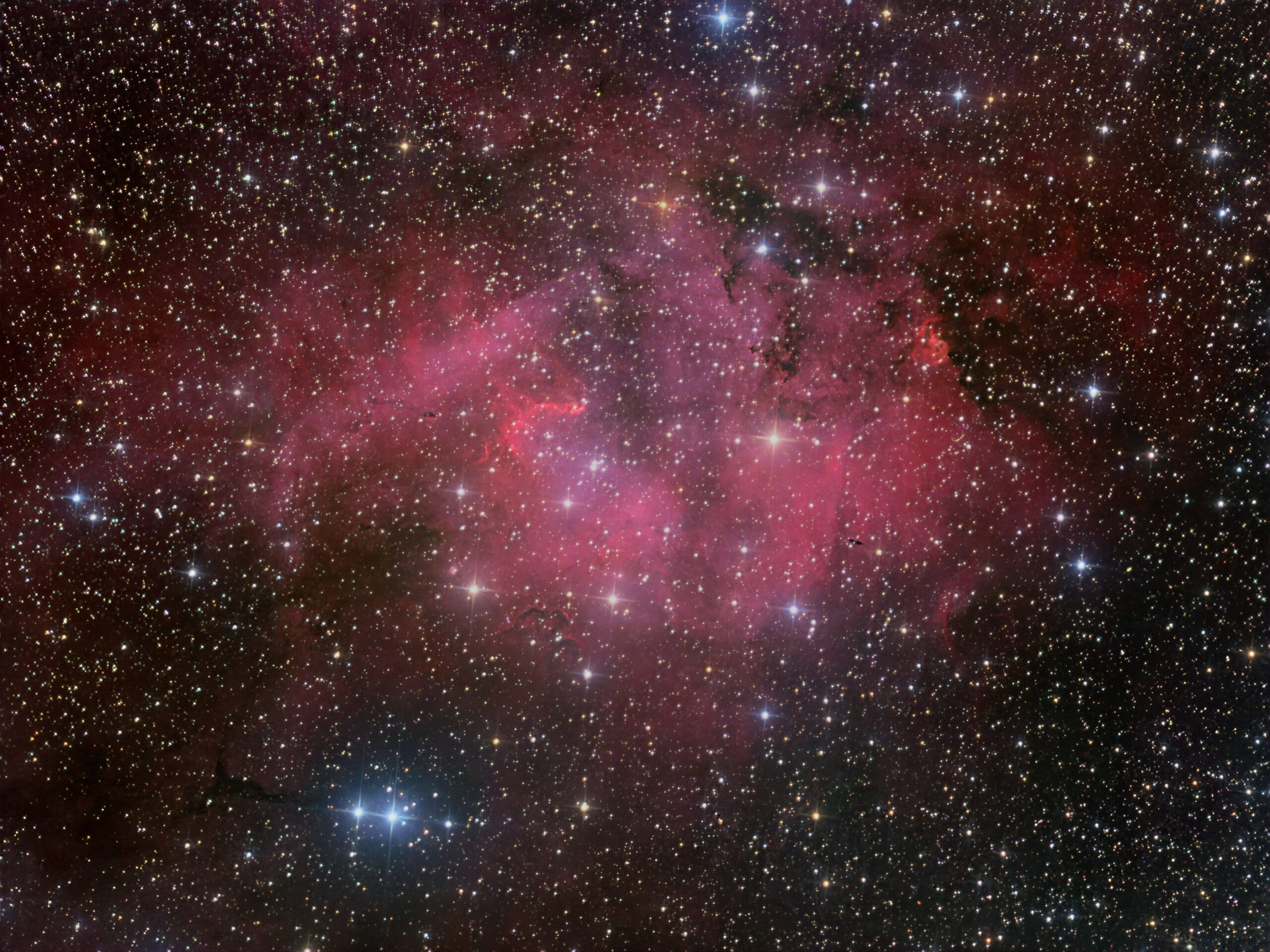
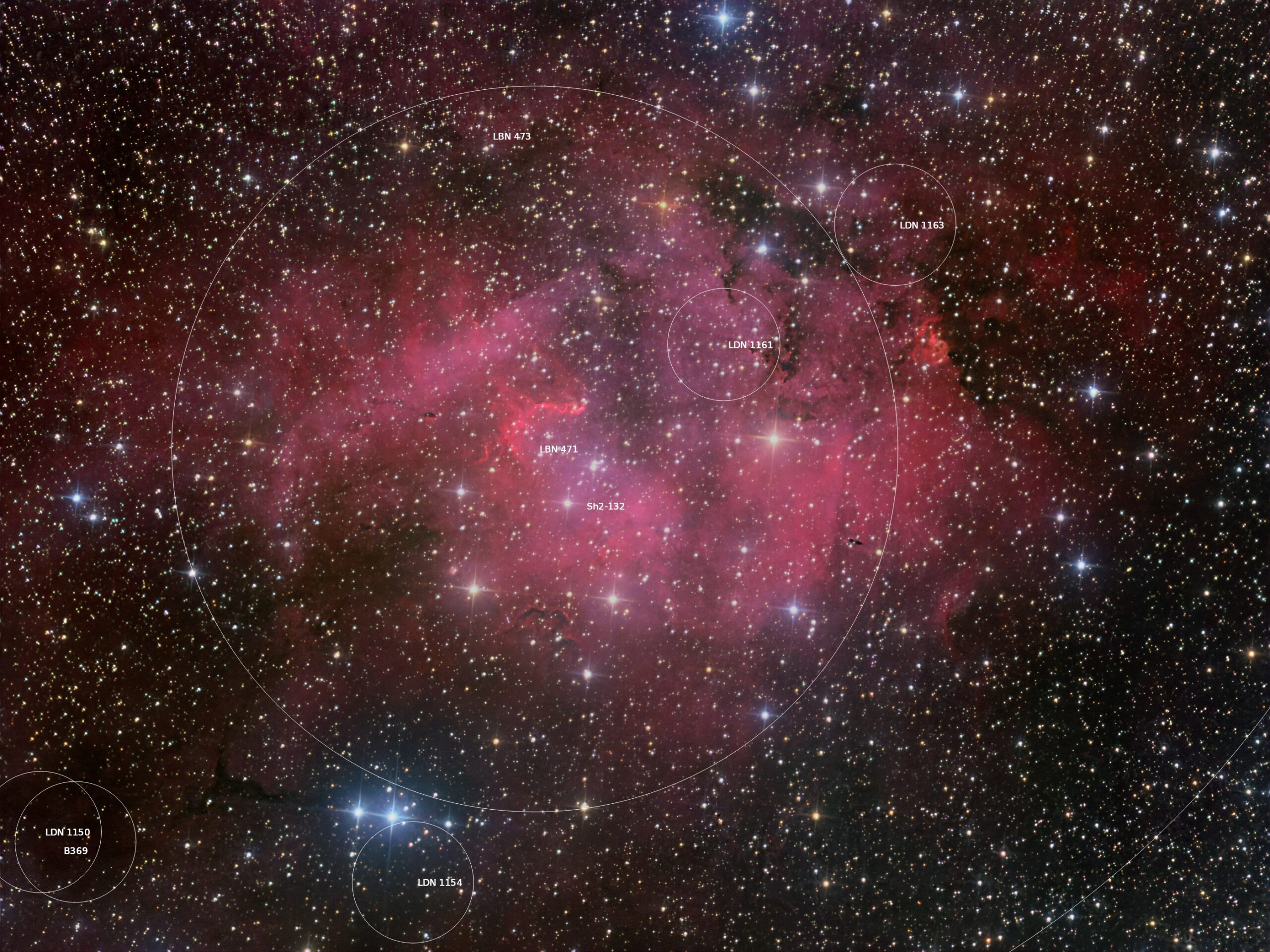
Here is an overview of the used equipment and the exposure times
- Date: September 2023
- Location: Krefeld
- Telescope/Lense: 10″ Newton ohne Namen
- Focal length [mm]: 1000
- Focal ratio: 3.9
- Mount: Skywatcher EQ8
- Camera: QSI 583WS
- Filter: R:G:B:[Hα]
- Exposure time [min]: 105:100:115:135
- Resolution: 1.12″/px
For the DSW data the calibration, registration and the final processing was done with PixInsight. The result was as follows:
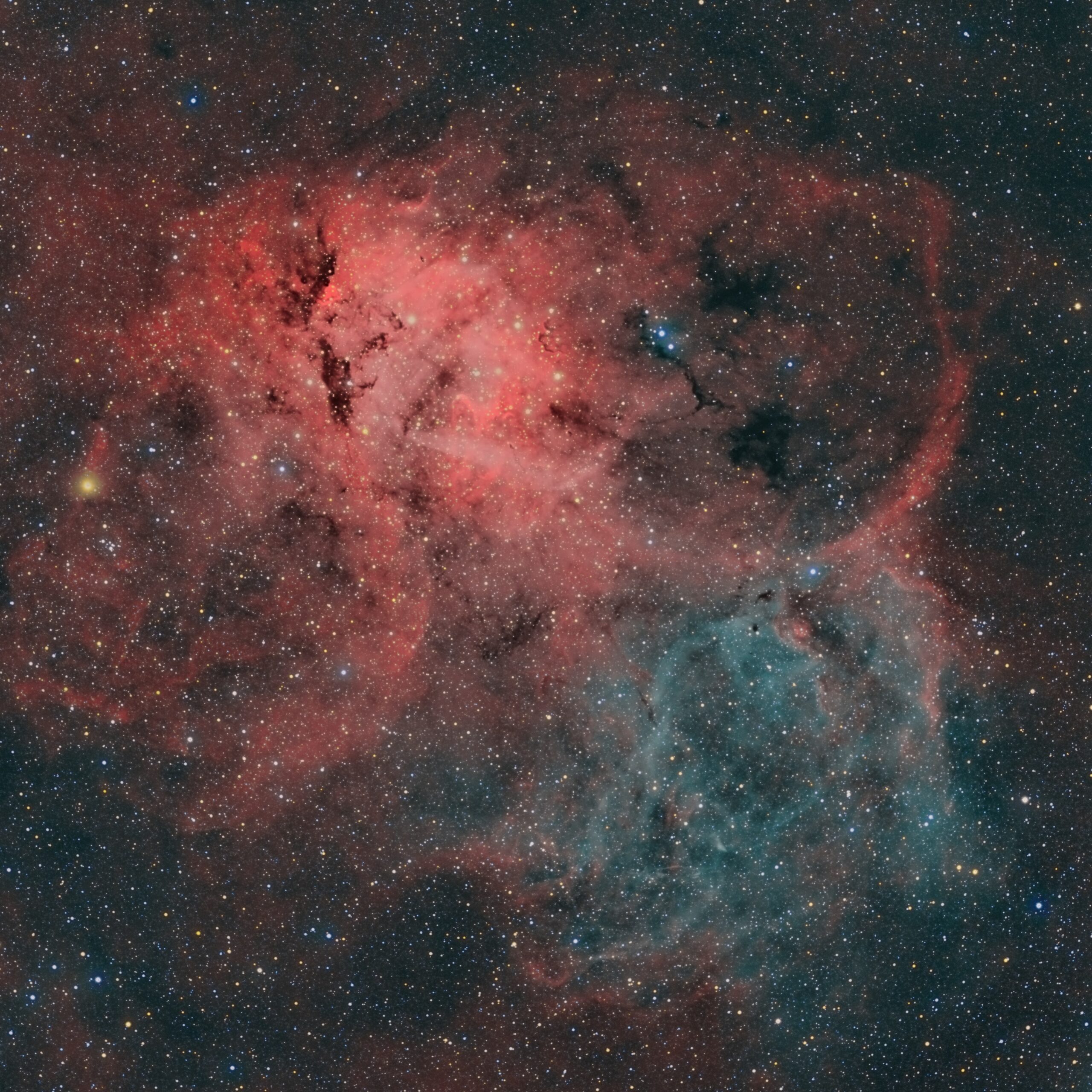
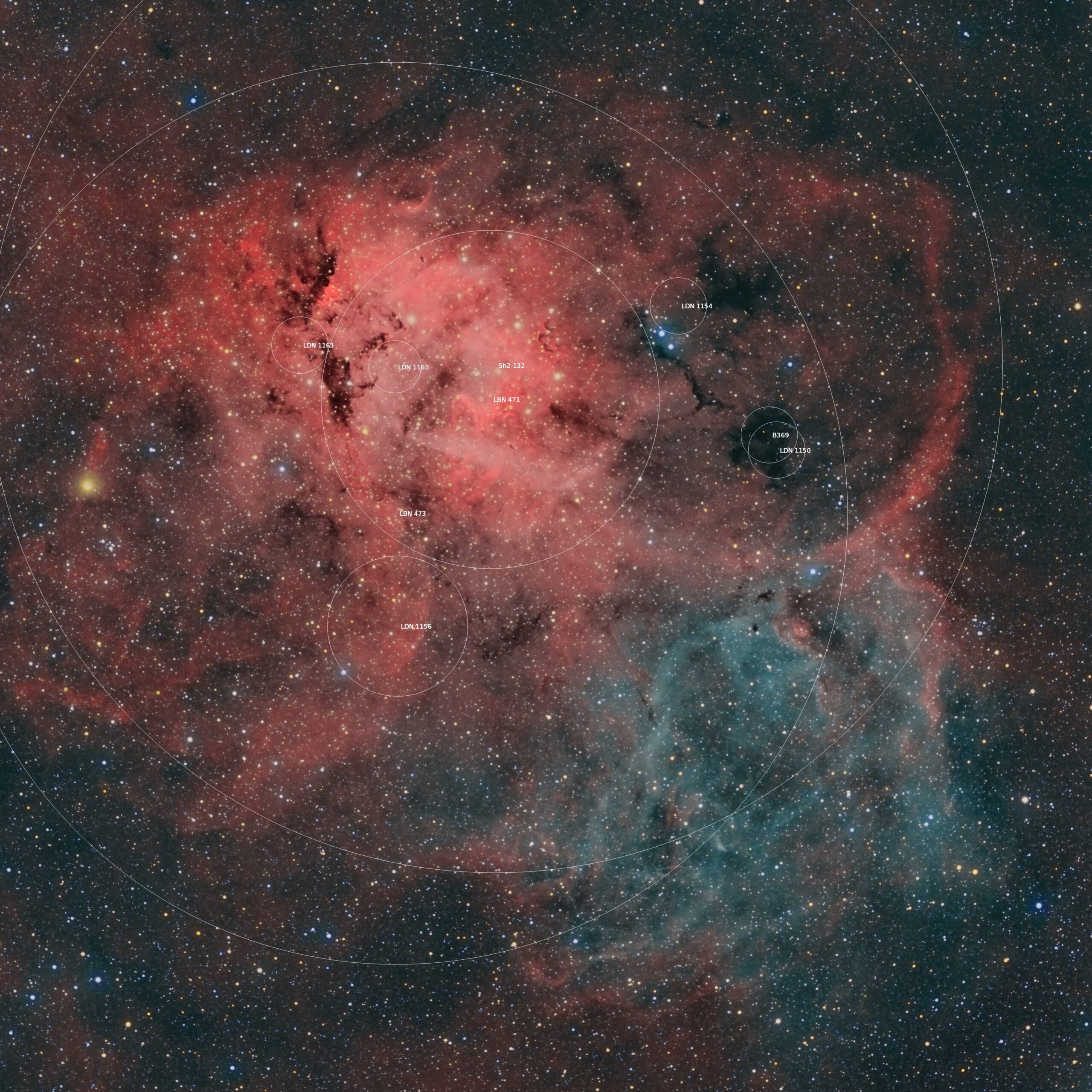
Here is an overview of the used equipment and the exposure times
- Date: 2018
- Location: Rowe, New Mexico
- Telescope/Lense: Astrophysics RH305
- Focal length [mm]: 1158
- Focal ratio: 3.8
- Mount: Paramount ME
- Camera: SBIG STX 16803
- Filter: Hα:[OIII]:[SII]
- Exposure time [min]: 440:460:440
- Resolution: 1.66″/px



Leave a reply