

Sh2-126
In 2022, I had the opportunity to process an outstanding RGB, H-alpha and OIII dataset of Sh2-126 acquired by the remote telescopes of Telescope Live at their observing site in Spain. Unlike many of my own imaging projects carried out from my backyard observatory, this dataset benefited from exceptionally dark skies, excellent atmospheric transparency, and stable seeing conditions. Such high-quality data provide an ideal foundation for revealing the intricate structures hidden within this faint Galactic emission nebula.
Sh2-126 is a huge, very faint emission nebula in Lacerta, often called the Great Lacerta Nebula or the Star Funnel Nebula, and it is part of the nearby Lacerta OB1 star‑forming complex.
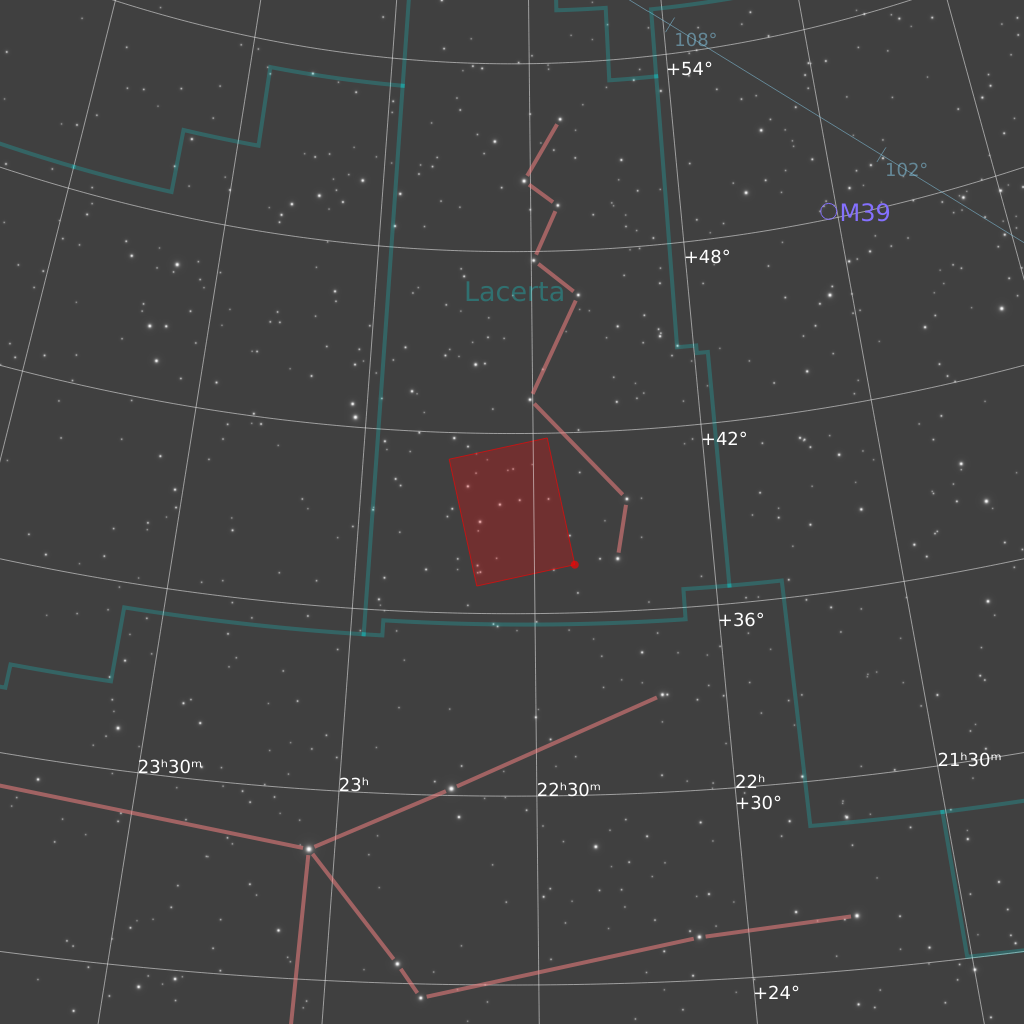
Sh2-126 lies in the southern part of the constellation Lacerta, roughly 1° west of the bright blue star 10 Lacertae, which sits near the centre of the nebula on the sky. Its apparent size is enormous: about 3×2 degrees on the sky, roughly comparable in angular extent to the Andromeda Galaxy, which is why it’s often described as one of the largest emission nebulae visible from Earth.
Distance estimates place Sh2‑126 and its associated clouds at about 1,200 light‑years from Earth, making it a relatively nearby H II region in the Orion Arm. At that distance, its physical size is on the order of dozens of light‑years across, a large bubble of ionized hydrogen wrapped around a molecular cloud complex.
The primary source of ionization for Sh2‑126 is 10 Lacertae, an O9V blue main‑sequence star whose intense ultraviolet radiation causes the surrounding hydrogen to glow in Hα. Additional UV comes from other massive stars in the Lacerta OB1 association and from the embedded Herbig Ae/Be star V375 Lacertae (also known as LkHα 233), which sits in one of the nearby dark clouds.
A particularly striking part of the region is LBN 437, the “Gecko Nebula” or “stellar funnel”, a yellow‑brownish molecular cloud whose densest part hosts young stars and a small reflection nebula around V375 Lacertae. This star drives bipolar Herbig–Haro jets, creating tiny shock‑excited knots in the surrounding gas—classic signs of active, ongoing star formation within the same complex that Sh2‑126 envelopes.
In wide‑field astrophotos, Sh2‑126 shows up as a subtle red background glow of hydrogen‑alpha emission, with faint filaments and waves of nebulosity spread across several degrees. Because the emission is so diffuse and low in surface brightness, it is nearly invisible visually and only becomes apparent with long exposures and careful processing; binoculars and small telescopes usually miss it entirely.
LBN 437 forms a darker, more structured “funnel” or gecko‑shaped cloud within this red background, often appearing brownish/yellow in broadband images and outlined against the Hα glow. Other nearby dark nebulae, such as LBN 438 and LBN 440, show as dusty patches and tendrils connected to the same molecular cloud system, adding texture and depth to wide‑field compositions.
For astrophotographers, Sh2‑126 is a classic “big and very faint” target: its size means you need a wide field, and its faintness means you need many hours of integration, especially in Hα, to reveal its structure. When presenting an image, you can describe it as the Great Lacerta Nebula, a sprawling H II region about 1,200 light‑years away, ionized by 10 Lacertae, with the Gecko Nebula (LBN 437) and its young star V375 Lacertae embedded in the same complex, all part of the Lacerta OB1 star‑forming region.
Data calibration and registration and the final processing was done with PixInsight. The result was as follows:
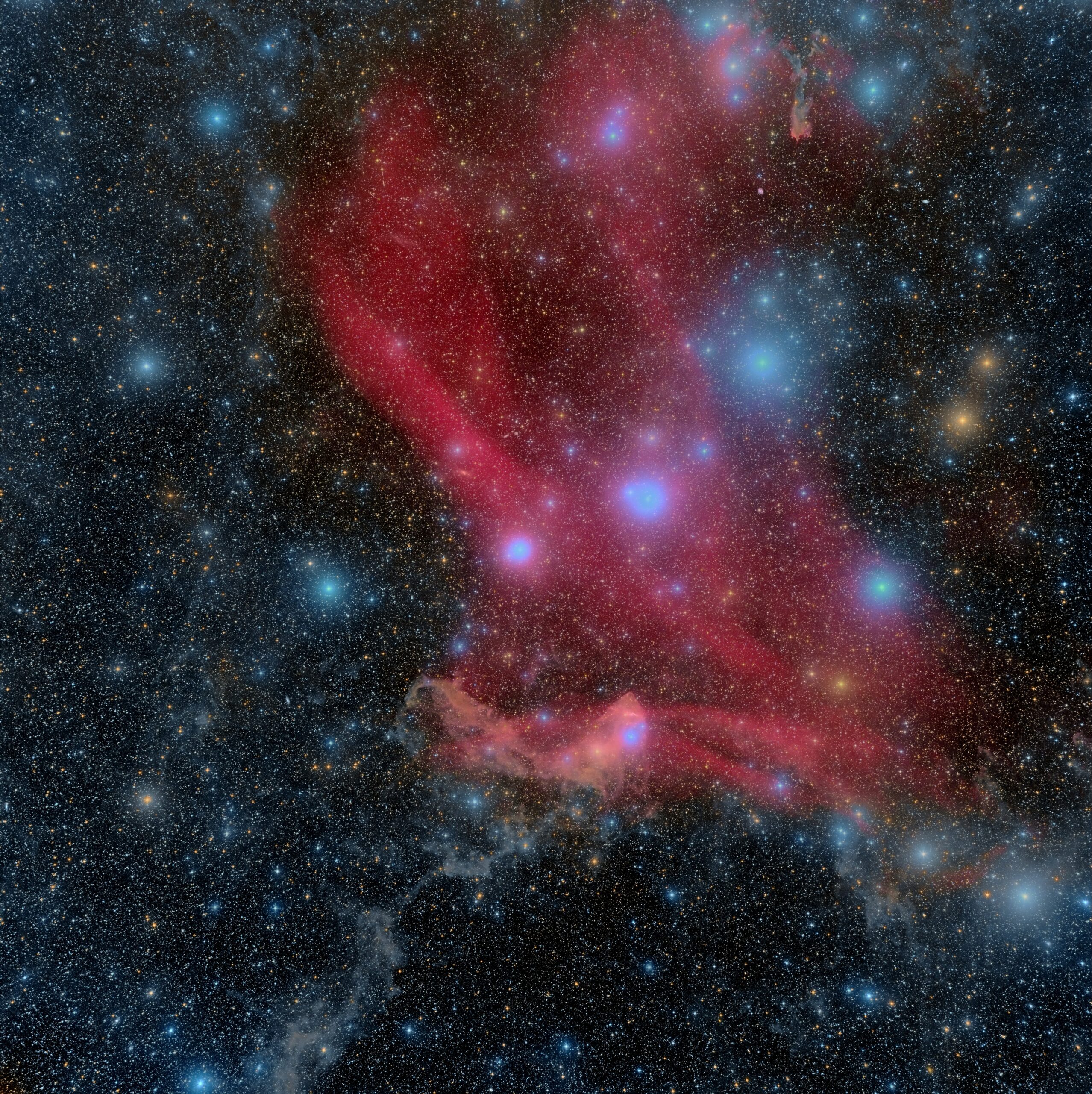
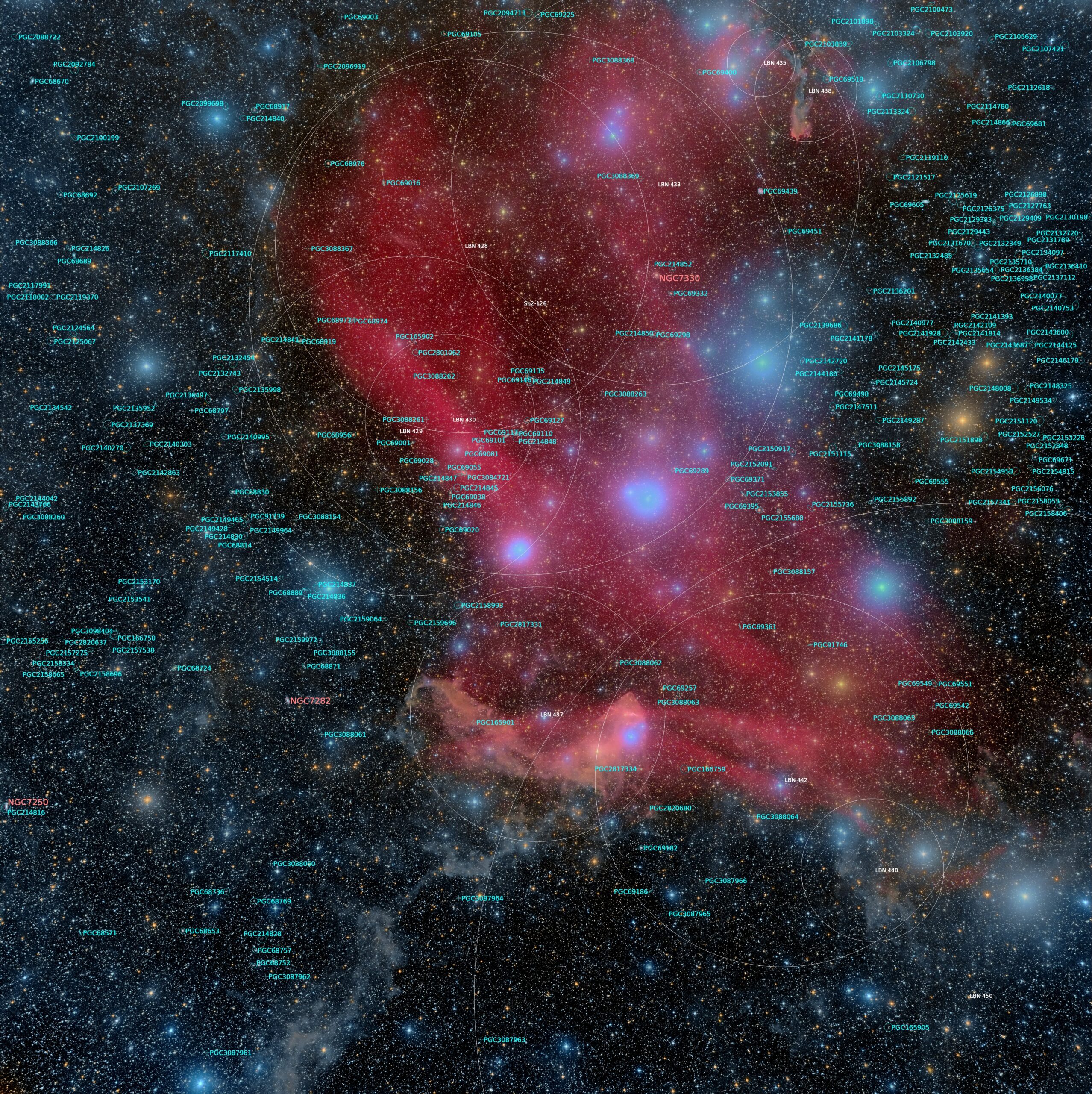
The images were taken with the following equipment (SPA-3 CCD, Telescope Live):
| Location | IC Astronomy Observatory, Spain |
| Telescope | Takahashi FSQ-106EDX4 |
| Focal length [mm] | 390 |
| Focal ratio | 3.6 |
| Mount | Paramount MX+ |
| Camera | FLI Proline 16083 |
| Filter | Hα:[OIII]:R:G:B |
| Exposure time [min] | 180:180:340:180:180 |
| Resolution | 3.6″/px |
- Date: 2022
- Location: IC Astronomy Observatory, Spain
- Telescope/Lense: Takahashi FSQ-106EDX4
- Focal length [mm]: 390
- Foacal ratio: 3.6
- Mount: Paramount MX+
- Camera: FLI Proline 16083
- Filter: Hα:[OIII]:R:G:B
- Exposure time [min]: 180:180:340:180:180
- Resolution: 3.6″/px



Leave a reply