• Home
  • Blog
  • Astrophotography
    • Deep Sky
      • Galaxies (Galaxien)
      • Nebulae (Nebel)
      • Planetary Nebulae (Planetarische Nebel)
      • Globular Clusters (Kugelsternhaufen)
      • Open Clusters (Offene Sternhaufen)
      • Miscellaneous (Verschiedenes)
    • Solar System (Sonnensystem)
      • Comets (Kometen)
      • Sun (Sonne)
      • Moon (Mond)
      • Mars
      • Jupiter
      • Saturn
      • Other Planets ( Andere Planeten)
  • Archiv

    • Juli 2026
    • Juni 2026
    • Mai 2026
    • April 2026
    • Februar 2026
    • Januar 2026
    • Dezember 2025
    • November 2025
    • Oktober 2025
    • September 2025
    • August 2025
    • Juli 2025
    • Juni 2025
    • Mai 2025
    • April 2025
    • März 2025
    • Januar 2025
    • Dezember 2024
    • November 2024
    • Oktober 2024
    • September 2024
    • August 2024
    • Juli 2024
    • Juni 2024
    • Mai 2024
    • April 2024
    • März 2024
    • Februar 2024
    • Januar 2024
    • November 2023
    • Oktober 2023
    • September 2023
    • August 2023
    • Juli 2023
    • Juni 2023
    • Mai 2023
    • April 2023
    • März 2023
    • Februar 2023
    • Januar 2023
    • Dezember 2022
    • November 2022
    • Oktober 2022
    • September 2022
    • August 2022
    • Juli 2022
    • Juni 2022
    • Mai 2022
    • April 2022
    • März 2022
    • Februar 2022
    • Januar 2022
    • Dezember 2021
    • November 2021
    • September 2021
    • August 2021
    • Juli 2021
    • März 2021
    • Februar 2021
    • November 2020
    • September 2020
    • August 2020
    • April 2020
    • März 2020
    • Februar 2020
    • Januar 2020
    • Dezember 2019
    • November 2019
    • Oktober 2019
    • September 2019
    • August 2019
    • Mai 2019
    • April 2019
    • März 2019
    • Dezember 2018
    • November 2018
    • Oktober 2018
    • September 2018
    • Juni 2018
    • Mai 2018
    • April 2018
    • März 2018
    • Februar 2018
    • Januar 2018
    • Oktober 2017
    • Juli 2017
    • Juni 2017
    • Januar 2017
    • Dezember 2016
    • September 2016
    • Mai 2016
    • März 2016
    • November 2015
    • Oktober 2015
    • Juli 2015
    • Mai 2015
    • März 2015
    • Februar 2015
    • September 2014
    • August 2014
    • März 2014
    • Februar 2014
    • Oktober 2013
    • September 2013
    • August 2013
    • April 2013
    • März 2013
    • November 2012
    • August 2012
    • Juli 2012
    • Mai 2012
    • März 2012
    • Januar 2012
    • November 2011
    • Oktober 2011
    • September 2011
    • August 2011
    • April 2011
    • März 2011
    • Oktober 2010
    • September 2010
    • August 2010
    • Juli 2010
    • April 2010
    • Juli 2009
    • Juli 2008
    • Januar 2008
    • Oktober 2007
    • Juli 2007
    • März 2007
    • Februar 2007
    • Juni 2006
    • Oktober 2005
    • September 2005
    • August 2005
    • Januar 2005
  • Kategorien

    • Asterism
    • Astrophotography
    • Barnard
    • Comet
    • Galaxies
    • Globular Cluster
    • IC
    • Messier
    • Moon
    • Nebula
    • NGC
    • Open cluster
    • Photography
    • Planetary Nebula
    • Travel
  • Meta

    • Anmelden
    • Eintrags-Feed
    • Kommentar-Feed
    • WordPress.org
  • Privacy Policy
  • Impressum
  • Haftungsausschluss
  • Cookie-Richtlinie
  • Datenschutzerklärung

wonderfuluniverse.de
  • Home
  • Blog
  • Astrophotography
    • Deep Sky
      • Galaxies (Galaxien)
      • Nebulae (Nebel)
      • Planetary Nebulae (Planetarische Nebel)
      • Globular Clusters (Kugelsternhaufen)
      • Open Clusters (Offene Sternhaufen)
      • Miscellaneous (Verschiedenes)
    • Solar System (Sonnensystem)
      • Comets (Kometen)
      • Sun (Sonne)
      • Moon (Mond)
      • Mars
      • Jupiter
      • Saturn
      • Other Planets ( Andere Planeten)

Sh2-124 from my own „Sterntaucher“ observatory


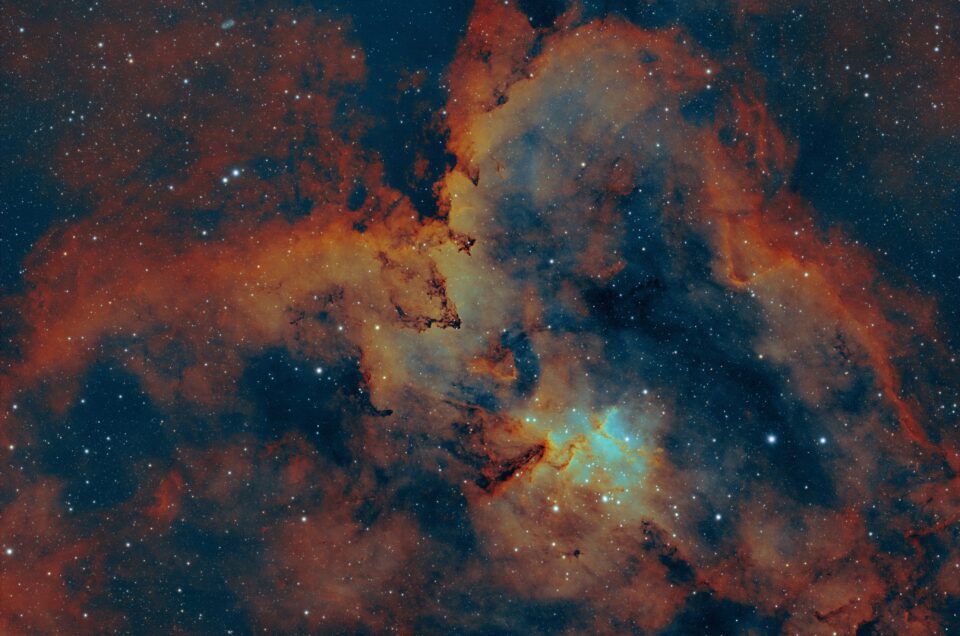
In 2019, I devoted several clear nights to imaging the beautiful emission nebula Sh2-124 from my backyard observatory. To maximize the efficiency of the available observing time, I employed two identical telescopes mounted side by side, each equipped with a different CCD camera. One system was dedicated to capturing high-resolution H-alpha data, while the second simultaneously recorded the RGB color information. This dual imaging setup significantly reduced the total acquisition time while ensuring that both monochrome and color data were obtained under nearly identical sky conditions. After careful calibration and processing, the H-alpha and RGB datasets were combined to produce a detailed color image highlighting both the intricate gaseous structures and the natural stellar colors.

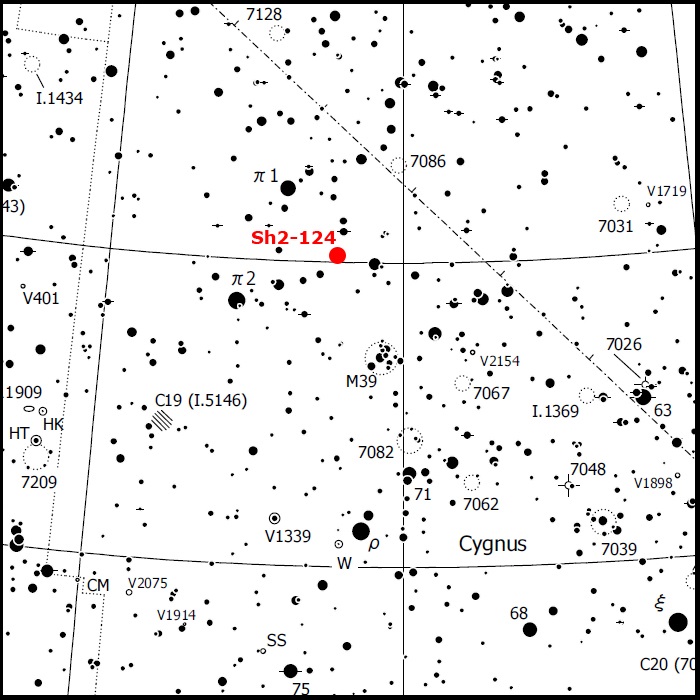
Sh2-124 lies on the north‑western edge of Cygnus, along the Milky Way, just east of the star pair ρ¹ Cygni and ρ² Cygni. Its centre is around RA 21h 38m–21h 39m and Dec +50° 19′–50° 21′, with galactic coordinates l≈94.5∘,b≈−1.5∘l \approx 94.5^\circ, b \approx -1.5^\circl≈94.5∘,b≈−1.5∘.

On the sky, the main complex spans roughly 1–1.5 degrees (about 70′×70′), corresponding to a physical size of about 170 light‑years if the commonly adopted distance of 2,600 pc (≈8,500 light‑years) is correct. It is catalogued as an H II region (ionized hydrogen) and also appears as LBN 426 and Avedisova 1220.

Sh2-124 is described in the literature as an “extended and enigmatic” nebular system associated with the infrared source RAFGL 2789, identified with the young stellar object V645 Cygni. V645 Cygni is likely a massive, early‑type star (either an O‑type or a Herbig Ae/Be star) embedded in the nebula and linked to strong infrared and maser emission.

The main ionizing stars are thought to include a blue O7V star and a B2V star, with possible additional hot members in a young cluster that collectively keep the gas ionized. The region shows clear signs of ongoing star formation: multiple infrared sources (including several IRAS objects) and two masers, one in water (H₂O) centred on V645 Cygni and one in methanol (CH₃OH), marking dense star‑forming cores.

The field surrounding Sh2-124 is exceptionally rich in foreground and background stars because the line of sight points almost directly along the plane of our Galaxy. Numerous dark dust clouds are superimposed on the glowing hydrogen, producing striking contrast between bright emission regions and opaque lanes of interstellar dust. These dust clouds absorb visible light and often conceal newly forming stars that can only be studied at infrared wavelengths.

Combining narrowband H-alpha data with broadband RGB images offers significant advantages for astrophotography. While the RGB exposures preserve the natural colors of the stars and reflection components, the H-alpha data dramatically enhances the fine structure and contrast of the ionized gas. During image processing, the H-alpha signal was carefully integrated into the red channel, increasing the visibility of faint nebulosity without compromising the natural appearance of the stellar field. The resulting image reveals subtle wisps of hydrogen extending well beyond the brighter central regions, demonstrating just how extensive these emission clouds are.

Although Sh2-124 is not among the best-known nebulae in the Sharpless catalogue, it represents an excellent example of the faint emission regions that permeate the Milky Way. Imaging such objects requires patience, careful calibration, and many hours of exposure, but the reward is the opportunity to reveal structures that are largely invisible to the human eye. This project also demonstrated the effectiveness of using two synchronized imaging systems simultaneously, allowing both narrowband and broadband data to be collected efficiently and combined into a detailed portrait of one of our Galaxy’s lesser-known stellar nurseries.

Data calibration and registration and the final processing was done with PixInsight. The RGB Data was upscaled to the Hα data. The result was as follows:
Sh2-124, Krefeld, 2019
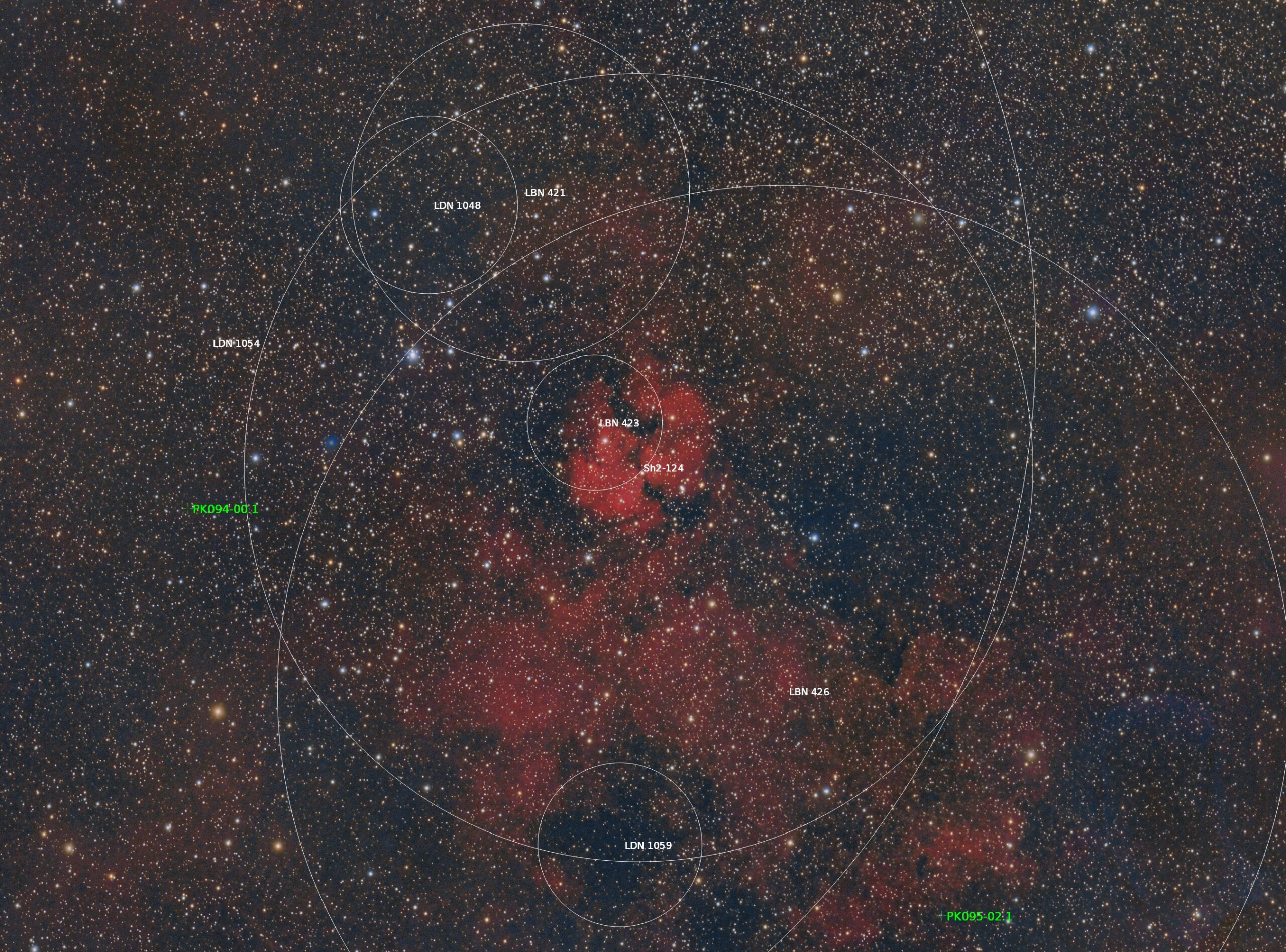
Sh2-124 annotated
Sh2-124 annotated

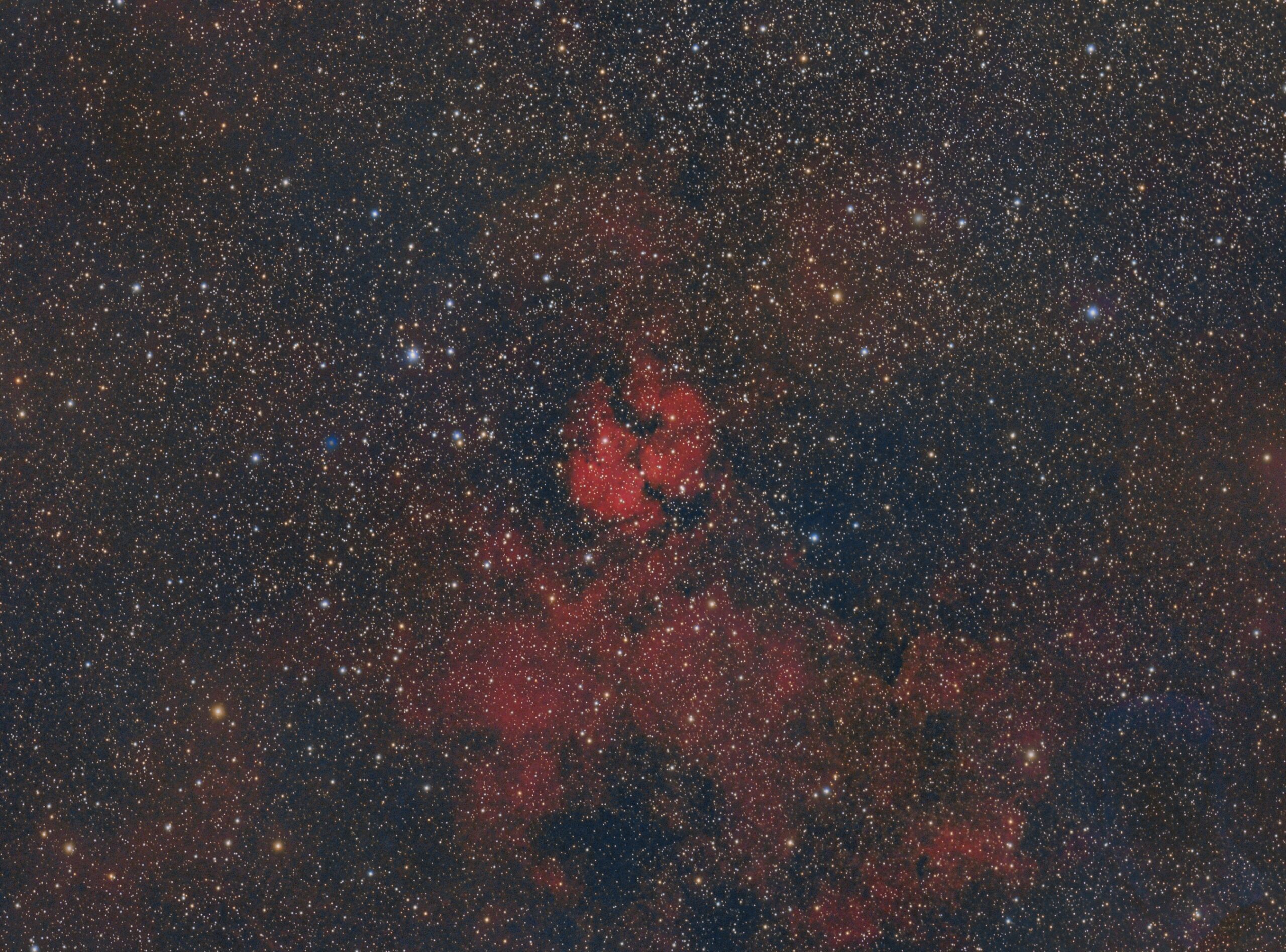
Below you can find an image where only the RGB data was used.
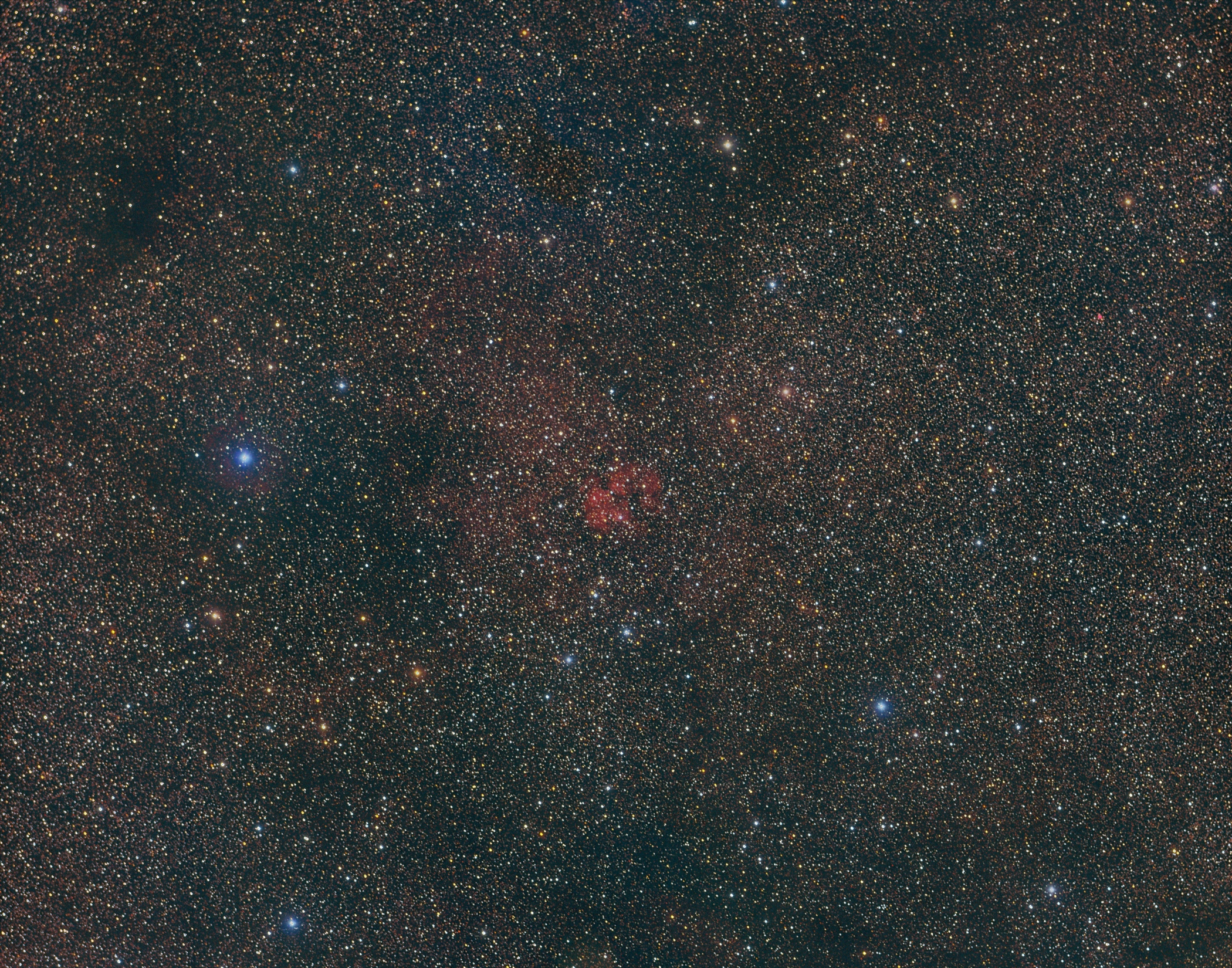
Sh2-124 only RGB
Sh2-124 only RGB


Here is an overview of the used equipment and the exposure times:

  • Date: September and October 2019
  • Location: Krefeld
  • Telescope/Lense: TSQ-65ED Apo
  • Focal length [mm]: 420
  • Focal ratio: 6.5
  • Mount: Skywatcher EQ8
  • Camera: Moravian G2 8300 FW – Moravian G3 16200 FW
  • Filter: Hα – Hα:R:G:B
  • Exposure time [min]: 310 – 670:190:200:190
  • Resolution: 2.63″/px – 2.95″/px


Stephan Küppers


You might also like
IC 1318
15. Juli 2026
NGC 7000 with IC 5070
24. Juni 2026
Sh2-129, Outters 4
29. Mai 2026

Leave a reply

Schreibe einen Kommentar Antwort abbrechen

Deine E-Mail-Adresse wird nicht veröffentlicht. Erforderliche Felder sind mit * markiert


© Stephan Küppers 2020-2026

Cookie-Zustimmung verwalten
Wir verwenden Cookies, um unsere Website und unseren Service zu optimieren.
Funktional Immer aktiv
Die technische Speicherung oder der Zugang ist unbedingt erforderlich für den rechtmäßigen Zweck, die Nutzung eines bestimmten Dienstes zu ermöglichen, der vom Teilnehmer oder Nutzer ausdrücklich gewünscht wird, oder für den alleinigen Zweck, die Übertragung einer Nachricht über ein elektronisches Kommunikationsnetz durchzuführen.
Vorlieben
Die technische Speicherung oder der Zugriff ist für den rechtmäßigen Zweck der Speicherung von Präferenzen erforderlich, die nicht vom Abonnenten oder Benutzer angefordert wurden.
Statistiken
Die technische Speicherung oder der Zugriff, der ausschließlich zu statistischen Zwecken erfolgt. Die technische Speicherung oder der Zugriff, der ausschließlich zu anonymen statistischen Zwecken verwendet wird. Ohne eine Vorladung, die freiwillige Zustimmung deines Internetdienstanbieters oder zusätzliche Aufzeichnungen von Dritten können die zu diesem Zweck gespeicherten oder abgerufenen Informationen allein in der Regel nicht dazu verwendet werden, dich zu identifizieren.
Marketing
Die technische Speicherung oder der Zugriff ist erforderlich, um Nutzerprofile zu erstellen, um Werbung zu versenden oder um den Nutzer auf einer Website oder über mehrere Websites hinweg zu ähnlichen Marketingzwecken zu verfolgen.
  • Optionen verwalten
  • Dienste verwalten
  • Verwalten von {vendor_count}-Lieferanten
  • Lese mehr über diese Zwecke
Einstellungen anzeigen
  • {title}
  • {title}
  • {title}